Feeds:
Posts
Comments

Archive for October, 2024

GC Myers- And the River Flows 2024

And the River Flows– At the West End Gallery


That time
we all heard it,
cool and clear,
cutting across the hot grit of the day.
The major Voice.
The adult Voice
forgoing Rolling River,
forgoing tearful tale of bale and barge
and other symptoms of an old despond.
Warning, in music-words
devout and large,
that we are each other’s
harvest:
we are each other’s
business:
we are each other’s
magnitude and bond.

–Gwendolyn Brooks, Paul Robeson


I had come across part of the poem above from Gwendolyn Brooks before, those last three lines: …we are each other’s harvest: we are each other’s business: we are each other’s magnitude and bond. These are strong lines, sentiments that always speak loudly to me, ones that I hope will more people would realize and take to heart.

Unfortunately, I hadn’t taken the time to search out where it had come from in her work.  I was pleased when I finally came across the whole poem and found that it was titled Paul Robeson, about someone who I consider one of the most fascinating people of the last century.

Paul Robeson (1898-1976) was a star athlete, a lead actor and headlining singer– the bright light in any sky in which his star appeared. He was also a scholar– valedictorian for the 1919 class at Rutgers where he was the only black student. He went on to graduate from Columbia Law School and worked for a time as lawyer. But his performing talents were undeniable and they brought him worldwide acclaim. But beyond all this, Robeson was throughout his life a ceaseless champion of the labor and civil rights movements, here and abroad. If you don’t know much about Robeson, please look him up.

He is best known to most folks for his performance of Old Man River in the musical Showboat. I thought the song would be a fitting companion to the painting at the top, And the River Flows. It’s a piece that keeps drawing me back to look a little deeper. I feel there’s something beyond the surface, a message or story in the river rolling by or in a lit room in one of those buildings that overlook it. I might never know that message or hear those stories but just knowing that the river keeps rolling it good enough this morning.

All I need to know…


Read Full Post »

9924132 Passing Through Blue sm

Passing Through Blue– At West End Gallery


Sweet moonlight, shining full and clear,
Why do you light my torture here?
How often have you seen me toil,
Burning last drops of midnight oil.
On books and papers as I read,
My friend, your mournful light you shed.
If only I could flee this den
And walk the mountain-tops again,
Through moonlit meadows make my way,
In mountain caves with spirits play –
Released from learning’s musty cell,
Your healing dew would make me well!

― Johann Wolfgang von Goethe, Faust


Maybe there is something to that line: Your healing dew would make me well! The moon last night (and this early morning, for that matter) was full and bright in the clear night sky. A glorious supermoon.

Though the full moon is often associated with madness– lunatics and lunacy, for example– there is also a great calming effect in standing under it.

Maybe it’s the polarity of it making you feel both insignificant and significant. You feel small compared to the magnitude of a universe where the gigantic moon that looms over us is miniscule by comparison. Yet in the bright moonlight, you are illuminated and made to feel larger as you cast a long shadow on the ground.

Or maybe it is just the moon’s symbolic nature, still and steady as it serves an essential service to humanity in the way it reflects the hidden sunlight into our dark nights.

Not a bad example to emulate– quietly steady and bringing light to others…

Here’s a classic from Frank Sinatra, Fly Me to the Moon. I never actually wanted to go the moon, never ached to travel in space, but I have often wanted to be transported there in the way this song describes. And fortunately, I’ve made that journey many times.


Read Full Post »

GC Myers- The Angst

GC Myers- The Angst


Anxiety is the handmaiden of creativity.


I don’t like starting posts with quotes where I am unsure of the attribution, but I like this one regardless of who spoke it first. It is most attributed to either the poet W.H. Auden or legendary animator Chuck Jones. Quite a gap there as far as gravitas is concerned. That makes me believe it was probably from Chuck Jones. Those who liked the sentiment most likely wanted it to be from someone with a little more intellectual weight and Auden did write a Pulitzer Prize winning poem, The Age of Anxiety.

During a quick search I couldn’t find anything that corroborated the Auden or Jones connections. I’ll leave it up to you. My money is on Chuck.

Let’s get back to the quote:  Anxiety is the handmaiden of creativity.

I can only speak for my experience, of course, but I tend to believe that my better work has sometimes emerged from periods of anxiety, times which have often been deep and dark for me. Maybe it is because my mind become sort of hyperactive in those time. It’s bouncing around like a mouse trying to find a way out a box, racing around to examine every possible point of exit even when one doesn’t seem evident.

It’s uncomfortable, to say the least. Actually, excruciating is a better choice of words. But sometimes during these periods where the mind is freewheeling, this mouse finds a way out of the box. Finds something that wasn’t evident to me until I was forced to see it.

Can’t explain it fully and maybe this is all in my mind. Though I think much of the work produced as a result of these times is among my best, there is no objective proof that others see it the same way. As much as I would like others to see what I see in it, it’s okay with me that they don’t.

I know that not all art reveals itself immediately. Time will tell.

There is also a contradictory position to anxiety is the handmaiden of creativity and I am experiencing it at the moment. Sometimes the anxiety is more than the mouse can handle. The racing and searching suddenly stops. The mouse stops it racing and tries to find safety by pressing as deeply into a corner as possible.

I feel a little like the mouse today, frozen in its anxiety.

It is, of course, the anxiety of current events and an election in a couple of weeks that could alter our collective future in in two very different ways. You might say that I shouldn’t be othered by this. There are some out there, those indifferent few, that aren’t affected.

That’s not in my makeup, however. I am forever the mouse in the box. That is not necessarily a bad thing as sometimes good work is produced from it. And maybe eventually that will be the case from this particular time in the box.

But for the moment, I am pressed tightly into a corner of my box, frozen in place as I count down the days.

While we’re in this corner, let’s listen to a song while we wait. It’s a longtime favorite from The Kinks. It seems appropriate for this post. This is 20th Century Man.


Read Full Post »

GC Myers- Imitatio

Imitatio– At  West End Gallery, Corning NY


The opposite of love is not hate, it’s indifference. The opposite of art is not ugliness, it’s indifference. The opposite of faith is not heresy, it’s indifference. And the opposite of life is not death, it’s indifference.

-Elie Wiesel


With a presidential election only three weeks away, I am concerned with those who are indifferent to the potential consequences, many dark in nature by their very design, that might soon be upon us all. Maybe these folks believe they don’t have to engage because we have become so encapsulated in our own little bubbles that we believe that nothing can pierce these seemingly safe little spaces. They think that by staying disengaged they will be safe and can’t be held responsible in any way.

Unfortunately, the world doesn’t work that way. Indifference is like being asleep at the wheel. It enables all manner of bad behavior, from minor abuses to the deadliest crimes against humanity. We need to be engaged, to stop and examine what is happening in the moment.

I thought this would be a good time to replay a post that has appeared here every several years. I apologize for using my insignificant experience as any sort of comparison to the indifference to which Mr. Wiesel referred. I do try to explain below.


I’ve been sitting here for quite some time now, staring at the quote above from Elie Wiesel, the late Nobel Laureate and peace activist. I had planned on writing about how my work evolved as a response to the indifference of others but now, looking at those words and putting them into the context of Wiesel’s experience, I feel a bit foolish. Wiesel, who had survived the Holocaust and spent his life crusading so that it might never happen again, was eyewitness to indifference on a grand scale. It was indifference that ranged from those who were complicit or those who did not raise their voices in protest even though they knew what was happening to the personal indifference shown by his Nazi guards, as they turned a blind eye to the suffering and inhumanity directly before them on a daily basis, treating their innocent captives as though they were subhuman, nothing at all in their eyes.

The indifference of which he speaks is that which looks past you without any regard for your humanity. Or your mere existence, for that matter. It is this failure to engage, this failure to allow our empathy to take hold and guide us, that grants permission for the great suffering that takes place throughout our world.

So, you can see where writing about showing a picture as a symbolic battle against indifference might seem a bit trivial. It certainly does to me. But I do see in it a microcosm of the wider implications. We all want our humanity, our existence, recognized and for me this was a small way of raising my voice to be heard.

When I first started showing my work I was coming off of a period where I was at my lowest point for quite some time. I felt absolutely voiceless and barely visible in the world, dispossessed in many ways. In art I found a way to finally express an inner voice, my real humanity, that others could see and feel a reaction.

With this in mind, when my first opportunity to display my work came, at the West End Gallery in 1995, I went to the show with great trepidation.

For some, it was just a show of some nice paintings by some nice folks. For me, it was a test of my existence.

It was interesting as I stood off to the side, watching as people walked about the space. It was elating when someone stopped and looked at my small pieces. But that feeling of momentary glee was overwhelmed by the indifference shown by those who walked by with barely a glance, if that. It was as though my work wasn’t even there.

Those moments crushed me. I would have rather they had stopped and spit at my work on the wall than merely walk by dismissively. That, at least, would have made me feel heard.

Don’t get me wrong here. Some people walking by a painting that doesn’t move them are not Nazis nor are they bad folks in any way. I held no ill will toward them, even at that moment. I knew that I was the one who had placed so much importance on this moment, not them. They had no idea that they were playing part to an existential crisis. Now, I am even a bit grateful for their indifference that night because it made me vow that I would paint bolder, that I would make my voice be heard. Without that indifference I might have settled and not continued forward on my path.

But in this case, I knew that it was up to me to overcome their indifference.

Again, please excuse my use of Mr. Wiesel’s quote here. My little anecdote has little to do with the experience of those who suffered at the hands of evil people who were enabled by the indifference of those who might have stopped them. The point is that we all want to be heard, to be recognized on the most basic level for our own existence, our own individual selves. But too often, we all show indifference that takes that away from others, including those that we love. We all need to listen and hear, to look and see, to express our empathy with those we encounter.

We need to care.

Maybe in that small ways the greater effects of indifference of which Elie Wiesel spoke can be somehow avoided.

We can hope.

Read Full Post »

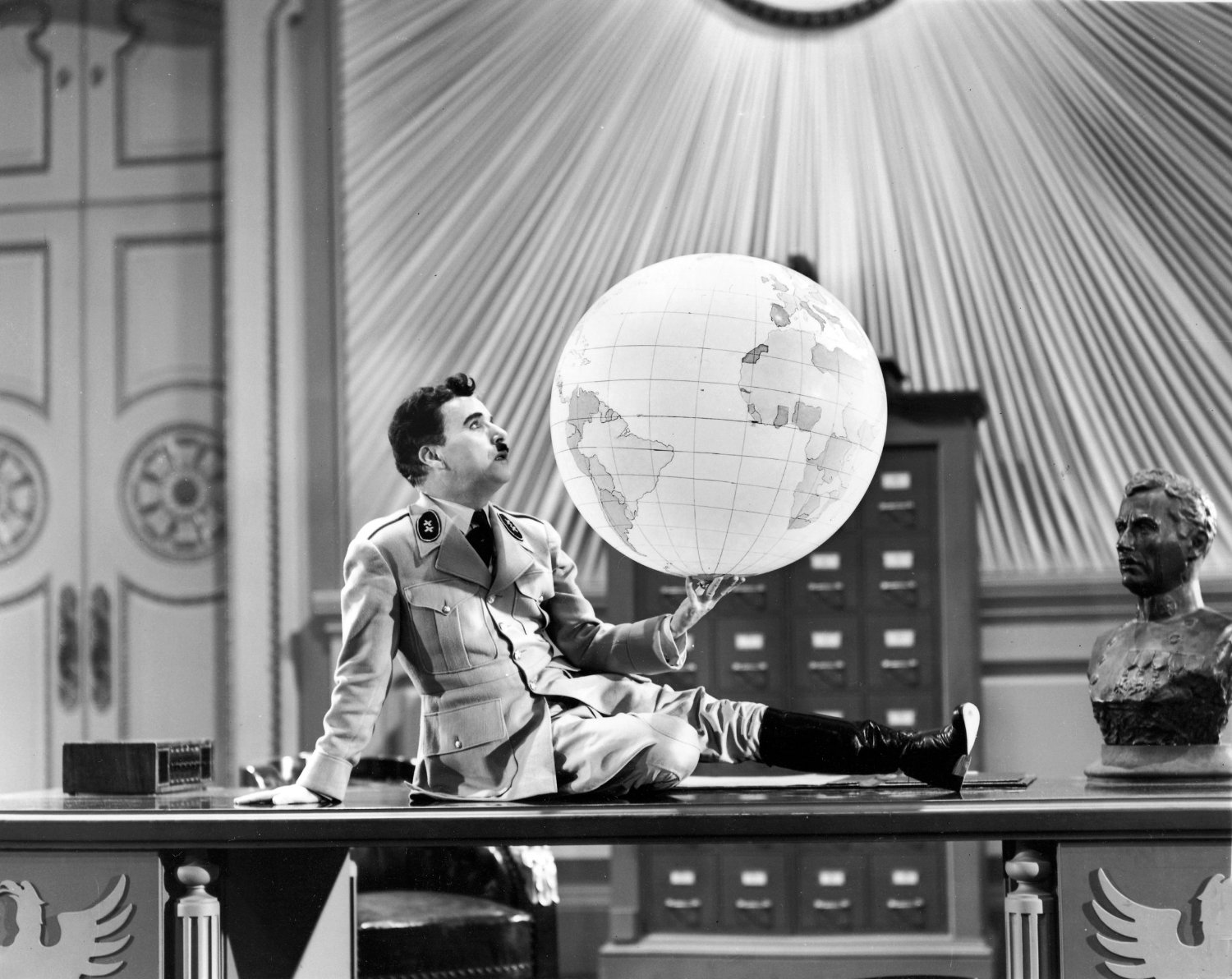
Charlie Chaplin The Great Dictator 1940

Charlie Chaplin- The Great Dictator, 1940


Our knowledge has made us cynical
Our cleverness, hard and unkind
We think too much, and feel too little
More than machinery, we need humanity
More that cleverness, we need kindness and gentleness
Without these qualities life will be violent, and all will be lost

— Charlie Chaplin, The Great Dictator Final Speech


The final speech in The Great Dictator the 1940 Charlie Chaplin film that brutally satirized the Naziism/Fascism that was then a dire threat to the entire world, feels very relevant to this moment in history.

The Great Dictator is about a Jewish barber in the fictional nation of Tomainia that is ruled by a ruthless dictator, Adenoid Hynkel. Without getting into the plot, Chaplin portrays both the Jewish barber and the Hitleresque Hynkel. At the film’s end, the barber is mistaken for Hynkel and is forced to make a speech, one in which delivers a message of hope to the world rather than the hateful rhetoric that was expected.  

It is a direct appeal to the people of the world to reject the brutalism of such dictatorships and fight for the humanity of mankind. It was controversial at the time and Chaplin’s friends and advisors tried to dissuade him from including it in the final cut, telling him that it would cause him to lose a million dollars, a vast sum in 1940. Chaplin responded that he didn’t care if it cost him 5 million.

It feels though we are at a similar point in time with a presidential candidate who threatens to unleash the military on US citizens who oppose him, to imprison his political rivals, to revoke the licenses of TV networks who displease him, to monitor and control pregnancies, and to first round up then mass deport millions of illegal immigrants along with many who are now legal. And so much more.

These are not inferred threats or hyperbole. These are his words. 

It is never wise to dismiss such threats. I hope enough people understand the peril we face.

Please take a few minutes to watch this final speech. It is inspiring in the context of history, then and now. If you get a chance, I urge you to see the whole film. It is both funny and heartbreaking on many levels and Chaplin exhibits his brilliance throughout. Jack Oakie is hysterical as the clownish Mussolini-like dictator, Benzino Napaloni, of the neighboring nation of Bacteria. He would have been a great choice to portray the current GOP candidate.

Anyway, here is the final speech from The Great Dictator:


Read Full Post »

GC Myers-  Something Beyond  2024

Something Beyond— At Principle Gallery


All human nature vigorously resists grace because grace changes us and the change is painful.

–Flannery O’Connor, The Habit of Being: Letters of Flannery O’Connor


Grace is such a wonderful word, yet it often eludes definition or understanding for many, me included. I think of it in terms of harmony, of being synchronized with the rhythm of the world and universe. There is a quality of smoothness in this, one that is accepting of the moment and place. Graceful in movement, gracious in manner.

And simple as that might sound, it eludes us mightily. And just when you think you might understand or recognize it, it seems to evaporate like morning mist in the sunlight.

Maybe it is as the author Flannery O’Connor wrote above. Maybe we live our lives out of rhythm and become comfortable in that way of being so that the idea of grace seems alien to us. To accept grace, to move towards it, would mean we would have to leave parts of ourselves behind in order to change.

And as we all know, change is dreaded by almost everyone. We often accept the misery we know in lieu of trying to change who and what and where we are.

That’s it for today. I am only throwing out that thought and may be wrong at that. Just a thought.

I will add that if you haven’t read any Flannery O’Connor, brace yourself. Her work presented a dark vision and place with residents who often both sought and rejected grace. Both heaven and hell are in the here and now and it is up to us to figure things out for ourselves. It might be our only chance, our only turn on the big prize wheel.

The paragraph below is a prime example of that, taken from her novel Wise Blood. It’s a tough and grim book to get through as was its film adaptation. But it certainly makes one think.

“Where you come from is gone, where you thought you were going to never was there, and where you are is no good unless you can get away from it. Where is there a place for you to be? No place.

Nothing outside you can give you any place,” he said. “You needn’t look at the sky because it’s not going to open up and show no place behind it. You needn’t to search for any hole in the ground to look through into somewhere else. You can’t go neither forwards nor backwards into your daddy’s time nor your children’s if you have them. In yourself right now is all the place you’ve got. If there was any Fall, look there, if there was any Redemption, look there, and if you expect any Judgment, look there, because they all three will have to be in your time and your body and where in your time and your body can they be?”

― Flannery O’Connor, Wise Blood

For this Sunday Morning Music, let’s continue with the theme of grace. Here’s a wonderful performance of the Paul Simon classic, Graceland, from Allison Krauss and Jerry Douglas.


Read Full Post »

Georgia O'Keeffe Autumn Leaves

Georgia O’Keeffe- Autumn Leaves, 1924


October is the month for painted leaves. Their rich glow now flashes round the world. As fruits and leaves and the day itself acquire a bright tint just before they fall, so the year near its setting. October is its sunset sky; November the later twilight.

–Henry David Thoreau


An October morning. I have nothing to say this morning. Well, that’s not true. I have things to say but don’t want to say them or, at least, don’t want to make the effort. Too interested in watching the light begin to show through the bones of the trees that have become more visible as the leaves have fallen. In the semi-dark. I am listening to Cannonball Adderley and his version of Autumn Leaves, with his all-star band featuring Miles Davis on trumpet. There are a wide range of takes on this song from many artists and most are wonderful. It’s that good a composition. But this remains a favorite for me.

Good stuff for an autumn morning…


Read Full Post »

gc-myers-early-figure


What are we when we are alone? Some, when they are alone, cease to exist.

Eric Hoffer


I’ve spent a tremendous amount of time alone in my studio over the years. Literally, tens and tens of thousands of hours in solitude. It has been time that has allowed me to close myself off in a certain way from the outer world and create the inner world that I show in my work. But occasionally the outer world breaks through and my simple solitude is shaken. I find myself caught between the outer world and my inner creation, my inner being.  

It’s a frustrating time and it becomes hard to focus in order to find that inner world. It’s been that way recently but I keep pushing for it and know that it will return soon. I am reminded of the post below from a few years ago that deals with being alone.


I was recently contacted by author for use of one of my images for inclusion in his upcoming book. It was an old image, one that I still possessed and had used on this blog, so I began to go through my files to find it. Shuffling through the old work, many from before I began exhibiting publicly, brought a number of surprises. There were pieces, like this one here on the right, that had slipped my mind and seeing them rekindled instant recognition and memory, like stumbling upon an old acquaintance who you had not thought of in ages. But there were others that had been lost in my memory and seeing them still only vaguely brought traces of their origin, as though you were again coming across someone who knew you, but you couldn’t quite remember them even though there was something familiar in them, something that told you that you once knew them.

Looking at these old pieces made me think of all the time spent alone with these images. The quote above from Eric Hoffer came to mind. What are we when we are alone? Is that the real you? Or is the real you that person that interacts with all the outside world?  Looking at these pieces, I began to think that the person I was when I was alone had evolved slowly over the years, becoming closer to one entity. What I mean is that the person I was when I was alone, my inner voice, did not always jibe with my outer voice and over time, especially as I have found a true voice in my work, has come closer and closer to becoming one and the same.

I don’t know if I can explain that with any clarity. It’s a feel thing, one that instantly comes from holding one of these paintings and still seeing the division that once was in them and in myself.  It is not anything to do with quality or subject or process. It’s just a perceived feeling in the piece, an intangible that maybe only I can sense.  But it’s there and it makes me appreciate the journey and the work that brought these two voices closer together.

My alone time immersed in these pieces has seldom felt lonely and, going back to Hoffer’s quote, never did I feel that I ceased to exist in my oneness. I know people who are like that, that need constant connection and interaction in order to feel alive and vital, but for me it has often felt almost the opposite. That probably is a result of that division of my inner and outer voices that I have been trying to describe. When I was alone, I was always comfortable with my inner voice and the work that resulted from it served in the forms of companions.

I definitely exist in my solitude and my work, my constant companion, is my proof.

I am going to stop now. Enough confession for one morning.  I have new companions on the easel to which I must attend.


This was a replay of a replay from back in 2017. Its message hasn’t changed a bit in the intervening years. Maybe I am just using it as pretense to play a song, The Inside Man. that I played here a few years back. I have no idea about its title’s meaning but for today it refers to the inner being. It’s a piece I came across awhile back, a piece of dance music from a Croatian DJ/ musician, Funky Destination. There’s something in it that always both focuses me and stirs me up– at least that inner part of me. The inside man…


Read Full Post »


He [Cézanne] reproduced himself with so much humble objectivity, with the unquestioning, matter of fact interest of a dog who sees himself in a mirror and thinks: there’s another dog.

–Rainer Maria Rilke, Letter to his wife, from Rilke’s Letters on Cézanne


After Paul Cezanne died in 1906, during the next year there was a retrospective exhibit of his work at a Paris gallery. Throughout the autumn of 1907, the poet Rainer Maria Rilke went to that gallery nearly every day to take in the Cezanne paintings. He would then write long letters to his wife describing the work and what he saw in it. These letters were later assembled in a book that expresses the joy and wonder that Rilke found in Cezanne’s paintings.

I came across the passage above about Cezanne’s habit of revisiting subjects again and again. He painted over 30 self-portraits (a handful are above) in his lifetime as well as over 80 versions of Mont Sainte-Victoire. His still life paintings were often new examinations of the same subject matter.

Rilke’s description of Cezanne as being like a dog gazing into a mirror and thinking that it was another dog made me laugh. But it also made me think about how many other artists often revisit the same themes and subjects repeatedly.

For me, it is in my landscapes and the ubiquitous Red Tree. When I think about it, every time I am in the midst of a new painting and it shows itself as Red Tree landscape, I seldom, if ever, think of it as a revisitation of a past painting. No, it always feels like it is something new, something fresh. It may be familiar to me, may spark a feeling of recognition but it seems new to me in that moment.

Another dog in the mirror.

One might wonder why that is so. I can’t say for sure, can only throw out theories based solely on my own glaring lack of knowledge in things such as art or psychology or most anything else. Just guesses really.

Maybe it is mere mental laziness? I might go with that but that is kind of insulting on a lot of levels. If that were the case, why even make the effort to talk or write about it?

Maybe one senses there is something more to be found in whatever that subject is but can’t quite determine what it might be. You need to come back to it again and again.

Kind of like a recurring dream, one that keeps showing up over time as the seemingly same dream but one that is slightly altered in some way that makes it feel somehow new to the dreamer. Certain aspects of the previous dreams remain but some are gone. Some elements that might have been mere background in former dreams suddenly take on greater significance. As a result, though it might have the same overall imagery and scenario the tone and feel of the dream is entirely different.

I could see this being the case with my painting. There is often a repetitive quality, but similar paintings never feel quite the same. There are often subtle (and not so subtle) changes in color, texture, emotion, depth, perspective, and on and on. There are refinements and progressions to the previous incarnations as well as regressions.

Like the recurring dream, some parts move forward to the new dream and some do not.

That dog in the mirror looks familiar but I don’t know it. Yet.

Here’s a tune that has nothing to do with this post other than the fact that it has dog in its title. Maybe that’s more than enough. Anyway, this is Sundog Serenade from the new album, The Southwind, from Grammy-winning guitarist Bill Mize. As mentioned here before, the album cover features one of my Archaeology paintings. That doesn’t matter– this is just a lovely tune for this morning.


Read Full Post »

Jamie Wyeth The-Sea-Watched_2009

Jamie Wyeth- The Sea, Watched


Painting to me is addictive. These are moments when it is inspiring, but they are few and far between. I keep my tools sharpened for the moment when things do start clicking, but that doesn’t happen a lot. I really have to push myself sometimes. Painting is a profession in which it is very easy to be lazy, particularly if you have any degree of success.

–Jamie Wyeth


I am in the same time period as the post below from 2018, in the weeks after my last major obligation of the current year and next year’s shows in the distance.  It’s a time to catch up on things unrelated to painting, things like maintenance projects on my home and studio, before the winter weather begins. I have found that while it feels like lazy time that takes me away from painting, it is actually a time of germination. Seeds of new images and colors grow during this period until they get to the point that break through the surface when I finally get back to painting in earnest.

I thought this was a good piece to share today. Its sentiment remains constant and serves as a reminder to not become too lazy, to get back to it as soon as possible. One difference might be that I could possibly have to adjust the amount of productive time as an artist I have left in my life. This morning, 30 years seems like a major stretch. But who knows, right? It remains something to shoot for, at least.


The painting above is The Sea, Watched from artist Jamie Wyeth. son of Andrew Wyeth and grandson of NC Wyeth. I came across the quote from Wyeth that is below the image, and it really struck a nerve with me, especially in the moment.

Being back in the studio after the Gallery Talk at the Principle Gallery [2018], I am conflicted by two desires. One is to just be bone lazy and do nothing, to simply enjoy the good feelings generated by the talk and my own sense of my work at the moment. The other is to dig back in with even greater fervor, to move the goalposts ahead and begin the next step towards reaching those goals. What exactly those goals are is yet to be determined but I do know they are there.

I do feel that I do have to move forward, to not be lazy and rest on the work that is out there at this point. Part of that comes from doing these talks and getting real feedback on what I have done. I don’t want to come before these folks next year and have nothing new, no advancement in the body of the work, to point to.

That is the one of the addictive parts of this painting thing– a fear of falling short.

But sometimes the lazy part is appealing. I look at the work so far and I feel good about it. I tell myself to take it easy. Relax. Coast for a while. That would certainly be easy to do.

But part of me knows that’s the wrong way to go. If for some reason my career ended today, I can’t say I would be satisfied with what I have done. I don’t feel that my story is completely told yet, that the work hasn’t yet revealed all that it has to yield.

So, I dig back in.

I was asked after the talk the other day if I planned to retire and I laughed. First, I said I couldn’t because all of the paintings I have given away at these talks represented my retirement funds. But I then said I couldn’t imagine not doing this to the day I either die or become incapacitated in a way that would prevent me from picking up a brush and making a mark.

Realistically, I figure I have a good twenty-five years in which to be productive. And if I am fortunate and take care of myself, maybe thirty. I notice more and more older artists working into their 90’s and beyond, producing new work that are exclamation points on long careers.

That would be good. But it won’t happen if one lets laziness creep too much into the equation. Fortunately for me, the credo, “Live to work, work to live,” is not a scary or depressing idea.

So, that being said, I’ve got a lot of work to do. Have a great day.

Read Full Post »

« Newer Posts - Older Posts »