Stone walls do not a prison make, Nor iron bars a cage; Minds innocent and quiet take That for an hermitage; If I have freedom in my love And in my soul am free, Angels alone, that soar above, Enjoy such liberty.
― Richard Lovelace, To Althea, from Prison, 1641
Some folks that freely walk around are as imprisoned by their behaviors and beliefs as anyone behind the stone walls of any prison. As the 17th century poet Richard Lovelace pointed out nearly four hundred years ago, freedom is a state of mind.
For the most part, we often make our own prisons and do our own time. And conversely, we have the ability to define and make our freedom in any situation.
I was struggling to title this new painting that is headed to the West End Gallery for my annual solo exhibit in October. I saw it as representing the type of solitude that I enjoy, one that is not hindered by imposed restrictions or apartness.
The freedom of the heart and the mind.
But I also realized that my perception is not shared by a majority of folks. Most people don’t relish extended periods of time alone. They need the sound and engagement of others and look outward, avoiding reflection and introspection.
I am not criticizing here, just noting the difference. As with everything, to each their own.
As I said, I wasn’t sure about expressing the type of solitude I saw in it in its title. Then I came across the lines from Lovelace in a prior blog entry from a few years back. It seemed to speak directly of what I was seeing in this painting.
The freedom of the heart and the mind cannot be caged or restricted. It is an island and world unto itself.
Hence, the title The Heart is Free came to be.
I can only speak for myself, but for me it fits.
The Heart is Free is 14″ by 14″ on canvas and is included in Guiding Light, my 24th annual solo show at the West End Gallery that opens Friday, October 17.
He who does not bellow the truth when he knows the truth makes himself the accomplice of liars and forgers.
–Charles Péguy, The Honest People in Basic Verities: Prose and Poetry (1943)
I didn’t know much about him when I came across the words above, but the author of them, Charles Péguy, was an interesting character from what little research I have done this early morning. Born into poverty in Orleans in 1873 and fatherless since the age of one, Péguy transcended his rough start in life with education, becoming a well-known essayist and poet in France. deeply nationalistic, Péguy enlisted at the outbreak of WWI and was among the first soldiers sent into battle. He died in combat at Marne in 1914.
The Poetry Foundation article on him states:
French poet, philosopher, and journalist Charles Péguy grew up poor in Orléans, France. He combined fervent Catholicism with socialist politics to create a body of work unlike any other. As a Twentieth-Century Literary Criticism writer suggested, “Most critics find that Péguy’s literary works exist outside the mainstream of modern French literature.” George E. Gingras, writing in the Encyclopedia of World Literature, noted, “Ultimately unclassifiable, Péguy was a solitary, best remembered for resisting all forces seeking to make political capital out of moral issues.” Péguy composed lengthy poems and plays, but philosophical journalism is his trademark.
In my brief research, I am finding he it is hard to attach a label on him. Unclassifiable is probably the right word for him. There seems to be a contrarian streak to him, one that made him willing to speak the truth as he saw it even when it went against the prevailing tides of sentiment. The next lines that follow the passage at the top are:
One must always tell what one sees. Above all, which is more difficult, one must always see what one sees.
A word is not the same with one writer as with another. One tears it from his guts. The other pulls it out of his overcoat pocket.
All three of these short lines speak a truth, at least in the way I perceive them. If you see what you see, you must say what it is and to remain silent, refusing to bellow out what it is that you do see, you then become complicit with those who seek to deceive and abuse. That certainly seems applicable to the current situation. Actually, it’s a truth that speaks to any time because there have always been those seeking to deceive and abuse along with the many who have remained mute as it happens.
That final line about a word not being the same with one writer as with another translates to artists as well. The work of some artists from the gut, is part and parcel of their being, while other artists maintain a distance in their work from their gut, their true self. This distance can sometimes be cloaked in beauty, but it is often perceptible, bringing a coolness and aloofness to the work.
Like the soul is not fully engaged.
Obviously, I hope that my work falls in that from-the-gut and with a bit of soul category. At least, I try to create it in such a way. Maybe I am not always successful, but I try to say what I see.
And I do try to bellow the truth in what I see. We have so little time here and the voice of each of us needs to ring out in some way that to not bellow what is right and true is a deception of ourselves and our souls.
That is what I see in the new painting at the top, A Bellow to the Void. It is 14″ by 14″ on canvas and is included in my October solo show, Guiding Light, at the West End Gallery. There is a primal quality in the image of someone yelling their truth into the night sky. Like Whitman’s barbaric yawp echoing over the rooftops of the world.
As I said, we have so little time here. We are witnesses to our lives and times. To say what we see, to bellow it out to the void, is a duty to ourselves, our descendants, and our souls.
That’s enough said for now. I have to get upon the roof now. A bellow will soon commence.
Here’s Mumford and Sons with their Awake My Soul. Good stuff to kickstart your soul on a Monday morning.
He began to search among the infinite series of impressions which time had laid down, leaf upon leaf, fold upon fold softly, incessantly upon his brain; among scents, sounds; voices, harsh, hollow, sweet; and lights passing, and brooms tapping; and the wash and hush of the sea.
–Virginia Woolf, To the Lighthouse (1927)
I’m a bit tired this morning and have to get right back to work this morning to finish up work for my upcoming West End Gallery show so this is going to be shorter than it should be. It was a long day yesterday, most of it spent on the road, but it was a good day with what I felt was a fun Gallery Talk.
Well, I had fun.
I just want to extend a special Thank You to all that came out to participated. I could not be more appreciative of the warmth and friendliness that I received from you. Your attention, kindness, questions, and comments were the real strong points of the talk yesterday, making me feel as comfortable as possible in my uncomfortable role of standing and speaking before a group.
You folks made it fun for me as well as providing a large boost of energy and a positive affirmation of sorts, something much needed in a year that has been filled with doubts, loss, and uncertainty along with several health concerns.
I received much more than I gave yesterday– and I needed it all. You deserve all the thanks I can muster.
And, of course, a special ThankYou to Michele and her wonderful group at the Principle Gallery– Clint, Taylor, Owen, and Brady. I could write a lot of words here (and probably should) about how much your friendship and affection, your caring attitude, and your hard work has meant to me in the 28+ years we have worked together, but my words would never properly capture the depth of feeling I have.
So, I will simply say Thank You with the hopes you know how much I truly mean those two simple words.
Hard to believe I’ve been with the Principle Gallery for over 28 years now. Like the title song chosen for this week’s Sunday Morning Music says, it’s Funny How Time Slips Away. This version is from the great Al Green and Lyle Lovett.
On the road this morning, headed down the highway to Alexandria for today’s Gallery Talk at the Principle Gallery. I’m hauling a group of new work (above), a painting (below) and maybe another to give away, some stories to tell, and the hope that I don’t fall off the highwire that I am stumbling around on while I talk.
But even if that happens– and it very well could– I am looking forward to today’s Gallery Talk and getting to chat with friends, old and new. Hopefully, they’ll take away something from the Talk that will stick with them for a while.
The Gallery Talk takes place at the Principle Gallery today, Saturday, September 27, beginning at 1PM. Come early to grab a seat. We can talk a bit before the proceedings begin and you can also fill out your entry for free drawing for the painting below which is going to be given away at the end of the talk.
It could be a good time. And these days, we could use all the good times we can grab, right?
Here’s a song, Mess Around, from Eilen Jewell. I don’t know if this applies in any way to today’s Talk but it has a sound and feel that always makes me stop in recognition whenever it comes on. Good traveling song. Hope to see you there so we can all mess around together.
A Place of Sanctuary— You Could Win This Painting!
And now we beseech of Thee that we may have every day some such sense of God’s mercy and of the power of God about us, as we have of the fullness of the light of heaven before us.
-Henry Ward Beecher
Henry Ward Beecher (1813-1887) was a superstar clergyman in the 19th century. Kind of the prototype celebrity preacher that set the table for later preachers like Billy Graham. He was known throughout the country, drawing crowds wherever he spoke, and was even featured on tobacco trading cards of that era. He was even the subject of a famous adultery scandal and trial that dominated frontpage news for over two years.
He was also a social reformer and abolitionist as well as the brother of Harriet Beecher Stowe and on a local note, the brother of Thomas K. Beecher, the Elmira minister who presided over the building of historic Park Church here and was good friend of Mark Twain during his summers spent in Elmira.
Just thought I’d throw in some info on Henry Ward Beecher. And though I don’t adhere to any particular organized religion or belief system, I thought his prayer above was a good fit for this new painting. It’s a new 15″ by 10″ painting on canvas titled Beseech the Moons that is coming with me, along with a group of other new work, to the Principle Gallery tomorrow for my Gallery Talk there.
The idea of the figure on the rooftop here pleading to the light of heaven above –or the light of the eight moons shown in the painting– so that he might every day have a sense of the beauty of the created world seems appropriate.
Or perhaps he is begging for it all to make sense?
If I am that figure on the roof, that would more likely be my plea. Not that I am discounting the gift that is the beauty and bounty of this world that we inhabit. It’s just that, even though there is much good in this world, there is what often feels like a staggering amount of the not-so-good, and the just plain bad along with plenty that might be fairly labeled as evil.
Can whatever power your Moonships possess help me understand why, if there is indeed an omniscient being overseeing this whole shindig, such badness and evil must continue to exist? I mean. thanks for the beauty and all, Your Moonships, but can you give me an answer to this question that makes sense?
All that being said, that might not be your take on this painting. And, as always, that is as it should be. Painting, to my way of thinking, should not be a detailed novel. It should be more like a poem, a short one like a haiku, that captures the essence and feel of something in hints and nudges, relying on the thoughts and life of the viewer to fill out its meaning and definition.
That’s just my opinion, of course. What do I know?
What I do know is that I will be giving a GALLERY TALK tomorrow, Saturday, September 27 at the PRINCIPLE GALLERY in Alexandria, VA. The Talk begins at 1 PM and ends with the awarding of the painting below, A Place of Sanctuary, to someone in attendance. Plus a few other things, as always.
The Gallery Talk is free and open to all. Bring your questions and I’ll do my best to answer– not like those damn moons that never respond when I yell my questions at them!
Hope you can stop in for the talk.
A Place of Sanctuary— You Could Win This Painting!
I don’t think life is absurd. I think we are all here for a huge purpose. I think we shrink from the immensity of the purpose we are here for.
–Norman Mailer, Interview in American Way magazine (1995)
The way I see it, this new painting, Purpose Bound, is very much about going all in once one’s purpose and mission in this life has been revealed to them. About embracing one’s purpose and not shrinking from the responsibility or toil required.
It’s about determination and fortitude, about persisting in a world that often seems single-mindedly hellbent on keeping you from accomplishing that mission.
It’s about converting that outer resistance into a rhythm and a harmony, about finding beauty and meaning in the struggle. About obtaining some form of grace.
Though that sounds like this takes place in the province of heroes, it most often exists on a much more everyday level. Simply leading a life of purpose is an epic task. The world and the lives we lead are often filled with challenges. That is just part of the admission price for having the privilege of being alive.
We can try to run and hide from those challenges, but they will still be there waiting for us. Or we can strap ourselves in, set our minds to the task, and run headlong into them.
And that’s what many of us do on an everyday basis. We might not even notice it in others but there are plenty of folks living heroic lives among us. They are out there quietly fulfilling their purpose and mission, taking on the many challenges being thrown at them.
Who knows, it might be you. You might not even recognize this in yourself. Sometimes, the hero’s journey or the purpose of one’s life isn’t evident until it has reached its end.
As you can tell by my words, this piece really hits the mark for me. It’s been an eye magnet here in the studio and sets off all kinds of feelings and thoughts with every look.
Purpose Bound is 14″ by 14″ on canvas and is headed with me to the Principle Gallery for this Saturday’s Gallery Talk. The Gallery Talk begins at 1 PM and includes, as you might be aware, of a drawing for one of my paintings. There are usually also a few other surprises, so I wouldn’t be surprised if that is the case on Saturday.
Hope to see you Saturday at the Principle Gallery!
The Wanderer’s Compass— Coming to the Principle Gallery
I think while appropriation has produced some interesting work … for me, the most interesting thing is to back yourself into your own corner where no one else’s answers will fit. You will somehow have to come up with your own personal solutions to this problem that you have set for yourself because no one else’s answers are applicable.
[…]
See, I think our whole society is much too problem-solving oriented. It is far more interesting to [participate in] ‘problem creation’ … You know, ask yourself an interesting enough question and your attempt to find a tailor-made solution to that question will push you to a place where, pretty soon, you’ll find yourself all by your lonesome — which I think is a more interesting place to be.
— Chuck Close, 2006 interview with Joe Fig for Inside the Painter’s Studio
I have written about late artist Chuck Close (1940-2021) a few times here before. While I was fan of his distinctive work, it was his words that really hit close to home for me. For example, his Inspiration is for amateurs, the rest of us just show up and get to work has been a credo of sorts for me for some time now. In this article which spawned that credo, Close also spoke the words above and they have the same sort of meaning.
Back yourself into your own corner where no one else’s answers will fit.
I love this and can easily identify with it. I have sometimes described it as working to a place where all your influences have faded away completely and your work becomes distinct, almost self-referential.
Painting is about problem solving. Just the process of taking paint and using it to give form and meaning in two dimensions is, at its heart, a major problem. Some artists follow the lead of those who came before them in solving the problems that come with painting. That’s the appropriation that Close mentions.
But as he also says, it is most interesting when the well-worn answers no longer solve the problem as you see it. You must depend on your own unique set of skills and intuition. That is when the work of any artist takes on a new dimension and singularity for a solution. It also creates a great sense of autonomy in the artist, one that feels freed from the constraints of the influence of the past.
I also like Close’s thoughts on problem creation versus problem solving in the creative process. Problem creation forces us into those corners where new answers emerge as solutions.
I think the painting at the top is microcosm or shorthand version of that principle. It was started at the Painting Demo I gave at the Principle Gallery in June. I had a young lady from the assembled group make the first mark on the canvas.
It was a slash in a difficult spot on the surface. Definitely a problem that somewhat backed me into a corner. But it was actually a good thing because it allowed me to demonstrate how I react to such problems and the problems that arose from my initial reactions. And in my own way.
I often think that my best work comes when I encounter a problem that stretches me out and makes me uncomfortable., forcing me to look beyond the toolbox of skills I have assembled. The creation of new problems allows us to react in different ways, to climb out of our own ruts.
To create new solutions and maybe open new avenues to follow forward– that is where growth begins.
The painting, a 20″ by 20″ canvas, from the Demo is now finished, framed, and titled The Wanderer’s Compass. It will be coming with me to the Gallery Talk this Saturday, September 27, along with a group of new work. The Talk begins at 1 PM.
Gallery Talks also fall into the province of problem creation and problem solving. A big part of my talks is Question & Answer, which by its very nature is problem creation which often makes me scramble to come up with an answer that makes sense. It’s much like painting in that way.
Of course, I can cover up all my mistakes at the Talks by giving away a painting at its end. The painting this year is A Place of Sanctuary, shown below. Hope you can make the Gallery Talk on Saturday. You might well walk away with this painting!
A Place of Sanctuary— You Could Win This Painting!
You must unlearn the habit of being someone else or nothing at all, of imitating the voices of others and mistaking the faces of others for your own.
When destiny comes to a man from outside, it lays him low, just as an arrow lays a deer low. When destiny comes to a man from within, from his innermost being, it makes him strong, it makes him into a god… A man who has recognized his destiny never tries to change it. The endeavor to change destiny is a childish pursuit that makes men quarrel and kill one another. All sorrow, poison, and death are alien, imposed destiny. But every true act, everything that is good and joyful and fruitful on earth, is lived destiny, destiny that has become self.
~Hermann Hesse, Letter to a Young German (1919)
This passage from Hermann Hesse says so much and may well sum up the differences that separate us as humans. So many of us accept an imposed destiny, one that doesn’t bring true joy or feed our soul. We live by imitating others, copying the words and actions which we believe are expected of us.
We follow in the direction of the outer voice rather than the inner voice.
And that way seldom, if ever, brings us to our true destiny. That way seldom finds us acting authentically or speaking with our true voices.
We become a mirror and an echo of others. We stray so far from our own path of destiny that we fail to recognize that which is truly good and joyful to us.
I love Hesse’s last sentence from this passage: But every true act, everything that is good and joyful and fruitful on earth, is lived destiny, destiny that has become self.
I love the idea of a lived destiny, one that has become enmeshed in a self that seeks to enrich this world, to find joy and share it with others so that they might find their own joy.
As Hesse points out, once you have found the less traveled road of lived destiny, you will never be tempted to find another route forward, to seek shortcuts or bypasses.
You trust the path you are on because you know that it is yours to follow.
Could I be off base here? Sure. This is the era of social media, after all, where every word and thought can be parsed, challenged, and argued.
I don’t really care though. Once you have found that path you can call your own, the one that you know is your destiny, the disembodied discouragement from others are but faint murmurs since their paths are so far away from yours. Anything said that does not seek to be fruitful or bring joy, love, or goodness to the world is only a distraction to those on their true paths.
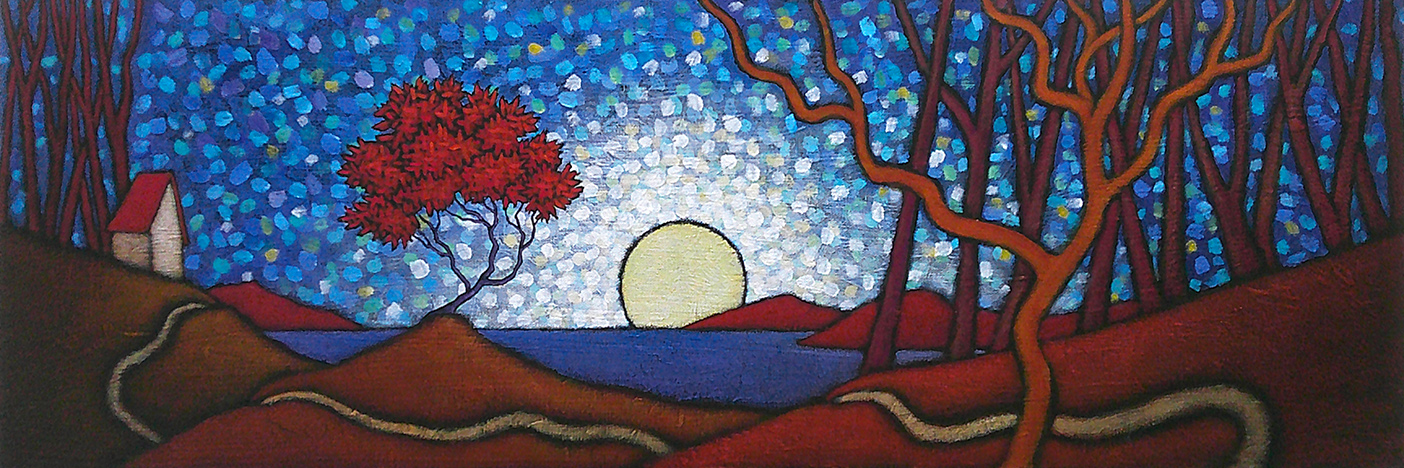
The painting at the top, a new 12″ by 36″ canvas, seemed to fit beautifully with this passage from Hesse. I call it Destiny’s Way. I guess any painting portraying my destiny would have to feature the Red Tree, right?
This painting will be included in Guiding Light, my 24tth solo exhibit at the West End Gallery which opens October 17.
Here’s I Want to Break Free from a 1986 performance from Queen. I suspect that Freddie Mercury knew a thing or two about following one’s own path.
Questions For the Moon-At West End Gallery in October
Do not now seek the answers, which cannot be given you because you would not be able to live them. And the point is, to live everything. Live the questions now. Perhaps you will then gradually, without noticing it, live along some distant day into the answer.
~Rainer Maria Rilke, Letters to a Young Poet
Do not now seek the answers…
Such a counterintuitive and wise bit of advice that Rilke passed on to his young poet friend. History and mythology are filled with characters who stand before the void, frustrated and grieved with life, pleading for answers to come out of the nothingness before them.
Answers seldom come.
But the questions remain. These questions and concerns become ingrained to the point of almost being unnoticed in the seeker’s life and being.
And one day, if they are fortunate, they realize that that the question itself was the answer and that it was always within them, ready to reveal itself when they have lived and dealt with that question in their life and finally came to this realization.
This realization is earthshaking for some and mundane for others. For others, it is both.
The point is that there are seldom easily obtained answers to the existential questions that plague us.\
Only time and life can turn these questions into answers. And some questions are such that the answers may well be beyond our living or recognition. Those answers remain a mystery.
Maybe the ultimate question here is how well we cope with lives filled with such mystery.
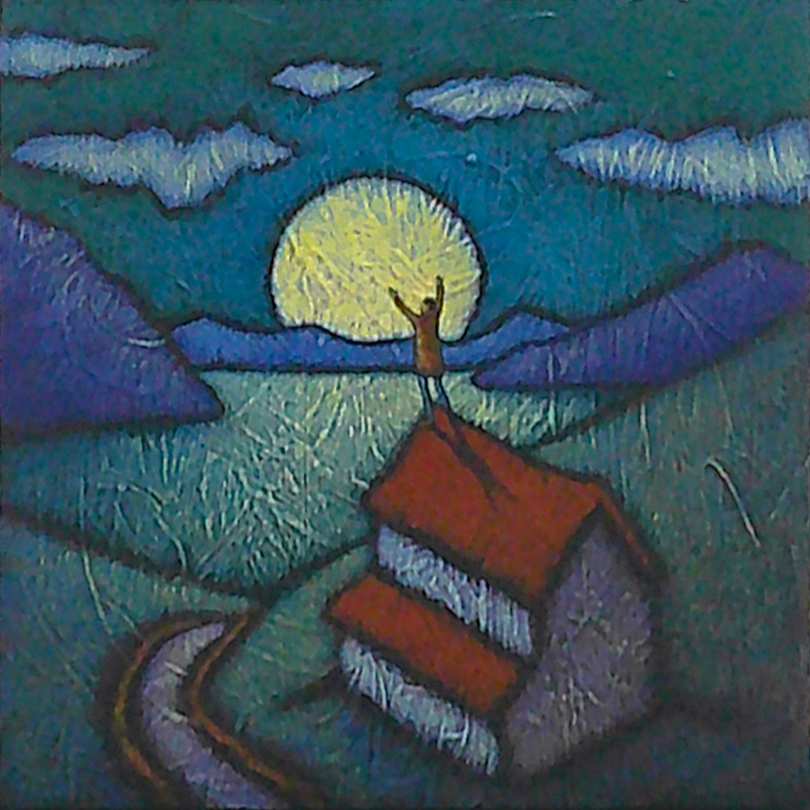
That is my first take on this new small painting, 8″ by 8″ on panel, that is included in my October solo show at the West End Gallery. I call it Questions For the Moon.
I’ve been on a lot of roofs in my life, having been a chimneysweep for several years, and, more importantly, have been on the roof depicted in this painting, sending out questions whose answers I was not yet ready to recognize within myself. I know the frustration and pain in that moment of questioning as you teeter on the roof’s peak.
In that moment, the only answer is to get off the roof in one piece and move on, accepting that this might not be such a bad answer. One day further down the road, if you’re lucky and have let those questions fade onto the deep recesses of your mind, almost forgotten, the question might once more show itself as an answer that has meaning for your life as it has been lived.
And you understand in that moment that this was the only way it could have been, that it took the pain and toil of life to get to where the question could be answered.
That’s a lot to ponder for a little painting.
Here’s song in that vein from the always charming Iris Dement. This is Let the Mystery Be.
The Restless Seeker– Coming to West End Gallery in October
He in his madness prays for storms, and dreams that storms will bring him peace”
― The Sail,Mikhail Lermontov
These are the last lines of the poem The Sail from early 19th century Russian poet Mikhail Lermontov. Actually, I haven’t been able to locate a translation of the poem that translates his lines with this wording, but since Leo Tolstoy quoted these lines in this way in his The Death of Ivan Ilych it has become the accepted wording. The meaning of these lines in any translation is pretty consistent in meaning– that there are some so desperate in their search that they will head into the teeth of storm and chaos because they believe that the calm naturally accompanies the storm.
As a bit of added info, the poet Lermontov lived his life as though he was the sailor seeking calm by heading into a storm. He packed a lot into his short life, including being acclaimed as the natural heir to Pushkin’s title as the greatest Russian poet, being exiled twice, serving in the Russian army where he led a troop of Cossacks described as a gang of dirty thugs whose duty was to charge headlong into their Chechen enemy forces, and dueling twice. The second duel left him dead after a direct shot to his heart at the age of 26.
He apparently adhered to the words of the old Faron Young song– I want to live fast, love hard, die young, and leave a beautiful memory.
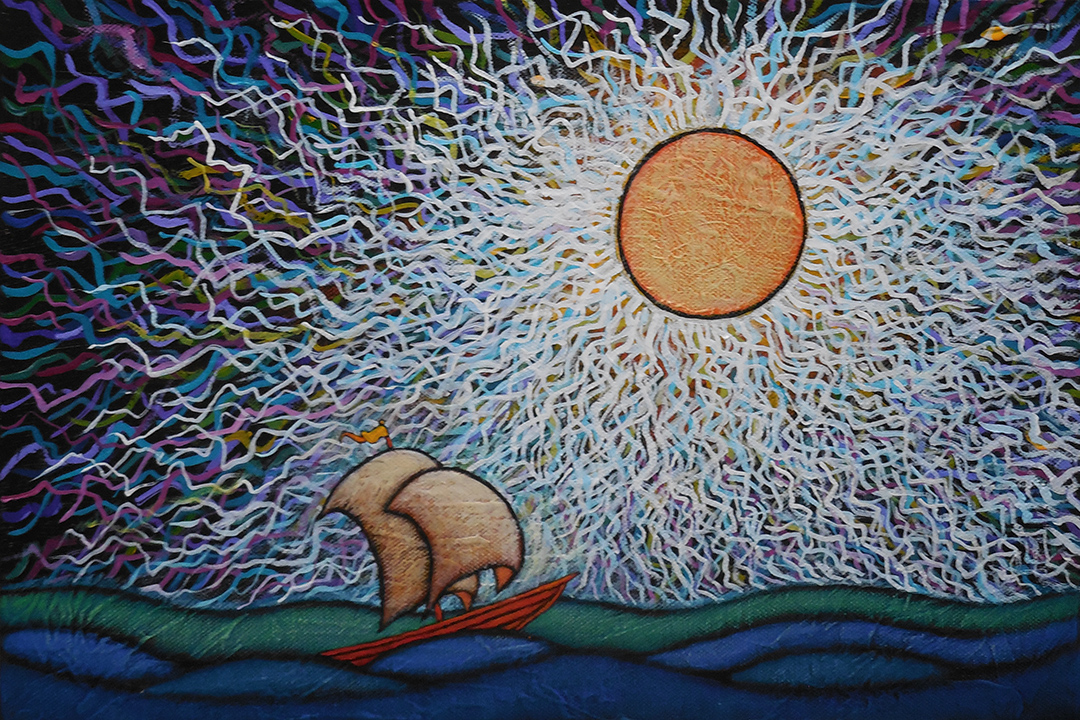
The poem itself, below, seemed to fit well with the new painting shown at the top. Titled The Restless Seeker, it is 6″ by 18″ on canvas and included in my solo exhibit, Guiding Light, at the West End Gallery that opens on October 17.
There is a stormy and otherworldly quality that comes with its chaotic sky and blood red sun/moon. Oddly enough, though it is a painting that is filled with motion, there is also a calm determination in it along with a feeling of defiant courage in the boat and its sails that I find particularly appealing. Maybe it’s the focused calm mustered by those ultimately endure the storm.
It’s a quality that we need a bit more of in these troubled times. That might be part of its appeal for me.
For this week’s Sunday Morning Music, here’s a song that has been shared here a couple of times over the years. It is The Ship Song from the always interesting Nick Caveand the Bad Seeds.
A lonely sail is flashing white Amdist the blue mist of the sea!… What does it seek in foreign lands? What did it leave behind at home?..
Waves heave, wind whistles, The mast, it bends and creaks… Alas, it seeks not happiness Nor happiness does it escape!
Below, a current azure bright, Above, a golden ray of sun… Rebellious, it seeks out a storm As if in storms it could find peace!





 Redtree Times