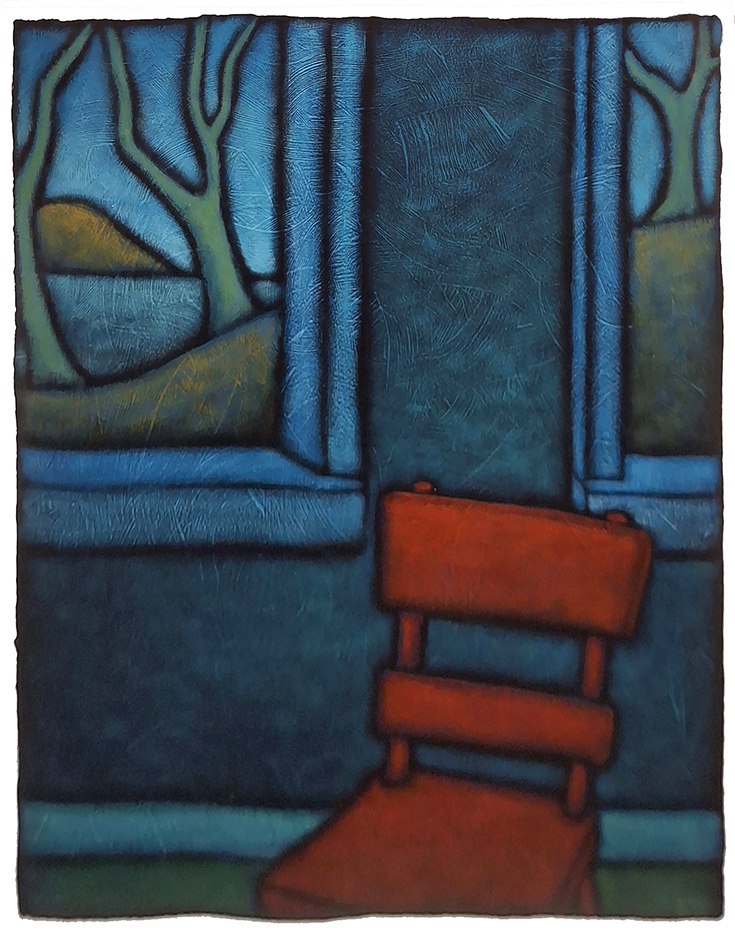
Introspection (2002)– Coming to Principle Gallery, June 2026
Wait, for now.
Distrust everything if you have to.
But trust the hours. Haven’t they
carried you everywhere, up to now?
Personal events will become interesting again.
Hair will become interesting.
Pain will become interesting.
Buds that open out of season will become interesting.
Second-hand gloves will become lovely again;
their memories are what give them
the need for other hands. The desolation
of lovers is the same: that enormous emptiness
carved out of such tiny beings as we are
asks to be filled; the need
for the new love is faithfulness to the old.
Wait.
Don’t go too early.
You’re tired. But everyone’s tired.
But no one is tired enough.
Only wait a little and listen:
music of hair,
music of pain,
music of looms weaving our loves again.
Be there to hear it, it will be the only time,
most of all to hear your whole existence,
rehearsed by the sorrows, play itself into total exhaustion.
—Wait, Galway Kinnell (1980)
I’ve recently come across the poetry of Galway Kinnell, an American poet who died in 2014 at age 87. It’s another of those cases where I am a bit embarrassed that I had never heard the name since he was highly acclaimed, having won the Pulitzer Prize. I know that it is foolish to be embarrassed by such a thing since most of us would struggle to name maybe one or two modern poets, if any.
Even so, I still find myself thinking I should know his work after reading just a bit of it.
It has a bite to it. Some call it dark, but I don’t know about that. What does that really mean? I think anything that deals with this ourselves and world in its totality has to have at least some darkness. It’s just part of our wholeness, our beingness.
That’s a nice segue into the painting at the top, Introspection. It is from 2002 and is a prime example of what I call my Dark Work, which was more of a stylistic shift that came in the aftermath of 9/11. My work became more centered on painting on a dark underpainting which gave any piece, no matter how bright and optimistic it might appear, a dark undertone.
I saw this as being a balanced view, as we are, in my view, creatures comprised of both darkness and light.
I feel this painting fits this poem from Kinnell very well. I could even change the title, and it would speak as clearly for it as the title I gave it 24 years ago. It is yet another painting that will be part of my June solo show at the Principle Gallery. As I mentioned in recent posts, this show will be a semi-retrospective, a hybrid of older and new work. There will be a couple of my Dark Work pieces in this show.
Like all art, this poem from Kinnell is open to a variety of interpretations, all validated by our own experience and understanding of life. Art gives us insight to that part of ourselves we recognize but don’t fully know or understand. I might see it one way and you, another.
As it should be.
I was pleased when I saw that Andrew Bird had made this poem the basis for a song. I’ve featured him here before in collaborations with both the Lumineers and Iron & Wine, but this is his first solo effort on the blog. He reconstructs Kinnell’s poem in a lovely way that maintains the feeling of it. Well, at least as Bird sees it. Again, purists might beg to differ.
Myself, I like it very much. It has, as the kids say, a vibe.
And as you know, I’m only here for the vibe. And the cake…
 Redtree Times
I’ve never heard of this poet, either. The poem is wonderful. There’s a difference between ‘dark’ and ‘realistic.’
Reading this poem, I thought immediately of T.S. Eliot’s lines from the Four Quartets:
“I said to my soul, be still, and wait without hope
For hope would be hope for the wrong thing; wait without love,
For love would be love of the wrong thing; there is yet faith
But the faith and the love and the hope are all in the waiting.
Wait without thought, for you are not ready for thought:
So the darkness shall be the light, and the stillness the dancing.”