Feeds:
Posts
Comments

Archive for the ‘Advice’ Category

I do what I can to convey what I experience before nature and most often, in order to succeed in conveying what I feel, I totally forget the most elementary rules of painting, if they exist that is.  In short, I allow faults to appear, the better to fix my sensations.

–Claude Monet, 1912

**********************************

I have had this little sign hanging in my studio for the last 16 years [over 20 years now], a rough reminder to myself when I begin to feel like my work is bending to the rules and judgments of others.  It reminds me that I am working in my own realm, my world.  I control the parameters of what is possible, of what defines reality in my work.  The rules of others mean nothing in my little painted world.

Over the years  I have glimpsed this small sign at times when I have been feeling that my work is stagnating or beginning to adhere to  accepted conventions.  At those times I have been spurred to push my work in some new direction.  It might come in the form of heightening the intensity of color or introducing new hues that seems incompatible with nature, for example.

It’s as though these two words are prods that constantly  tell me that nobody can control me when I am here in my created world.  There’s a great liberation in this realization and I find myself trusting my own judgment of my work more and more.  Because I have created  my own criteria for its reality, criticism from others means little now.

I think that’s what I am trying to get at here, that an artist must fully believe that they are the sole voice of authority in their work, that they, not others, determine its validity. Maybe that’s why I am so drawn to  Outsider artists, those untrained artists who maintain this firm belief in their personal vision and create a personal inner world of art  in which it can live and prosper.  Rules mean nothing to them- only the expression of their inner self matters .
Read Full Post »

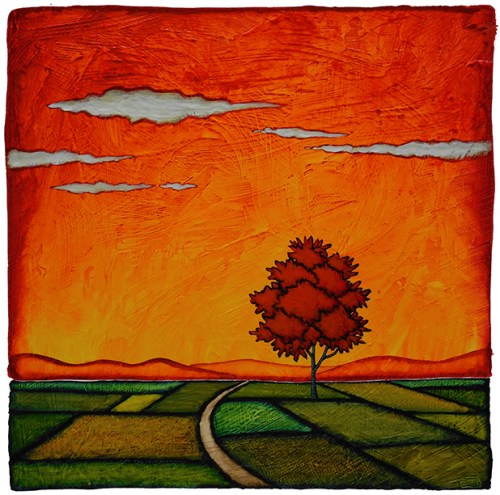
Even though this post only ran last August, I thought it was worth replaying, if only to remind us to maintain some semblance of civility and sanity in this bitter election season.  I was reminded of this post because the painting featured in it, Raised Up, went with me to the Principle Gallery for my talk there this past Saturday.  It’s a piece that I like very much as is the song at the end from John Prine.  Hope you’ll enjoy them as well…

GC Myers- Raised Up

Practice kindness all day to everybody and you will realize you’re already in heaven now.

Jack Kerouac

****************

I am not sure what to do with these words from Jack Kerouac but I do like them and think they deserve to be passed along.  I am a firm believer of kindness in all forms and believe that it is a pathway to a better life here in this world.

When I was waiting tables I found that my own attitude and demeanor often dictated how others responded to me.  If I smiled and acted congenially, more often than not the person I was dealing with responded in the same manner.  We are reactionary creatures and we instinctively respond according to the tone we encounter– rudeness with rudeness and anger with anger.

And kindness with kindness.

It’s our choice.  If we can fight against our reactionary nature and choose to act and react with kindness, we can shape our world and then perhaps realize that a form of heaven might be within our grasp.

I have never had the faith or certainty of those who believe that there is an actual heaven waiting beyond this world.  I would like to but I just don’t have it within me.  So, for me, if there is to be a heaven it is something to be sought in the here and now.  By that, I mean creating an environment that is honest, kind and gentle.  A life that is peaceful and quiet–that would be heaven to me.

So, when you’re out there today and face rudeness and anger, make the choice to react in a gentler manner and be kind.  Your world might be one small step closer to heaven.

This quote reminded me of a song from one of my favorites, John Prine.  The title pretty much sums it up: He Was In Heaven Before He Died.

Read Full Post »

GC Myers- The PauseThe right word may be effective, but no word was ever as effective as a rightly timed pause.
Mark Twain

*****************

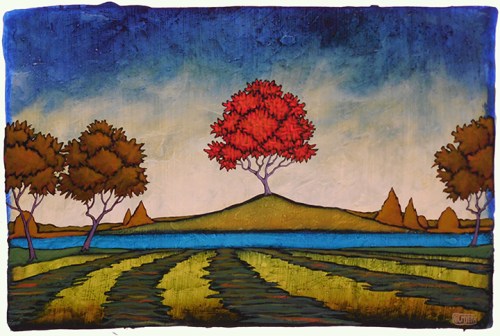
The painting shown here is titled The Pause and is 16″ by 16″ on paper.  It is included in my upcoming show, Contact, at the West End Gallery which opens on July 22.

I am a big believer in the pause as a form of communication.  That brief moment of silence between words said and words not yet spoken, that small period of inaction between actions, is often filled with a great and ponderous anticipation of what might come next.  In that tiny span of emptiness there is both a look backward at all that has come before and ahead at all that the future might bring.  The pause allows for contemplation of both.

Okay, now that may be putting the importance of a pause in larger than life terms.  Not every pause holds all the past and all the future.  But every pause allows consideration and thought of the immediate past and future, giving that moment a certain degree of importance.

I learned the lesson of pausing from the many gallery talks I have given over the years.  Halting for just a moment to ponder the question asked or the statement made is far more effective than simply beginning to speak.  That was a difficult thing to do at first when it sometimes seemed like every moment needs to be filled with sound and content to cover my insecurity.  But I learned that that moment of silence was not a bad thing at all.  It showed an appreciation of the question or statement, showed that I heard what was being said and showed that I wanted really consider how I would answer.

Moving back to larger terms, the pause works in much the same way.  The pause takes the past and brings it into the present and makes it part of the decision for the future.  The pause consoles us as to what has failed us in the past and what has succeeded.  It cautions us against rash and impetuous actions.

The pause is a deep breath that freshens us, allowing us to take in the world around us and to refocus, to reconsider our words and actions.  The pause allows us to see other paths leading forward.

The pause can be a potent force, if only we choose to use it.

Read Full Post »

gc-myers-the-angst (1)Each man has his own way of being himself and of saying it so ultimately that he can’t be denied.
Henry Miller

*******************

I ran the entry below back in 2009 and again back in 2013.  It is a favorite of mine and one of my more popular posts,  regularly drawing a number of readers who find it via web searches.  I like it because it describes the internal transition that took place over the years on my path to becoming and accepting my place as an artist.  I say path because it took a long time before I found the  confidence to call myself an artist.  For many years, even as I was working full time as a painter, I was hesitant to say those words, to say that I was an artist.

I periodically pull this entry up and read it just to remind myself to trust my inner voice and the work that comes from it.  I think it is worth running yet again.  Oh, and excuse Henry Miller for the sexist sounding nature of his words above– it would read better if it went Each person has their own way...

********************

When I used to enter a gallery or museum, even up until several years ago, I would be filled with a severe sense of dread and anxiety.  Angst. The knot in the stomach. The racing pulse. The whole thing. 

I would go from painting to painting and would feel lessened in some way because in each piece I would see something that I could not do, some technique that was not in my toolbag. There were colors and forms that I could not replicate and all I could think was that I was somehow inferior. 

I didn’t belong. 

The resulting feelings would leave me reeling and sometimes angry, making me even more determined to create something that would validate my work. 

While this was a motivating force for many years, helping me actually find my voice, it gradually subsided over the years as I became more and more aware that I had been focusing on things I could not control and on being something I was not. 

I began to see what I was. My perceptions and feelings were only mine.  To express these, I had an individual voice and vocabulary that was mine and no one else’s.  I began to see that other artists felt about my work as I had felt about their work. I saw that while they were doing things that I could not, the reverse was true as well. I recognized that my voice, my technique and style, was finally mine and mine alone. I saw that my form of expression was every bit as valid as any other artist hanging in any gallery or museum. 

This was a liberating feeling. It allowed me to go into galleries and museums and , instead of seeing what I was not, recognize the beauty of expression that was there and be excited and inspired by things other artists were doing.

Instead of coming out saying ” I’ll show them ” I was saying “I can use that”. 

Instead of asking “Why am I not good enough?” I was asking “Why not me?” 

It was merely a matter of trusting that what I saw in my own work was a true and real expression and would be visible to others. I think this a lesson from which any viewer of art can benefit. They must learn to trust their own instincts and reactions when looking at art. Like my self-expression, their reaction to a work is theirs and theirs alone. Their reaction is as valid as anyone else and no critic or gallery-owner can make a person like a piece that doesn’t move them. When the viewer realizes that there is no right or wrong, that their own opinion is truly valid, their viewing pleasure will increase dramatically. 

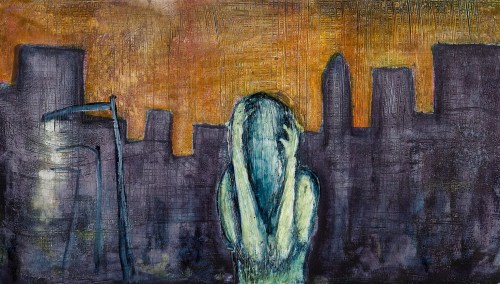
By the way, the piece at the top is an old experiment from around 1994. I always enjoy pulling it out even though it doesn’t fit neatly into my normal body of work. No more angst. 

Well, a different kind of angst…

Read Full Post »

GC Myers- The Bridging

We want to be sure that it has that drama to it, that vividness to it, that focus, that cleanliness to it that is going to say something to you.

Thomas Keller

***************

The words above from chef Thomas Keller, owner of the fabled French Laundry restaurant  in Napa Valley, were in reference to food but I couldn’t help thinking that it was good advice for artists as well.

As an artist, you want your work to have a sense of drama that compels the viewer (or listener or reader or whoever it is that is taking in your work) to pause and ponder the work.  This sense of drama tells the viewer that there is something beyond the surface if they only take the time to fully appreciate it.

The vividness is in the uniqueness of it, how quickly it reaches out with its essence and reaches its intended audience.  I think of this as the work being a sort of beacon that is calling out.  Sometime, I will go in a gallery or museum and there are things on the wall that just call out to me from a great distance away.  It can be in the color or contrast or composition– something that just grabs my eye.

Focus is in the sense that all of the elements in the work come together in a harmony that pushes the central theme through.  I think there is a lot of work that is quite well done but never fully comes together in a single message that comes through to the audience.  I’m sure you’ve experienced work that you know is well done but just doesn’t seem to have much to say to you.  It kind of leaves you cold.  Focus, I believe, brings the work to life.

And there’s cleanliness.  I don’t think Keller was speaking about the cleanliness of a sanitized kitchen in his quote.  I think he was referring to the execution of the work– in his case food– so that all the elements of it sparkle and there is no distraction from what it is meant to be.  There are no unnecessary flavors or embellishments.  All excess has been pared away and there is a lightness and brightness to it.

Taken all together these qualities make for a delicious dish.  But it doesn’t happen with every effort.  There are days when finding one of these is difficult.  Then there are days when they just emerge, seemingly without effort.

The example I’m putting forward that I think fulfills Keller’s requirements — you might not agree– is the painting at the top, a 10″ by 30″ canvas called The Bridging that is part of my show at the Principle Gallery, opening in a couple of weeks on June 3.

It was the first piece I looked at after reading Keller’s words and it just seemed to have that beacon effect on me.  It was vivid and focused in it’s communication and there was a sense of drama to it.  Plus, there was a sharpness in its look and finish that just made it very appetizing.  ‘

If this were food, I would gladly eat it.

As I said, you might disagree.  Our tastes in food and art may differ.

And that is just as it should be…

Read Full Post »


GC Myers- Jumping Off PointWhenever I am asked to speak with students I usually tell them to try to find their own voice, to try to find that thing that expresses who they really are.  I add that this is not something that comes easily, that it takes real effort and sacrifice.  The great poet e e cummings (you most likely know him for his unusual punctuation) offered up a beautiful piece of similar advice for aspiring poets that I think can be applied to most any discipline.

Or to anyone who simply desires to feel deeply in this world.

I particularly like the line: To be nobody-but-yourself-in a world which is doing its best, night and day, to make you everybody else-means to fight the hardest battle which any human being can fight; and never stop fighting.  That line alone speaks volumes.

Take a moment to read this short bit of advice and see what you think– or feel.


A Poet’s Advice To Students

(e e cummings)

A poet is somebody who feels, and who expresses his feeling through words.

This may sound easy. It isn’t.

A lot of people think or believe or know they feel-but that’s thinking or believing or knowing; not feeling. And poetry is feeling-not knowing or believing or thinking.

Almost anybody can learn to think or believe or know, but not a single human being can be taught to feel. Why? Because whenever you think or you believe or you know, you’re a lot of other people: but the moment you feel, you’re nobody-but-yourself.

To be nobody-but-yourself-in a world which is doing its best, night and day, to make you everybody else-means to fight the hardest battle which any human being can fight; and never stop fighting.

As for expressing nobody-but-yourself in words, that means working just a little harder than anybody who isn’t a poet can possibly imagine. Why? Because nothing is quite as easy as using words like somebody else. We all of us do exactly this nearly all of the time-and whenever we do it, we’re not poets.

If, at the end of your first ten or fifteen years of fighting and working and feeling, you find you’ve written one line of one poem, you’ll be very lucky indeed.

And so my advice to all young people who wish to become poets is: do something easy, like learning how to blow up the world-unless you’re not only willing, but glad, to feel and work and fight till you die.

Does this sound dismal? It isn’t.

It’s the most wonderful life on earth.

Or so I feel.


Read Full Post »

« Newer Posts