Feeds:
Posts
Comments

Archive for the ‘Advice’ Category

Art is a lie that makes us realize the truth.

Pablo Picasso

****************

Many of my favorite artists worked and produced their greatest works in times where the world was under great stress. World wars and– in the case of Picasso’s painting, Guernica, shown above– Civil Wars. The Great Depression. Times of social transformation. Even when the work didn’t overtly deal with the events of the day, much of the work reflected on the collective consciousness of that time.

I think that is so because art is, just as Picasso so succinctly states, a lie that makes us realize the truth.

Artists fabricate, often creating work that is on its surface pure fantasy with little relation to the world as others might observe it. But their fabrication is made up from everything that impacts them– their knowledge, their observations, their opinions and emotions. Artists take in the world and create something that seems like a pure fabrication.

A lie.

But what seems the lie often proves to be built of ultimate truths, just constructed in a manner that allows others to see this truth clearly.

I don’t know that we artists always succeed. I certainly don’t feel that I do as often as I would  like. But so long as we feel deeply and create our lies, we will at some point reveal a truth.

Got to get to work now…


Read Full Post »

.

The value of the prototype does not consist in the rarity of the object, but in the rarity of the quality it represents.

–Victor Vasarely

*******************

I have to confess up front that I am not a big fan of Victor Vasarely (1906-1997) or the Op-Art movement of which he is at the forefront. It’s not that I am denigrating it. I have seen a number of pieces that I do like and I can certainly see people being intrigued by its color and forms and how it can reverberate in certain environments.

If I had a mid-century home with lots of glass and chrome, I might think about hanging this type of work. But I live in a cabin in the woods.

It’s just not to my particular taste, that’s all.

That being said, I immediately nodded in agreement when I read the quote above from Vasarely. As I read it, it jibes well with my own views on the intrinsic value of art and how the artist behind it affects the artwork’s value beyond that of a mere object.

When I have spoken with students in the past I try to impress on them that while they must learn their craft, they should also focus on making themselves fully rounded humans with an individual voice that reflects their uniqueness and individuality.

I urge them to read more, listen more, and to look at more things, all preferably outside their own known preferences.  I believe it creates a sense of fullness that will extend into their work, giving their work a greater sense of that quality that takes a piece beyond being a mere object of decoration.  And today, when there are more artists than at any other time at any point in history, its that rare sense of this quality that can make the difference in how seriously an artist’s work is viewed.

I don’t know if that ever gets through to these kids or if it even holds true in reality, but it seems right to me. I personally try to view each piece as a combination of skill, experience, acquired knowledge and influences, and the flaws and strengths of my own character–hopefully, the better parts of it.

Sometimes it works and at those times I see the quality represented by it that Vasarely described. When it doesn’t, I see a mere object that lacks the fullness that I am trying to put in it. I can see that I have somehow withheld some part of myself from that work and I try to figure out how to overcome that deficiency.

But most of all, I keep trying to find that rare quality…

Read Full Post »

I’ve been under the weather for most of this week, which is never grounds for throwing a party. But maybe there’s an upside here in that it keeps me from spending too much time dwelling on the work of the past year and in which direction next year’s work will head. That is something I tend to do a lot at this point on the calendar as we get ready to turn the corner into the new year.

It’s a constant evaluation of how I see my work and it run s the spectrum depending on my mood and confidence level. I fear that if I did it now, I wouldn’t fare too well against my own judgement.

Thinking about this reminded me of a post from about 5 years ago after I had sat down for a radio interview. You can hear that interview here. The advice I talked about then is as applicable now as it was twenty years ago. I sometimes forget these important things…

Another thing from the Out of Bounds interview that I wanted to expand on was my answer to Tish Pearlman‘s question as to what advice I  might give to aspiring artists. I said that I thought that they should paint the paintings that they wanted to see. I think there needs to be a little more depth to that answer.

Earlier in the interview I had said that I was influenced by a wide variety of imagery from many great painters and illustrators to advertising and film and television. Any visual input had some influence. I spoke of deeply saturated colors that I had seen maybe 25 years ago in a Coca Cola ad on TV, colors that still dwell in my mind. There are hundreds of little nudges that push you towards that perfect, idealized  image that you maintain in your mind but is never quite fully captured. I know that’s how it was for me.

I would go into museums and look at great works of art and absolutely love so many of them yet still felt that none was exactly an expression of what I was feeling or who I was. There was always a lingering feeling that there was work that was closer to the hazy criteria my mind presented, work that I still wasn’t seeing. It was this feeling that led me to the conclusion that I would never find what I was looking for by trying to paint in the style of other painters. If their work was what I was looking for to begin with, why even paint? It seemed to me that too many artists are satisfied by simply doing work that resembles other work, safe in the accepted pack, rather that taking the gamble on stepping away from it.

But I wanted to step away and to do so I would have to assess what I was as well as what I wasn’t. By that, I mean I would play to what I felt were my strengths and not waste too much energy on my weaknesses. I knew that anything that would be close to what I wanted to see had to come from a total belief from within and that trying to do things that were not who I was, which would be a weak area in my abilities, would diminish the whole thing. No, it needed a total commitment from myself.

I guess what I am saying it that aspiring artists need to focus on what they believe they want to see and use their strengths to try to achieve that end. By concentrating their efforts on their strengths, a natural style or voice will evolve. If they accept this voice with a real belief in its validity, it will soon be as natural as signing their name. They will soon be able to celebrate the things that make them different than others, rather than striving to be like them.

I don’t know if any of this is making sense this morning. I’m sure some of the above will ring true to some and ruffle the feathers of others. That’s art  for you. It’s more mystery than science. I might be right or wrong or both. Depends on who’s looking…

Read Full Post »

***********************

The thought manifests as the word;

The word manifests as the deed;

The deed develops into habit;

And habit hardens into character;

So watch the thought and its ways with care,

And let it spring from love

Born out of concern for all beings…


As the shadow follows the body,

As we think, so we become.


 —From the DhammapadaSayings of the Buddha

***********************

I’ve been writing this blog for over five years [actually, it’s nine years now] which I find hard to believe. Some days I have nothing to say but still feel the need to keep this habit alive. Sometimes I read through older blog posts to gather inspiration and in doing so, I came across this bit of wisdom from the Buddha that I featured in a 2009 post.

When I used it at that time, I was referring to people’s words and deeds of incivility eventually hardening into character. For example, if you speak with anger and hatred constantly, it eventually becomes a permanent part of who you are. This was of course inspired by extremist nature of the political climate. But today when I read it, these words didn’t strike me in that cautionary way.

Instead, it was more inspirational, seeming like good advice for the young artist or anyone aspiring to something more. For me it was: Think as an artist, act as an artist. Eventually, the thoughts, words and actions become part of who you are– an artist. It took many years before this habit hardened into character. I often questioned the validity of the claim over the years but slowly these doubts faded, replaced by a belief in those words and deeds. I had practiced the habit of being an artist for so long that I could no longer  feel that doubt.

As I said, this applies to so many things, even simply being happy. If you think of joy, speak of joy and act with joy and eventually happiness becomes part of who you truly are– a part of your hardened character.

It’s a simple precept, almost too simple to be taken seriously especially on those days when it is challenging to remain joyful. But it holds true, as the Buddha instructed, for those who can maintain the way.

**********************

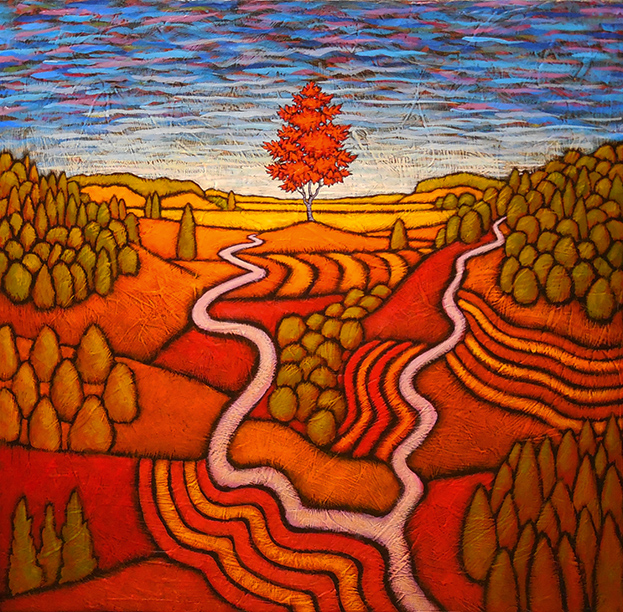
The painting at the top is “The Kinship” which is included in the Kada Gallery show.

Read Full Post »

Keeping Hope, Again

I have been filled with a dark and foreboding anxiety lately.  It’s even deeper and darker than the uneasiness and apprehension that has been with me for the past year as I watch the fabric of this country seem to unravel before my eyes. In recent weeks I get the sense that we are nearing a tipping point, that without some sort of dramatic change in our course forward we may find ourselves at a time and place from which there may be no recovery. 

At least in a peaceful and orderly manner.

I know this sounds hyperbolic but I feel that even darker days may be ahead. 

It’s easy to lose grip on our hope in these times, to feel our own humanity slip away only to be replaced by fear, anger and paranoia. That is something that seems evident by observing the growing division and incivility taking place in day to day life. 

As bad as it seems, I am reminded of an entry posted here several years back soon after the death of historian and social activist Howard Zinn. It was about the need to behave as a real human in the darkest of times, if only to remind us of those better qualities that we are struggling to maintain. The world may be dark and darkening with each passing moment, but kindness and compassion have the power to create moments of light that defy the shadows that creep over us and to give us a renewed energy to go on.

It’s short–less than the blather I’ve written here to introduce it– but it is worth a moment to absorb it. The last paragraph is a gem.
***********

To be hopeful in bad times is not just foolishly romantic. It is based on the fact that human history is a history not only of cruelty, but also of compassion, sacrifice, courage, kindness.

What we choose to emphasize in this complex history will determine our lives. If we see only the worst, it destroys our capacity to do something. If we remember those times and places — and there are so many — where people have behaved magnificently, this gives us the energy to act, and at least the possibility of sending this spinning top of a world in a different direction.

And if we do act, in however small a way, we don’t have to wait for some grand utopian future. The future is an infinite succession of presents, and to live now as we think human beings should live, in defiance of all that is bad around us, is itself a marvelous victory.

——Howard Zinn

************

Read Full Post »

The past is our definition. We may strive with good reason to escape it, or to escape what is bad in it. But we will escape it only by adding something better to it.

Wendell Berry

***************

I finished this 40″ by 16″ canvas just the other day, readying it to take with me to the Principle Gallery for my Gallery Talk on Saturday. It was one of those times where the painting itself felt good and invigorating, to the point that I wished there was more to do when I was done with the painting.

Everything came easily and every stroke seemed to add something evident and valuable to the piece. There was no struggle to try to determine what path to follow- it all was there waiting for me to simply take action.

That’s a rare and wonderful moment, at least in my experience.

That ease of process normally shows in the final product. It doesn’t seem worked over and has a freshness in its color and line rhythms. I think that holds for this painting, at least to my eyes which I admit may be somewhat biased.

The meaning that I have attached to this painting adds to to my pleasure in it. A lot of what I see can be gleaned from the words at the top from poet Wendell Berry. I see this as about how one rises above their environment, their past, their failures, their shortcomings and the examples set by those around them.

Betterment.

Trying to be better at whatever they choose, be it their jobs or relationships or their knowledge of the world around them.

Just being a better person, allowing yourself to rise to new heights where you can see beyond the encroachment of the past and the obstacles of the present.

I call this painting Above and Beyond.

Read Full Post »

I have been working on some new small pieces. When I finished this piece, which is 2″ by 6″ on paper, and was trying to read what I was seeing in it, I immediately thought of the blog entry below from several years back. The article and the painting both deal, as I see them, with how we often look for answers from far outside ourselves and fail to see the riches and possibilities that surround us in plain sight. I call this painting In the Gem Fields.

“The more intensely we feel about an idea or a goal, the more assuredly the idea, buried deep in our subconscious, will direct us along the path to its fulfillment.”

—Earl Nightingale

______________________

It’s funny sometimes what you take from an experience in your life.  At one point in my life I was in the retail car business, working at a Honda dealership both as a salesman and a finance manager.  In order to keep their sales staff engaged and excited about pushing their product, the management there would periodically send us to seminars with industry-specific motivational speakers and would also have sets of motivational tapes from other speakers that they would encourage us to listen to in our free time.

One of the sets of tapes was from a famed motivational speaker named Earl Nightingale who had a deep and engaging voice that added a serious dimension to whatever he said.  As I listened to his tapes, it was easy to feel my interest growing as he told his little tales and his lessons began registering within me.

One of his stories was a short retelling of a classic lecture  called Acres of Diamonds from Russell H. Conwell (1843-1925), an interesting fellow who was a baptist minister, a lawyer, a philanthropist and the founder and first president of Temple University.  The lecture, one that Conwell delivered over 5000 times during his lifetime, made the point that the riches we seek are often right in our own backyards.  His tale is of an African farmer who sells his farm in order to go in search of diamonds and finds nothing but failure that ends with his suicide.  Meanwhile, the man who took over the farm found an abundance of diamonds and ended up with one of the largest diamond mines in Africa.

There were a lot of lessons to be learned from this tale but primarily  what I took away  was that I must leave the car business–it was not my backyard.   It was the place to which I had come in search of my own diamonds.  I had not even, at that point, began to search my own backyard. I am not sure if that was the message that management had been hoping would sink in.  Or maybe it was.

The other part of Nightingale’s message was that you had to set a course, aim for a destination.  Everything was possible if you knew where you wanted to go and truly set your mind to it.  He gave a laundry list of great human accomplishments that were achieved once we put our minds and wills in motion towards their fulfillment.  That resonated strongly with me.  I had seen many people over the years who seemed deeply unhappy in their lives and most had no direction going forward, no destination for which they were working.  Aimless, they drifted like a rudderless boat on the sea, going wherever the strongest current took them without having any influence over this motion.

If you can name it, you can do it in some form.

As I said, it’s funny how things influence you.  It’s been about twenty five years since I heard those words but they still resonate strongly with me, even now.  I try to be always conscious of the goals I set, knowing that the mind and the universe will always try to make a way for the possibility of achievement.

Read Full Post »

I don’t know…

I would guess that I’ve said that phrase a couple of hundred thousand times in my life. Or maybe even a million times. But then again, I don’t know.

As years pass, I am constantly fascinated by how little I know despite consciously trying to obtain more knowledge. It turns out the only thing I really know is that there are an awful lot of things out there that I will never know.

That doesn’t make me happy but I have learned to live with it and take some comfort in knowing that I am not alone. I don’t think any of us really knows as much as we let on. Oh, some speak with absolute certainty and and an air of confidence but that’s just bravado or a simple failure to recognize their lack of knowledge. I do know that.

From personal experience, unfortunately.

So I cringe a bit now when I spot that arrogant certainty in the declarations coming from myself or others. Then I cast a doubtful eye towards these claims, my own included.

What does this have to do with the price of a gallon of milk in Kokomo? I don’t know. I’m just blabbing in order to set up this week’s Sunday morning music. It’s from the Irish singer Lisa Hannigan  and is titled, fittingly, I Don’t Know.  I particularly like this version shot in a Dingle pub. Lovely.

Have a good day and be wary of those who seem a bit too certain. Or not.

I don’t know.

********

Read Full Post »

So runs my dream: but what am I? 
         An infant crying in the night: 
         An infant crying for the light: 
And with no language but a cry.
                                                                                                          .
Alfred Tennyson, Canto 54, In Memoriam A.H.H.
**********************
.
I came across an online article a few weeks back that captured my interest. Written by British designer Benjamin Earl Evans, it is titled 11 Brutal Truths About Creativity That No One Wants to Talk About. It’s a pretty short read.
.
Many of the points Evans makes seem pretty evident to me– your ideas are not original, everybody is creative, creativity is hard, success depends on the assistance of others and so on. Art, like any business or real endeavor, is filled with difficulties and harsh realities and if someone has spent anytime trying to be a working artist, they recognize many of these as absolute truths.
.
Perhaps the greatest difficulty for the visual artist is that you are faced with the prospect of competing with other artists, many with greater skills and training than yourself, for dwindling opportunities to show your work in the traditional gallery spaces that best gets your work in front of prospective collectors. Add to this that the artist then has to have their work somehow create an emotional bridge to the viewer, something that connects with them on the most visceral level.
.
I find myself often wondering what might be the differentiating factor in why the work of some artists succeed at these difficult tasks while the work of other greatly skilled artists does not? It is surely something beyond technical prowess and a solid resume. Something almost indefinable.
.
Evans provides one possible answer in this article, one that stopped me in my tracks with its simple obviousness– allowing yourself to be vulnerable.
.
It made me think the many times I have seen artists with incredible technical and observational skills create work that just doesn’t seem to reveal itself emotionally. Perhaps their ability has overshadowed their need for expression? I don’t know that answer.
.
But reading that, I immediately recognized the place of vulnerability and my willingness to share it in my work. I realize that my fears and shortcomings come through in my work.  My weaknesses, my uncertainties and my tears are readily on display as are my affections, hopes and aspirations. Even my lack of certain skills is a vulnerability that I am willing to expose and share, mainly because I cannot hide behind them.
.
Maybe that kind of vulnerability is one of those differentiating factors. I don’t know for sure though I tend to lean that way in my belief. How does an artist gain vulnerability? Again, I don’t know. Not even sure they can outside of trying to work on those things that allow them to really feel deep emotion.
.
No easy answers, unfortunately. But for me, I will continue with my transparency, my own vulnerability. It’s all I know.

Read Full Post »

Rules: Replay

I wrote the following post back in early 2009.  I am replaying it today just as a reminder to myself to not get too caught up in my own set of rules for my work.  I have to tell myself to remember that sometimes it’s the straying from the norm that creates the new norm.

GC Myers-  Solitary Crossing- 2009


Any fool can make a rule, and any fool will mind it.

     –Henry David Thoreau

*********************

I have always had a problem with adhering to rules, in practically all aspects of my life.  It’s as though when a rule is presented, a part of me automatically starts figuring out an exception to the rule, a way to go around it.  In everyday life this is not always a desirable trait, often putting one at odds with the law and one’s own conscience.

But, as luck would have it, this trait is indispensable in art.

It’s always amazing to me how many artists are tied to their own set of rules and nothing can deter this adherence, even if straying a bit might actually cause their work to really blossom.

For example, I know a painter who will generally only paint what is before him, either in person or in photos, and will not add or subtract any detail from the scene.  He once showed me a painting that was really painted beautifully, rich and bold. Everything worked well and the piece was really eye-catching except for a telephone pole that bisected, in a very intrusive fashion, the very middle of the canvas. It was a real distraction that threw off the whole weight of the composition and stripped away a lot of the appeal that it might hold.

Why is this pole here?” I asked.

He gave me a quizzical look then said, “Because it’s there.

He explained that it was in the scene as he had photographed it. When I asked if it had any purpose in the painting he said that it didn’t but it was part of the original scene as he saw it.

There was a certain realization that came from this brief exchange.  I realized that there were truly talented artists who can sometimes be shackled by their own rules and that absolute adherence to any arbitrary rule can be the death of creative expression.

Now, I’m sure there will be those who would argue this point and would be able to point out any number of examples that might contradict this statement.  So what? They are mere exceptions to this loosely formed rule.

So, kids, here’s the moral of this story:  In art, keep the rules around as guidelines, but when you need to paint outside the lines or cut out that ugly pole that is breaking up a beautiful scene, just do it.

PS: I would probably amend the wording in Thoreau’s quote to damn fool. Those two words seemed forever linked in my mind. Besides, if you’re a fool there’s a pretty good chance you’re a damn fool.

Read Full Post »

« Newer Posts - Older Posts »