Feeds:
Posts
Comments

Archive for the ‘Favorite Things’ Category

I look at the work of a lot of artists and usually see something I can relate to in much of it.  It might be the way a color sings or the way the painting is put together or in the expressiveness of a line.  Or just in simple emotion.  But very seldom do I stumble upon the work of an artist who I immediately feel as though I am sharing the same perspective.

Such is the case with Oscar Bluemner.

I came across his work a few years back.  I saw an ad for a piece of his in an art mag and was captivated.  There was something very familiar to me in it which made me want to know more.  But I could find little about Bluemner.  This was strange because he was in the right circles where one would think he would get some attention even if only by association.  The German-born painter, who was born in 1867 and moved to the US in 1893, was part of the Modernist painters group of the early 20th century represented by Alfred Stieglitz , famed photographer/gallerist and husband of Georgia O’Keefe.   His work hung in solo shows at Stieglitz’s famed NYC gallery and in the fabled Armory show of 1913.  You would think there would be no shortage of material on him or that his name would raise the image of some piece of his work.

But Oscar Bluemner had a knack for failing.  He was trained as an architect and designed the Bronx Borough Courthouse.  However, he was not paid for his services and the seven year court battle that ensued drove him away from  architecture and into the world of art,  where his paintings never garnered the attention or lasting reputation of his contemporaries.  He sold little and lived in abject poverty, which is said to have attributed to his wife’s early death and ultimately to his suicide in 1938.

But there is something in his work that I immediately identify with when I see it.  It’s as though I am seeing his subjects in exactly the same way as he did and would be making the same decision he made when he was paainting them.  His trees feel like my trees is the way they expressively curve and his colors are bold and bright.  His building are often windowless with a feeling of anonymity.  His suns and moons are solid presences in the sky, the focal points of many of his pieces.   In this piece to the right, Death,  he uses the alternating abnds of color to denote rows in the field as I often do and has his twisted tree rising from a small knoll in the forefront of the picture. 

I find myself saying to myself that I could very easily have painted these same pictures.  It’s odd because it’s not a feeling that I’ve experienced before even with the artists whose work I think has most influenced me and with which I feel a real connection.  And it feels even odder because I didn’t become aware of Bluemner’s work until long after I had established my own vocabulary of imagery. 

There are finally a few things out there online about Oscar Bluemener.  You can see more of his images now than you could even a few years back.  The Whitney in NYC had a retrospective of his work in 2005 (here’s a review) and that seemed to raise awareness of his work.  So maybe a few more people, a new generation, will finally see what I see in Bluemer’s work.

Read Full Post »

Garryowen

When I wrote about Custer yesterday, on the 135th anniversary of the Battle of the Little Big Horn, I forgot to mention the one thing that always comes to my mind when I hear anything about Custer: the song Garryowen.  It’s an old Irish drinking song that was adopted as the marching tune for Custer’s troops and is legendarily regarded as the last song played as they entered battle.  It remains the official song to this day for that same regiment, the US 7th Calvalry.

I was doing some genealogy and found that my grandfather, who had died when I very young and of whom I knew very little, had served as a  Sargeant with the 7th Calvalry during and after WW I.  They were stationed in El Paso so they didn’t see battle overseas but they continued their forays into Mexico in search of Pancho Villa as they had done under Black Jack Pershing before the war.  The first thing that I thought was that he might have heard Garryowen playing as he rode across the Mexican plains. 

And that made me happy.

Here’s a great version of Garryowen by one of my favorite guitarists, Martin Simpson.


Read Full Post »

This is a new piece that I just completed for my next show which opens in a scant three weeks at the West End Gallery in Corning.  This is a smaller painting, at just over 6″ by 14″ on paper that I’m calling Island of Memory.  It incorporates two of my icons, the Red Tree and the Red Chair, in a simple composition that recalls much of my earlier work.  It also is divided into two large blocks of color with a ribbon of white between the two parts, also like the earlier work.

I have mentioned the Red Chair signifying memory for me and in this painting it takes on that role.  It seems that often our memories become unique through time and  a memory of an event might only exist for one single person even though others might have witnessed the same event .   The event may not have etched itself as deeply in the minds of the others or may not have much significance.  Or they may remember it in a much different way, perhaps a differing aspect of whatver happened, if they remember it at all.  That is what I see here– the idea of a recollection exisiting in one small place.  I know I’m not doing this justice with this explanation.

It also reminds me of the classic Otis Redding song, (Sittin’ On) The Dock of the Bay, a song which fills my own island with memories.  I listened to that single hundreds, maybe thousands of times growing up yet I’ve avoided using it on this site.   I always felt a protective attachment to it and it’s always bothered me when other singers (and non-singers– I’m reminded of a hysterical George Hamilton version of it from the late 60’s) covered this song through the years.  It seems like these other versions somehow pulled from the special nature of Otis Redding’s version, making it less special.  The awful histrionics of Michael Bolton come to mind.  But all I have to do is hear the simple ease and strength of Otis’ rendition and those thoughts fade to nothing.

It is a special song.  And it seems to go along in tone with this small painting.  Give a listen…


Read Full Post »

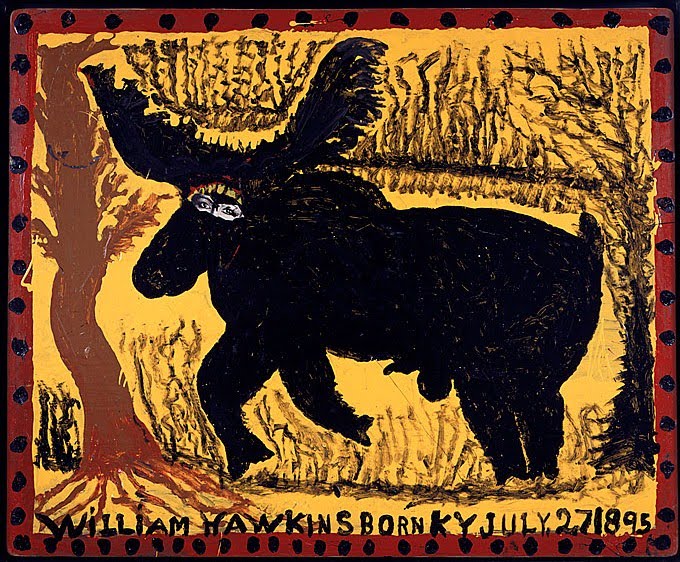
I really like self taught artists. I identify with these people who are usually living lives far removed from the world of art but who feel a compulsion to express something within them and create.  There’s something very pure in this work that transcends the lack of sophisticated technique and extensive artistic education.  In fact, it’s this very absence of these things that gives the work its purity.  It is a raw and often powerful synthesis of what these artists observe– something that can’t be taught.

One such powerful artist was William Hawkins who was born in Kentucky in 1895 amd died in 1990, in the Columbus,  Ohio area where he lived most of his life.  Most of his paintings are recognizable by his name and birthdate and birthplace emblazoned across the bottom.  But more than that,  his works were noted because they were diverse and always interesting, with their bold strokes and strong imagery.  The more pieces of his I see, the more I really see his strength as a painter and as observer of his and the greater world.

The Foundation for Self-Taught American Artists, one of my favorite sites and one that I’ve mentioned here  before, has produced a short film, which can be seen at the bottom of this post, that shows Hawkins at work in the late 1980’s.  It gives an interesting insight to the works and his process.  You can find more about Hawkins at their site and at a number of other sites.  Take some time and look at the images.  Find the rhythm in the slashing stokes and get to what Hawkins was seeing as he painted.  You’ll begin to appreciate that purity of which I spoke.

Read Full Post »

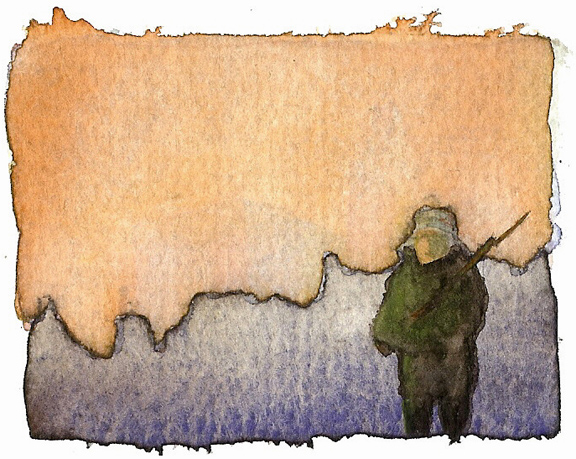
I came across this little piece that I had painted long ago, before I ever showed my work to anyone.  It’s a small little thing, barely 2″ by 3″ in size, but it’s a painting that I consider one of my favorites.  It’s not because of anything in the painting itself, although I do like the way it works visually.  Actually, it’s because I see an entire narrative in this piece and it always comes back as soon as I see it, even after many years.

I call this Guenther Hears the Boogaloo Softly.  The story I see here is a German soldier on patrol in the second World War, in a wintry forest,  perhaps in the Ardennes during the Battle of the Bulge.  He is separated from his group and as he is alone in the forest he suddenly hears a sound from deep in the woods, echoing softly through the frozen trees.  It is a piano and it is like nothing he has heard before.  It has a loping bassline that churns and pops and over it is a tap dance of notes that bounce and roll on the rhythm.  It’s American boogie woogie.  Somewhere unseen in the forest a piano is rolling out boogie woogie.

Guenther is transfixed and holds his breath to better hear the music that enchants him. A siren’s song.  He loses all thought of his mission and his duty.  He is engrossed by the music. 

I don’t go any further with this scenario in my mind.  There are obvious directions the story could take.  Guenther might allow the music to transfix him to the point he doesn’t hear the American patrol coming upon him.  Or he might throw down his weapon and flee.  But most likely, he would return to his patrol and  if he were lucky enough to survive the war, the memory of that music would haunt him for years, sending him on a search to recapture the sound of that moment in the forest.

I see it simply as a being about the transformative power of music and art, about how they unify humans despite our differences.  When we hear or see something, we don’t do so as a German or an American, as a democrat or a republican, as a Christian or a Muslim.  We react as a human to our individual perceptions.  Sometimes we cannot shake these other labels we carry with us but there are moments when our reaction is pure.  Which is what I see in this little bit of paint and paper, in Guenther’s reaction to the piano. 

Such a little bit of paint yet such a lot to say…

Here’s a little taste from one of the kings of boogie woogie from the 30’s and 40’s, Albert Ammons.

Read Full Post »

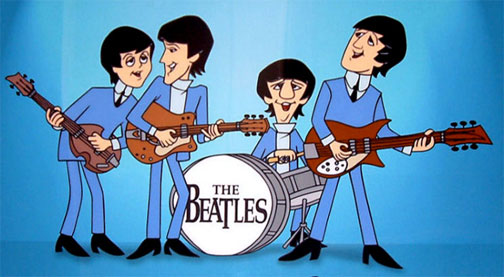
I wrote yesterday that the future is never as bad as we fear and that the past is never as good as we remember.  Well. there are exceptions, of course.  The Beatles, for instance, fall into the as good as we remember category.  Actually, I sometimes think they were better than our memories will allow us to believe. 

 However, their cartoon show was every bit as bad as I remember.  Bad animation and amateurish writing to get to the featured song in each cartoon made these hard to watch.  But the strength of the Beatles’ music kept this show on the air for four years.

We’re on our way to Alexandria for tomorrow night’s opening for my show at the Principle Gallery and I thought this cartoon choice would be a good one for a little travelling music.  I get to feel a bit like Ed Sullivan here. So without further ado:  Ladies and gentleman– the Beatles!

Read Full Post »

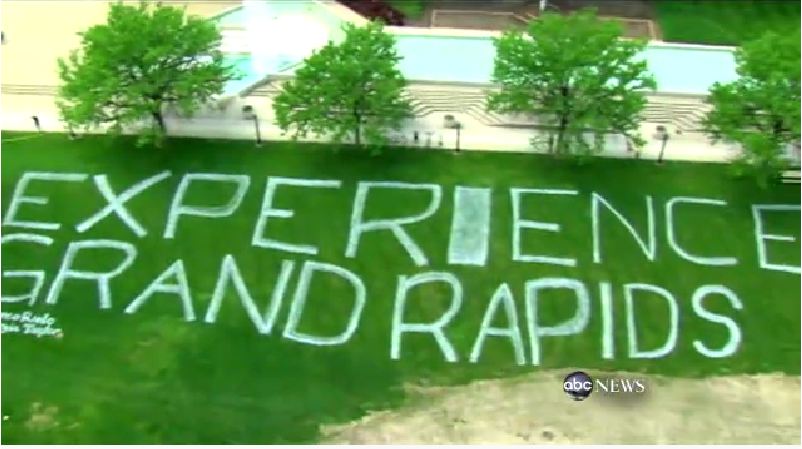
I saw a neat story on the evening news about one city’s response to being listed by Newsweek as one of America’s top ten dying cities.  The people of Grand Rapids, Michigan got together to create  a video promoting their fair city and created quite a stir with a terrific piece of film.  It’s one continuous 9 minute shot rolling through the city of Grand Rapids with over 5000 of the residents participating in different scenarios as they lipsync to a live version of  Don McLean’s American Pie.  There’s a little bit of everything here, from football players and firetrucks to fiery explosions and helicopters.  All accompanied by hundreds of guitar toting residents, all strumming along. 

This struck me first because I love continuous, uncut shots in movies.  Think of Henry Hill’s entrance into the nightclub in Martin Scorsese’s GoodFellas or the amazing scene from the Dunkirk of WW II in Atonement.  These are incredibly intricate shots requiring a vast choreography in order to preserve the continuity of the scene.  It can take months of planning for a relatively short shot.  With this in mind, the Grand Rapids film is a pretty remarkable video,  given the fact that all of its performers were amateurs who completed the whole thing in about 3 1/2 hours.

But it also hit me because I have lived in and near a small dying city for my entire life.  We, too, were once part of that band of industry heavy cities that spanned the northeast and midwest.  Cities that saw their factories close or relocate, causing huge portions of the population to flee to seemingly greener pastures.  My city’s population is about half the size it was at its peak over 50 years and there are no signs of it ever recovering that loss.  It has left a huge hole in the area that goes beyond the sheer loss of people.  There is a loss of momentum, a loss of vibrancy and a loss of confidence.  The remaining folks start picking at the things that are lacking and forget the things about their home in which they take pride.  The entire area ends up with a feeling of general malaise. 

So to see the people of Grand Rapids exhibit their pride in their own battered hometown was a wonderful thing to see.  I think there’s lesson here somewhere.  Maybe it’s that making lemonade when all you have are lemons thing.  Sounds simple but we all too often forget to try to make the best of what we have, instead lamenting what we don’t have.  So kudos to you, Grand Rapids.  Your lemonade is tasty!


Read Full Post »

I just love this photo.  It’s a classic from around 1920 from the great Lewis Hine, the photographer who is best known for his photos of children at work in the mines, factories and fields of  early 20th century America, images which aided in the crusade for child labor laws.  Hard to believe but nationwide child labor laws weren’t fully enacted as law until 1938, about 30 years after Hine started his documentation.  I will show some of those photos at another time.  They are extremely powerful and human and should be seen by those of us with short memories for our not so distant past.

But Hine also was fascinated by the interaction of the worker with the machinery in the burgeoning industrial world.  Man and machine.  His photos are very poetic, the beautiful curves of the machine encompassing the straining form of the worker. Beautiful work.

For me, I am reminded of the A&P factory where I worked for several years as a candy cook.  Our equipment was ancient, much of it built in the 20’s and 30’s with these same curves and weightiness of material.  I always felt like the building was one large machine with multiple parts and we, the workers,  were a sort of  flexible cogs that connected the various parts.  I often felt dwarfed by the sheer size and power of some of the machines but after a bit found that there was a wonderful sense of rhythm and empowerment in mastering a machine.  That’s sort of what I see in this photo.

I’m also reminded of a piece of equipment I bought a number of years ago to clear some of my property here.  It was a late 1940’s Allis Chalmers track loader, much like the one shown here.  I spent as much time working on the machine with big wrenches much like the one the worker is using in the Hine photo as I ever did clearing land.   After many headaches, I finally got rid of it after a few years.  But I did come to appreciate the weight and intrinsic beauty of those big tools and still enjoy feeling them in my hands, if only to hold them for a moment.

Here’s a neat little videoon this photo from the George Eastman House, where much of Hine’s work is held.

Read Full Post »

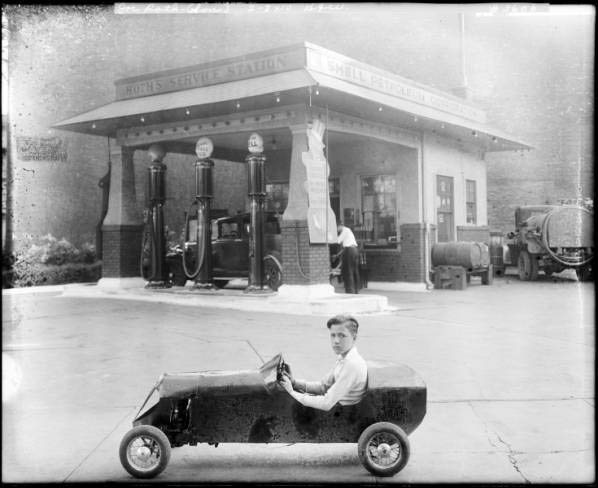
I came across this photo,  titled  Roth Service Station, Muscatine, Iowa, May 14, 1934, on a terrific site that features a great archive of photos of historical and sociological significance, These Americans. Well worth a visit.

I was immediately taken by this image.  I loved the way it came together as a composition as well as the beautifully simple yet elegant design of the service station.  It also made me think about that boy in his road racer, made me wonder if he was aware this image of his eternal youth was out there somewhere, floating in cyberspace.  He would have to be near 90 years old if he were still alive and would have a lifetime of experiences to place on that youthful face.  But here he is always 11 or 12 or whatever age he was.   There is no evidence of what might come of him except for that road racer in Iowa. 

Maybe he ended up in Detroit,  becoming one of those designers who brought us those wonderful cars in the post-war years of the 40’s and 50’s.  That is, if he survived the war.  He would have been about the right age when war broke out for us in late 1941, seven years after this photo. 

Or maybe he didn’t even live to see the war.   A tragic road racer accident?  Who knows?

A photo like this is such an enigma, filled as it is with multitudes of possibilities with only a few people, if any,  knowing the true story of that boy.  I’m hoping he lived a long and calm, uneventful life, surviving the highs and lows we are all subject to in our passage through this world.  Whatever the case, he lives on as young man in a road racer on a spring day in Iowa in 1934.  Great photo…

Read Full Post »

I’m off to talk with professor Dave Higgins’  drawing class this morning at a local coffeehouse, something I have done in the past.  It’s always a challenge speaking to students, much different than speaking to a gallery audience of people who somewhat know your work.  There’s a bit of a wall to knock down with some of the students and sometimes its not an easy thing to accomplish.  All I can hope is that I come out with at least one or two thoughts that might prove useful to some of these kids somewhere down the line, some little tidbit that they might hold on to for more than five minutes.

I will probably talk about the focus and choice I mentioned in a post last week.  Making a choice and giving a fully invested effort is essential, be it in art or some other field.  But it’s also important to recognize that this choice can be an evolving, changing thing.  Where they headed for may not be their final destination.  But if they make that first conscious decision to head in a single direction they will at least be on some sort of path forward, one of their own choice.

We’ll see.

Anyway, here’s a little musical interlude for this lovely Thursday morning.  It’s a video that mixes two of my favorite things, the singing of Neko Case and beautiful old film and photos of the last century.  I find myself always moved by this kind of imagery, as though it is exposing our commonality as a people, our interconnectedness with one another.  Whatever the case, it’s a beautiful song that meshes very well with the video here.  Enjoy.

Read Full Post »

« Newer Posts - Older Posts »