Feeds:
Posts
Comments

Archive for the ‘Favorite Things’ Category

I came into the studio this morning and immediately sat down to read my emails.  Among them was the most recent post from American Folk Art@ Cooperstown titled Ralph’s Take On Rembrandt.  It concerned the late and great American folk artist Ralph Fasanella and his reaction to criticism and unsolicited advice.  I finished reading and burst out laughing.  Boy, did it hit close to home!

Over the years, I have been approached by several people who think they are doing me a great service by telling me that I should change the way I paint in some way or that I should try to paint more like some other artist.  Early on, when I was first exhibiting my work, I had another more established artist tell me that I should change the way I paint my figures, that they should look the way other artists paint them.  I responded to this artist and the others who offered me their advice with a smile and an “I’ll look into that.”  But  that one time,  I also mistakenly heeded the older painter’s words, being inexperienced and seeking a way as I was, and stopped painting figures for a while before realizing that this was not good advice at all. 

Here’s the post about Fasanella and his response to such advice. 

Ralph Fasanella had trouble painting hands. A lot of trained artists do too, so it is not surprising that a union organizer who turned to drawing suddenly at the age of 40 would struggle with hands early in his career. But he did have something that proved better than years of formal training: he believed that he was an artist and that what he was doing – painting the lives of working people – was a calling that deserved his complete attention and all-consuming passion.

And that made him react when anyone suggested that his paintings weren’t up to snuff. He said that he was painting “felt space,” not real space. His people and the urban settings he placed them in were not realistic in the purest sense of the word, but they sang with spirit and emotion. As Ralph said, “I may paint flat, but I don’t think flat.”

Rembrandt Hands

His most memorable quote, and the one that says the most about him, occurred very early in his artistic career, when someone told him that his hands looked like sticks. He ought to study Rembrandt’s hands, they said, in order to get it right.

His response is priceless: “Fuck you and Rembrandt! My name is Ralph!”

I may not really adopt Ralph’s approach but you can bet his words will be echoing in my head the next time someone says “You should paint like…”

Read Full Post »

I Love Lucy

Today would have been comedienne Lucille Ball’s 100th birthday.  It’s said that she can be seen on television somewhere around the world any moment of the day, most likely in her classic series I Love Lucy.

Growing up in the 60’s, it was not a personal favorite of mine.  It seemed very old compared to the sitcoms of the day with its very 1950’s settings , hairdos and clothing.  The credits seemed dark and the theme music didn’t have the goofy jingle quality of the 1960’s sitcoms that I watched at the time.   But that was the perception of a child.  Over the years these ideas have faded away and the show  began to shine for me as the classic it always has been.

I Love Lucy became the template that most sitcoms tried to emulate and most ended being mere shadows of Lucy.  The show had everything– a deep and talented cast, great writers, and great production values.

And Lucy.

The more I watch this show, the more I appreciate the immense talents  of Lucille Ball.  Her comedic timing is perfect and her naturalness on camera pulls you in.  In lesser hands, her title character could have appeared irritating and might have turned off her audience but Lucille Ball made them love her flaws and identify with the way she often found herself  finding improbable trouble.

Her physical comedy was remarkable.  She was trained as a dancer and you could see it most shows as she moved gracefully through the sets and danced with husband Ricky.  But when she danced for comedic effect, it was pure brilliance and a testimony to her  to her talents as a dancer.  I still outright laugh at some of the dancing  bits even though I’ve seen them over and over. 

I often think of her when I head out to Erie, PA and pass through the area where she was born and raised around Jamestown in western New York.  It’s an area that is surrounded by a rural emptiness that most people don’t associate with New York and I can imagine how a young and talented girl in the Roaring 20’s might have dreamed of escaping to the bright lights of NYC or Hollywood.  Well, she did but she did return and is buried in Jamestown, not far from the museum there that honors her and Desi Arnaz.

Anyway, here’s to Lucy on her 100th.  May your show forever run.

Here’s her theme song with lyrics sung by Ricky in a n episode.  The actual theme music was an instrumental piece but the lyrics capture the memory of the show well.

Read Full Post »

The Giving Tree

Yesterday I received a copy of the classic children’s book The Giving Tree written by the great Shel Silverstein.  It was sent by a friend who had been at the recent gallery talk at the West End Gallery.  I had been asked during the talk if I had ever read the short tale and I said that while I had heard of it, I had never chanced across it .    I was moved when I found it in my mailbox and even more so after reading the simple story of a  boy and a tree and the loving sacrifices made by the tree.

It’s a lovely story and will have a spot of honor on my studio bookshelf.

I used a Shel Silverstein poem, Smart, a couple of years ago on a Father’s Day post and knew of some of his other books and his song A Boy Named Sue that was a favorite of mine growing up.  But I never knew that he wrote so many other well known songs.  For example, I didn’t know that he had written The Unicorn that is the signature song of the Irish Rovers  or The Cover of the Rolling Stone which became an instant classic for Dr. Hook.  He also wrote a couple of lesser known favorites of mine– 25 Minutes To Go for Johnny Cash and Tequila Sheila for Bobby Bare.  A great talent. 

Silverstein died in 1999.  If you’ haven’t read this lovely story, here’s a short film of Shel Silverstein from 1973 reading The Giving Tree with his animated illustrations.

Read Full Post »

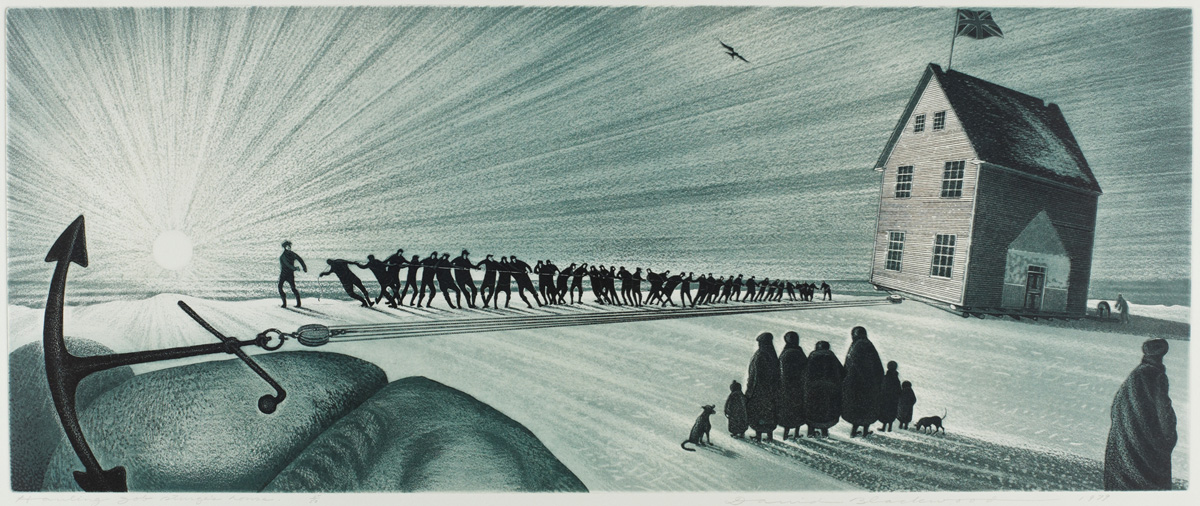
With all the heat lately, I’ve been seeking at least an imagined respite by looking at the work of Canadian printmaker David Blackwood, whose work I highlighted here a couple of years back.  Set in the Canadian North Atlantic provinces of Labrador and Newfoundland,  Blackwood weaves a black and white (sometimes with a bit of color) tapestry that is filled with the myth and mysticism of people who somehow survive in a cold and harsh landscape.  If you know of the book or movie  The Shipping News from Annie Proulx, you’ll be somewhat familiar with some of the tales that shaped Blackwood’s world.

I am always engrossed by both the sheer beauty of his images as well as this world he seeks to both document and create.  The stories have their own narrative but there is a quality to them that seems beyond the local flavor of it, as though they are telling some primal tales that are part of our collective memory, pieces of a whole that we don’t even realize we are part of or that even exists.  Maybe the stark desolation of this world makes this struggle for survival seem more evident, more contrasting.  Whatever the case, I find them beautiful to see and stimulating to the mind.  And they never look like 100 degrees in the shade.

Read Full Post »

The Returning

I went to the Kada Gallery yesterday to drop off some new work and to also retrieve some pieces that had been with them for a while, unsold.  It’s just part of this and almost every business, this  exchanging of new product  for older.  Of course, most artists try to dissassociate themselves from the concept of their work as a product but in the long run that is what it amounts to, in the business sense.  I know my work is a product when I deal with galleries as far as inventory andsales and such but also try to keep an equal footing with them in maintaining the artistic merits of my work.  It can be a fine line.

When I first started in this business, I viewed the return of work to me from a gallery as a failure of sorts.  My work had failed to spark the interest of any potential collector so there must be something amiss in the work was how I viewed it.  I mistakenly attached a shelf life to the work early on as a result.  But time passed and I soon realized that each locale had different tastes and preferences and that each gallery had their own way of presenting the work which affected how the different paintings were viewed.   After a time, I realized that the work was soon gone away to the homes of collectors, often after having been at one or more galleries previously.  It wasn’t a failure of the work when work was returned, it was simply not the time or place for those pieces that found their way back to me.  In almost every case, they found homes somewhere.

The sense of failure I experienced early on when work was returned also made me question the validity of my work.  I’ve often said that when you’re first showing your work, you want to sell every piece because every sale is a form of validation, a bolstering of your confidence in your own work.  So when work didn’t sell, it made me wuestion the value of the work.  But over time,  I recognized the error in thinking this way and actually began to hope that certain paintings didn’t sell, that I could somehow hold onto them a bit longer, as if holding onto a piece of myself that I had let go too soon.

So yesterday, when I picked up several paintings, including the one above,  I wasn’t disappointed.  Instead I was almost excited to see these paintings, to have them in my hands again.  Even now, as I glance over them scattered around the studio, I get a great sense of pleasure and fullness of self in having them there even though I know that eventually most will be gone.  Some I take great pride in and some have some sort of  personal bond.  But all feel like parts of me and, for the moment, it’s good to have these parts of myself back.

Read Full Post »

I ahve a feeling that most Americans don’t know much about the English artist Stanley Spencer, who lived from 1891 until 1959.  I have to admit that I knew very little until stumbling across a book of his unique paintings.  However, our ignorance doesn’t detract from the man’s greatness or his fame as one of the greatest British painters.  Some maintain that he is their greatest Modern painter.

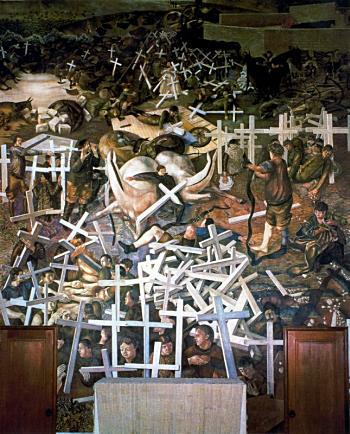
His work is unique and always interesting, with densely colored and arranged scenes that sometimes seem overwhelming to take in at one viewing.  The piece shown here at the top, The Resurrection of the Soldiers, is one such painting.  It depicts the World War I soldiers that Spencer saw as a medic and soldier undergoing a rebirth on the battlefield.  It serves as the altarpiece( you can see the altar and podiums in the foreground of this photo) in a chapel, the Sandham Memorial Chapel,  that was designed to specifically hold his war paintings.  Iam totally pulled in by the the intricacy and contrasting tones of the composition, taking in at as a whole without even being able to discern what the subject might be.  Moving in closer, it becomes even more compelling.

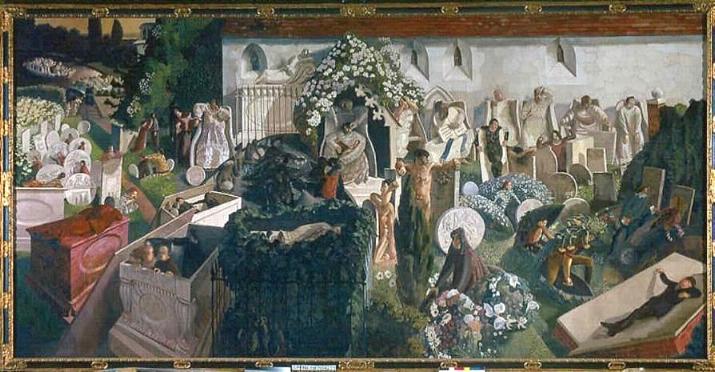
The idea of resurrection and other biblicaland Christian themes were sometimes the subject of Spencer’s paintings, in which he would transform the subjects of biblical stories into characters residing in his beloved Cookham, a small village in Berkshire. One example is his depiction of St. Francis, shown here to the left. Perhaps his best known work and one that  many consider one of the greatest British paintings ever is his painting of the resurrection of Cookham, shown at the bottom of this page. 

 I realize that the size of these photos doesn’t do justice to these paintings.  I had put off showing his work on the blog for this reason  but hopefully it will serve as an entrypoint to those who might want to investigate further his paintings or his interesting life which served as the basis for the play Stanley, a Tony nominee in 1997.  But even without the biographical material I’m sure you’ll find something in his work that stops you in some way.  I know it always stops me in my tracks.

Read Full Post »

Well, the opening is over and the show continues to hang at the West End Gallery.  Good opening.  Talked to a lot of really nice people, many new to me.  Many thanks to everyone who came out.   You made the evening complete and  I could not be more grateful.

That said, I was sure glad when the night was over.  There comes a point near the end of an opening, especially in the aftermath of constantly promoting it by writing about it here,  where I am really tired of talking about me and can’t wait for that moment until I don’t have to say anything to anyone. 

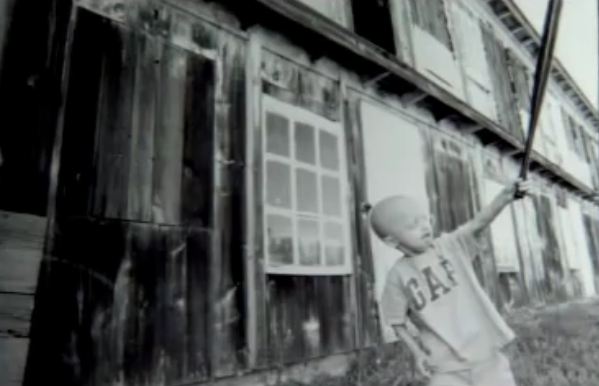
So later that night, we came home and decided to quietly watch that night’s Jeopardy,  a show I have watched intently since I was a child when Art Fleming was the host in the 60’s. Before it came on, I caught the end of the ABC Evening News and there was a story about their Person of the Week.  It was a young boy, Josiah Viera, from central Pennyslvania who suffers from Progeria, an exremely rare (something like only 54 cases in the world) disorder where the child begins prematurely aging, most having life expectancies of between 8 and 13 years.  Josiah, now 7 years old, has the tiny body of a 70 year old.  He is 27 inches tall and weighs 15 pounds.

But Josiah doesn’t dwell on the hardships of his condition.  Instead he concentrates on his passion, that thing that brings him sheer joy: baseball.  He lives for the game, wanting to play it from the minute he wakes until the end of each day.  He approached a coach at the local t-ball league in Hegins, PA and told him that he wanted to play in the games.  They feared he might not survive more than a single game and indeed, after his first game, Josiah suffered a series of mini strokes and was hospitalized.  But he recovered quickly and his desire for the game was so strong that he was back after three weeks.  The news of this little boy and the joy with which he played the game captured the hearts of the local folks and by the last game there were several hundred fans ( not your usual t-ball crowd!) all cheering him on and chanting his name.  And as he stands on the bag at first base, which seems like a table under his small body, Josiah smile glows with the sheer and absolute joy of being safe.

Absolute joy.  How many of us allow ourselves to feel that?  Josiah’s time here is limited, as it is for all of us.  Yet his life is not sadder for that knowledge.  Instead he has somehow chosen to find joy in those few days, rejoicing in the moment instead of fearing the future or focusing on the  life that might have been under different circumstances, things which too many of us allow to take over our lives.

Life is now.  His pure joy is a lesson for us all.  Life’s too short to not revel in those things that make us happy. 

What is your joy and if it’s not the biggest part of your life, why is that so? 

Here’s the longer version of the story from ESPN on which the ABC story is based.  It’s a beautifully done report.  Have a great Sunday and again, thank you for everyone who came out Friday night– you brought me a little of that joy that I speak of.

Read Full Post »

I was attracted to the numbers of baseball when I was a kid.  Those magical statistics that defined the performance of my favorite players, numbers that made the case that my favorite  was better than your favorite or at least gave me a hint as to how my favorite stood up against the numbers of the legends.  For instance, Ty Cobb’s .367 batting average and Babe Ruth’s 714 homers has been deeply ingrained in my memory for well over forty years, a span in which I’ve forgotten many other numbers that were more significant in my life.  So when when Derek Jeter reached the magical 3000 career hit plateau yesterday, I paid attention.

3000 hits is a venerable number to baseball fans.  In the 130 or so years of major league baseball only 28 players have ever reached this milestone number.  28 out of the countless thousands who have strode to the plate, bat in hand,  with hopes of one day reaching that exalted number.  It is a number that denotes excellence and durability, both traits that Jeter possesses.

Another trait for Jeter is his flair for showing himself in the biggest moments, as the many accolades he has received will attest.  Many other players have struggled with the pressure of reaching this and other milestones and have went into slumps, making the tension on themself unbearable as the games pass.  But Jeter would have none of that.  Needing two hits to reach 3000, he flew by the number with a legendary performance going 5 for 5 (that’s 5 hits in five at-bats or chances  for non-baseball fans) including a long homerun for his 3000th hit, a feat only accomplished by only one other player. 

But for all the numbers he has amassed, for all the World Series titles and records he possesses, one has to watch Jeter on a day-byday basis to get the full impact of what a great player he is. and what he has meant to the game.  I know for myself, he brought me back to the game after many years of having lost that spark for the game.  I was never a Yankee fan and often considered myself a Yankee-hater as I grew up.  Oh, I liked certain players, Mickey Mantle for example,  and revered their legends such as Ruth and Gehrig ( I remember with great clarity as 9-year old staring at Ruth’s glove in the Hall of Fame at Cooperstown as though it were the Holy Grail) but the team itself rubbed me the wrong way.  I loved the underdog and they were never the underdog at that time.  I just couldn’t like such a team.

But that changed with Jeter’s rise to stardom.  He ran out every ball, did small subtle things that often changed the course of games.  He did some things very well and on those things that he didn’t  do well, he worked hard to make himself better.  As a young player, his fielding was somewhat suspect but as the years have went on his fielding has gotten better and better and now, even though his range is somewhat diminished, he is one of the most surehanded shortstops in the game.  Watching him on a daily basis, I was hooked on the game once more by something more than his numbers.

Yes, for Jeter you must judge him by more than numbers, even though he has an excess of golden stats.  For me, it was his ability to put aside failure, to not dwell on the last at-bat or error.  You never see panic in his game.  You never see him play with anger.  Oh, it might be there but his game face will never betray it.  It was this attitude of total effort that won me over.  I have never seen him take a game lightly or give a half-hearted effort and that is saying a lot in a game that stretched through three seasons of the year. He has taken a talent that could esily be squandered in the hands of a less disciplined player and transformed it into a Hall of Fame career through his hard work and attitude.

So, congratulations to Derek Jeter.  And thanks, for bringing a game that I loved back to me and for turning a Yankee-hater into a fan.


Read Full Post »

I grew up reading the humor of Jean Shepherd, the man behind the movie, A Christmas Story, now a holiday staple around Christmas.  I remember seeing his books in the library when I was just a teen and being pulled in by the titles, like Wanda Hickey’s Night of Golden Memories and In God We Trust, All Others Pay Cash

Many of Shepherd’s stories about growing up in a small midwestern city were put together for a film in the early 1980’s.  Called The Great American Fourth of July (and Other Disasters), it was shown on PBS and starred Matt Dillon as Shepeherd’s alter ego, Ralphie.  If you’ve seen A Christmas Story the characters will be very familiar.  It opens with Shepherd driving down I-95 approaching that iconic tourist trap, South of the Border in South Carolina, as an introduction to his 4th of July saga.  Anyone who has ever made the trip north or south on 95 has witnessed the seemingly neverending barrage of billboards for Pedro’s paradise.

All in all, it was a very funny film and a great view of Americana but unfortunately is not on DVD and is seldom seen.  You can see it on Youtube in six 10 minute clips.  It’s not the greatest way to see something but if you enjoy the humor of Jean Shepherd it’s worth the effort.  Here’s the first part:

Read Full Post »

Another Tour

Well, it’s the first weekend in July which means  we’ll be eating breakfast with the Tour de France, which kicks off this morning,  in our house for the next few weeks.  My wife is a huge fan of the fabled bike race and avidly keeps up with the standings, although I suspect it is the stunning scenery of some of the climbs in the Alps and Pyrenees that are the real attraction. 

It’s going to be a different Tour this year.  Lance Armstrong has retired and is under constant attack for purported use of performance enhancing drugs (PEDs).  Three time champion Alberto Contador is under close scrutiny following a positive result for PEDs in last year’s tour, one that he blamed on steroids in Spanish steaks.  He was booed loudly at the team introductions and has taken over as the most reviled rider in the Tour.  Andy Schleck seems poised to finally win the Tour.  He came in second in last year’s Tour, his margin of defeat exactly matching the time he lost in an incident where his chain came off on a climb– 39  seconds.

As far as I know, Schleck has no PEDs rumors hovering around him. 

I believe that PEDs have been part of the Tour for many years now.  I don’t doubt that Lance Armstrong used them just as I don’t doubt that every team competing has at least two or three riders, most likely their best, who are doing exactly the same thing.  It is a very competitive sport with pretty high stakes for those who race near the front and that usually means that whatever it takes to be first when they cross the finish line will be done, even if it skirts the rules.  This is a race over 19 days that stretches for around 2000 miles, over peaks that are ridiculously steep and  high, in heat that is often extreme with the top riders often finisihing mere seconds apart.  You would be naive to think that riders aren’t trying to achieve some sort of edge over their competitors. 

I tend to believe they all are.  This way I can simply watch the race and enjoy that gorgeous scenery and the struggles of my favorite riders.  Go, Andy!

Read Full Post »

« Newer Posts - Older Posts »