Feeds:
Posts
Comments

Archive for the ‘Favorite Things’ Category

Sustenance-- GC Myers

Maybe it’s the gray paintings that I’ve been working on lately.  Or maybe it’s just the unseasonably cool morning with the temperatures in the mid-40’s.  Or maybe it’s a somewhat contrarian nature.  Whatever the case, I find myself this morning longing for cold weather and gray skies and flecks of snow gathering on the grass that has lost much of its green.  The feel of a sharp wind  on the cheek like a reviving slap.  The harsh bones of the leafless trees in silhouette against the slate sky.  The absolute quiet of the forest, save the creak of the trees swaying in the cold breeze.

I know that for many this sounds absurd.  Most want to bask in the summer heat.  Most want to feel the adolescent charm of days spent shoeless under a relentless sun. 

 Easy days.

Not so for winter.  Maybe that’s what I like.  Winter gives you nothing.  No warmth. No sustenance. No cover.  What you take from winter is a hard fought victory and that makes it all the sweeter.  Anyone can  feel the carefree lure of summer.  But winter drives off those unwilling to endure its own special charms. 

Cold, refreshing charms…

Here’s a wonderful version of  the Winter section from Vivaldi’s Four Seasons by violinist Gil Shaham to get you into the winter mood…

Read Full Post »

Paper Doll

I often feature some of my favorite music in this blog, which covers a pretty wide range of artists.  I just realized I hadn’t paid homage to one of my longtime favorites, the Mills Brothers.  A vocal quartet comprised of four brothers from Ohio, the Mills Brothers performed together for nearly 60 years from the 1920’s through the 1980’s. 

I love these guys .  I know it’s an older and seemingly dated sound but I have never heard anything from them that wasn’t an absolutely gorgeous sound.  Their voices have a richness that you seldom hear and they mesh together so effortlessly that it allows the listener to sink into the music like a soft mattress. 

 Or to put it in visual terms, their sound has the richness and depth of the colors in the most vivid stained glass windows, the deep reds and blues that glow as though lit from inside.  I don’t know if anybody knows what I trying to say with this analogy.   All I’m trying to say is that they made beautiful music with an ease and a quality that you seldom see today.  If you could sing like this, why would you want to sing in amy other way?

Here’s one of my favorites from them, Paper Doll

And here’s a 1938 recording of several songs.  I mainly wanted to have you hear the first, an English version of the Italian classic Funiculi Funicula, where their voices fill all the parts of the song including horns and strings.  Great stuff…

Read Full Post »

John Isner in the 5th Set

When I was doing research on my grandfather’s career as a professional wrestler in the earliest days of the sport, back in the first decade of the 1900’s, I came across a newspaper account of  one of his earliest matches.  It was held at the Kanaweola Club in Elmira which was one of the men’s sporting clubs of that era, a place where men gathered to to participate and watch sports.  Since there wasn’t ESPN, or television, or even radio, they often held live sporting events such as pro and amateur boxing and wrestling.  Oh, and they also would drink  a bit at the clubs.

In one of his headline matches at such a place, Shank, my grandfather’s wrestling moniker, started a match one evening at 9 PM and wrestled until midnight without either wrestler gaining a fall, which means neither was able to pin his opponent or get him to submit.  They stopped at midnight and resumed the following night, wrestling for another two and a half hours before Shank was finally pinned.  I wanted to lie there and say that Shank had gloriously persevered but I just couldn’t do it.  I was proud enough that he just competed in such a marathon and I think he might have been proud of the feat despite the loss.

I don’t know if the two competitors in the current marathon competition still in action on the tennis courts at Wimbledon, John Isner and Nicolas Mahut,  are ready to say they’re proud just to be involved in such a match.  To say so would be a psychological concession of sorts and they both aren’t ready to give in just yet.   They started this match Tuesday and played until dark.  The match resumed yesterday afternoon and stretched until they could barely see the balls.  Or stand.  Ten hours in all.  The fifth set, still unfinished, stands in at a time of 7 hours and 6 minutes, making it alone longer than the longest match ever.  The third day of this grinder takes palce this morning and I might have to watch.

At this point, the competition between these two men has transcended physical triumph of one over the other and moved into the realm of conquering their own psyches, convincing themselves that they can persevere.  Steeling themselves against the desire to just give in and let it be done.

It’s a remarkable thing to witness, this stalemate of wills between two equally matched competitors.  It’s liking stealing a raw glimpse of our desire to survive, our desire to overcome struggles of life and death.  To be wounded, hurt, but still rise to our feet and return to the fray.  Only in a safer way.  This is tennis, after all.

Good on both of you today, Mr. Isner and Mr. Mahut.  Don’t give up now.

Read Full Post »

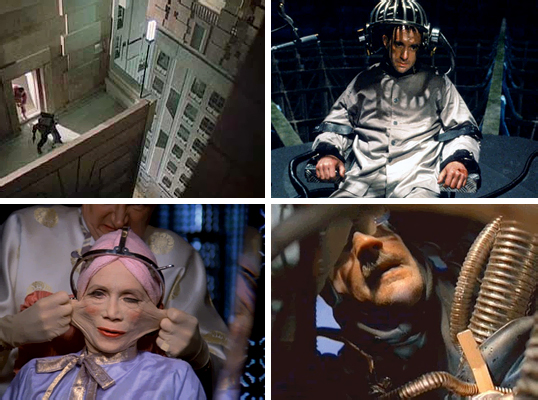
Images from Terry Gilliam's "Brazil"

It’s about 6:30 in the morning and I’m sitting here, stumped and looking at a blank screen.  Nothing to say so I flip on the television.  Don’t really want to watch the news.  Not ready for that just yet.

So I flip around the dial and up comes the opening from the movie Brazil with the music from the old song of the same name blaring, but in a gentle way.  It’s a sort of  1984 storyline that is set in a futuristic nightmare world that vaguely  resembles 1950’s England, only with some slight twists and bends.   I know I can’t watch it and get anything done but keep it on because I know that at any moment I can look up at it and see incredibly interesting imagery.

It’s a Terry Gilliam film after all.

Terry Gilliam was the American member of Monty Python’s Flying Circus, the least visible member but the one responsible for much of their visual look including their trademark opening credits and most of their animations.  In his post-Python life he has become one of the most original film-makers in the world, creating films that are wildly original and always richly visual.  Films like Time Bandits, The Adventures of Baron Munchausen, Jabberwocky, Twelve Monkeys, The Fisher King and  most recently, The Imaginarium of Doctor Parnassus.  All films that march to their own drum and have had degrees of success but hardly movies that have had widespread appeal for the general movie-going public.

I can imagine when film critics in the future, if there are such things then, will look back on Gilliam’s body of work and will recognize him for the creative genius he is for creating richly detailed alternate visions of this world in his films,  with stories that are consistently strong and beautifully conceived, that often deal with the individual trying to make his way through a world in which he is usually out of place in some way.  A theme I think we can all identify with in our own way.   I think that is how his work will be remembered, as highly individualistic visual feasts. 

Each film is definitely recognizable as his work.

So, as I struggle tofinish this post and get back to my own work, Brazil still rolls across the TV screen in my studio and I know I won’t get much done until it’s over.  Thanks, Terry…

Read Full Post »

I’m not going to go all sentimental about my dad on this Father’s Day.  It’s not either of our styles.

But I did want to show this picture of him from back in 1963 or 1964.  That’s my brother, Charlie ( Chuckie back then), in the background.  When I think of images of my father this one is always first in line in my head.  It was a Sunday morning ( my memory says it was an Easter but I can’t be sure) and we were living in an old farmhouse on Wilawanna Road, outside Elmira, that played a very large part in my formative years.  We had a large chunk of yard to one side of the house that became a ballfield, a place where many of the kids on our road came to play baseball regularly and where Dad would often pitch to us or hit soaring fungoes that we would run under, pretending to be Willie Mays or Mickey Mantle.  Dad is standing near home plate in this photo.

I love this photo.  It show my father at about 30 or so years of age, as strong and powerful as I would ever know him.  I was four or five years old and he was larger than life to me then, could do no wrong.  My protector and my boon companion.  This view of him sums that all up.

  The pose has a bit of the pride and arrogance of youth in it, still brimming with the what-if’s and what-can-be’s of potential.  It’s not something you’re used to seeing in your parents and witnessing it is like seeing a secret glimpse of them, a side you know must have been there but remains hidden from you in your day to day life with your parents.  Maybe that’s why I like this picture so much.  It seems like a marking point between his youth and ours, his kids. 

I don’t know.  Like many personal things, it’s hard to explain.  All I know is that when I see my Dad today or think about him, the image of this photo is never far from my mind.

happy father’s day….

Read Full Post »

Diego Rivera's Mural at the City College of San Francisco

There are pieces, paintings, out there that I would love to see in person and then there are some I would rather see from a distance, if only to avoid feeling utterly humbled in my own small talent by their beauty and grandeur.  The great Mexican muralist and painter Diego Rivera created such a work.

It is his Pan American Unity mural that resides at the Diego Rivera Theatre at the City College of San Francisco.  Painted in 1939/40, it is a massive true fresco that measures about 22 feet tall by 73 feet long.  Because of time overruns in the painting of such an epic piece, much of  it was painted as a public display during the Pacific Exposition of 1940.  Actually, after its completion it was packed away for over twenty years, unseen, as World War II intervened then the Cold War.  There was some controversy in the 1950’s over Rivera’s dalliance through the earlier parts of the century with the Communist Party in Mexico and and at that point, anything red was dead in the eyes of those in authority.  So, a masterpiece sat and sat like a dormant volcano, waiting to burst into open air once more.  It finally did in 1961, four years after Rivera’s death.  There is a piece of silent color film from the exposition that shows Rivera at work as well as his assistants at various tasks.  You can see it by clicking here.

I have seen other Rivera works and never fail to feel humbled by his great talent as well as his larger than life persona.  The Pan American Unity mural seems to sum up Rivera in one giant sweep, a piece so dense with imagery that one could spend months examining it and still find new details of beauty and color.  It is bold and big, like the man.  Epic.

My ego hopes I never see it…

Read Full Post »

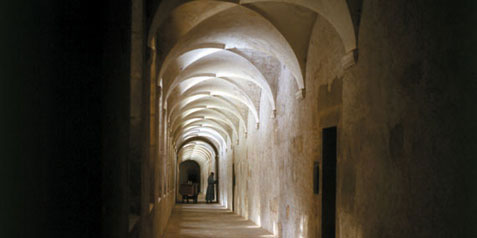
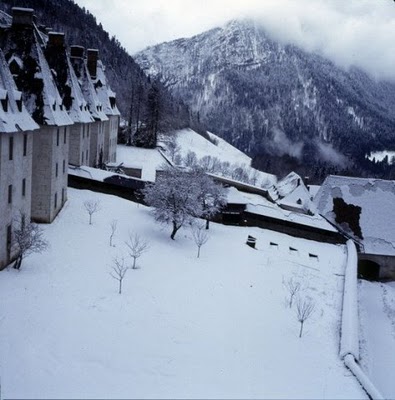
There is a film that was made a few years back by Phillip Groning called Into Great Silence.  It is a documentary that was filmed over a year at the Grand Chartreuse Monastery in an awe-inspiring setting in the French Alps, home to the Carthusian Order which dates back to the year 1084 and remains fairly unchanged from that time to the present.   It is an order that maintains silence at all times in the monastery.

I came across this a few nights back as I scanned the channels and only caught a short bit of it near its end.   It is a film that is silent but for the sounds of the monks movements that echo in the ancient spaces of the monastery.   The sound of footfalls down a long stoned hallway.  The sound of the monastery bell.  The sound of their Gregorian chants from the sanctuary. The filming is in natural light so there is a quality to all the scenes, combined with the surroundings, that gives the film the feel of a medieval painting– dark and quiet.  It moves beautifully with a spellbinding quality and a rhythmic quietness  that seems the antithesis of  most  modern films.  No car crashes here. 

 No cars.

There is one segment where the camera follows a group of monks as they head out into the snow outside the monastery in their flowing robes.  It is shot from a distance so you can’t hear anything specific but you suddenly realize they are chatting away, almost excitedly, once they leave the boundaries of the monastery.  They come to a smaller hill set among the higher, sharp peaks of the Alps.  You sit watching and wondering what they might be doing as the scene unfolds, the camera set several hundred feet back so the monks are small in the frame.  And with a faint laugh that carries across the distance, they are sliding down the hill as though their feet were  snowboards.  They would whoosh for a bit then often tumble through the snow to the accompaniment of guffaws that seem startling in the context of the rest of the  film.  It is a moment of pure but simple joy and gives the monks a more human quality, lets the viewer identify with them and see them not only as dedicated men of  their faith.

This film and its imagery have haunted me since I saw the small part of it that I did that night.  I have always claimed to be seeking Big Silence and these men seem to have found it.  And it appears just as I hoped it might.

Do I want to be a monk?

No.  I don’t have the faith or belief that must be required.  Not even sure I could live with so many others, even without words. 

 But that silence.  There is something there in the void of words, something that speaks volumes, that gives us a peek into the chasm of time that we all seek and fear.  And not too many of us are willing to take that leap into great silence… 

Here’s the US trailer for the film-

Read Full Post »

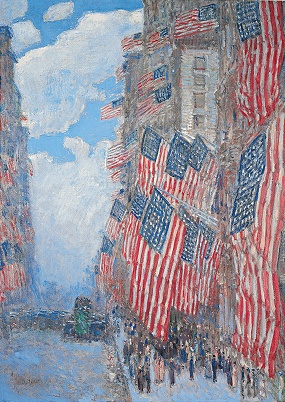
Childe Hassam-The Forth of July, 1916

Today, June 14th, is Flag Day, a semi-holiday without a lot of fanfar ethese days that came about in 1916 when Woodrow Wilson proclaimed it as a day to celebrate the day of the origin of our flag in 1777 as we, as a country, were on the brink of entering the war in Europe.  The flag has always been a strong iconic image in art, used by a number of artists to make a statement of sorts.  Perhaps the best known of these are the flag paintings of Jasper Johns, one of which has sold at auction for over 28 million dollars.

However, when I think of paintings of flags I always think of the work of Childe Hassam.  He started this series of paintings in 1916 as the buildup to our entry in World War I was reaching a crescendo.  In many cities around the country there were Preparedness Parades that displayed  the general population’s escalating enthusiasm for entering the fray.  The most famous of these was in San Francisco where, at one such parade in July of that year,  a bomb was exploded by radicals of the time that killed 10 bystanders and injured many more.  However, Hassam was in NYC and the displays on the avenues of multitudes of flags among the canyons of the growing city inspired him to produce a number of powerful paintings, not bombs.

I think these paintings say a lot about America, especially at that time.  The cityscape shows an expansion of urban growth brought on by the influx of an immigrant population and a prospering, industrialized economy.  The flags represent a unifying bond that ties together all these diverse groups, a simple symbol that speaks easily to the wants and desires of the population.  Their dream of America.  Perhaps it also covered up many of the injustices and inequalities rampant then.  And now.

But I tend to think of it in the better light, as a call to our better nature and to a society of choice and opportunity.  An image of possibility and hope.   And Hassam’s paintings do that for me in a beautiful, graceful manner.  The flag in its best light…

Read Full Post »

Keynote-- GC Myers 2010

Well, this year’s opening for my show at the Principle Gallery is over and it actually went very well.  Great crowd with many familiar faces and many new ones as well.   It was a lovely evening and I left feeling that it was, by all accounts, a very successful show.

Two of the new faces I saw at the show belonged to the charming twin daugthters of Erin and Noah Ristau.  Ever and Grey are 7 or so months old  and came out to their first opening with their parents who made this a pitstop as they moved their home from Richmond to Ohio for a new position for dad Noah.  The lovely girls seemed pretty at home and I was honored to meet them for the first time.  I’m sure they and their parents will prosper in Ohio.

Actually, Grey and Ever were not the only children at the show.  There was Henry, fresh (and tired) from a swimming lesson, accompanied by his parents, Stephanie and Tom.  I first met Henry at a gallery talk there when he was just under a year old.  He sat placidly through the whole time of the talk, taking in the paintings and never fussing once.  I always think of  him as the calmest child I know but I’m sure his parents beg to differ.

Then there was the shy Lexy who hid behind her mom, who asked if I had advice for her aspiring artist  daughter.  Lexy likes to draw.  The best I could tell her was to be bold, make strong marks on the paper.  Show people who you are.  And there was Kai, the young son of Leslie, who hails from my home area.  Kai is a big eyed waif  who aked if I remembered teaching him how to draw Snoopy at last year’s opening.  I told him I most certainly did then  told him about the lesson from my 5th grade art teacher who had us fill sheets of paper with little drawn objects, making  a trash heap.  This lesson had led to the Archaeology series for me and I hope Kai gets something from it as well.

I answered what seemed like an unending barrage of questions until my throat was dry and sore.  Afterwards we went with a group from the gallery and their friends (and my old friend Al)  to see the band The Reserves (who used a painting of mine for the cover of their first CD) play a set at a local club.  Dave and the other members of the band had stopped in for a while at the opening and I didn’t have an opportunity to say hello so it was good to catch up a bit.  They have a new CD that is garnering really positve reviews and they sounded great that night.  

But soon, I just ran out of steam and the night was done for me.  All in all, a good night.

I wish to thank everyone who came out to the show this year.  It is this support and interest for my work that makes it possible and I am ever appreciative.  Also, special thanks to Michele, Ali and Clint at the gallery for making this show possible and providing such a comfortable and relaxing environment for the work.  Their partnership in showing my work for these past 13 years has played a vital part in any growth I may have had as an artist and for that alone, putting aside the friendship they have always extended, I will always be indebted.

Thanks, everyone…

Read Full Post »

Setting Time Aside

As the days wind down before I head to Alexandria for Friday’s opening, I’m still pretty busy in the studio.  I’m in the midst of completing several pieces for another show later in the year as well as working on several projects unrelated to shows, including minor repairs on an older painting of mine that was damaged in a fall at its owner’s home.  Another is a request for a painting from a couple marking their 10th anniversary.

I often get requests for commissioned work but usually am not excited by the prospect of being dictated to in the creation of  my work, actually turning down many that get too specific in their requirements.  I want my paintings to reflect my thought process and emotion as well as my craft.  As a result, I have an informal set of rules that let me have free rein in the creation of the work so that the painting is allowed to form in an organic way.  Not forced, which often takes away the vitality of many pieces, in my opinion.

But this particular request is unlike many others that I receive.  They want this piece to relate the story of the classic myth of Baucis and Philemon, which is the tale of a poor but happy couple who are unknowingly visited by Zeus and Hermes disguised as dusty travelers.  Beggars, really.  The two gods had went door to door among their neighbors seeking hospitality and were rebuffed in every attempt, often with harsh words.  Zeus became angry as door after door was slammed in his face.  Finally, they came to the door of  the shack of Baucis and Philemon, the poorest looking home they had yet approached. 

 Upon knocking, they were greeted warmly by an elderly couple  who welcomed them in to their simple but cleanhome and treated them with what little they had in the way of food and drink.  They were gracious and hospitable, seeking to give comfort to the strangers.  As the night wore on, the couple, who had been serving their simple wine to the travelers from a pitcher, noticed that the pitcher stayed full even after many pours.  They began to suspect that these were not mere beggars but were, in fact, gods.

They apologized to the gods for not having much to put before them then offered to catch their prized goose, which was really a pet, and cook it for them.  The old couple chased the goose around the shack until finally the frightened creature found sanctuary on the laps of the gods.  Stroking the now safe goose, Zeus then informed them of their identities and, after complimenting on their hospitality and of the mean-spiritedness of their neighbors,  told them to follow them.  They climbed upon a rise and Zeus told them to look back.  Where once their town had stood was nothing but water,  from a deluge that had washed away everything, including all who had insulted Zeus.  From where their poor home had been, a majestic golden-roofed  temple with sparkling marble pillars rose from the receding waters.

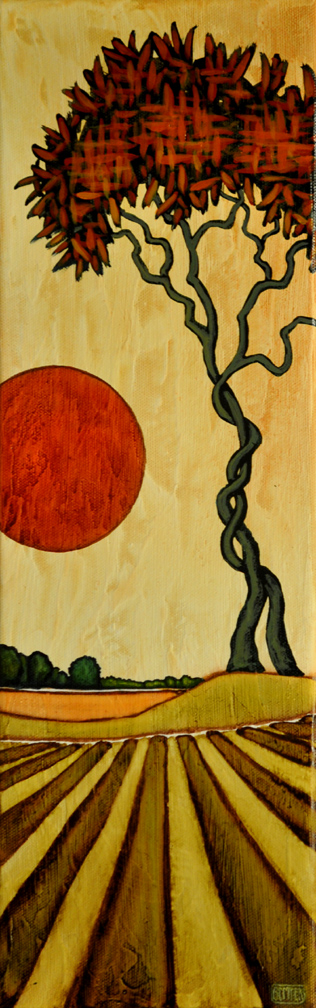
Zeus told the couple that this was their new home and asked what wish he could grant them.  They asked that they be made priests, guardians of this temple and that they should always remain together until the ends of their lives.  Seeing their obvious love for each other, Zeus readily agreed.  The couple lived for many more years together, reaching a prodigious age.  One day they stood together and all the past moments from their life and love together flooded over them.  Baucis saw leaves and limbs sprouting from Philemon and realized that the same thing was happening to her. On the plain outside the temple, they transformed into two trees, an oak and a linden, that grew from the same trunk, their limbs intertwined, eternally together.

That’s a simple re-telling of the tale but I think you can see why this couple might want a symbol of this story to mark their time together…

Read Full Post »

« Newer Posts - Older Posts »