Feeds:
Posts
Comments

Archive for the ‘Favorite Things’ Category

The Crew

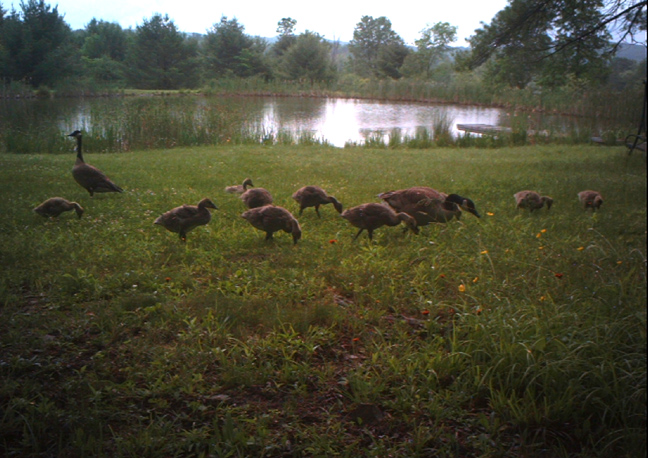
This is my new crew for this year. 

 It’s a family of Canadian Geese who’ve taken up residency in the general vicinity of our pond.  I say general vicinity because they split their time here and at a neighboring pond, waddling back and forth over the quarter of a mile or so through the woods.  It’s always a thrill to have them back here even though they pretty much monopolize the pond area and make it treacherous to walk with the prodigious amounts of waste they leave behind. 

 I’ve written before how interesting it is to watch the effort and care they take in parenting their young.  The parents are observant and protective and are always in teaching mode.  The two parents maintain separate posts to keep an eye on the young and are stern when any of them stray, quickly bringing them back to the group.  In a few weeks, after the soft down of the goslings is replaced with feathers, the teaching of how to take flight begins.  It’s one of my favorite things to observe these first tenuous take-offs with bellies skimming the water and wings flapping frantically.  It’s comically awkward but then suddenly the wings grab the air and they arc upward a bit and for a brief moment there is a sense of grace in their movement.  The excitement in the recognition of their new ability as they land that is obvious.

This year’s group initially started as the parents and 6 goslings but one day we found it had grown to 10 little guys.  The four newer ones were much smaller, obviously having been born at least a week or two earlier than the original group.  These four were probably orphaned or abandoned by parents who had been chased away away or killed by predators and had been adopted by this set of parents.  Apparently, this is quite common among geese.  From what we can observe, there is no difference in how the parents treat their own or the adopted goslings.  As they age, the size difference between the two groups of young becomes less noticeable with each passing day. 

It’s a funny thing.  I’ve created many paintings that have traveled around the world yet perhaps the greatest gratification I’ve achieved from anything I have made comes from our pond and the wildlife it sustains, such as this family.  It always fills me with a sense of hope for the larger world.

Read Full Post »

Harold Russell in “The Best Years of Our Lives”

It’s Memorial Day weekend and every year at this time, TCM shows films with  military themes as a way of honoring the holiday.  I see that tonight they’re showing The Best Years of Our Lives from 1946.  It’s a movie I have watched a number of times and am always reminded of one of its stars, Harold Russell.

Harold Russell was not an actor.  He had been an Army instructor during World War II when he lost both hands in an accident while handling explosives.  Near the war’s end, he was the focus of a film about the rehabilitation of disabled vets which is where director William Wyler first saw him and decided to cast him as Homer Parrish, a sailor who loses both hands in the war.

Though not a trained actor, Russell gives a spectacular performance as Homer.  There are many memorable scenes with Homer that linger with you long after the film ends.  One that stands out for me is one in which Homer is in the garage and his young sister and a friend are watching from outside and Homer, tired and frustrated at the stares and pointed fingers from the curious, smashes his hooks through the window at the girls.  The visual impact of the scene is brilliant.

There are many other scenes  that shine as well and they came together to bring Russell the Best Supporting Actor Oscar for the film.  He holds a unique distinction as the only actor to have two Oscars for the same performance.  You see, the Oscar board thought Russell had no chance at winning and wanted to honor his performance for bringing attention to the plight of disabled vets so they chose to honor him with a special Oscar.

The Best Years of Our Lives is a compelling film.  Sure, there are moments of sentimentality.  How could there not be?  But this is no rosy view of the world in any way.  It has a dark grim tone and shows the damage the war has inflicted on the returning vets, both physically and emotionally.  It has an honesty about the subject of the effects of war that you didn’t often see in contemporary films of the time.  The vets returned to a world that was changed from that which they remembered and they were often forced to deal with indifference and sometimes scorn from a public that soon forgot their sacrifice.   It seems to me to be the jumping off point for the dark realism of  many films from the next decade.

So, if you get a chance tonight take a look.  It’s a great film and you’ll be reminded why we honor the sacrifice of those who served.  Here’s a great scene with Harold Russell as Homer and his girlfriend, who he has felt alienated from because of his disability. He’s trying to show her what she will face in the reality of  a life with him.

Read Full Post »

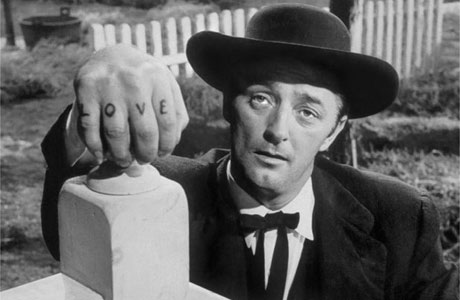
You come across some goofy stuff when you’re looking up things.  I was looking up some info on screen icon Robert Mitchum, for instance, and ran into some really interesting nuggets that surprised me.  I’ve always been a fan of Mitchum and his distinct brand of movie masculinity, the sort of which is absent in today’s cinema.  He looked like a man, not a movie star.  Moral ambiguity was not present in his screen portrayals.  The good guys he played were good guys and the bad guys bad.  Really bad. 

He was the first Max Cady, the evil ex-con intent on destroying his prosecutor ,  in Cape Fear and brought new meaning to the word menace without the embellishments that Robert DeNiro needed in his portrayal.  Then there was his lead in the beautifully creepy The Night of the Hunter as Reverend Harry Powell, the serial killing minister with the words “love” and “hate” tattooed on his knuckles.  He brought a realism to these parts that took away all implausibility.  I saw both of these films as a kid and they scared the hell out of me because, unlike horror films where you could rationalize away the fear, the evil in these films could be right outside your door with a smile on his face.

Okay, he was a great actor.  But it was some of the other details of his life that caught my eye.  I discovered he was one of the “wild boys of the road” during the Great Depression, young men and women, often no more than 15 or 16 years old, who were cut loose from their families during those dire times, told that they were a burden on the family and that they must go out on their own.  It was estimated that during the peak years of the Depression, when unemployment was over 25%, that there were over 250, 000 of these wild boys riding the railroad boxcars and hitchhiking around the US seeking work and a better life.  It was a life of violence, depravation and hardship, one that is a little known footnote to the history of that time. 

After leaving this life as a hobo (the term is supposedly derived from hoe boy when migrant workers followed the crops by riding the boxcars) Mitchum found himself in the world of movies and never looked back.  He was a star of the highest magnitude for many decades until his death in 1997.  Part of his legacy are a few albums he recorded of  songs from his films,  including the title song from  Thunder Road, which was a country hit for him in the 50’s.  And no, it’s not the same song as the Springsteen song.  But my favorite album of his has to be Calypso- Is Like So…

Mitchum came to know and love the music of the Caribbean  while filming there in the 50’s.  Whether this love required him to make such an album is questionable but the fact remains, he did.  It may not be your taste but credit the guy for not giving a damn what you might  think and just doing it.

Give a listen…

Read Full Post »

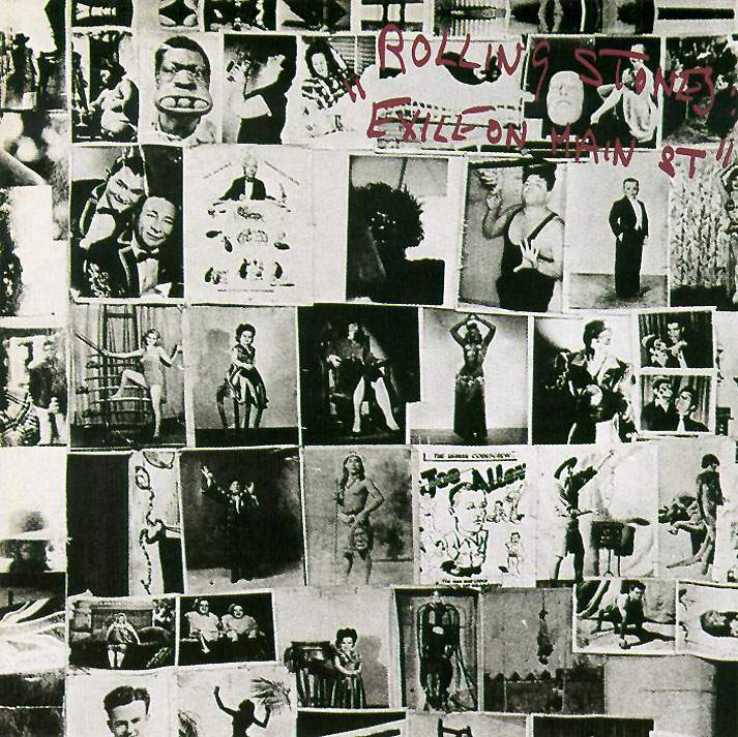
There’s a lot to do this morning so I’m a little distracted by my work.  So I’ll quickly make quick work of something I meant to mention earlier,  last week’s reissue of the Rolling Stones’ 1972 classic LP, Exile on Main Street.  I grew up with the Rolling Stones’ early albums and over the years my appreciation for this album has grown time I hear it.  Love or hate the Stones, this is great stuff.  And it has a great album cover, to boot.

So, even though this is not off this LP, I’m playing their earlier Get Off My Cloud,  mainly hoping that that infectious guitar line and defiant chorus will  keep me away from simply railing against all the crap that is going on in this world.

Read Full Post »

The term bucket list has become very popular over the last several years.  I suppose everyone has things they would love to do before they kick the bucket, fantasies they want to fulfill.  I don’t have anything formalized myself, anything written down, but a few weeks ago I saw something on television that I might have to have at the top of the page if I ever were to assemble such a list.

Yell at the moon with Buzz Aldrin.

In a recent episode of the NBC sitcom 30 Rock, Liz Lemon, Tina Fey’s character, discovers that her mother in her younger days had been in love with Buzz Aldrin and sets out to reunite them.  When Liz finally meets Buzz, he tells her how awful her mother’s life would have been had she stayed with him and that she was lucky to have left.  Having always fantasized about marrying her own aerospace hero, the imaginary Astronaut Mike Dexter, Liz is disappointed and seeing this Buzz asks her if she would like to yell at the moon with him.

“I walked on your face!” Aldrin yells as the two stand looking at the moon from a lofty apartment in NYC as the moon hovers in the daylight.

“I own you!”

“Stupid moon!” Liz chimes in.

I know it’s goofy.  And even though Aldrin’s delivery is a little stiff and stilted, it reminded me of the way Chief Dan George spoke and acted  in Little Big Man.  There’s something in it that feels honest and sincere that makes it more endearing. Unreal but real.  And the idea of Buzz Aldrin, the wizened old astronaut standing in the window and yelling out at the moon as though it were a living being to him, as though it were a kid he was shooing off his lawn, has an almost mythic quality.  This feels magical to me.  It would be great to be able to stand, next to Buzz Aldrin,  there and tell the moon where it could go.

So, if I ever get down to making a bucket list, that would have to be at the top.  Especially since Edmund Hillary is dead.  I would have loved yelling at Mt. Everest with him.

Stupid mountain…

+++++++++++++++++++

PS: The painting at the top of this post is a new piece, A Time to Rest, and is about 11″ by 15″ on paper.  It will be shown at the Principle Gallery show in June.

Read Full Post »

Peers- GC Myers 2003

I’m in the last days of painting before I start final preparations such as framing and such for my upcoming show.  I’m currently putting the final touches on a piece that is a multiple similar in form to the one shown here, Peers from back in 2003.   The piece I’m working on consists of 3 rows of 3 red trees on a 30″ by 30″ canvas.  I’ve used multiple images a number of times over the years, although I often go years between.  There is something almost musical, almost choral, in the repetition of form.

I only mention this today because when I came into the studio I put on an album (CD actually but I still call them albums) of work from Arvo Part.  One of the first pieces to play was Cantus in Memoriam of Benjamin Britten.  It was a mesmerizing tonal piece and as it played, I looked at the title and realized I didn’t know what was meant by the cantus in the title.

Looking it up brought me to the term cantus firmus which is described as a sort of polyphonic composition, meaning it is comprised of multiple interwoven and, often, the same melodies.  A Gregorian chant is an example of one type of polyphony.  The voices, or melodies, are repeated,  one over the other, some at different tones and varying lengths.  I don’t know much about music but as I read I began to equate this meshing of voices and melodies in a cantus firmus with what I was trying to achieve with the multiple images in the painting I was working on.  Each image is basically the same but because of the way they are positioned and come together as a whole, they become more than the product of their parts.

At least, that’s my take on it. 

Anyway, I found a name for the piece I am finishing.  Cantus Firmus.

Here’s the composition from Arvo Part:

+

Read Full Post »

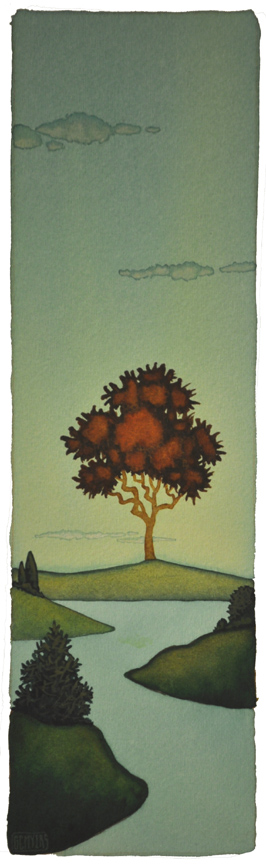
Signet of Eternity


This is a new piece that I am calling Signet of Eternity, taken from a poem by Rabindranath Tagore, the great Indian writer/poet.  There’s a great sense of the eternal in this smallish ( a 4″ by 14′ image) painting on paper.  I find it very calming, very soothing, with its clear, cool colors and crisp line work.  There’s a simplicity and delicacy in this that hints at how fleeting and fragile are the the glimpses of eternal forces we are fortunate to witness in our lifetimes. 

I know that sounds pretty metaphysical but I’m just talking about those moments when all the forces of the world present themself before you in an almost perfect harmony and there is a moment of stillness.  Clarity.  As though the world has chosen to reveal its purpose to you for those few precious seconds and in doing so has taken away all the weight of everyday life. 

 I thought about that yesterday as I trudged, head down, through the woods between my home and my studio.  I stopped on the path suddenly and looked around.  The trees were so graceful and  I caught sight of  the trunk of a tall shagbark hickory.  I let my eyes follow it upward to the powerful arms of branches that seemd to plead to the blue patch of sky above.  It was a grand moment and I thought about how often I traveled that path with eyes fixed on the ground before me.  How many times had I let the thoughts and worries in my head carry me without seeing past these things of beauty?  These signets of eternity.

Here is Tagore’s poem:

Read Full Post »

Waterfalls

Monday morning.  For me, it’s not like the start of the week. Just another day in a continuum that is more a straight line than circular.  At least, that’s how I usually view it.  Today,  it feels like the start of a week.  Maybe it’s the fact that I’m in full work mode or just that I’m a little tired this cool morning.  Whatever the case,  I find myself at a loss for meaningful words.  So instead of agonizing for any appreciable time searching within, I’ll simply depend on someone else for meaningful words.

Here’s a song from Jimi Hendrix, May This Be Love which most people know as Waterfalls.  Don’t want to even talk about it this morning, just give a listen.  Nice stuff…

Read Full Post »

I was working in the studio yesterday with the television on, set to one of the news channels.  After a while, the constant drone of bad news from every corner of the world- unstable economies, Wall Street panic, oil spills. floods, terrorist bombings, wars and on and on-became more than I could bear.  I flipped over to a movie channel and there it was.  Meet John Doe, the Frank Capra classic from 1941 starring Gary Cooper and the great Barbara Stanwyck.

Meet John Doe is one of Capra’s visions of American idealism wherein the main character hesitatingly fights the malevolence and greed of those in power for the rights of those with little power.  Think Jimmy Stewart in Mr Smith Goes to Washington or It’s a Wonderful Life.  In these movies, the hero often has the very people he champions turn on him, usually as the result of those in power twisting the truth to suit their own dark agendas.  But in Capra’s world, the hero perseveres and is vindicated by the truth.  Sure, it’s naive but it’s a wonderful place to let your imagination rest for a spell.

The hero here is Cooper who plays a drifter who is enlisted by a newspaper  to play the part of John Doe, a character in a publicity stunt who threatens to kill himself on Christamas Eve because of the state of the world.  This was 1941, folks.  Europe was at war with the Nazis marching and we were on the verge of entering the fray. We were still reeling after a decade of the Great Depression.  It was not a pretty time. 

The John Doe character was supposed to disappear after Christmas but it hit a note with the common note and a populist movement grew from it, funded by the newspaper mogul (played to perfection by Edward Arnold who I will someday highlight in this blog) who seeks to usurp and mold it to suit  the political agenda of his powerful cronies and himself.   Sound familiar?  The mogul tries to destroy the movement and Doe, who has come to believe in the ideals that he is supposed to represent as John Doe,  by turning the movement against, portraying him as a fraud and an opportunist. 

Eventually, right prevails, of course, and Doe overcomes the powerful and the people’s movement continues.  I know it’s a fantasy but after day after day of watching newcasts filled with nothing but darkness and dire pessimism, I’ll choose this fantasyof hope and possibility anytime.  I never fail to be moved by these movies from Frank Capra, and the day that I’m not,  I will truly be worried because that means I will have lost all optimism.  And that is a dark day for anyone.

Here’s one of my favorite scenes with the great Walter Brennan, who plays John Doe’s traveling companion.  Here, he gives his theory about heelots

Read Full Post »

Kabuki TV-- circa 1994

Just looking through some old things, mostly little pieces that are from the time when I first started painting, and I came across this.  At the time  I was playing around with color and masking, where you put something such as tape on the painting surface and paint over it then peel it away to reveal the unpainted surface underneath.  It can be a big part of traditional watercolor painting and I wanted to see if it fit with the way I thought and wanted to paint.  It didn’t.  But I did come up with this little abstraction that always catches my eye and makes my mind’s gears turn.

It’s always interesting to see these little pieces because it inevitably triggers memories of that time when every day was bringing new discoveries as I tried to learn more and more about color and different mediums.  Sometimes things clicked and it was revelatory to discover my strengths.  Other times, it was a struggle and the end product was muddled, labored.  But there was still something to be learned there.  Like identifying my weaknesses and learning how to strengthen these areas or, at least, downplay them.

I guess that this is the process for development in any area of your life,  playing up your strong suits and trying to cover your weaknesses.  Perhaps that is why I like to see these old experiments, to be reminded of my growth, artistically and personally, through the years. 

At least, what I perceive as growth.

Read Full Post »

« Newer Posts - Older Posts »