Feeds:
Posts
Comments

Archive for the ‘Favorite Things’ Category

Albrecht Durer- Sudarium Displayed by Two Angels

Relief of cool air on a Sunday morning.  I’m about a month or so out from my next show and there’s so much to do.  I’m itching to get at some new work that I started yesterday so I think I’ll just play a tune  today.  It’s Two Angels from Peter Case.

I’ve been looking for a decent version of this song to put on the blog and finally came across one that does it justice.  It’s been one of my favorites for a long, long time but doesn’t seem too well known.  I’m always surprised at its relative anonymity.  The good part of not being too well known is that it doesn’t get played to death, so that when I hear it it sounds fresh.  Retains all its beauty.

By the way, the engraving shown here is Durer’s Sudarium Displayed By Two Angels.  FYI,  the sudarium here is supposedly the piece of cloth that covered the face of Jesus as he was being transported from the crucifix to his tomb.  Sort of a pre-Shroud of Turin relic. 

Anyway, here is Two Angels

Read Full Post »

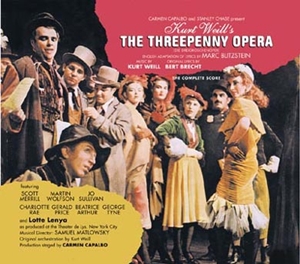
Bea Arthur as the original Lucy Brown

It’s one of those cases of one thing reminding you of something else.  I heard Bobby Darin’s swinging version of Mack the Knife yesterday and there’s a line that ends with and Lucy Brown.  One of those parts of a song that your mind is somehow attuned to and always hears whenever the song is played.

Anyway, it immediately reminded me of  seeing Bea Arthur, of Maude and Golden Girls fame, a number of years back in a one-woman show on Broadway of personal stories and song.   Going in, I knew only a little of her career outside the TV roles so I didn’t have high expectations.  I was pleasantly surprised by a great show.

 I didn’t know much of her Broadway career and didn’t know she originated the role of Lucy Brown in the original Broadway version of The Threepenny Opera back in the ’50’s.  She told several great tales about the show and then did a stirring version of the The Pirate Jenny.

I’m embarassed to say that I didn’t know much about The Threepenny Opera or Brecht or Kurt Weill.  Had never heard the The Pirate Jenny and it’s story of a cleaning woman who daydreams of rising from her life of powerless drudgery to become a powerful and cruel pirate.  Great song with great imagery and Bea Arthur’s version was wonderful.  Angry.  You could feel her desire for retribution for every time she was wronged by those who simply overlooked her and  took her for granted.  It was a very powerful song and one that became and remains a personal favorite.

Anyway, here’s a very good version of The Pirate Jenny from singer Anne Kerry Ford:

Read Full Post »

I often get comments from people asking about the Eastern, particularly Japanese, influence in my work.  While it has never been intentional, I have always been drawn to the prints of the Japanese masters Hiroshige and Hokusai and their influence inevitably finds its way into my own work.

I find the rhythm and structure of Hokusai’s wave prints very appealing.  There is a great combination of quietude and motion in the prints, brought to great effect with the use of gorgeous colors and impeccable design.

Along with this dichotomy of quiet and movement, there is a omnipresent sense of the immense force of nature over man.  Hokusai often has Mt. Fuji in the distance behind the curls of his powerful waves, reinforcing the power and sanctity of nature.  The finger-like  quality of the edges of the breaking waves seem like the hand of mother nature reaching out to slap at the reaching hands of her children, the boatmen.  Again, reinforcing the dominance of nature over man.

There is a lot more I could say about Hokusai’s work but so much of my appreciation for it is almost indefinable.  The work allows me to enter and translate it easily and thrill in the beauty of the lines and hues of the picture plane without determining why I am drawn to it.  This unquantifiable ease of translation may be the element of Hokusai’s work that I desire to see in my own work.

Great stuff…

Read Full Post »

Once again, it’s the time of the year when the movie, The Ten Commandments, takes to the airwaves, an Easter tradition on ABC.  I’m pretty sure I mentioned in the past how much I enjoy this film on so many levels.  It has a great epic quality from the solemn narration by its director, Cecil B. DeMille, to the huge sets employed.

It also has a great deal of goofiness in the writing and acting, where I sometimes feel like I’m watching an SCTV skit and half expect Eugene Levy to stumble into the scene.  Pure kitsch.

When you throw in the fact that it’s such a great tale, it makes for a great night of viewing.

Here’s something that has very little to do with the movie except for the title.  It’s Desmond Dekker‘s early reggae hit, The Israelites.  When I hear this song I am immediately transformed to being a kid listening to this song in our kitchen on my Dad’s big old plastic AM radio that had its batteries held in place with a piece of wood in its open backside.

Anyway, enjoy…

Read Full Post »

The other day I wrote in this blog about the process of painting which brought a comment about appreciating the physicality of painting in person.  It immediately brought to my mind the paintings of Joan Miro, the great Catalan painter/sculptor.

I have always been greatly attracted to his paintings having seen them countless times in books and in popular culture, such as on the cover of Dave Brubeck’s  jazz classic Take Five.  There was something very enticing about the imagery and the geometry of his work, something that that was symbolic and beautiful at once.  However, I never wanted to know too much about the paintings, never wanted to try to read into every symbol.  I just loved the way they felt on the eye.

Dark joy.

But my main memory, and the one I returned to when I read the comment about seeing the physical nature of work in person, is of seeing a Miro painting in person for the first time.  When I saw it across the museum hall, I was excited.  It was like seeing an old friend after a long time, even though I had only seen the work in print.

But as I got closer I began to feel a dull pang of disappointment.  Up close, the surfaces were flat and dull, the paint thin.  It was still striking imagery but the feel on my eye was different and I left feeling a little different about his paintings.  A feeling that has remained with me even though I rationally accept it as his style and have come to more fully appreciate it.

I suppose it was simply the difference between expectation and the reality of actually seeing the work.

As I said, I have come to terms with the way they appear up close and understand that was how he worked, how his mind best translated to his chosen media.  That’s enough for me and far outweighs my own initial expectations and reaction.

The imagery still stuns me.

Read Full Post »

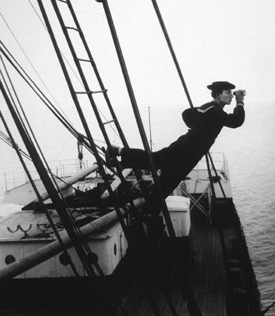
Buster Keaton in "The Navigator"

I’m kind of busy this morning.  I’m getting a group of work ready to be delivered to a couple of my distant galleries so I’m hustling around, finishing the details and things that should have been finished some time ago on a few pieces.

But I did want to comment on another of my favorites, the great comedic film actor, Buster Keaton.  They showed his 1924 classic, The Navigator, late last night on TCM.  Like many of Keaton’s films, one of the main characters in the movie was the main prop in the film, a hulking old steamship that is abandoned and adrift.  Keaton could make incredible use of his prowess as a physical comedian with the physical dimensions of such a ship, as he had done in other films with locomotives and falling houses, among other things.

With his deadpan, melancholic face and ability to find comedy in very a physical manner, his humor is universal and timeless.  I find myself laughing out loud at his work often and marveling at the his daring in performing all the tremendously dangerous stunts that he did without a double.  For what it’s worth, Jackie Chan mentions him as one of his biggest influences.

Here’s a short with several of his bigger stunts from several of his films including a funny underwater bit from The Navigator

Read Full Post »

Busy this morning, I wanted to just have a small bit of music on this Sunday so I chose a song from Bonnie Prince Billy, known to some as Will Oldham.  I’ve always liked his very distinct style and songwriting and chose this song, I Am Goodbye. I wanted to have an image to accompany the song so I gave a quick look in a file and came across my old friend here.  I thought he might fit the song well.

This is a piece that I did about fifteen years ago, in 1995.  He was the first figure like this that I painted and became the basis of a series that I called Exiles which was a creative breakthrough for me at the time.  Thankfully, he never was sold or given away and remains with me.  He is one of my treasured pieces, holding many meanings in many aspects for me.

But for today, while this is  hello,  he is goodbye…

Read Full Post »

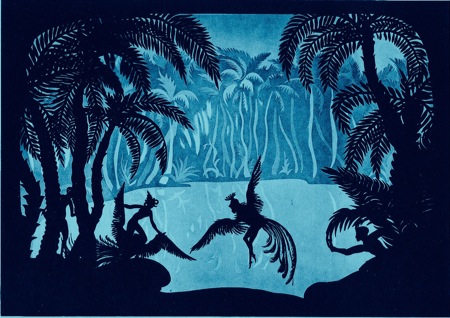
The Adventures of Prince Achmed (1926)

I first saw a film, The Adventures of Prince Achmed,  from Lotte Reiniger several years ago in a series about early silent films.  It was made in 1926 Germany and was one of the first animated films made.  It’s a form of animation that Reiniger pioneered and mastered, based on Eastern shadow theatre.   Using silhouette figures, each is painstakingly cut and hinged then  filmed in small movements with time lapse photography to produce motion in the film.  This film took three years to complete.

Lotte Reiniger At Work

In this telling of the Arabian Nights stories, I was immediately struck by the beauty and movement of the colors in the film.  Each cell was tinted by hand to produce intense bursts of color that gave the film a gorgeous surreal quality.  The movements of the figures in the film are smooth and natural,  very subtle.  I found myself so taken with watching the movements and changes that I found myself not following the story.  But I didn’t care.  It was beautiful to see and sparked the imagination.

Lotte Reiniger (1899-1981), born in Germany and living most of her post-WW II life in Britain,  left quite a body of work from a career that spanned over 50 years, including one of the first film versions of Hugh Lofting’s Doctor Dolittle. She’s pretty much unknown in popular culture which is a great shame.  Her work is marvelous and deserves to be seen.

Here’s a small clip of Prince Achmed:

Read Full Post »

I love it when people exceed the expectations put upon them by others.  People who persevere in pursuit of a dream despite little or no encouragement from the outside.   My current favorite is Jeff Foote, shown here, the starting center of the Cornell Big Red basketball team who is on an improbable run in the current NCAA tournament.   Jeff and his teammates face the highly favored and number one seed Kentucky team Thursday night for a chance to move into the final eight teams in the tournament.

Like the Big Red team in this tournament, Jeff Foote has always been an underdog.  He went to Spencer-Van Etten High School, located in a very small rural village not far from where I live.  It’s a small school with most graduating classes numbering less than a hundred students and isn’t known as a hotbed for turning out sports stars.  So when Jeff was playing for S-VE as a gangly 6′ 8″ teenager, he kenw he wanted to play Division I ball but attracted practically no attention.  Division I powerhouses didn’t come to see him.  Neither did even smaller Division I schools.  For that matter, no Division II schools came calling.  Only RIT, a Division III school  a couple of hours away in Rochester expressed any interest at all.

But he wanted to and believed he could play Division I ball and instead of just giving in to the expectations of others, Jeff kept pushing.  He applied to St. Bonaventure, a Division I school in western NY, and made the team as a walk-on.  No scholarship.  No guarantee of playing time.  But he was in Division I even if it was at the end of the bench as a now gawky 7-footer.  At the very least, it gave him a framework in which to work hard towards improvement.

In the meantime, Jeff’s mother, a nurse at a hospital in Elmira, became acquainted with the coaching staff at Cornell when one of their players suffered a back injury and came to her hospital for treatment.  She became friendly with them and told them that they should take a look at her son, the 7- foot walk-on for the Bonnies. 

They were intrigued by the thought of the big unknown kid.  They gave him a try-out and the work Jeff had put in was apparent.  He transferred to Cornell and has had a wonderful career there, improving steadily as the starting center for the three-time Ivy League champions, going each of the last three years to the NCAA tournament.  This year he was named the Ivy League Defensive Player of the year and his game continues to grow as he continually strives to improve.  He’s eyeing a career in the European Leagues and has set his long range goal on the NBA. 

Don’t underestimate the kid.

And don’t count out the Big Red.

Read Full Post »

I  have many guilty pleasures, things that I enjoy but am hesitant to admit to others for various reasons.  I don’t know if the television series Breaking Bad , which starts it’s third season tonight on AMC, qualifies if only for the fact that the word pleasure doesn’t seem to fit the viewing experience.

Unsettling.  Disturbing.  These words seemed like a better fit.  And fascinating, always fascinating, despite the uneasy hellscape in which you find yourself immersed.

For those unfamiliar, Breaking Bad is the story of Walter White, a struggling high school chemistry teacher in New Mexico who discovers that he has malignant cancer and in order to provide for his family, which includes a baby and a teenage son with cerebral palsy, turns his chemistry knowledge towards the production of crystal meth.  It’s basically the story of a good person who makes the decision to compromise his beliefs for what he views as good reason and must deal with the transformations and unintended consequences of that decision.

And there are transformations.  And consequences.

I think that’s the appeal of the show.  It’s about a seemingly normal person with good intentions that we can all identify with in some way.  He could easily be someone we know, someone we nod to on the street or chat with at the supermarket.  But his initial bad decision has placed him a labyrinth where every subsequent decision sends him in veering directions that take him further and further from his intended destination.  It’s something that many people who’ve made drastically wrong choices in their lives often encounter although most will never encounter the often horrifying circumstances that accompany Walt’s oddyssey.  When you see where Walt finds himself, you look at your own life and breath a sigh of relief.

And maybe that’s the attraction.

Read Full Post »

« Newer Posts - Older Posts »