Feeds:
Posts
Comments

Archive for the ‘Favorite Things’ Category

Today is the beginning of March Madness, the annual tournament to determine college basketball’s national champion.  The first two days are wall to wall games, 16 each day.  It’s a virtual all-you-can-eat buffet for any college hoop fan.

I’ve followed the Syracuse Orangemen since I was a kid and still get giddy at this point in the season when they play in the tournament.  It has more often than not ended in disappointment and frustration but  the several times when they’ve moved deep into the tournament have been worth the pain of the imminent defeat.

I guess that’s the beauty of the college game, the excitement of a new and changed team with new players every year.  Experiencing how they evolve and grow ( or falter and come apart) as the season progresses.  Like many things, it often comes down to establishing a rhythm and making every part move together in an intuitve way.  When these teams gel and become a cohesive unit, it’s an exciting thing to see.  When they don’t, you simply say, “Wait ’til next year…”

Hopefully, one of these cohesive units will be Syracuse.   Go, Orange.

Read Full Post »

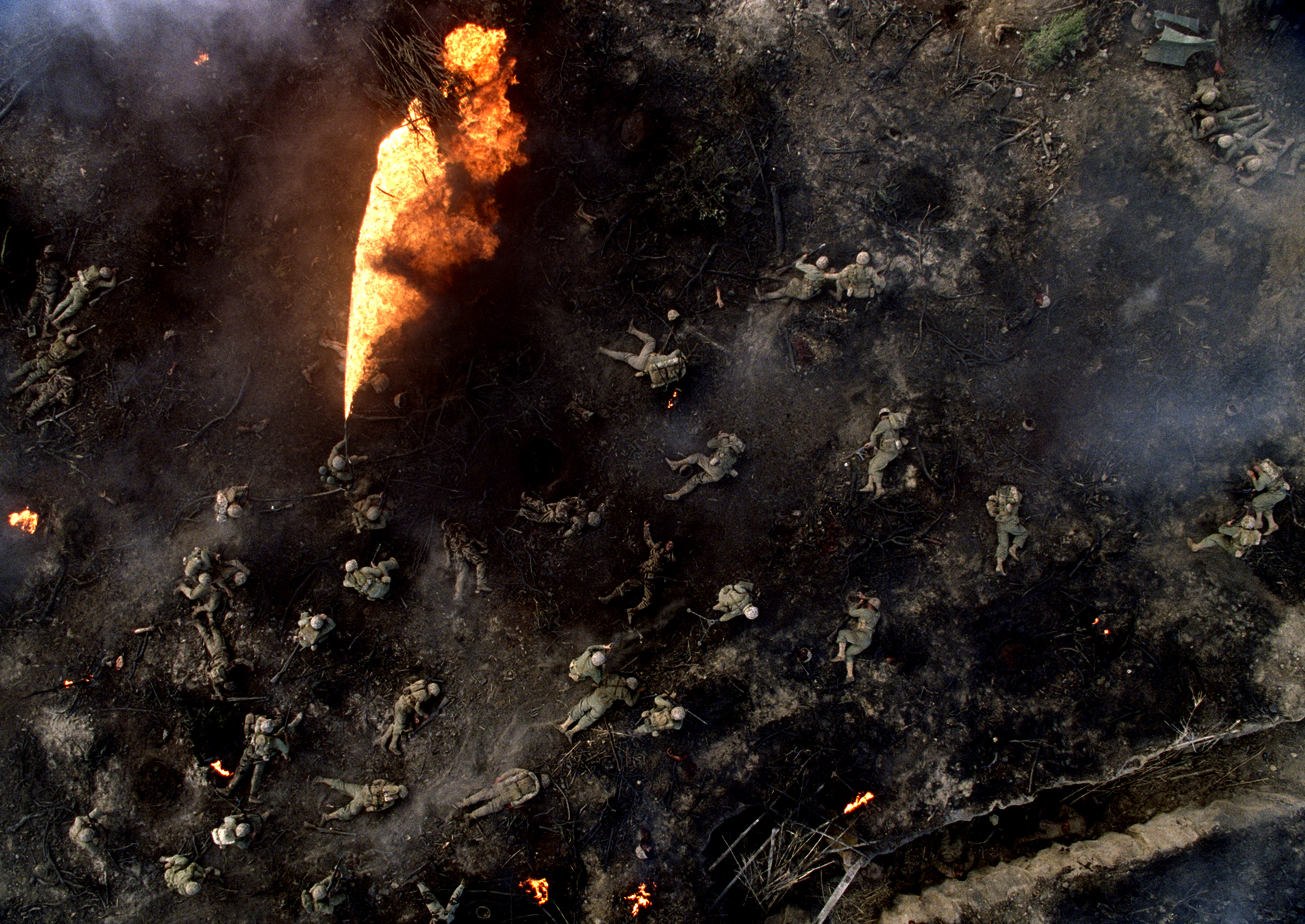
HBO starts a new series tonight that I’ve been anticipating for a while now.  The Pacific is a 10-part series that follows the path of several soldiers as they fight in the Pacific theatre of World War II

It’s in the same vein as Band of Brothers, which  was set in WW II Europe, and set the standard for films of the sort with it’s fast paced action and dynamic camera work that gave one a true sense of the danger and the brutal reality of the situation.  The Pacific is produced by Steven Spielberg and Tom Hanks who also produced Band of Brothers.  They wanted to honor the soldiers who fought in the Pacific by giving their stories the same careful treatment in the telling that they did with Band of Brothers.

I doubt that anyone will be greatly disappointed. 

When I saw the image above I was instantly hit with the feeling that one gets from looking at one of the nightmare landscapes of Hieronymous Bosch which I suppose is only fitting.  I can’t fully imagine what it must have taken to persevere through the extreme hardships of the  campaigns on those islands.   It must have literally felt like hell on earth , a neverending carousel of horror and terror.  Those who survived deserve every honor they received and more.

They certainly have my respect…

Read Full Post »

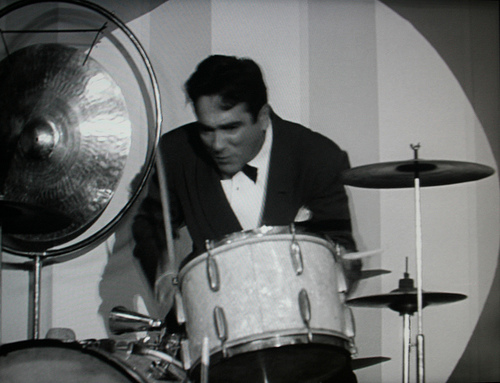
I was painting in the studio yesterday and I threw on a movie that I hadn’t seen in years, Ball of Fire starring Gary Cooper and Barbara Stanwyck.  It’s a great comedy from1941, written by Billy Wilder and featuring some of the great character actors of the time.

I only mention  this because there’s a great scene of Stanwyck performing as a nightclub singer with Gene Krupa, the legendary drummer , and his band.  They perform Drum Boogie and if you ever doubted that your parents or grandparents knew how to rock, this will put those doubts to rest.

Try to stay with it to the end.  Krupa does a part where he changes Drum Boogie to Matchbox Boogie and plays the song with wooden matches as his sticks.  There’s a lesson in there for artists about the power of contrasts.

Good stuff…

Read Full Post »

Signs of Spring

Whenever I have been outside over the last several days, my ears are filled with the sounds of spring.  Our small creek is roaring with the sound of the snow from the forest melting and running off.  The smalll birds are twittering and tweeting all through the woods and from above, the constant honk of Canadian geese moving northward.  Huge flocks with hundreds of geese soar high overhead in flying vees, one after another.  It seems as though on some days there is hardly a break in their migration.

This year, for the first time, we have seen very large groups of the beautiful white snow geese fly over.  I’m sure they must have went over in the past but somehow over the years they have eluded our sight.  It was stunning to see a recent group that flew over at a very low altitude.  It was a very large flock and their braying honks filled the air.  As they passed the sun perfectly lit their wide white wings,  giving them a glow and showing the black tips in stark contrast.

Just beautiful.

They’re a pretty amazing bird.  We’ve been fortunate a few times to have a family reside for the summer on our pond.  Although I could do without the incredible amount of crap they produce, they are great to observe.  They are exemplary parents, keenly observant of every move of their offspring and everything anywhere near their location.  They keep the young in line with scolding honks and as the summer progresses they make the pond a clasroom as they teach each gosling the proper way to take to flight from the water.  When all have learned and have made several short flights, they begin to think about joining the larger flock that gathers a mile or so away at a larger lake and soon they are gone for the year. 

Heading further south for open waters to spend their winter.

And the cycle continues and once again they are honking overhead.

Read Full Post »

There’s an old piece of film that I have often seen in snippets, usually in a montage about the earliest days of film in the late 1890’s.  It’s a short film of a dancer with swathes of fabric twirling, very modern dance-ish in style, and as she spins the fabric changes color.  It’s a pretty mesmerizing piece of fim, even more so given the infancy of the medium of the time.

Doing a little research I found that this was filmed by the French film pioneers, the Lumiere Brothers, in 1896.  Each film cell is handpainted to achieve the color effects.  The dancer in the film is Loie Fuller, an American-born pioneer of modern dance who was the toast of Paris in the 1890’s, starring often at the Folies-Bergere

I find this film quite enchanting which is pretty amazing considering how many different  moving images, how much computer generated animation and other advances in film-making I, like most people, have witnessed in this time, over 110 years in the future.  Can you imagine how mind-blowing this must have seemed to the average person of the day?

This point is well illustrated in the movie, The Magic Box, a 1951 film in which Robert Donat portrayed British inventor, William Friese-Greene, who had invented and patented the motion picture camera a year before Edison but never received any credit and died in virtual anonymity.  In the film, when he finally is able to fully demonstrate the motion picture with his invention he is alone in his lab, late at night.  He is frantic with excitement and runs out into the London streets to let the world know of his triumph.  The only person he encounters is a London police officer, played by Laurence Olivier.  The bobby suspiciously goes along with Friese-Greene thinking he has a psychotic on his hands.  He hesitantly agrees to look at Friese-Greene’s demonstration and when the film rolls and the images of the London citizens strolling in Hyde Park appear, he is frozen with amazement.  It is as though he is looking on a true miracle.  And perhaps he was– the miracle of invention.

Anyway, take a look to see a beginning point and realize how far we have come…

Read Full Post »

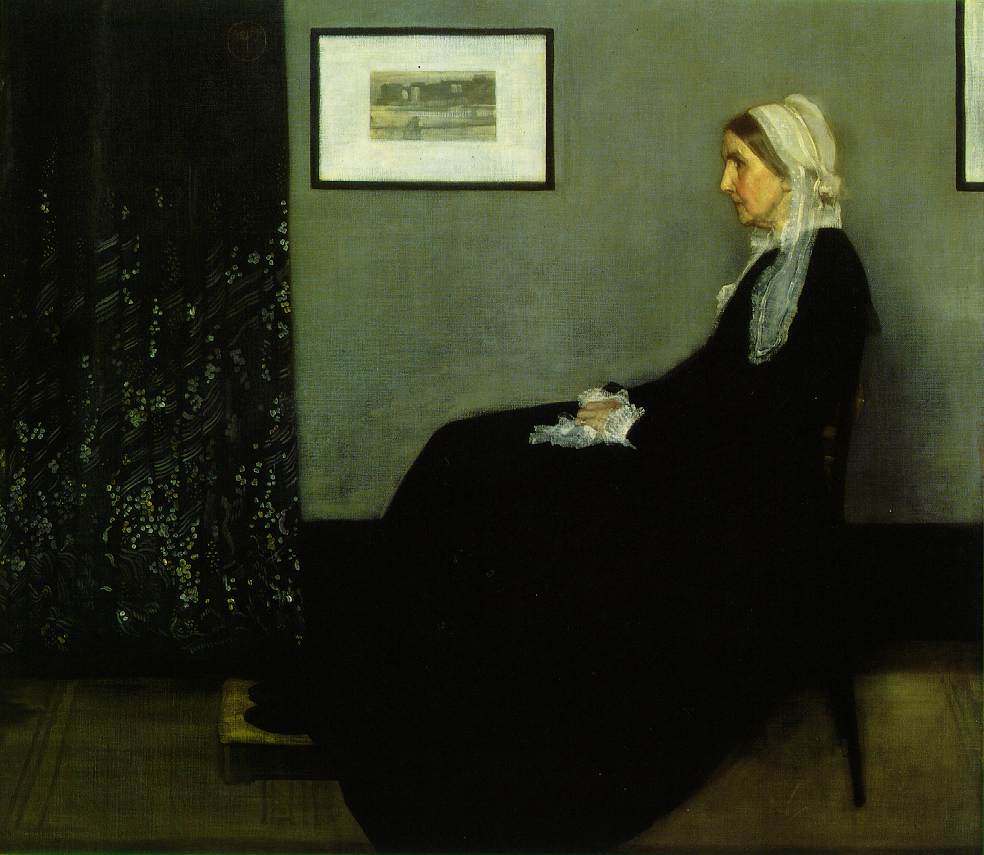
This is James McNeil Whistler’s most famous piece, Arrangement in Grey and Black, No. 1:  Portrait of the Painter’s Mother.  It is, of course, better known as Whistler’s Mother.  It was a painting that I was casually familiar with as I grew up but it wasn’t until I looked more closely at it after I had started painting that I saw the brilliance of it’s composition.

Whistler always asserted that the painting was not about his mother but was more concerned with creating mood with color and composition, which the primary focus of almost all his work. This piece achieves it’s mood with beautiful diagonal lines formed by the woman’s form and contrasting verticals and horizontals that create great visual tension and energy.  The stark whiteness of the matted print on the wall behind shines like a full moon against the pale blue-gray sky that is the wall itself.  The head of the old woman seems to be almost lit by the light from the moon/print.

This is not a portrait of an old woman.  It’s a nocturnal landscape.  That’s what I saw when I looked at it as a painter trying to glean what I could from it for my own use.  This was a composition that had a geometry that just felt so right immediately.  It had such a sense of perfection in the way color and form combine with sheer simplicity that I knew I would have to use it for myself.

And I have, quite a few times over the years since I first really looked at it, sometimes with slight variations in the placement of the elements but still basically with the same compositional base.  And inevitably, they are pieces that great immediacy in their impact, pieces that carry great mood whatever their subject matter.

And for that I thank you, Mr. Whistler…

Read Full Post »

I’ve written quite a bit lately about the concept of home and the search that many of us go through in defining what home truly means.  It’s all part of a process of determining who we really are as individuals and what our place is in the grand scheme of things.  Home and family are the two fundamental building blocks upon which we build our own definitions of self.  Home is where we are and feel we belong in the present and family is where we have been in the past, the basic bloodlink that has carried us to this point in time.

I’ve written about my research into my family and that of my wife so it was with some interest that I watched a new program last night called Who Do You Think You Are? that traces the lineage of celebrities on a weekly basis.  I really couldn’t  care less about the celebrity part (in fact, this show might be more interesting if they randomly chose to trace the roots of some very everyday folks) but am always interested in seeing how a person is affected when finding a new depth and understanding of their distant past.  Such was the case with last night’s subject, Sarah Jessica Parker.

Parker, like many of us, knew little of her past and felt that her family was only on the fringe of the American experience, that they had little to do with the events of the past that shaped and made this country.  I knew that feeling well .  In her case, her past easily revealed itself with just a bit of research and she was able to find a great-grandfather who from several generations back who left home and family in Ohio and crossed the country via wagon train, questing for fortune for his family in the gold mines of California.  Part of the Gold Rush and staking a claim with partners, he worked the mine and died of illness within a year.  His story is emblematic of the American push into the west.

Going back further, she found her family in the center of the Salem witch trials of the 1690’s, with a great-grandmother who, as a young woman, was accused of witchcraft but was spared from the death by hanging that all other who had been previously accusedsuffered as the trials were halted before her case came before the court.   Without the stoppage of the trials, Parker’s very existence would be in doubt.  Again, she finds herself in the middle of events that shaped the narrative of our country.  Going further, I’m sure she will find her family in the midst of events that shaped history in the countries of her ancestors.

Such is the case with us all.  It was interesting to see her story and to see how she was moved by and connected with the stories of her ancestors, how she gained insight and appreciation for the journey that led to this very moment in time.  Her’s is a wonderful story but not a rare one.  All of us have a rich heritage if we only choose to look, a wealth of information that winds through and connects us with the annals (yes, annals) of history.  We all are more than we seem and all are alive as the result of  many amazing sets of circumstance.

I have often thought if we all comprehended what it took to get us as a people to this point, how those ancestors who came before us risked and sacrificed for home and family, then we might take more pride in who we are and take more personal responsibility for our future.

Read Full Post »

Spring Training!

As I worked in the studio yesterday, familiar sounds filled the space for the first time this year.

The slap of a ball on the leather of a glove.  The crack of the bat.  The muffled bellow of a called strike from the umpire.  The crowd roaring when a ball clears the outfield wall.  The familiar voices of the longtime announcers describing a pitch or giving a player’s stats as he strolls to the plate.

Baseball’s back.  Spring training is underway once more.

I feel as though my year is officially started and that I am once again engaged with the continuum of time.  Baseball is a symbol of the cyclical nature of time and the fallibility of man for me and feels almost ingrained.   The biggest stars, names that will resonate with fans for generations, fail on a regular basis, much more often than they succeed as their season goes on an almost daily basis through three seasons of the year.  The game is about patience and perseverance, continually slogging ahead day after day.  Putting aside setbacks and looking at each new day and the next game as a new start.  Grinding it out.

Doesn’t sound too appealing when put that way but the beauty comes from the moments of triumph that sprout during this long march through the year,  bursts of brilliance and sudden victory that overshadow the failures that came before.

Much like life. 

So again, pitchers throw, catchers catch and hitters swing .  Fielders kick the dirt of the infield and track flyballs across the lush green carpets of the outfield and once again, I feel as though I am back in the flow and rhythm of my year.  Play ball!

Read Full Post »

This etching hangs on my studio wall, near my painting table.  It’s titled The Devil and the Messenger and it’s from  Grant Silverstein, an artist from rural northern Pennsylvania not far from where I live.  He is self-taught and has worked in intaglio etching, which is engraving the image on a copper plate with a sharp needle, for many years now. 

I’ve always liked the look and feel of etchings and have great admiration for those who can translate their vision through this medium.  I don’t know if I would have the patience. Grant has his own look and feel, often dealing in the allegorical.  Whenever I come across his work I have to stop and look with great pleasure.

My eye often drifts up to this piece and fills me with a lot of different questions and feelings, outside of the satisfaction of the viewing the composition itself.  I am curious as to what the messenger is carrying and to who is he taking it. Is the Devil is taking the message or replacing it as the messenger sleeps.  Is the messenger merely sleeping  normally or is it the result of the Devil’s work?

I see it as a reminder that one is always vulnerable in some way, that there is always the possibility of some Devil tinkering with you while you least suspect it.  A little vigilance is required.   I don’t mean that to sound paranoid.  What I mean to say is that it’s best to view strangers you encounter in a dark wood  a bit warily, particularlly if they are horned. 

And to be careful where you sleep.

To see more of the etchings of Grant Silverstein click here to go to his website.

Read Full Post »

Sitting here as the first light of morning reveals snow falling, piling quickly and coating the limbs of the trees in the forest.  Truly beautiful.  However, we’re expecting a foot or so and, while I really love the snow, I am reminded of the tropical watercolors of Winslow Homer.

Homer, perhaps best  known for works such as The Gulf Stream which is  the second image from the bottom of this post, fled the cold of winter starting in the 1880’s, travelling and painting in such places as the Bahamas, Bermuda and Florida.  Because of their convenience, he chose to paint in watercolors for his travels.  The results were stunning pieces with rich colors and an feeling of immediacy and spontaneity in the way they were painted.  They have a really modern yet timeless feel, as though you could be looking at something painted just yesterday.  They were unlike anything being done at the time and have been highly influential to generations of  artists.

Despite less than flattering comments from the critics of that time, Homer knew they were special and has been quoted as saying, “You will see, in the future I will live by my watercolors.”  In fact, his watercolors were extremely popular with his collectors and provided a great portion of his income.  But I think with this quote he also alluded to his name living through future generations via this work, which has been the case.

On this snow-filled day, I am momentarily transformed by these pieces to warmers climes…

Read Full Post »

« Newer Posts - Older Posts »