Feeds:
Posts
Comments

Archive for the ‘Favorite Things’ Category

I’m battling a cold and don’t feel like I have much to share today but I did want to show this piece, Flower Beds, from Vincent Van Gogh.  It’s not one of his better known iconic pieces but whenever I come across it, it makes me stop and look.  It’s from early in his career and is painted in a more impressionistic fashion than his later, more signature works with their bold strokes of vivid color.  This piece seems to be a bridge between his influences and the style that he later adopted as his own, going from the darkness of the past as represented by the cottages to the new, colorful strokes that are the flower beds.

I like seeing that transition, almost can feel how Van Gogh was taking on his own voice at that time.  Seeing things with his own eyes for the first time.  Becoming the Van Gogh we know now.

I don’t know why I mention this piece today.  I was thinking that I don’t often mention Van Gogh as an influence even though I consider him a large one.  I think I try to avoid invoking his name simply because I hear so many painters list him as their primary influence and seldom see the energy or passion in their work.  His work had an incredible accessibility and drew such an  immediate  basal  reaction  that it makes him an easy, romantic choice as an influence for many.  I guess it’s a fear that if I come out and say it, that I’ll be lumped in with the posers when I would rather just have my work speak for itself, away from any comparison.

As it should be.

But how do you not like the guy’s work, not feel inspired by his need to constantly move forward in his desire to express the rhythm and feeling of the world around him?  How can a painter not want to capture the essence of his singular voice?

Read Full Post »

I’ve written recently about the upcoming Little Gems show at the West End Gallery in Corning, a show that has a lot of meaning for me as far as being the jumping off point for my career.  I also really enjoy this show,  just to see other artists’ work.  It’s always interesting to see how artists who more often work in larger formats  handle the challenge of working on a smaller scale.

Here’s a great example from Marty Poole.  It’s a beautiful little 6″ by 8″ painting, a wonderful  example of his great ability with color and light.  The face of this child just glows on the panel. Marty is well known nationally for his large landscapes with broad, evocative skies as well as for his figurative work.  His handling of paint is remarkable in any genre.  He very seldom works so small so this show presents a great opportunity for collectors to pick up more affordable pieces from an artist whose work is widely sought.

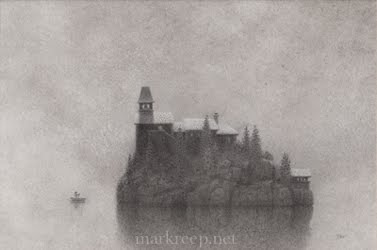
Another aspect of Little Gems is allowing artists who normally work in a smaller format to show their work on equal footing, as far as size, with artists who works’ normal sizes would dominate the gallery walls.  It allows their normal work to really shine.  Here’s a great example called Last Bell from Mark Reep, whose meticulous black and white small works are always filled with ponderous atmosphere that belies their size.  Just beautiful work.

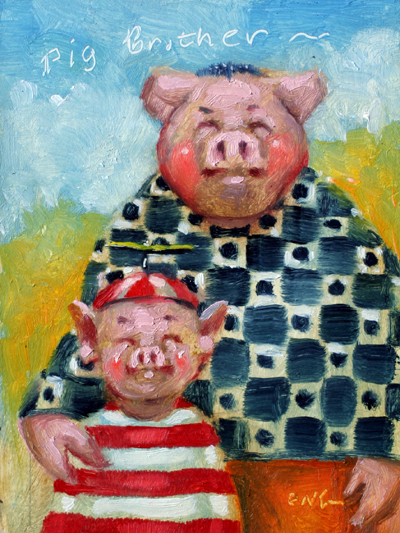
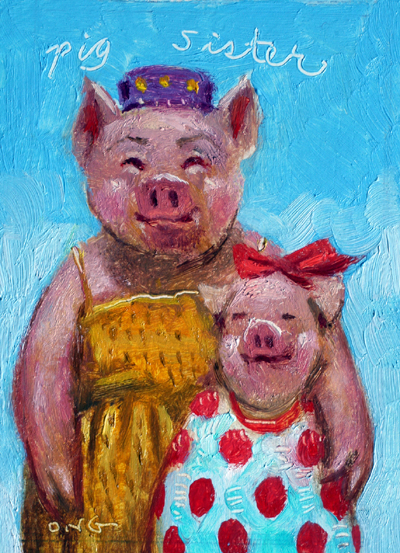
Then there are artists who take this opportunity for small works to show a different side of their talent.  Such is the case with Wilson Ong who is perhaps best known for his sublime portraiture.  His small pieces are whimsical tiny (in the 2″ by 3″ range)  paintings of animals in unlikely situations. Here are two of my favorites:

*

*

*

*

*

*

*

*

*

*

*

*

As I said, this is always  a great show to see really talented artists working on a small scales.  Stop in and see these gems.

Read Full Post »

The other day I had a post about Lon Chaney and my friend, Dave, commented that he had wanted to be Chaney when he was a kid.  This made me wonder what movie hero I wanted to emulate when I was young.  It’s easy to rattle off stars now, when you’re older and know their full careers and the impact they made.  But when you’re a kid the attraction is more basal, less thought out.  More limited to the scope of your own small world.

I wanted to be Audie Murphy when I was a boy.

Though hardly known today, Audie Murphy lived for me in the B-movie westerns that were shown every Saturday morning at 7:30 AM on our local TV station.  They were pretty predictable stories with Audie as the lawman or the wrongly accused cowhand who ferrets out the bad guys, often played by Dan Duryea, another name that is little known today, and finds justice with his fists or his six-guns, riding off into the western sunset.

His appeal for me was in that, as a kid, he seemed both like the hero and the underdog.  He wasn’t a big  tough guy who physically dominated the screen like John Wayne.  He seemed smaller than the villains who threatened him.  Maybe that was the appeal to a kid.  But he had quiet determination and grit and always upheld the heroic qualities of honesty, courage and justice.  He always persevered.

While most of his films were B-movies, he did have a few higher quality outings.  He starred in the classic The Red Badge of Courage and in The Unforgiven with Audrey Hepburn as well as a starring role as himself in the biographical To Hell and Back.  Did I forget to mention that Audie Murphy was a real-life  war hero?  Audie Murphy was the most decorated soldier of World War II and his exploits in the field are legendary.  He received the Purple Heart  when a German bullet hit and shatter his hip.  He recuperated for all of ten weeks, came back and was wounded within days by a mortar then again some time later  during incredible combat actions which led to him receiving the Medal of Honor.  He received 33 medals, all that were  possible, plus 6 medals from France and Belgium.

Not bad for a guy who was listed upon enlisting as being 5′ 5 1/2″ tall and weighing 110 pounds.

But I didn’t even know about his offscreen heroics then nor did  I know about the emotional struggles that came with such brutal war experiences that haunted him until his death in 1971.  He was just the little guy in the light colored hat with the fast fists and quiet determination, fighting for what was right.

Not a bad guy to want to emulate…

Read Full Post »

Before I was a painter, I had jobs, as a service tech and a salesman,  that quite often had me in the homes of clients.  One of the first things I did when coming into a home was to look for bookshelves and scan them quickly.  You could tell a lot about a person by seeing if and what they read.  I was looking for something that gave me an idea of common ground we might have.  It was disheartening how many homes had no books visible and many times, if they did have books, the books were mass market romances or self-help books.  But sometimes there were shelves filled with great books that jumped out at me and generally I was able to establish instant rapport with that person.  I became very adept at glimpsing shelves and judging what was there.

This particular edition of The Catcher in the Rye had a cover that my eye could glimpse at a hundred feet.

JD Salinger died yesterday, at age 91.

I don’t know that this tale of teen Holden Caulfield still resonates with the youth of today but for the generations of the 50’s, 60’s and 70’s, this book was an eye-opener, one that gave voice to the real emotions of many young adults.  It was bold and funny and real.  It was unlike any literature that featured a teen protagonist ( if you can call Holden a protagonist) at that time.  I don’t know if Holden was just a reflection of true behavior of disaffected teens or if he became the template.  That will have to fall to sociologists and cultural anthropologists to determine.

Whatever the case, Holden Caulfield and JD Salinger both became cultural  icons.  Salinger became the very definition of recluse, eschewing all publicity and interviews with steadfast determination for all these many years, and living a quiet  life in New Hampshire.  While his last published piece, a short story,was in the mid 1960’s, he continued to write but only for himself, filling bookshelves with his written notebooks.  I wish I could have scanned those shelves.

I wonder if Holden lived on in his private writings, moving through his phony-filled life in the manner of  Updike’s Rabbit Angstrom?  Perhaps we will never know.  If so, let it be JD Salinger’s choice to share it with us.

Read Full Post »

I don’t know what made me think of this movie so early this morning.  Something made me think of clowns and how even though their aim is to be comedic and entertaining, they often come across as scary or tragic.

I saw a couple of Lon Chaney silent films a few years back that really reinforce this image.  He Who Gets Slapped and Laugh, Clown, Laugh are anything but laughfests.  Both are grim in nature and filled with tragic circumstances, like many of the films in the post-WW I early 1920’s.

Lon Chaney was a huge star of early films and is pretty much unfamiliar to modern movie fans.  He was known for his ability to transform himself into a wide variety of characters, often contorting his body and altering his face for grotesque effect.  This transformative ability won him the nickname The Man of a Thousand Faces which was also the title of a great film biography of him starring Jimmy Cagney as Chaney.  I recommend this film for those who wishing to learn a little more about an incredible talent.

Chaney is probably best remembered for his classic roles as The Phantom of the Opera and The Hunchback of Notre Dame, but for me it’s these roles as clowns that define Chaney for me.  They are dark films filled with grim  melodrama and tragedy.  They’re sometimes hard to watch.  But they are filled with real human emotion and complexity, so dark that it’s hard to believe that these were popular successes of the time.  Hollywood had yet to perfect the happy ending.

Again, I’m not sure why these came to mind today.

Maybe I’ll be painting clowns today.  Brightly painted sad faces.  Like Red Skelton.  That’s probably another too obscure reference.

Anyway, if you get a chance, and don’t really want to have your spirits lifted, check out these classics from the great Lon Chaney or his film biography.

The Man of a Thousand Faces.

Read Full Post »

When most people think of paintings by Georges Seurat, the French pointillist painter, they probably think first of his famous painting,Sunday Afternoon on the Island of La Grande Jatte which is probably remembered by many as Sunday In the Park With George , from the Stephen Sondheim play which revolves around the Seurat painting.  For me, the Seurat paintings that spring to mind are a couple of his pieces that revolve around the circus, such as the one at the top of this post, Circus Sideshow.

For me, this painting just has magical, mysterious  feel.  I can imagine the tinny sound of the musicians, a kind Kurt Weill/Threepenny Opera  quiet cacophony.  The composition of this piece also reads very easily into my brain and I find myself excited by it to the point of envisioning work of my own that will borrow from  the light and dark blocking of the piece, the way the figures are between dark borders formed by the patterned edge at the top and  the shadowy people at the bottom.

While I can appreciate many paintings just for what they are and their own sheer beauty, it’s the paintings that spark something in myself, that inspire something in my own work from some connection in that painting that jumps out at me, that are usually my favorites. These Seurat circus paintings do that for me.  While I find many of Seurat’s other paintings pleasant enough and lovely to see, they don’t fire my imagination in the same way.

Maybe it’s the subject matter.  Maybe it’s the angular edges in these compositions compared to the softer , rounder edges of  the Park painting, for instance.  Maybe it something as simple of the colors of these pieces.  I don’t know.  I just know they make me want to get something down on paper or canvas quick before the inspiration fades.


Read Full Post »

I’m trying to refocus my attention back to my work after the last few days of the auction.  Currently, I am working on a group of very small paintings for an annual show called Little Gems at the West End Gallery in Corning.

This show has always had special significance for me in that it was the first show that I ever publicly displayed my work, back in 1995.  I wasn’t sure where the road would lead at that point and surprisingly, it has surpassed my hopes of that time.  Without that first step, at that first show fifteen years ago, I might very well have a very, very different life now.  So you see how I put some weight towards this exhibit of small paintings.

I also like this show for the format which forces me to work small.  It’s a great opportunity to work out new things on a small basis,such as amping up different colors and blocking in new compositions.  Or in the case of this small piece shown above, revisit a composition with a different feel and color.  Small pieces enable me to work on dynamism on a small scale, finding what elements work and might translate to larger work in the future.

Important rehearsal time.

From a collecting standpoint, small works have always been important to me.  Many of my longtime collectors obtained a small painting of mine as their first piece of art.  I try to make the small pieces every bit the same as the larger, more expensive paintings in all aspects except for the price.  I like the idea of making original work available in price to most people, opening the sometimes overbearing world of art to a wider range of the public.  There is something exciting about having new eyes and new energy in the galleries and both often come from people who may have been intimidated by the idea of even being in an art gallery in the past.

And like my first foray into the world of art fifteen years back, that can be an important first step.

Little Gems opens  February 5, with a reception from 5-7:30 PM,  and runs through March 12 at the West End Gallery in Corning, NY.

Read Full Post »

I can’t believe I failed to mention the birthday of Elvis Presley, who would have turned 75 a  few days back.  It’s not that I was the hugest of Elvis fans although I was an admirer of many of his songs and performances and recognized the attraction his talent had for many.  It’s just that in death he has become this cultural phenomenon, an icon that has taken on almost mythic and mystical qualities for his ardent fans.

That’s kind of what I saw when I painted this small piece a few years back.  It’s called Elvis in the Wilderness which recalls Moses‘ exile to the wilderness.  I may do a follow-up where Elvis leads the exodus from Eygpt.

Or maybe Elvis healing lepers.  Or perhaps traveling through time, battling various injustices throughout history.  Elvis in hand to hand combat with the tag team of Hitler and Mussolini.  Elvis at Valley Forge.

TCB, baby.  Just like the 3 letters on his huge belt buckle indicate.  Taking care of business.

It could be anything, anywhere.  That’s the beauty of Elvis as a mythic character, a superhero.  He fits easily into any time and setting with the powers imbued on him by his fans and as a result, never really dies.

Here’s a performance that I really love if only for the iconic stance in his white suit before the huge ELVIS sign.  Great visual.

Read Full Post »

Work! labor the asparagus me of life; the one great sacrament of humanity from which all other things flow — security, leisure, joy, art, literature, even divinity itself.

Sean O’Casey

.

.

.

I had the movie Young Cassidy on in the studio yesterday which is a mid-1960’s biopic  starring Rod Taylor as the great Irish playwright Sean O’Casey.   It documents the formative years up to the time when he finally had his first plays produced at the Abbey Theatre , the first being in 1923 when he was 43 years old.  It ends with the production of his play,  The Plough and the Stars , which caused  riots at the time and propelled him into a career as a full-time playwright.  He had worked as a laborer for the many years before this breakthrough and as a result his work often dealt with the inequality of  the classes and other societal ills.

I can’t say that it was a great movie but it was pretty good, good enough that it made me think.  Think about O’Casey’s work and how it was shaped by his early life, living in poverty and oppression.  Think about how such inequalities still rule our world and how we so willingly live with them so long as it doesn’t affect our own little worlds, so long as we don’t have to think about them.

Makes me glad there were men like O’Casey to inflame thought and passion with their work,  because to make us think is to put us on the road to action.  It seems that such thought is a rare commodity today even with the billions of words that spring forward every day on the web, on blogs like this, on Twitter, on text messages and on and on.  We talk and talk, blathering on and on (this is a prime example!) but are these words adding anything to the greater good?  How many of these words make us stop and think or inspire us to action?  Or is action lost in the deluge of words?

Could we even hear the words of an O’Casey today in the din of all these meaningless words?


Read Full Post »

When we were driving back from my great-nephew’s birthday yesterday, Cheri mentioned something that a friend had told her earlier this week.  It was a minor incident, one of no great consequence, that happened locally.  Neither of us had heard anything about it nor had we seen it in our local newspaper.

I said that it was the type of thing that you would have seen in local newspapers of the past but which no longer appeared in the new reality of print journalism.  Our local newspaper, the Elmira Star Gazette, which was the first newspaper that Frank Gannett operated on the way to building his news empire, has evolved over the years from an informative, vital chronicle of the local area to  a much leaner, less informative leg of a group of local  newspapers that is more regional in coverage, sharing reporters and coverage.   As a result, there are  fewer reporters covering much greater areas with less space to fill on the pages of each paper.  Local coverage consists of a page or two, at best.

Gone are the little details that newspapers of the past provided, the minutiae of day to day life in a locality that gave the reader a true feel of the newspaper’s area of coverage.  Less coverage of small incidents, minor arrests, social gatherings, small local events, etc.  The type of things that give an area’s readers a sense of definition of what they are as a community.

That’s a lot to lose.

My fear, which is beyond nostalgic longings for a return to some idealized past, is that the generations of the future will actually have a harder time trying to put together the day to day life of any specific area because of the loss of this minutiae  that was in the past always gathered in one convenient source, the newspaper.  For instance, as I’ve written before, I didn’t know much, practically nothing, about my great-grandfather’s life in the Adirondacks in the late 19th and early 20th century.  But by reading the old newspapers of that time and locality ( St. Regis Falls) I was able to get a very good an detailed idea of how that area’s inhabitants lived their lives, their social  and family networks and how they operated and interacted as a community.  It seemed like every little detail was chronicled in some way that I would never be able to find in today’s papers.

It gave depth and detail to a time and place that is a distant point in the past.

With the loss of the newspaper’s effective local coverage, I don’t know if the same could be said today, even with all the awesome sources of information available to us.  There is an enormous amount of data, given all the new technology such as the internet, out there but it’s not unified and day to day in one specific area.

Maybe I shouldn’t care about this.  Who does?  And maybe I’m just plain wrong.  Maybe it will be easier in the future to pull all the data together and get an idea of how specific people lived in specific localities.  I just feel there is a loss here that goes beyond the purely nostalgic, especially when examining the historic anthropology of a given area.

I think a small part of our cultural voice and identity will fade away…

Read Full Post »

« Newer Posts - Older Posts »