Feeds:
Posts
Comments

Archive for the ‘Favorite Things’ Category

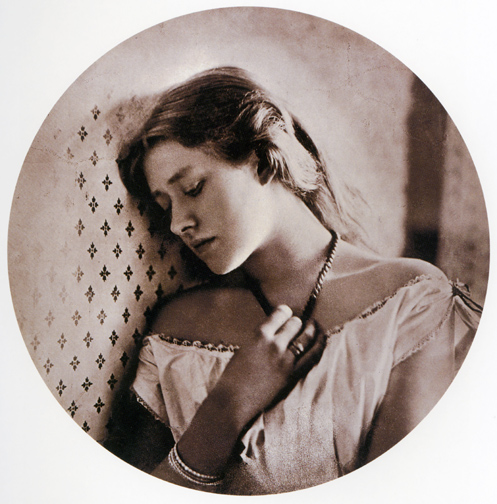
If you are a regular reader, you probably know that I like old photography from the 19th century.  I am constantly fascinated by being able to step into that time period via these images, more so than reading a passage from literature of the time.  There’s something about seeing how the reality of the time is portrayed as well as seeing how our commonality as humans remains over time.  It’s like the difference between picking up a worn book printed in that time, the pages frail and stained with waterspots, and looking through a clear window that somehow takes you back to that moment.  I think this photo shown here is a great example of this.

This photo is called Sadness and was taken by the British photographer Juliet Margaret Cameron in 1864.  Cameron was a Victorian aristocrat who took up photography, in the medium’s relative infancy, at the age of 48.  Over a ten year period she took over 3000 large format images of many of the celebrated figures of the time– Lord Tennyson, Carlyle and Darwin, for example– as well as staged recreations of literary and dramatic scenes.  She moved to colonial India in 1875  at which point her career in photography effectively ended.
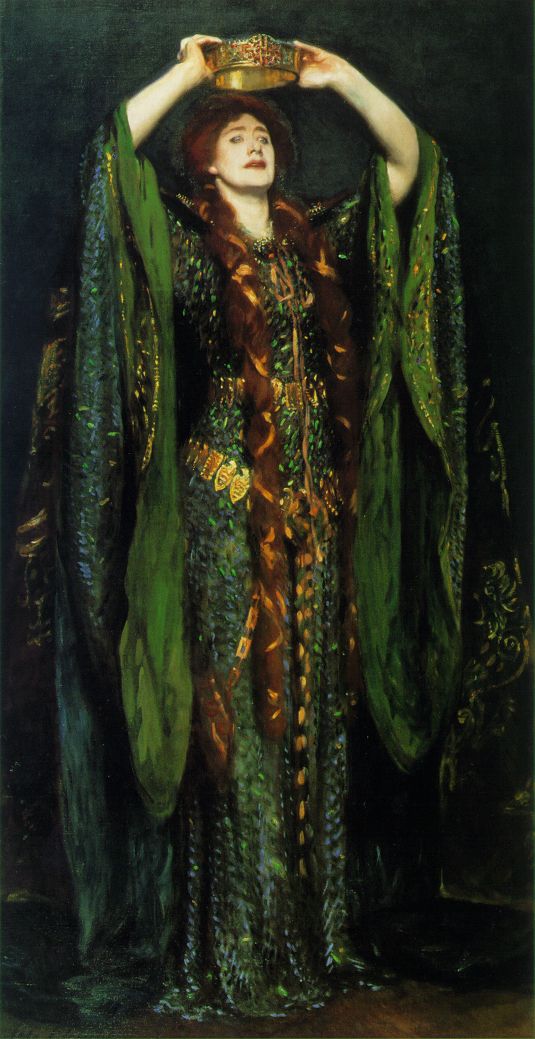
Sadness is an image of the legendary British actress Ellen Terry, who became the most celebrated Shakespearean actress of the 19th century and continued well into the 20th century until her death in 1928, a career that spanned 70 years.  You may not have heard of her but her image as Lady MacBeth was immortalized in this  1889 painting  by John  Singer Sargeant .  In Sadness,  Terry was but a girl of 17 and was about to be married to a much older man, artist George Frederic Watts.  Perhaps the sadness portrayed in this image foreshadowed their short  marriage, which lasted less than a year.

History aside, I find the immediacy and presence of the image very appealing.  I don’t feel as though I am looking back in time.  This could be this very morning.  The humanity in it is great and I can easily feel the moment, could feel myself in the very instant that it was set.  I think this sense of  being set in the now of the viewer is a defining quality of  all great visual art, at least in my eyes.  And this image from Juliet Margaret Cameron has that.

Read Full Post »

This is  a very famous photo by Edward Weston of a nautilus shell that is considered one of the jumping off points for the Modernist movement in art back in the first quarter of the 20th century and one of the great photos of all time, selling a few years back at auction for over a million dollars.  It’s a beautiful and simple image that transcends itself.  I came across it recently along with a mention as to how it came about  when  Weston, on a trip to California,  encountered a painter whose work, particularly in some close up pieces of shell, greatly stimulated him.  Her name was Henrietta Shore.

It was not a name I had encountered  and doing a quick Google search came across a number of striking images that reminded me of Georgia O’Keeffe.   It turns out that she was a contemporary of O’Keeffe and  it was said that Shore’s work had eclipsed O’Keeffe’s when they were exhibited together, something which happened a few times.  Shore also had an incredible painting pedigree, training with the likes of William Merritt Chase, Robert Henri and even John Singer Sargeant.  She had lived in London and New York before moving to California, settling in Carmel around 1930.  Once there, she didn’t show her work much outside of the Carmel/Monterey region  and never really gained the notoriety that came to O’Keeffe.  It was another one of those cases where I have come across amazing talents who have fallen off the wider map for some reason that remains a mystery to me.

There is great sensuality in her work, for instance the human-like twist and feel of her Cypress trees, that I found really appealing, something I try to work into my own paintings.  Looking at Weston’s body of work, I can see the similarity in how he portrayed many of his subjects, finding wonderful beauty in simple twists and curves.

I also liked that she stopped dating her paintings because she  didn’t want them categorized into time frames in her career because she viewed her work and her life as being part of a continuum  that transcended time.  Again, something I hope for in my own work.  How had Henrietta Shore escaped my notice for all these many years?

There’s not a lot of data out there about Shore, at least with a quick search.  She didn’t have a long list of exhibitions after the 30’s and those that she did have were in the Monterey area, so became a sort of regional painter which doesn’t take anything away from her great talent.  It only deprives the rest of us from finding her and finding something for ourselves in her work.  Thankfully, modern technology and the web allows us to stumble across such a wonderful painter long after she has faded from the national stage, even though her work will always live on in the continuum.  Just plain good stuff…


Read Full Post »

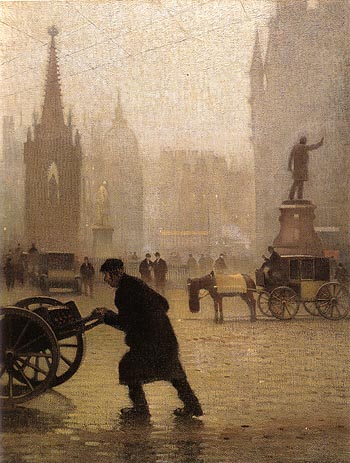
Adolph Valette- Albert Square 1910

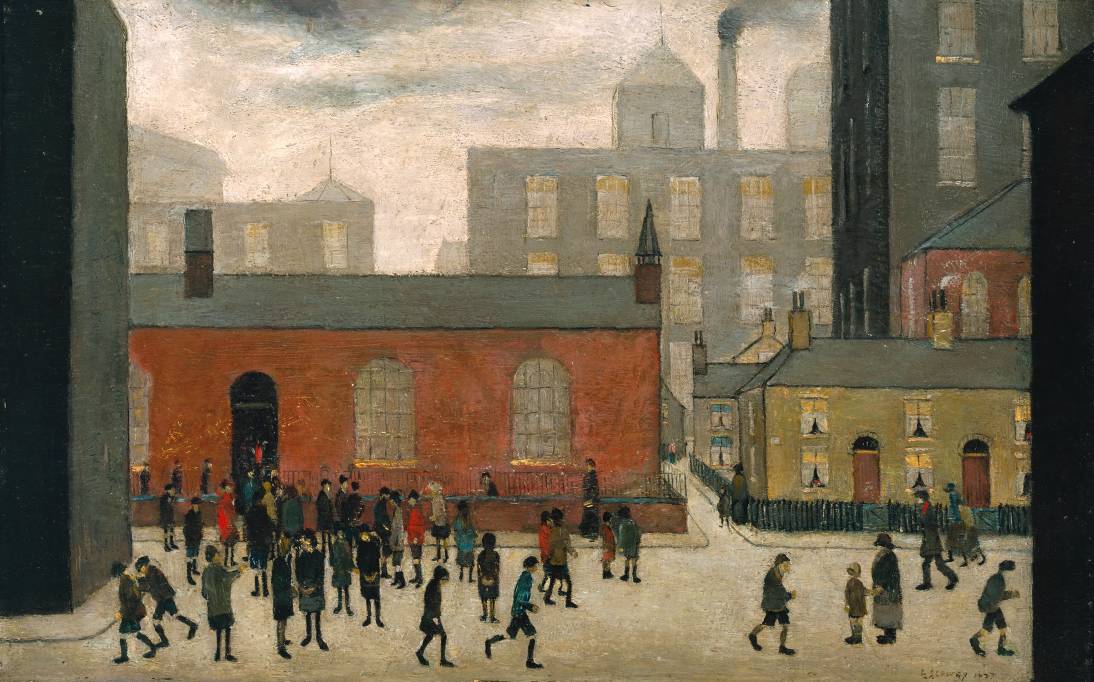
I’m always interested in how artists of all kinds use their influences, about they evolve their own style from the sources of their inspiration.  Back in August, I wrote here about the British painter L.S. Lowry, the man best known for his matchstick men figures and the urban landscapes of his native Manchester.  He is generally considered a self-taught painter despite the many years he spent taking evening classes at the Manchester Municipal School of Art while he worked his days as a rent collector. It’s even more surprising that the critics still attach this self-taught tag to Lowry once you begin to look at the work of the primary influence on him, Adolphe Valette.   In looking at Valette’s paintings, you can see how Valette’s style and eye had a tremendous influence on Lowry.

Valette was a Frenchman who arrived in England in 1904, carrying with him the influence of the Impressionist movement that was in full bloom in France at the time.  He eventually ended up in the north of England, to Manchester, a city at the center of the British industrial revolution.  It’s smoke-filled and foggy landscape provided the perfect inspiration for the hazy and  evocative paintings of Valette and his student, Lowry.  Valette taught for many years there until returning to France in 1928, where he died in 1942 at the age 0f 66.

I’m  surprised that Valette didn’t gain more notoriety for his work , that his name and work wasn’t well known before Lowry’s popularity brought him to light.  The images that I can find are beautiful and strong, rivaling much of the work of his better known Impressionist contemporaries.  I suppose that painting and showing in Manchester in the early 1900’s didn’t provide much access to the salons and museums of the greater art world.  At least Lowry’s recognition has pulled him into the present, giving his influential works greater influence and making them the subject of study.

As it should be.


Read Full Post »

Rhea

I am always stunned by the photos sent back to us from our robotic spacecraft as they explore our solar system.  The sheer beauty and magnitude of these images really puts our own world into a different perspective, one that is humbling to say the least.  The vastness of these shots makes our personal concerns seem small and insignificant yet, at the same time, inspiring.There’s also an elegance to them that is so appealing.

I can’t explain this fully so early in the morning.

This photo from a few years back is one of my favorites.  Take from NASA“s  Cassini-Huygens craft which is exploring around Saturn, this image is like a beautifully constructed abstract painting with cool colors and stark geometry.  Beautiful.  The image consists of one of  Saturn‘s moons, Rhea with the gray atmosphere of Saturn acting as a backdrop.  The image is taken in a way that looks directly at the very edge of the rings of Saturn which creates the black band that cuts across the image.  The result is just a beautiful image, one that I find myself just staring at for long moments at a time while I consider how we fit into this vast puzzle.


Read Full Post »

Well, this year’s Name This Painting! contest has come to an end, as of  several hours ago.  There are so  many worthy titles here.  I’m going to go over the list today and choose the one that I feel fits best.  I will announce the winner tomorrow although it seems hard to say that some of these titles are not winners in some way.  I want to thank everyone who submitted titles.  Your insights and thoughts are really inspirational, believe me.  If I could, I would be sending you all prizes.

So, as I go back to contemplating which title stands out for me, here’s a version of a favorite song of mine, Perfect Day from Lou Reed.  I’ve played his original version before here but this is a bit different.  It’s actually a BBC promo that has multitudes of artists singing lines from the song.  But the power of the song comes through.  Enjoy and come back tiomorrow to see which title wins.

Read Full Post »

It’s that time of the year.  Cooler.  Darker at the edges with leaves coming down.  A   feeling of reflection comes with this turn from summer to autumn and it inevitably brings to my mind  September Song, the old Kurt Weill standard.  It is high on my list of favorite songs and at this time of the year I tend to seek out versions of it that I haven’t yet heard.  There are so many to find by such a wide array of artists, from Sinatra to Lou Reed.

I came across the version below from a guitarist I bet most of us have never heard before, Lenny Breau.  I know that I didn’t know his name or work, which is  a shame given the scope of his talent.  He was a great jazz guitarist who died in 1984 at the age of 43 ,  the result of a murder which remains unsolved to this day.  Another shame.  But he left behind a body of work that is wonderful and his playing is well known in some circles.

His version of September Song comes from a CD,  Boy Wonder,  that was released after his death.  It contains a group of work that he recorded as a 15 year-old  when he was a studio musician in his native Maine.  Beautiful work for such a young player which does this always lovely song great justice.

Read Full Post »

I wrote  here last year about my admiration for the photography of Robert and Shana ParkeHarrison contained in their beautiful book,  The Architect’s Brother.  They are spectacular and moody allegorical images that really captivate the imagination.  What I particularly liked is that they are true photographs– no computer manipulation.  Everything you see is really in their viewfinder.  They create their visions as an old  film producer might have, with elaborate sets  consisting of detailed painted backdrops and theatrical props.  I think that staying away from computer generated effects gives their work a fuller sense of reality and possibility.  Maybe it’s that sense of rightness I often mention on this blog.

Whatever the case, it’s powerful work.  Here’s a neat video I came across that features a very wide cross-section of  the ParkeHarrisons’ work, including works in full color rather than the sepia tones that mark that work in The Architect’s Brother.  These striking images are set to music from Canadian indie band, The Bresnard Lakes.


Read Full Post »

I wrote last week about a   painting, Babette’s Feast,  that was part of a small group of my early formative work on display at the Fenimore Art Museum.  Each of these pieces marked a new step forward in the development of my work that became more and more obvious as the years went by.  The painting shown here, Redstar, is another of this group.

It’s a tiny little piece, only around 2″ tall by 3″ wide but it spoke loudly to me.  It was painted in the format that characterized my early pre-Red Tree work, a larger block of color over a contrasting smaller block of color separated by a white line.  This line was actually just the paper showing through, not a painted line at all.  The distinction of this painting is in the larger block of color that made up the sky.

It was a random pattern of smaller blocks of color that gave the piece a different rhythm and feel that my earlier pieces in this format.  These curved lines that crisscrossed the sky gave it a  texture  that was distinctly different from the smooth, textureless  work I had been producing until this point.  This sparked something in my mind and set me on a path where I sought more and more ways to create texture within the picture.  I saw this texture as an enhancement to the colors of the work, something that gave the color the  added dimensions of depth and complexity-  perhaps the most important elements to the color in my work.

So, while it may be an easy piece to overlook due to it’s diminutive size , it appears  very large  for me.

Read Full Post »

I feel sort of embarrassed to admit this but I had never heard of L.S. Lowry until I stumbled across him the other day.  I am most likely not alone in this but would have thought he would have crossed my radar screen at some point, especially given his prominence in the British art world and in British culture.  Not that I know a lot about British art or culture.  But this is a painter who has sold many works in the multi-million dollar range, one selling for a record $9+ million last last year.  This is not an anonymous artist.

I am still discovering more about this  painter  with a most individual style but here is a very short summation.

He was born in the north of England in 1887 and died in 1976, having spent most of his life as a rent collector for a property company.   Although he is often referred to as a self-taught artist, through much of his working life he studied art in the evenings at various schools. He used this study and the environment around him to find the distinctive style that marked his work, one that is populated with matchstick figures walking through   urban scenes, often heavily filled with images of  the English industrial landscape.

His work has permeated British popular culture as well. His matchstick figures were the basis for a 1967 rock song, Pictures of Matchstick Men, from Status Quo that was later became a hit  here in the States when covered by Camper Van Beethoven in the 80’s. And more recently, the British group Oasis had a video, The Masterplan, featuring the band members as matchstick men walking through animated scenes from Lowry’s paintings. In fact, Noel Gallagher, one of the leaders of  Oasis, has joined a growing chorus of fervent Lowry fans in Britain who have been  calling for greater displays and recognition of the late painter’s work there.  As a result, the Tate is mounting a major retrospective of Lowry’s work for 2013.

There’s a lot for me to like about Lowry which makes just finding him now more puzzling. But I have found him and will continue to learn more.  For now, here is the both the Status Quo song and the Oasis video.

Read Full Post »

A friend posted one of my favorite songs online a few weeks back, the Nat King Cole version of  Irving Berlin‘s classic What’ll I Do.  As with just about anything Nat King Cole performed,  it’s a great rendition of the song.  I have heard numerous versions of this song  as it has been recorded by hundreds of artists since Berlin wrote it in 1923 and, for the most part, they’re all wonderful- a tribute to Berlin’s skill as a songwriter.  But I wanted to hear one that I hadn’t come across yet .

I found a version from the  great  Chet Baker, the late Jazz musician who  I mentioned briefly in a post earlier this year.  I find him a fascinating subject.  His story is tragic and the images of  his physical change through the years from the ravages of drugs and violence are heartbreaking.  As a young lion of the jazz scene, he was truly the Golden Boy, strikingly handsome and hugely talented, and you can see life beat him down in the photos over time.  There’s a worn down sadness in his being that makes a perfect match for the melancholy tones of a song like this.

Give a listen on a slow and quiet Saturday morning…

Read Full Post »

« Newer Posts - Older Posts »