Feeds:
Posts
Comments

Archive for the ‘Favorite Things’ Category

I recently came across this piece of writing from Eugene V. Debs that struck a chord with me, reminding me of this particular painting from a few years back, The Heart’s Standard Bearer.  I think it captures what I would like much of my work to represent– the flag of high hope and high resolve, as he puts it.  I know that in these politically divided times invoking the name of Debs is probably a risky proposition.

He was, after all, a prominent Socialist, a term which raises the hackles of many, most who have no true idea of what it truly means or has represented in the not-so-distant past.  Debs, who lived from 1855 until 1926, was absolutely committed to the fight for fairness and rights for the poor and the working class, spending several stints in prisons over the course of his life for the stands he took.  He ran for president from his cell in 1920, the last of the five campaigns he led for the high office as the candidate of the Socialist Party.  You may cringe at the current populist interpretation of socialism, but you should realize that we have all benefited from the efforts of Debs and others like him who fought for living wages and decent working conditions for all citizens and against exploitation of all sorts.

I am often asked why I use the color red in many of paintings.  Red trees.  Red chairs. Red roofs.  Red fields. I always struggle to describe what meaning it has for me.  But reading this made me feel that the red in many of my paintings might somehow be, as described in Debs’ words, the pure red that symbolizes the common blood of the human family, the equality of mankind, the brotherhood of the race.

Debs’ The Crimson Standard was published in 1905 in Appeal to Reason, a weekly progressive/socialist publication of the era that featured the writings of Upton Sinclair, Jack London and Helen Keller.  It was an extremely popular magazine, with the fourth highest circulation of any weekly at the time.  As I said, socialism was not the anathema then as now.

**************************

A vast amount of ignorant prejudice prevails against the red flag. It is easily accounted for. The ruling class the wide world over hates it, and its sycophants, therefore, must decry it.

Strange that the red flag should produce the same effect upon a tyrant that it does upon a bull.

The bull is enraged at the very sight of the red flag, his huge frame quivers, his eyes become balls of fire, and he paws the dirt and snorts with fury.

The reason for this peculiar effect of a bit of red coloring upon the bovine species we are not particularly interested in at this moment, but why does it happen to excite the same rage in the czar, the emperor and the king; the autocrat, the aristocrat and the plutocrat?

Ah, that is simple enough.

The red flag, since time immemorial, has symbolized the discontent of the downtrodden, the revolt of the rabble.

That is its sinister significance to the tyrant and the reason of his mingled fear and frenzy when the “red rag,” as he characterizes it, insults his vision.

It is not that he is opposed to red as a color, or even as an emblem, for he has it in his own flags and banners, and it never inflames his passion when it is blended with other colors; but red alone, unmixed and unadulterated, the pure red that symbolizes the common blood of the human family, the equality of mankind, the brotherhood of the race, is repulsive and abhorrent to him because it is at once an impeachment of his title, a denial of his superiority and a menace to his power.

Precisely for the reason that the plutocrat raves at the red flag the proletaire should revere it.

To the plutocrat it is a peril; to the proletariat a promise.

The red flag is an omen of ill, a sign of terror to every tyrant, every robber and every vampire that sucks the life of labor and mocks at its misery.

It is an emblem of hope, a bow of promise to all the oppressed and downtrodden of the earth.

The red flag is the only race flag; it is the flag of revolt against robbery; the flag of the working class, the flag of hope and high resolve – the flag of Universal Freedom.
Read Full Post »

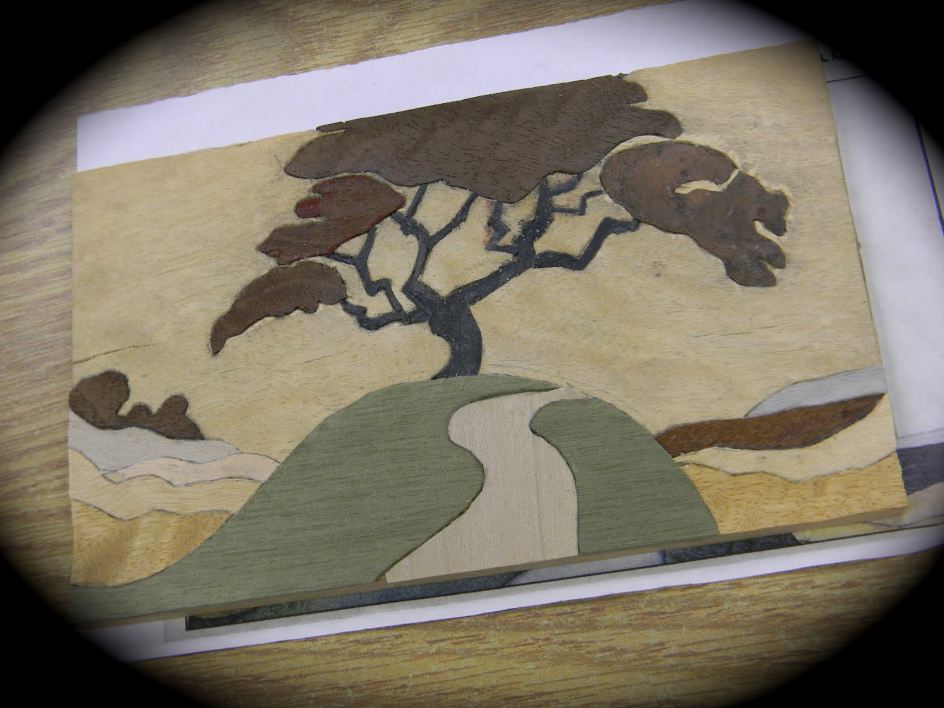
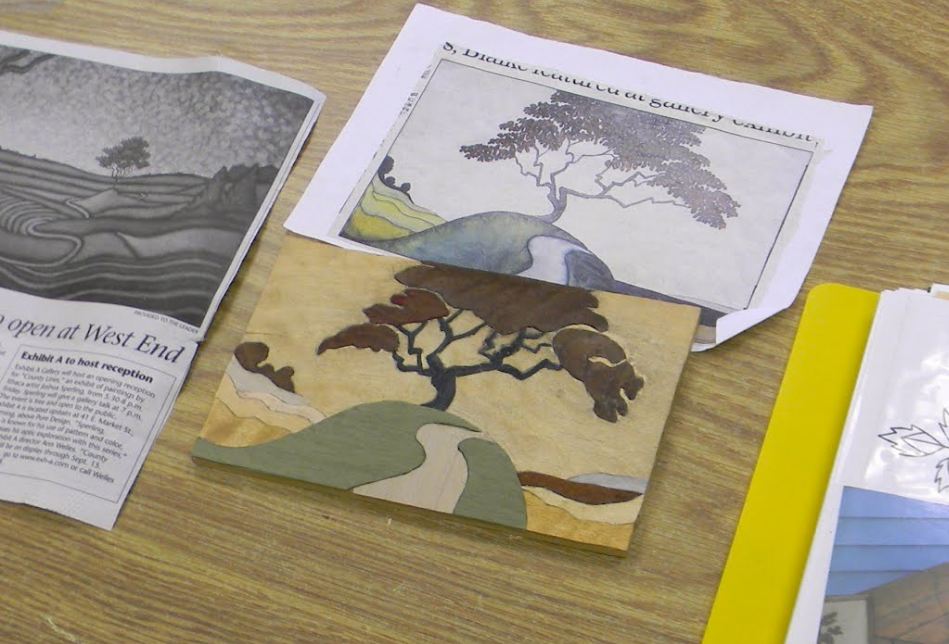
Back in February of this year  I wrote here  about a friend telling me of a group of folks at the Corning Senior Center who meet weekly to practice the art of marquetry, the inlaying of wood to create pictures.  He told me that there were some there who regularly copied my work with their work.  I have not had a chance to visit the Center yet but mentioned the marquetry group a couple of weeks ago at my Gallery Talk at the West End Gallery, explaining how flattered I was by this.

Afterwards, a friend in attendance, Kathleen Richardson, said she was in and out of the Center on a regular basis and would check it out.  A few days later Kathleen, who writes a blog called Corning NY Step by Step which documents her discoveries as she walks about the city, posted an article documenting the work of one of the folks who practiced the marquetry of which I had spoke, a woman by the name of Nellie Telehany.

Nellie Telehany at Work

There were several photos showing Nellie at work and a piece in process, including showing how she would transfer the composition from an image printed in the newspaper by tracing it on  an overlaid clear sheet of acetate.  It was great to see how well she captured the essence of the paintings with her work and I have to admit to being very flattered, thinking how neat it is that this piece of marquetry will be around somewhere for many years to come.  If my paintings are my children, then these must be grandchildren. Cheri, my wife, was even more effusive in her praise of the work– more so than she is for my own work!

Thanks, Kathleen, for looking up Nellie at the Senior Center and showing her work on your blog.  And a big thank you to Nellie for making such lovely work from my images.  I love your work and hope you’ll continue.  I look forward to meeting you someday soon and seeing your work.


Read Full Post »

Release

I’m in the studio on a Sunday morning and itching to get back to work.  Sounds like a good time for a musical interlude, something bright and positive.  This song  comes to mind.  It’s from Laura Marling, a young British singer/songwriter that I highlighted here back in December.  It’s titled All My Rage and, despite the title, is quite upbeat, with a line that serves as a mantra:  I leave my rage to the sea and the sun…

Good advice.  Have a great Sunday.

Read Full Post »

There is usually a piece or two in most of my gallery shows that never get the attention that some of the other paintings despite the fact that I often think they are really strong and are often some of my personal favorites.   It may be that the strength that I’m seeing is based on a different criteria than that of the average viewer.  Maybe I am influenced by my knowledge of the history and process of the painting.  Or maybe it is one of those instances where a painting has to find the place and time to shine fully.

The painting above is one of these pieces.  Called Captain, it is a 12″ by 36″ canvas that is part of my current West End Gallery show, which hangs there until the end of August.  It was a piece that really hit for me when I was painting it.  I liked the color and motion of the trees in the foreground that reminded me of dance.  The Red Tree seemed to be standing back,observing and supervising the movements of these dancing trees.  A sort of choreographer or dance captain, from which the title is derived.

There’s a lovely color harmony in this piece, at least for my eyes.  There is a mix of contrasting  richness and transparency in the colors that makes the piece very musical for me.  I can’t explain this fully and it sounds a bit goofy to even write this but seeing this painting reminds me of a piece of music, the dancing trees turning into  notes that hover and dance above the lines of the musical staff.

Maybe it’s this lack of a single explanation that makes this painting an enigma for me.  I see a lot of things here and hope that someone someday discovers it for themselves.

Read Full Post »

Ulysses Davis- Lost Tribe in the Swamp with Alligators

I recently came across the work of another folk/outsider artist whose work really resonates with me.  It is by Ulysses Davis, a barber who lived in Savannah, Georgia, passing away in 1990 at the age of 76.  His medium was woodcarving and over the course of his life he created a very diverse body of work that had both the simple and free feel of the Outsider artist’s vision and the compositional sophistication of a fine artist.  His subjects covered a wide spectrum,  ranged from the fantastic to straight portraiture including a series of busts of all of  the US Presidents up to the year of his death. Very striking stuff.

Ulysses Davis- No No Bird

He  seldom sold his work, saying “They’re my treasure. If I sold these, I’d be really poor.”   As a result, his work never garnered the exposure or the recognition it deserved although he did receive a few honors before his death, his work showing in an important 1982 exhibit of modern Black Folk Art at the Corcoran Gallery of Art in Washington, DC.  In the years since, the American Folk Art Museum did mount a retrospective of his lifework in a 2009 exhibit called The Treasure of Ulysses Davis,  the title playing off of Davis’ own words on his work.

And what a treasure it is, one that we are fortunate enough to at least share in images and in a few museums.  Beautiful work with a unique vision…

Ulysses Davis- Get Off My Back


Read Full Post »

Last week I had a post that featured a photo of a French boy with cigarette and rooster that I found interesting.  It was from Luminous Lint, one of my favorite sites that features great and historic photography.  But I also love looking at some other photo sites that feature vernacular photography.  Everyday stuff.  Posing around the Christmas tree or day at the beach family photos that  often have an unusual quality that I’m sure  that the people who originally took the photos never expected or even noticed.  Probably the latter since most of these sites pick up most of their photos from flea markets.  Not all of the photos have any artistry at all but there is often humor, humanity or have an air of mystery around them that conjures up all sorts of possible stories about them in one’s mind.

One such site is The Boat Lullabies which is ran by the person behind Square America, a downed site that was amazing and one that I documented here several times over the years.   Then there is Accidental Mysteries from the collection of John and Teenuh  Foster which features found photos that really do have a mysterious quality about them.  Time Tales is a  neat Dutch site that features photos from around the world that are categorized into time frames.  And there’s Big Happy Funhouse  which offers found photos and free pie and GargantuaPhotos which has vintage photos for sale, including the photo below of Rivets, the terrier whose photo lists him as being the mascot of the USS Nitro in 1945.


These are all great sites where you could spend way too much time so be careful.  But do give them a minute to at least let your mind take in some of the imagery and let your imagination off of its leash for a bit.  I guarantee you will find at least one thing that will make you smile or at least feel as though you might somehow know these people or have worn that same goofy Halloween costume.

Have a great day…

Read Full Post »

Well, another opening has passed.  The West End Gallery show went well the other night, thanks to everyone who came out.  I couldn’t be more appreciative for people taking time to visit and look at my work.  It makes  all the time and effort feel worthwhile.

The show hangs together really well with a great deal of color and warmth cast from the walls.  One piece that drew a lot of comments is the painting shown here, a 16″ by 20″ canvas called Air of Mystery.  It has a real presence on the wall with its strong color and purple fingers of cloud reaching across the moon/sun that sheds light on the patchwork fields on the distant hills.  A blood red field that makes up the foreground adds to the mysterious feel of the piece.

I don’t really know what it means yet and, for the time being, I’m content with that.  I’m going to take a few minutes to relax this morning, drink my coffee, read the newspaper then do a little painting.  A good Sunday morning and I feel like I’m reflecting light which happens to be the title of a Sam Phillips song from several years back that always makes me stop and listen when it comes up on my playlist. Maybe it’s that line: Now that I’ve worn out the world/ I’m on my knees in fascination.  It has it’s own melodic air of mystery. It’s from an album, A Boot and a Shoe, produced by her then husband T-Bone Burnett,  that I like very much.  Here it is:

Read Full Post »

I have painted several pieces over the past few years based on the mythic tale of Baucis and Philemon, taken from the Metamorphoses from the Roman poet Ovid.  I have described the story here several times of the visit  to a village by Zeus and Mercury, disguised as beggars.  They are roughly tuned away from every door in the village until they come to the home of the poor elderly couple, Baucis and Philemon, where they are welcomed with warmth and gracious hospitality despite the  poverty of their household.  Sparing the couple as he destroys the village in his wrath, Zeus then grants them any wish they might desire.

They choose to be allowed to stay together for eternity.  When they pass away simultaneously years later, they are resurrected as two separate trees that grow from the same trunk, united forever.  It’s a lovely fable and one of my favorites.  I have always chose to depict this story simply, with two trees, one red and one green, intertwined together.

I call  this painted version The Gift of Zeus.  It is a n 18″ by 18″ canvas that is headed to the West End Gallery for my annual solo show there which opens next Friday, July 20.  There’s a crispness in this piece that I find very appealing as well as interesting contrasts and subtleties in the sky, which may not show up well in the photo here, that give this piece a dramatic edge that catches my eye each time I pass by it in the studio.

Read Full Post »

I thought I had mentioned the work of photographer Paul Strand here before but can’t seem to locate it.   Strand lived from 1890 until 1976 and was part of the Modernist era of the early 2oth century, using his camera to capture the urban landscape’s abstracted forms in a way that no photographer had to that time.  The image shown here, Wall Street, is perhaps one of his most famous.

His portraiture is also quite striking.  Doing a Google image search, the page is immediately filled with multiple fairly closely cropped images of  faces in black and white.  They’re shot in a way that might make you think it would be difficult to discern any particular photographer’s eye but seeing them altogether shows clearly how he saw his subjects and show the continuity in his work.  Strand was a student of the great Lewis Hine and carried on Hine’s use of the camera as a tool for social reform.  His photos of the inhabitants of the city streets are powerful and gritty.

One of his projects was a film, Manhatta,  with the great Modernist painter/photographer Charles Sheeler, another of my favorites.  It is a really interesting view of the bustling, swelling city from 1921 taken from Strand’s and Sheeler’s unique perspectives.  Just great imagery.

Read Full Post »

It’s fitting that on this American holiday that we mark the passing of an actor who represented an idealized slice of Americana.  Andy Griffith, who died yesterday at the age of 86, was best known for his portrayal of Sheriff Andy Taylor on The Andy Griffith Show.  On the show he and his deputy, the immortally funny Barney Fife, prowled the mean streets of Mayberry, a gentle North Carolina that has come to symbolize  America’s rural past for many.  Andy administered an equally gentle brand of justice with folksy common sense  and patience.  Of course, no real town could live up to the idyllic nature of Mayberry where everyone got along and even Otis the town drunk was lovably comic but it didn’t matter.  It was a lovely comic fantasy that was easy to buy into.

I know that I did.  I can still watch the show and laugh out loud or be touched when Andy straightens out Opie with a folksy moral tale.  A pure slice of goodness.

The flipside of that goodness was exhibited in Griffith’s performance in the 1957 film from Elia Kazan, A Face in the Crowd.  It’s a dark satire that chronicles the rise of Griffith’s character Lonesome Rhodes from drifting drunkard to a national media star  with great influence over public opinion that he wields in a cynical fashion.  Lonesome Rhodes is a classic film character, a larger than life personality that is a little over the top  with a veneer of charm and charisma that hides a truly nasty inner core.  He’s a far cry from anyone ever seen in Mayberry.   A Face in the Crowd is a great, great film that still rings true today.  I periodically hear rumors of people wanting to remake it today and I always hope that they let it be as it is.  I don’t think you could have a better Lonesome Rhodes than Andy Griffith.

Have a great 4th of July.  Here’s a taste of Lonesome Rhodes:

Read Full Post »

« Newer Posts - Older Posts »