Feeds:
Posts
Comments

Archive for the ‘Favorite Things’ Category

I wrote last week about the work of the Chicago-based artist Roger Brown, who was part of the Chicago Imagists which were a group of artists who were inspired by the pop imagery of comic books as well as surrealism.  Another artist who was in this circle was Jim Nutt, born in 1938 in Massachusetts and educated at a variety of universities including the Art Institute of Chicago, where he met his wife, artist Gladys Nilsson.  He has lived and painted in the Chicago area since the 1960’s.

Nutt’s early work in the 60’s and 70’s was very much in the comic book/pop art style with bold, flat colors that were often harshly contrasting and fantastic imagery bordering on the bizarre, as can be seen here in the image to the left.  It’s strong, exciting  work but for me the more interesting part of Nutt’s career has been his obsessive, repeated painting of a single imaginary female portrait over the past twenty-five years.  He spends nearly a year neticulously painting  each of these portraits of a woman with a hairdo that evokes the 1940’s and a most unusual large nose that is typically colored in direct contrast to the rest of the woman’s face.  He paints these works in thin acrylic paint with tiny brushes which accounts for the long time frame for each piece.  The resulting work, as a result of this technique, is meant to be seen up close where they reveal their refined surfaces and subtle tones, revealing beauty that belies the sometimes grotesque appearance of the image from afar.

I am always drawn to the artist who repeatedly revisits a form, finding something new in each new foray.  This subject of Nutt’s may be the same image he sees in his mind but each piece is decidedly different  in presentation and feel.  And, while I feel his early work is interesting and distinctive, it is this obsession that has held Nutt for the past 25 years that defines Nutt for me.

Read Full Post »

Oh, it’s that time of the year once more.  Pitchers and catchers reporting to warm southern sites.  The first tentative soft toss of the ball and the swing of the bat.  Spring training is starting and for diehard baseball fans  it is the true beginning of the year, a time when the disappointments of last year are wiped from the slate and all that remains is the giddy hope that your team will experience that special year this year, topping it all off with a World Series crown.  It is, for me,  the best and most hopeful time of the year.

The photo I’m showing here may seem at first glance to have little to do with baseball but it is from a very important goodwill  tour of Japan that American players took in 1934.  Lasting a full month, it featured some of the best players of the day but by far, the biggest draw was the Sultan of Swat, Babe Ruth.  The crowds were massive wherever he appeared, with his every movement drawing oohs and aahs from the adoring Japanese fans.  This photo is from a parade from the Ginza in Tokyo which drew over 500,000 fans.  Most baseball historians mark this tour as the beginning of the baseball mania which still remains in Japan today.

I think it’s events like this that make me such a baseball junkie.  I mean, there’s  so much than just the game, which itself  has a Zen-like perfection in its geometry and a unique skillset  that allows players of any size to excell.  I mean, in what other sport can a 150 pound man utterly dominate a player that is a foot taller and  a hundred pounds heavier?  But it’s the  interweaving of the game with our history and our day-to-day lives through the past 150 years or so that also makes it different than other sports.  It has an ingrained tradition that  lives with us, existing in the same rhythm of our lives.  It is mythic with players like the Bambino who were larger than life and whose appeal made entire nations want to emulate him.  It inspires poetry and music.  It is, like those first days of spring training, all about hope and possibility.

It makes me want to smell the fresh cut grass of a ballpark.

Babe Ruth at the Meiji Shrine 1934

For more info on the 1934 tour of Japan, there is a book titled Banzai Babe Ruth: Baseball, Espionage, and Assassination during the 1934 Tour of Japan from author Robert K. Fitts.  It documents all the aspects of this famed tour including what might be the first mission in espionage from Moe Berg, the Princeton educaated Detroit Tiger catcher who was an OSS (forerunner of the CIA) operative during WW II.  See? History!  There are excerpts from this book here.

Batter up!


Read Full Post »

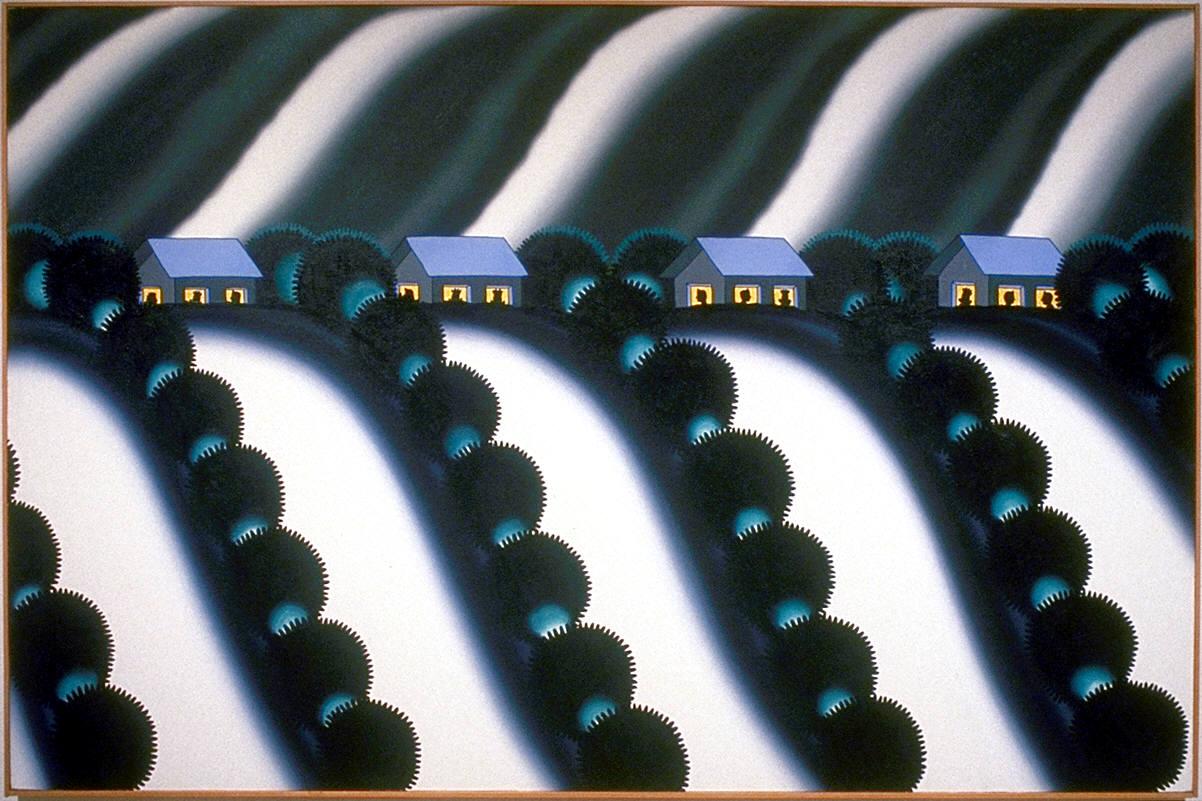
I was looking up something totally unrelated to his work when I stumbled across the paintings of Roger Brown, a painter who was one of the group of Chicago Imagists, an informal school of art in the late 1960’s that had it roots in comic book art, Surrealism and  Primitivism.  The work was highly individual and always bold in style and statement.  When I saw Brown’s images, I wondered how I had missed him before.  Strong work with big rhythmic patterns.  Just plain good stuff that turns my wheels.

Brown was born in Alabama in 1941 and came to Chicago in 1962 to study at the Art Institute of Chicago and remained a resident of the Windy City until his death in 1997 from liver disease at the age of 55.  I can’t give a lot of info here about his biography as I am still learning about his life and work myself.  I will let his images tell the story here .

Read Full Post »

I’ve been working on my large painting, as I have noted in the past few posts here.  I decided to take a few moments this morning to explore one of my favorites sites at the Foundation for Self-Taught Artists, just to browse for a bit to maybe clear my mind before jumping into today’s work.  I always love browsing the work here, feeling a real affinity with the artists here who often followed a circuitous route to their artistic lives and their personal visions .

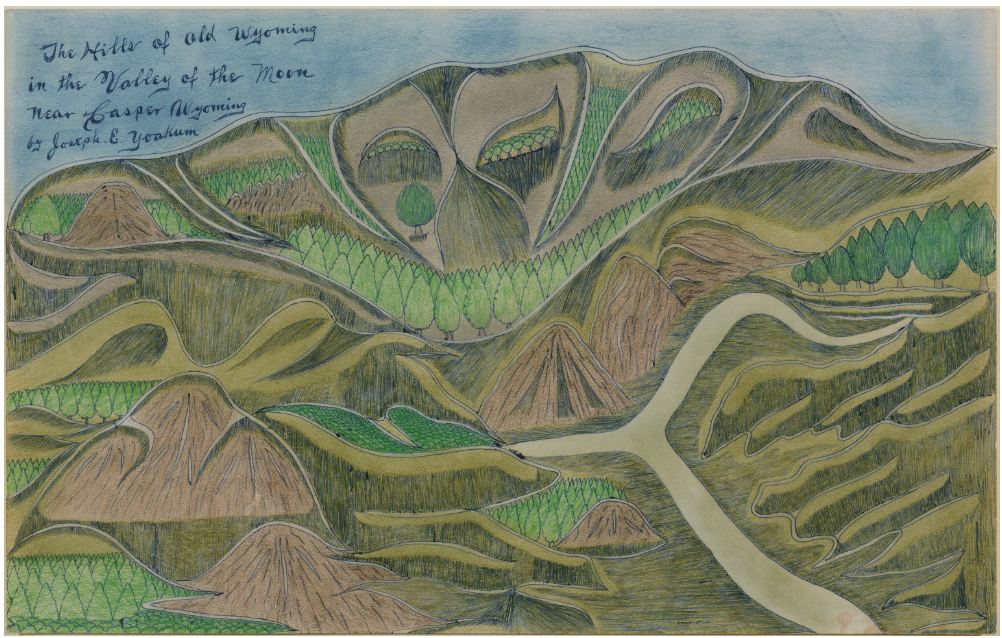
As I clicked through the work, a greenish colored landscape caught my eye.  Called The Hills of Old Wyoming, it immediately reminded me of the piece on which I was working.  I mean, there are obvious differences in the composition and the manner in which it was rendered, but there was something familiar in the manner, the rhythm, in which the artist portrayed the landscape– the hills, the trees and the roads.  I understood his vision in much the same way I understand and see my own.  Makes me feel that there is a commonality of perception in the rhythm of the landscape that compells some, like this artist, Joseph Yoakum, and others, such as myself,  to put down how they perceive the world around them.

Here is a little biographical background from the Foundation’s site:

1890–1972, lived and worked in Chicago, Illinois

Joseph Yoakum arrived at art in his later years, making approximately 2,000 small-scale drawn landscapes in the last decade of his life. Unlike many self-taught artists, he enjoyed at least a modest amount of appreciation and remuneration from the art world before he died in 1972. While much of Yoakum’s biographical information cannot be verified, he was likely born in 1890 in Missouri to parents of African, French, and Cherokee descent (although he claimed he was born in 1888, in Arizona, to a Navajo family). The artist said that, at age nine, he ran away to join the circus and later traveled the world as a billposter. Upon his return as to the United States, he settled first in Missouri and finally in Chicago. He began drawing in the 1950s, and in 1967 his imaginary landscapes came to the attention of the Hairy Who and Imagist circle of the Art Institute of Chicago. Artists Ray Yoshida, Jim Nutt, and Whitney Halstead praised and promoted Yoakum, who was granted a solo show at the Whitney Museum shortly before his death in 1972. 

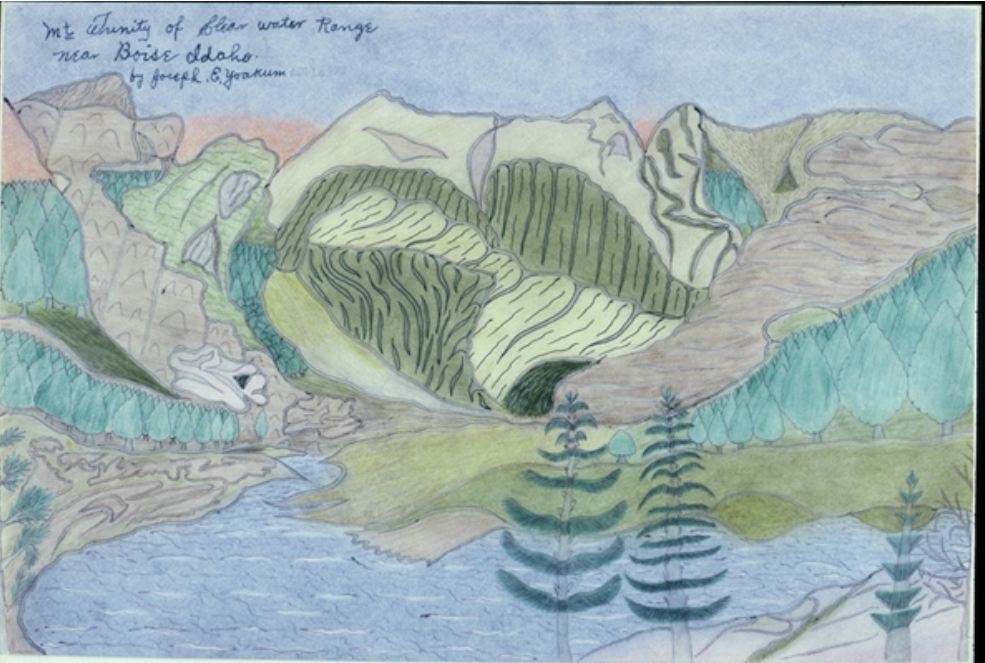
A proud world traveler and a deeply spiritual man whose beliefs embraced both Christianity and Navajo animism, Yoakum instilled in his work elements of travelogue and revelation. Usually rendered in ballpoint pen and colored pencil, and then buffed to a shine with toilet paper, these evocative drawings feature a refined color sensitivity, a sublime sense of compositional balance and symmetry, and a sinuous organic line. Most of his drawings include inscriptions indicating the location of the drawn scenes, though the depicted landscapes bear no resemblance to the actual named locations.


Read Full Post »

I’ve been a fan of the work of Chuck Close for some time, admiring the grand scale that much of his work assumes as well as his evolution as an artist, especially given his challenges after a spinal artery collapse left him paralyzed from the neck down in 1988.  He regained slight use of his arms and continued to paint, creating work through this time that rates among his best.  He also suffers from prosopagnosia which is face blindness, meaning that he cannot recognize faces.  He has stated that this is perhaps the main  reason he has continued his explorations in portraiture for his entire career.  The piece shown here is a portrait of composer Phillip Glass that was made using only Close’s fingerprints,  a technique which presaged his incorporation of his own unique form of pixelation into his painting process.

His determination to overcome, to keep at it, is a big attraction for me and should be an object lesson for most young artists (and non-artists, also) who keep putting off projects until all the conditions are perfect and all the stars align.  Waiting for the muse of inspiration to take them by the hand and lead them forward.  Sometimes you have to meet the muse halfway and Close has this advice for those who hesitate:

The advice I like to give young artists, or really anybody who’ll listen to me, is not to wait around for inspiration. Inspiration is for amateurs; the rest of us just show up and get to work. If you wait around for the clouds to part and a bolt of lightning to strike you in the brain, you are not going to make an awful lot of work. All the best ideas come out of the process; they come out of the… work itself. Things occur to you. If you’re sitting around trying to dream up a great art idea, you can sit there a long time before anything happens. But if you just get to work, something will occur to you and something else will occur to you and something else that you reject will push you in another direction. Inspiration is absolutely unnecessary and somehow deceptive. You feel like you need this great idea before you can get down to work, and I find that’s almost never the case.

Amen to thatThe process provides the inspiration.  I’ve stumbled around for some time trying to say this but never could say it as plainly and directly as Close has managed.  Thanks, Chuck.  I think I’ll take your advice and get to work.

Read Full Post »

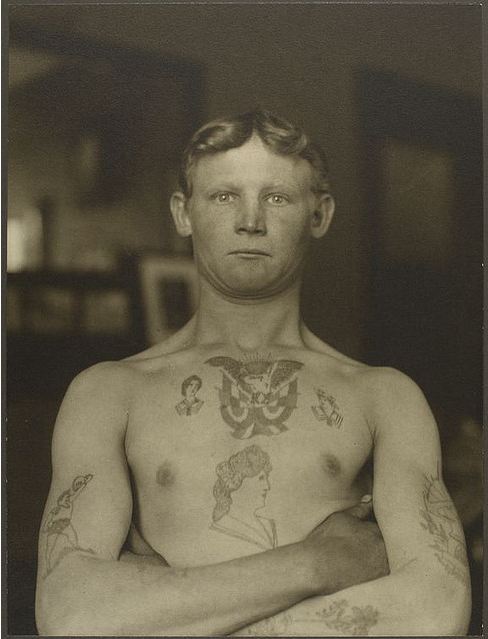
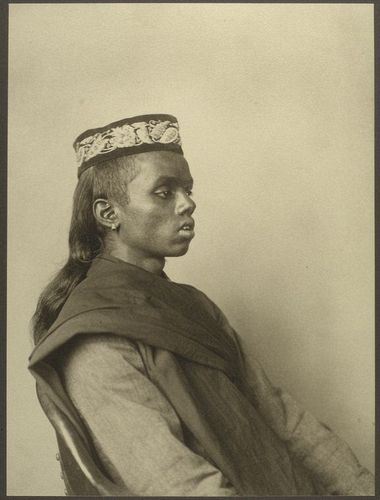
This photo caught my eye recently.  It’s a shot of a Romanian piper, most likely a shepherd, taken around 1906.  It was taken by Augustus Francis Sherman, a registry clerk who worked at Ellis Island, the primary processing point for immigrants coming to America around the turn of the early 20th century.  Sherman was an amateur photographer who would sometimes document those would-be immigrants who were detained at the facility as the officials determined whether they would be allowed to enter the country.  Sherman would ask the detainees to don the clothing of their native country so he might document them during their time at the Ellis Island,which might be hours, days or even weeks.   Some of these subjects made it through and others were deported.

Seeing this photo and others taken by Sherman made me wonder about these folks as they posed in their native garb.  If they made it through the  immigrationprocess, how did they make their way in America and where is their family now?  This Romanian man with the flute– what became of him?  What was his new occupation? Was this perhaps the last time he ever wore the clothing of his earlier life?  And what became of this group of Cossacks, shown to the right?  I wonder how their new life here differed from that one they left behind, where they donned such large knives.  Are their descendants aware of these photos?

As I said, some of these portayed by Sherman did not make it into America, at least at that time.  Some had physical ailments or mental illness and some, like the young German man with the multiple tattoos shown to the left, came as illegal stowaways and were immediately deported back to their native land.  I wonder how many of these deportees came back and tried again?

Sherman’s photos have been the subject of a number of exhibits over the years.  Though he was untrained, he had an ability to see the individual humanity that was sometimes lost in the masses that were paraded before him.  He was able to capture the pride and dignity in his subjects at a time when they were under great stress as they awaited the decisions on their futures here.  I find them fascinating, both as a documentation of the many diverse  peoples who built this country and the innate human drama in the process.

Though provoking.

Read Full Post »

Once again, I came across a painter from the past of which I knew absolutely nothing.  That is nothing new but when I first saw these paintings I was shocked he was unknown to not only me but to most other people as well.  Actually, his biography is pretty thin in content but the sheer power of his work makes up for it. 

 His name was Thomas Chambers and he was born in England in 1808, probably training there as a decorative painter for the theatres of London.  He popped up in the States, in New Orleans, in 1832, filing for American citizenship.  Over the next few decades he moved along the Atlantic Coast and New England working as a landscape and marine painter as well as a fancy painter, meaning that he also painted  objects such as mirrors and furniture in a decorative fashion.  After the death of his wife in 1866, he returned to England, where he died in 1869.  He never really prospered as an artist, just scraping by for most of his life.  He died in an English poorhouse.

All of that seemed impossible to believe when I first saw his work.  It was unlike anything I had seen from that era.  They felt like folk art but with a stylized sophistication that displayed a distinct and fresh voice.  They seemed so modern, feeling to me as though they were perhaps 75 years before their time.  The colors were powerful.  The forms were stylized and rhythmic, the skies often having wonderful whirls of clouds and light.  Looking at some of these landscapes, I could believe that they were influenced by some of my heroes such as Thomas Hart Benton and Grant Wood even though I know that this is impossible because of their age.  I wondered if some of the more modern painters had come across his work or if his work was merely a similar artistic evolution, just earlier, isolated in time.

It’s hard to believe that this work was practically unknown until around 1940 when a group of his paintings were found in upstate NY.  How something this dynamic and modern in feel could slide by unnoticed is a mystery.  The first major museum exhibit of Chambers’ paintings was only held in late 2009/early 2010 at the American Folk Art Museum in NYC. 

There’s a good article from the NY Times that offers a good overview of Chambers’ life as well as a review of this museum show that I found very interesting, particularly when the author, Roberta Smith, writes about the works included in this exhibition of other painters who were better known contemporaries of Chambers, such as Thomas Cole and William Matthew Prior.  She writes:  This exhibition includes landscapes by other artists, including Cole, Thomas Doughty and William Matthew Prior, but don’t be surprised if you pass them by. Chambers’s work may lack the historic pedigree and national symbolism, say, of Cole’s paintings, but on the wall, it’s no contest.

As I said, potent stuff.  I’m hoping to find out more about Chambers but for now I am basking in these rich images. 

Read Full Post »

I came home from my roadtrip last week and decided to take a few days off from the blog.  It was a pretty good trip, even with some iffy weather for travelling, that crossed some of the flat, open  farmlands of the midwest.  Heartland. On this trip,  I was especially encouraged by my visit to Watts Fine Art.  The gallery is located in Zionsville, a bedroom community just a bit north of Indianapolis.  The village is a lovely place having a compact and very inviting commecial district with brick-paved streets lined with shops, galleries and restaurants.  Just a charming and very comfortable place.

I was especially pleased with the gallery.  It is a great space and the owners, John and Shannon Watts, have assembled a very eclectic mix of  talented and very distinct artists from around the country.  As an artist, I am always concerned with how my work fits in with a gallery’s lineup of other artists, desiring a high level of quality as well as a variety of styles.  Even though I might feel confident about the strength of my own work, I realize that the overall strength of a gallery’s talent affects how those who come into the gallery view my work.  I always like to be hung near what I consider the best work in a gallery, believing that a gallery is remembered either by its best work or its weakest.  I prefer to be surrounded by the better work.

 I was really pleased with the group of artists at Watts Fine Art.  They came from many differing genres and all had very distinct styles and voices.  I immediately felt that my work would fit well within this group.  Although I liked almost of the work there, there were several that really stood out for me.  For example, they had a couple of beautiful pieces from Fatima Ronquillo , a self-taught artist now residing in Santa Fe,  that have the feel of the fine folk art portraits of the 19th century mixed with a sense of whimsy.  Beautiful surfaces.  Shown to the right  is her Lady With a Marvelous Pig, a painting that my eyes kept coming back to during my visit.

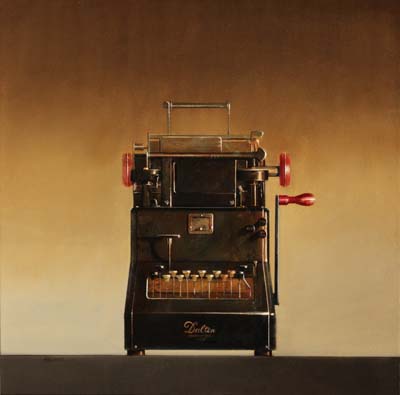
I also really liked the moods created by the paintings of Wendy Chidester, a Utah artist whose beautifully rendered still life pieces often evoke a sense of nostalgia.  Old typewriters, adding machines and vintage luggage populate her pieces and allow you to find something more beneath the surface appearance of these objects.  They also have beautiful surfaces.  Shown to the left is her Dalton on Brown.

There were several more artists who I could easily point out here but I think these examples will suffice for now.  Just really good stuff.  I am pleased and honored to be hanging alongside this group of artists, glad to be well represented in the heartland.

Read Full Post »

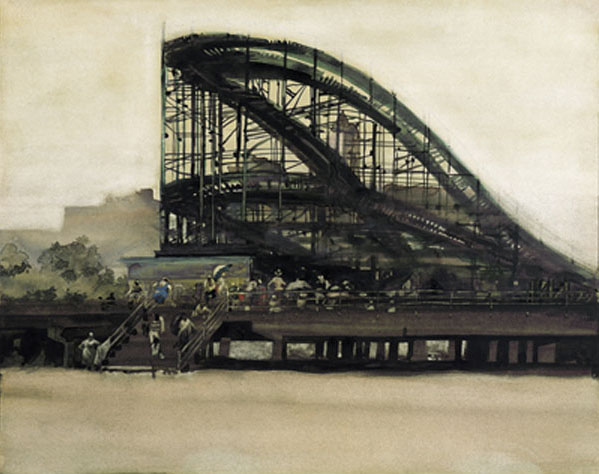
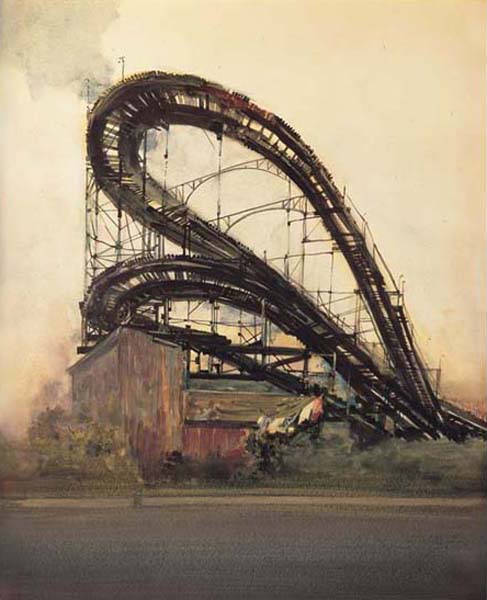
I’ve written here before about the work of David Levine, the late artist best known for his wonderful caricatures of public figures and politicos that graced many magazines for several decades, writing once about a caricature of composer Richard Wagner and another time about a painting of a pig’s head .   Despite his fame as a pen-and-ink caricaturist,  Levine was also a fabulous painter, executing  many works beautifully in oil and watercolor.  Though not as famous as his caricature work, his work is very seriously collected and respected.  A series of pieces he painted depicting the landscapes and people of Coney Island is among his best work and one of my favorites.

I particularly love his images of the Thunderbolt roller coaster of Coney Island.  There’s a monumental quality in the way Levine depicts the coaster, it’s skeletal framework towering above the boardwalk like the remnants of a long gone and enormous dinosaur.  In fact, he shows the coaster in varying states of decay before its demolition in 2000.  I still remember vividly riding the fabled Cyclone at Coney Island with my Dad and feeling that same sense of awe that I feel in these pieces.  I think that Levine understood that child’s sense of awe and I think that might be why he turned to Coney Island again and again as a subject.  There is a real sense of  affection in this work which I think enhances its power, inspiring the same in the viewer. 

You can see more of Levine’s  paintings, including the Coney Island series,  at a site that  represents his work, D. Levine Ink.  Though there only a small handful of his original paintings available on the market, they still make his work available through limited-edition prints.  Just plain good stuff.

Read Full Post »

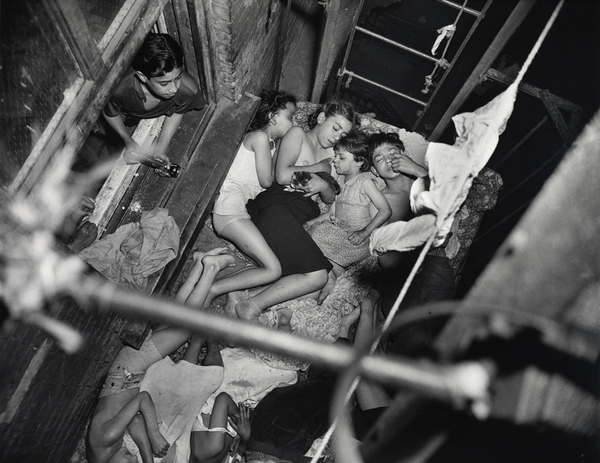
A friend pointed out to me that that a new exhibition of work opened yesterday at the International Center of Photography in Manhattan featuring the work of the fabled NY  freelance crime photographer, Weegee.  Most have seen his work in some form, perhaps in his graphic shots of murder scenes or the less lurid but still compelling shots of everyday New York in the 1930’s and 40’s.   I had been wanting to feature his work here for some time so I thought this was as good a time as any.

Weegee was the nickname given to Arthur Felig, who was born in the Ukraine in 1899 and came to NY as a young boy.  He worked as staff photograher for a news service in the 20’s before becoming a freelancer in the mid-1930’s, selling his photos to a number of NY papers.  Cruisng the city in his salesman’s coupe (a car with a front seat and the rear seat removed for extra room for samples cases) that he had equipped with a police radio, he earned his nickname from the police who were amazed at his ability to instantly appear on the scene, as though he had a Ouija board. 

His work was graphic and sometimes seedy.  But it was always well composed and thought out, each frame revealing the drama or pathos of the moment.  His work was all about telling a story and murders, mob hits, transvestites and drunks made up a big part of Weegee’s world.  But he also captured the feel of the NY of that time.  His shots of people sleeping on fire escapes during an extended summer hotspell or the incredible views of massive crowds filling every possible inch of Coney Island or a young couple with 3-D glasses caught in a passionate embrace  in a darkened theatre   (shown at the top) tell more humanly accessible stories. In addition to providing an anthropological record of that era in MYC, he also transformed the tabloid photo from mere documentation to an artform, in a way that has never been matched.

Weegee died in 1968 but his work has maintained great popularity through the decades.  If you’re in NYC, check out this show at the ICP.  It runs until September 2, 2012.

If you have a few minutes, here’s a film of Weegee explaining a few things about his business and talking about a few of his memorble photos.  Very interesting stuff.

Read Full Post »

« Newer Posts - Older Posts »