Feeds:
Posts
Comments

Archive for the ‘Favorite Things’ Category

I recently picked up  the second volume of The Complete Graphics of Eyvind Earle, a 9-pound behemoth of a book featuring the work of the artist who I have written about here once before.  It’s an incredible book, full of spectacular imagery and pure color that I find both inspring and humbling.  He had a tremendously long career, about 70 years, that began with a one-man show at the age of 14 and continued through stints as a fabled Disney artist and graphic artist known for his  highly stylized greeting card design.  Through it all, there was an amazing consistency and brilliance to the many pieces produced by a prolific artist in such a long career.  I find myself overwhelmed by the variety and quality of his work as I go through the book which only covers a small part of work.

Just incredible.
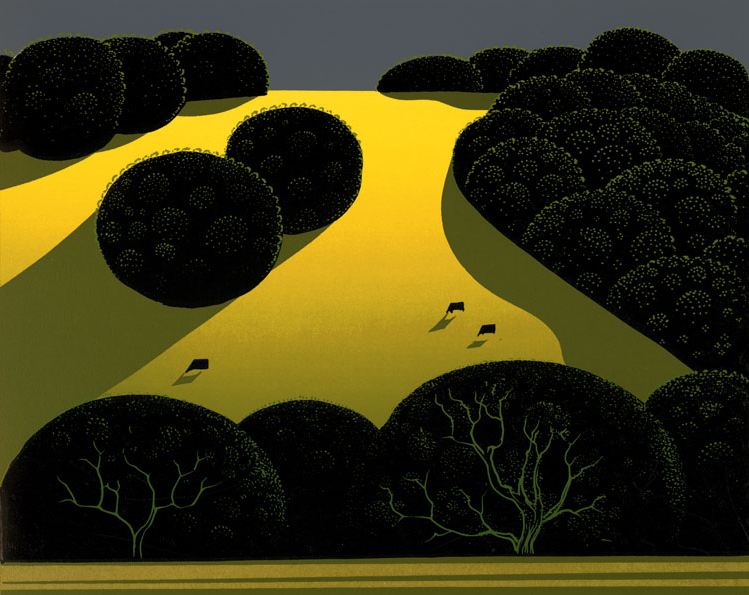
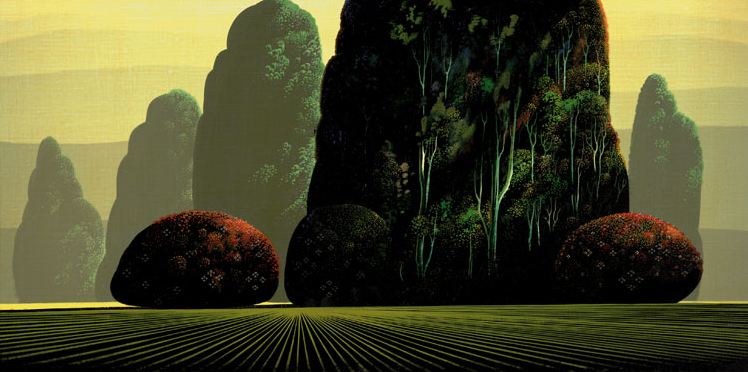
There’s great clarity in the work of Eyvind Earle.  The compositions are often both complex in design but come across as simple, a duality that I really find appealing.  The color is bold and could be a little sharp in tone if it weren’t harmonized so masterfully within the picture plane.  He is a pure genius at handling harmony and contrast– another duality that strikes me. 

I also like the fact that Earle was an unabashed landscape artist, feeling no desire to express himself  through figurative work.  He found total expression in his handling of the landscape around him, often depicting the open spaces and coastlines of California. They are not mere scenes but have emotion and a depth that goes well beyond the surface, another aspect that appeals greatly to my  desires for my own work.  In short, it’s just beautiful work and an inspiration with every look.
Read Full Post »

He draws earth as another might draw the exciting and desirable strong body of a man or woman.  His earth is essentially a naked savage earth living out of doors, not so much a cruel and terrifying savage as a wild and free one.

–Grant H. Code on the work of Rockwell Kent

**************************************************

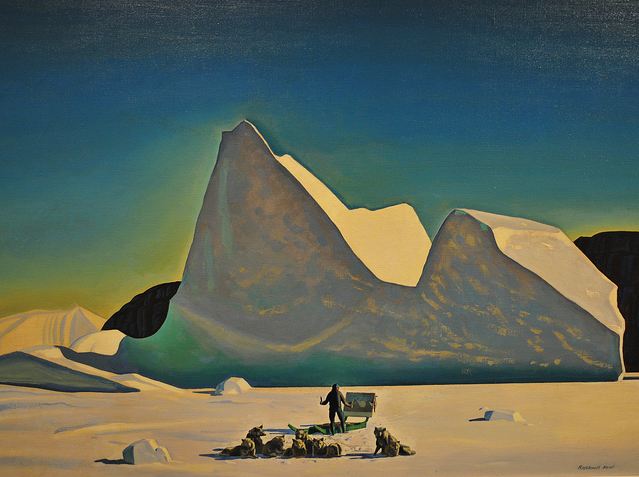
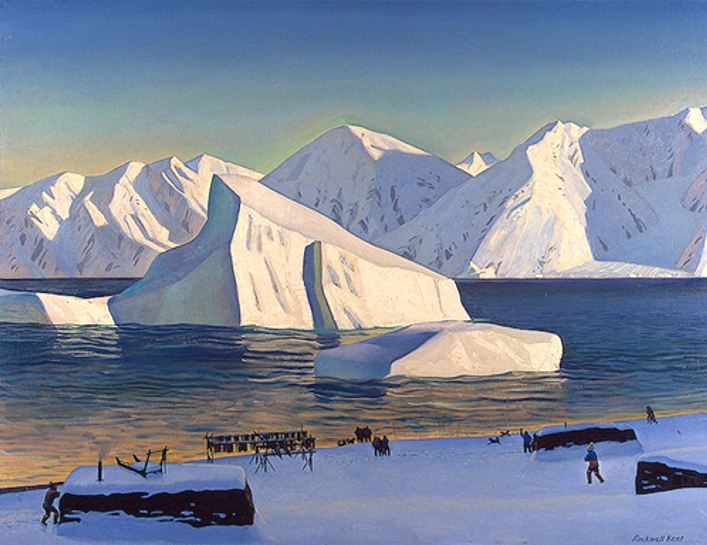
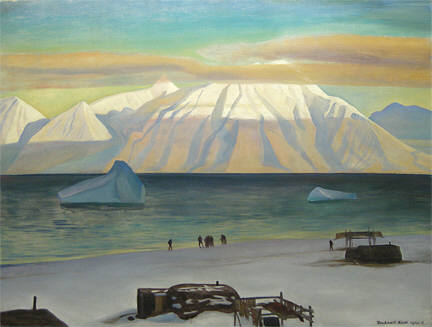
I’ve written about my admiration for the work of Rockwell Kent here in the past, about how his landscapes have a mystic feel, seeming more than mere depictions of this world.  There is an existential aura about them so that when I look at them there seems to be  an added layer of mood and emotion.  It reminds me of the paintings of Edward Hopper that have that peculiar feeling that hints at more than the scene depicts. 

Some of my favorite pieces from Kent are his Greenland paintings, done during the several extended periods that he spent there during the late 1920’s and 30″s.  The colors are beautiful and clear with subtle gradation in the sky that gives it a light and free feel with massive icebergs and mountain faces providing a wonderful counterweight.  As the writer Grant Code wrote above in 1937, Kent  depicts a landscape that is wild and free, not a cruel and terrifying savage.  It’s just spectacular work that has an ethereal air that I can only hope for in my own work. 


Read Full Post »


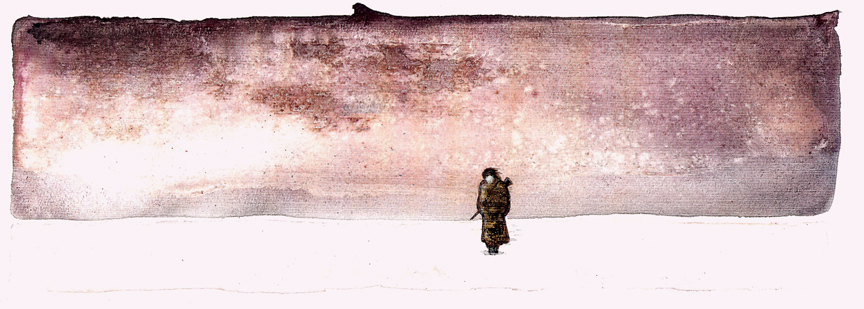
I woke up very early this morning with many things running through my mind.  All sorts of thoughts and  imagery crowded my thoughts and I found myself thinking of this painting above, Strange Victory.  It was painted many years ago and this is the only image I have of it, a bit more washed out than the original so it doesn’t quite catch the subtlety of the snowfield.  It has long been a favorite of mine as well as of my wife who calls it the Dr. Zhivago painting.  It is perhaps the piece I regret letting go most of all but at least I know where it is and know that it is well cared for with its current owner.

I particularly like the barren feel of the snowy plain and the way the sky dominates and sets the emotional tone of the piece, its red tones set against the cold setting in a way that makes the moment seem large as the figure trudges slowly forward.  The rifle slung over his shoulder with the gun  barrel down gives it an ominous sense, as though this figure was returning from battle or returning empty-handed from a hunt for sustenance.  The moment just seems to loom large in this piece.

The title came after the painting was complete and was based on a favorite poem from Sara Teasdale, the great and tragic American poet.  It is short and elegant, filled with the grand emotional swing of going from the depths of despair to an elation in finding someone familiar who has somehow survived where others have not.  To find this simple discovery as something to rejoice of in the face of  what seems to be total loss.  Just a powerful statement of existence.

So, while I am up much earlier than I normally would be, I find myself thinking of this painting and these words.  There are worse things…


Strange Victory

To this, to this, after my hope was lost,

To this strange victory;

To find you with the living, not the dead,

To find you glad of me;

To find you wounded even less than I,

Moving as I across the stricken plain;

After the battle to have found your voice

Lifted above the slain.

Sara Teasdale


Read Full Post »

I don’t want to get into the habit of revisiting past blogposts here, as I did the other day when I reposted a blog on the similarity between a painting of mine and the trees from Dr. Seuss’ Lorax.  But there is a painting that I wrote about back in March of 2009 called Endless Time that I really wanted to revisit today.  It’s a personal favorite and one that hangs in my studio, always giving me pause when I let my eyes rest upon it, as it did in the very early hours of this morning.   It has dwelt here for a couple of years now and remains special for me, always making me think. 

Or better yet, not think.

   There is something in it that is as definitive of all that  I desire from this world and of myself as anything I have ever painted.  It makes no overt appeal to the viewer, like nature, not giving a whit if you enter or not.   It has gifts to offer for those who make the effort to enter but there is no path inviting them in.  No beckoning tree or clusters of humble homes.  It simply is. 

Here is what I wrote back in March of 2009:

I wanted to talk a little about the piece shown here, Endless Time, which is a 24″ X 30″ canvas. This is what I consider a performance piecemeaning that I have performed several paintings that have a similar palette and composition in different sizes.

Each piece has its own character and feel, distinguished by differing color intensities and textures. The colors of each are similar but have their own peculiar colors due to the factors that make my color palette differ from day to day. Things like humidity and temperature, different gessoes that I use with differing absorption rates and my own lack of consistency in mixing color.

I call these performance pieces because I equate painting them to a musician performing their own composition. The musician may often change bits of their own compositions, changing things like tempo or intensity. Changing the coloration of the notes and how they’re played. The composition is intact and is identifiable but each individual performance has its own character, its own wealth.

You may notice something quite different in this piece as well.

No tree. No red tree. Nothing…

This is really a direct descendent from my earliest work that focused on open spaces and blocks of color, work that was meant to be spare and quiet. The weight of the piece is carried by the abstract qualities of the landscape and the intensity of the colors.

With this piece, I have chosen to forego the kinship that the red tree often fosters with the viewer, acting as a greeter inviting them to enter and feel comfortable within the picture plane. In Endless Time the viewer is left to their own devices when they enter the picture. There is no place to hide, no cover. They are exposed to the weight of the sky and the roll of the landscape. They are alone with not a sound nor distraction.

It becomes, at this point, a meditation. One is not merely looking at a landscape. To go into this painting one must be willing to look inside themselves as well.

And I think that is where the strength of this piece dwells. I hope this is evident to some viewers and they feel welcome to enter this quiet space…

Read Full Post »

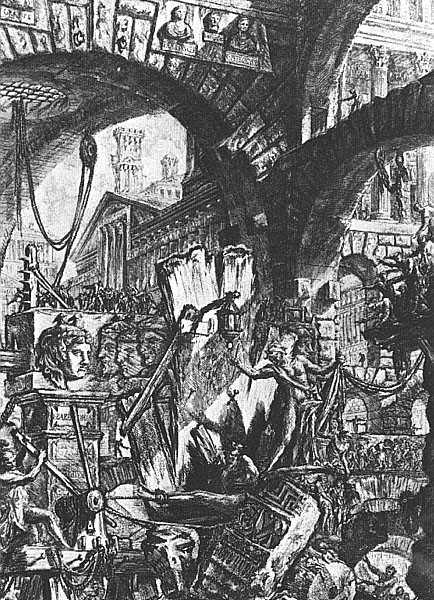
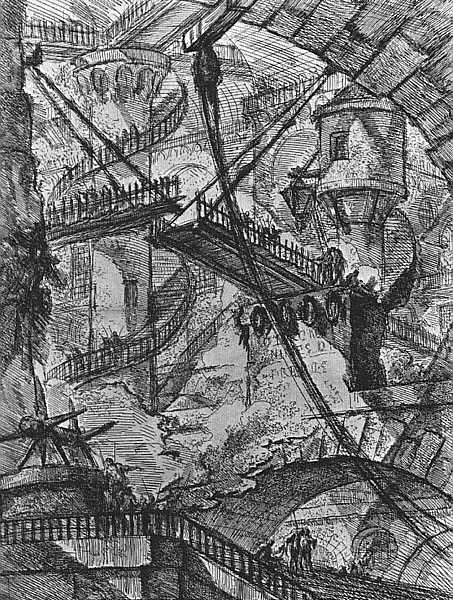
I consider my landscapes to be internal, which is to say imaginary. Places that represent a place where I wish to be or at least have the feeling of it in my real world.  Places that act as refuge from the sometime harshness of the real world.  Giovanni Bauttista Piranesi had a much different sort of internal world.  Piranesi (1720-1778) was an Italian artist who gained fame for his engravings of the views and architecture of Ancient Rome.  He meticulously measured the ruins of Rome and would recreate them as they had once stood.  Beautiful work.

But he is also well known for a series of engravings issued  in 1745 and reworked and reissued in 1761.  These were his Carceri  d’invenzione, or Imaginary Prisons.  They were dark and foreboding visions of cavernous subterranean prisons with twisted , strange stairways that foretell the work of the M.C. Escher and ominous machines of torture.  Over the centuries they were cited as being very influential on the writers and artists of the Romantic and Surrealist movements. 

They’re very intriguing and they are filled with layers of detail, the result of his time spent among the architectural wonders and ruins of Rome.  There is a site, CGFA, which has the entire series of prints online.  Below is a wonderful video created by Gregoire Dupond that takes you on an animated  journey though the details of these internal  prisons. It’s really interesting and worth a look.  It’s in high-definition so you can put it up full screen to capture all the details.  

Piranesi Carceri d’Invenzione from Grégoire Dupond on Vimeo.

Read Full Post »

 With the recent release of The Lorax, an animated film based on the environmentally centered Dr. Seuss book and the continued popularity of his books (I think there are 6 in the top 100 of the NY Times bestsellers list), I thought I would reblog this post from back in August of 2010. 

Yesterday’s post about the 50th anniversary of Green Eggs and Ham by Dr. Seuss made me think about a piece that I’ve had hanging around my studio for the past decade. It’s a painting that I did in 2001 that I call Red, Hot and Blue. It’s an oil on panel piece that is pretty big, almost 5 1/2′ tall in its frame. It could be a small door. It showed in a few galleries after it was first painted and never found a home so it retired to my studio, to keep me company.

I mention it because it was been called the “Dr. Seuss painting” by several people who saw it when it was hanging in the galleries. They saw something in the way the trees were shaped and colored that gave them the appearance of a Seuss character. I had no thought of Seuss when I painted the piece but when I heard these comments I began to see it.

The expressive sway of the trees as though they were dancing. The bright primary colors- the red of the foliage and the bright blue of the trunk. Even the two trees in the background added to the Seuss-y feel.

The foliage actually looked like the endangered Truffala trees from Seuss’ cautionary fable about the environment, The Lorax.

It was not intended but it made sense. Seuss’ books were about communicating by giving strange creatures and things we often see as objects, such as trees and flowers, human qualities. His characters moved with a rhythm that made them feel alive. Just what I was trying to do with my painting. I’ve often felt that we best see and better understand things that possess human qualitities. I remember being taught that the Native American tribes in the area where I grew up gave names to local hills based on the human qualities they had. It made an impression and started me looking for the human form in all things.

The curve of a tree trunk. The roll of the land. The fingers of clouds in the sky.

To communicate.

So, while it was never intentional, this painting was very much a product of the influence of Dr. Seuss and others. When I look at it today, I don’t see the name I gave it. I see it as that “Dr. Seuss painting”.

Read Full Post »

Well, I am finished with the large canvas I started over three weeks ago.  It is the largest piece in size I’ve ever attempted by quite a bit at 54″ by 84″ which I often found intimidating at times, as I freely admitted here.  But that intimidation and fear faded over the weeks as the painting evolved, moving from the darkness in which it began to the vibrant brightness of the finished product.  This shift in tone mirrored my own shift in my feelings for the painting.  I began with a fearful anxiety that began to ease with each new layer of color added.  I began to feel a lightness in myself as the piece began to find its unity and rhythm and a sense of confidence when it began to start taking on a life of its own as it neared completion.

It was interesting  to see how its domination of the studio space changed.  At first, its size and darkness made it seem at times like a big canvas eclipse blocking out and absorbing all incoming light.  But near the end it bagan to have its own glow, seeming to give off more light than it absorbed.  Even after the large floodlight under which I work was turned off, its glow cut through the hazy darkness.  Those moments of seeing that really struck me and gave me a real sense that it was becoming what I hoped for it. 

 As the final strokes went on to the Red Tree that stands above the lake, bringing the piece into a state of completion, it began to move completely into its own realm, its own life.   I felt like a parent watching their child move out of their home and into their own life.  The  influence of the parent is evident but there is a point where the child moves on, no longer dependent on the parent.  It is a moment filled with both the joy of  pride and the sadness of loss. 

 Like this parent, I feel both of these emotions.  I am proud of how this painting has come around and grown into something strong and viable but sad that my time with it has come to an end.   Well, close to an end.  I will spend the next few months with it, making little tweaks here and there.  Nothing large.  Just a tiny  rounding of the edges here and a smoothing of the line there. 

I’m calling this painting The Internal Landscape.  I will discuss this at a later date along with some other observations about it.  But for now, I’m going to simply stand back and take it all in again.

Read Full Post »

There’s an exhibition currently hanging at  one of my favorite museums, the  extremely comfortable Phillips Collection in Washington, DC, called Snapshot: Painters and Photography, Bonnard to Vuillard.  It bascially shows how the advent of personal photography in the late 1800’s, with the invention of the Kodak handheld camera, changed how many artists worked.  The camera allowed artists to capture moments without their easel as well as permitted them to ponder an image long after the moment had passed.  This exhibit focuses mainly on the effect fo the camera on the Post-Impressionists, such as George Hendrik Breitner, whose photo of a girl in a kimono and the resulting painting is shown here.

I have seldom used photos as a pure reference source but, as this blog will attest, have been influenced by many of the photographed images I have come across through the years.  I think this exhibit would be a wonderful insight into how the photographed image is used to translate the artistic vision.   It runs at the Phillips until May 6 of this year

Read Full Post »

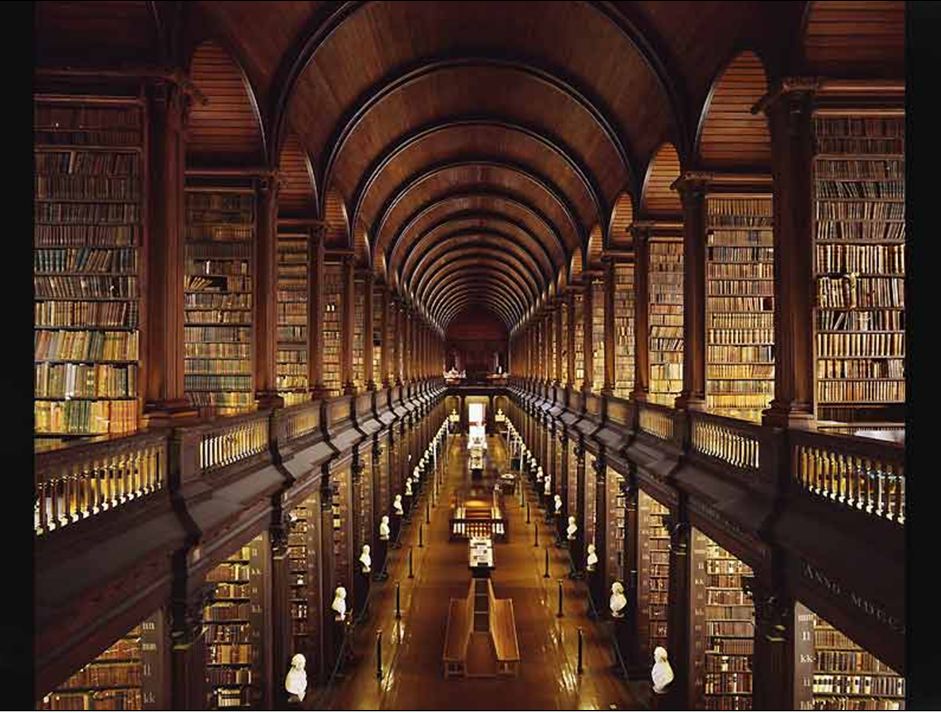
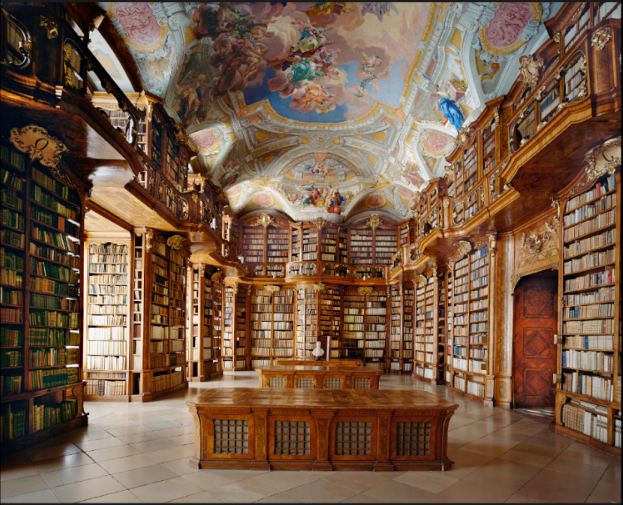
Ahmet Ertug is an Istanbul based  photographer who began his career as an architect.  This interest in architecture has led him to a renowned career photographing the great buildings of the world.  He works in a very large format that produces huge fine prints that are spectacular.  He shoots the interiors of these buildings in natural light with exposures that often run 2-4 minutes in length, capturing the  beauty of the building as it naturally appears.  Grand and beautiful.

 He has produced a number of limited edition volumes of his work that are hand bound.  One of these is Temples of Knowledge.  It features his exquisite photos of the great historic libraries of the Western world.  For those of you into bookshelf porn, excited by the beauty of the library, his photos are a marvel.

Read Full Post »

This is a small piece that I used here last year in a blogpost featuring Richard Thompson’s song Shoot Out the Lights.  I showed this piece but didn’t say anything about it which I think was an oversight because it is one of my personal favorites from this particular series.  It’s called Two Sides and is part of my Outlaws series from several years back, a group that was influenced by some small Goya works done in carbon on ivory as well as by powerful imagery from some later films of the silent era.  Many of the pieces featured a single figure, often holding a handgun, usually in a monchromatic sepiatone.  A few, such as this piece, incorporated more color as well as a copper foil border.

Some folks saw these pieces as being a bit scary, with the handgun imagery and the figures often seeming to be peering out (or in, as some saw it) a window.  I understood the scary part but not for the same reason as those who saw it this way.  They saw the figures as menacing while I saw them as being frozen with their own fears.  These figures were the scared ones.

The title of this piece, Two Sides, is a reference to the polar opposites that make up a yin-yang symbol.  In fact, it’s composed like a yin-yang symbol. with the light of the hand and gun appearing in the dark shadow in which he stands and the darkness of his face appearing in the incoming light.  I see this as representing the light and dark,  the good and evil, that resides in everyone.  At any one time, we may appear to be more to one side  or the other but we normally, and hopefully,  exist between these opposing forces.  This piece reminds me to temper my darker side when it wants to push outward, to maintain this equilibrium.  It makes this a special piece for myself.


Read Full Post »

« Newer Posts - Older Posts »