Feeds:
Posts
Comments

Archive for the ‘Favorite Things’ Category

I’ve been running a few of my favorite posts from the past recently as I’ve been very busy in the studio.  This one from back in December of 2008 speaks a bit about our perceptions of an artist and how these views might affect the way we see their work. 

In the comments from the original post, someone made the point that the work should stand on its own regardless of the mannerisms or perception of the artist.  Of course, I agree completely with that in theory.  But I point out that sometimes the artist can affect, both positively and negatively, how their work is viewed with their words and actions.  I cite a story I’ve told innumerable times of going to a local college to hear a famous author speak.  I was seventeen years old and aspiring to be a writer at the time, armed with a legal pad filled with questions that I hoped to ask this author so that his words of wisdom might guide me along.  At the reception afterwards when I finally got a chance to speak with him, he was half in the bag drunk and a prick as well.  He rudely  dismissed me and moved on without taking a second to consider my question to him.  I was crushed and left knowing that i would never read another word that fool would write, which I haven’t to this day.  I also vowed to myself that if I was in that position I would never treat anyone dismissively.  Hopefully, I have kept that promise.

 This was written in the first few months of writing this blog so some things have obviously changed.  I was still up in the air about writing this blog, something which I have obviously reconciled with myself.  But I am still the same middle-aged guy with a thick waist and a sloppy gray beard.

************************

At the opening for my show at the Haen Gallery in Asheville, a young woman approached me, telling me first that she had a piece of mine and she loved the work. We talked for a bit then she came out with the inevitable.

“You’re not what I had expected. I thought you might be wearing a beret or a cape or something like that.”

I get that a lot.

People expect something much different than I appear to be. More flamboyant, I guess. Maybe more boorish. Maybe like this guy, Salvador Dali, who exemplified that stereotype of the crazy artist. But they’re faced with me- a thick-waisted, middle-aged guy with a sloppy gray beard. I used to kid with the folks at the Principle Gallery that I would show up at a show one day in a Dali-like manner, swooping in to hold court in my flowing black cape, waving my arms about in dramatic flourishes. Maybe wearing a monocle? I sometimes wonder if people would look at my work differently if I donned a cape and had a long waxed mustache. Would they find different attributes in the paintings? Would they find a different meaning in each piece?

I don’t know. I hope not. But I do know there is an illusion behind each person’s impression of a piece of art, that it is a delicate web that supports how they value a piece and that can be affected by my words or actions or even appearance. That is one of the reasons I’m a little reticent to do this blog. I could write something off the cuff, something that I might soon realize was a product of flawed logic, and quickly destroy someone’s whole interpretation of my work.

Perhaps that is not giving the work enough credit for its own strength and life. Perhaps this is the flawed logic I mentioned. Whatever the case, it’s something I bear in mind. But for the time being, I will keep the cape in storage and stick with the credo of my childhood hero, Popeye: “I yam what I yam.”

And that’s all that I am…
Read Full Post »

One of the benefits of having my studio located in the woods is the opportunity to watch the wildlife from a fairly close perspective.  I have known all manner of animals over the years, from the mother raccoon and her kits that took up residence for a short time in the roof of my first, more rustic studio further up in the woods, and the everpresent deer that often nap  in the shady lawn outside my studio windows to the coyotes and bobcats that I have captured on my trail cam and have ran across in person, as well. 

I get to see how the animals interact, how they break down into family units and establish order.  How they survive the elements and their habitation among us humans.  Their survival instinct is powerful, a hard thing to see at times but powerful, nonetheless.

Over the years I have witnessed many deer with legs that have been broken, most likely from a misstep or an encounter with a woodchuck hole.  I am always amazed at their ability to persevere and prosper.  There was a doe several years ago who came around with a front hoof dangling, completely broken away from the leg above.  Eventually she lost the hoof completely, leaving a stump.  But it didn’t stop her.  She actually had 3 or 4 fawns over the next few years and it was only when she walked slowly to feed that you recognize that she was missing a hoof.  In full flight, she moved as fast as  the other deer and managed to evade predators and hunters for years.

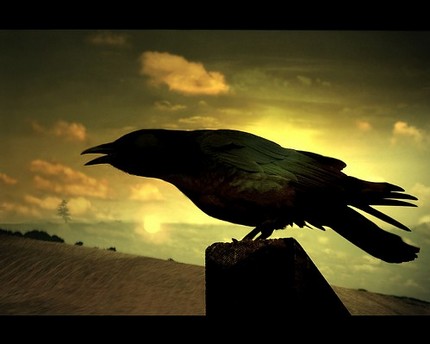
I currently have a black crow that haunts the pines in front of my studio.  He came to my attention early in the winter.  I saw crow tracks in the snow that went from the studio all the way down the long driveway, about 1/5 of a mile.  I couldn’t understand why a crow would walk throught he snow when he could fly.  This went on for several days until I finally caught a glimpse of him, ambling up the drive.  It was a badly damaged  wing that hung off of his back to one side.  He would walk and hop with real determination and was seldom alone.  There was normally a group of crows that accompanied him, cawing to him from the trees above and sometimes coming down to walk with him.  I got the idea that they sometimes let him know what was ahead or behind, acting as his eyes in the sky.

I thought about trying to capture him and get him to an animal rehabilatation specialist such as the unit at Cornell but he was always quick to spot me and would disappear into the woods with surprising speed.  He was even aware and suspicious  of me when I watched him from my front windows. 

His mobility has improved over the past six months.  He hops quickly and to my surprise has developed the ability to take flight for moments at a time.  Not for very long distances but enough to carry him to low branches of the trees from where he can hop to higher branches.  Once he reaches the top he will glide, without flapping his wings, to a point quite a ways down the drive from where he will commence his walk/hop.

I really admire his grit and evident intelligence.  I have gotten into the habit of putting out for him  the poor small rodents that my studio cat, Hobie, captures and kills in the woods around the place, laying them at  my feet proudly as gifts on a daily basis.  I have watched him and his kin find these small gifts  a number of times and I think he understands the gesture.  Doesn’t make him any less wary of me but that’s okay.  He gets an easy meal and I get to see that the mice and moles go back into the big circle quickly.  Win/win.

Here’s a really nice rendition of Joni Mitchell’s song Black Crow from Diana Krall.  Just right for a Sunday morning.

Read Full Post »

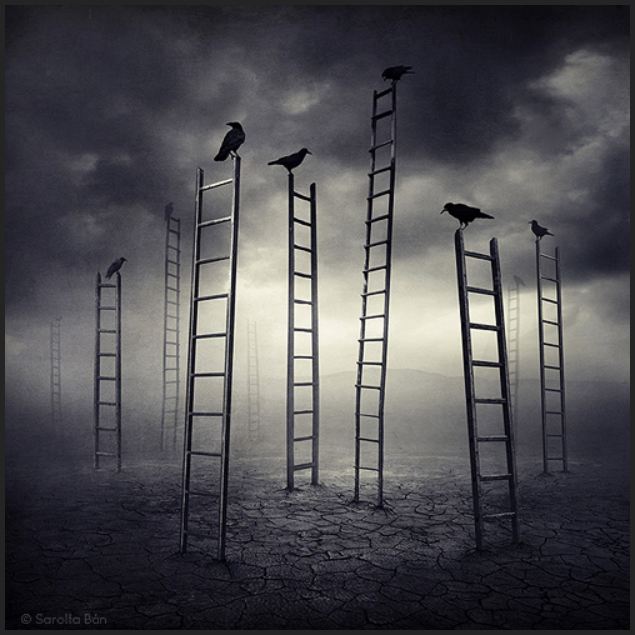
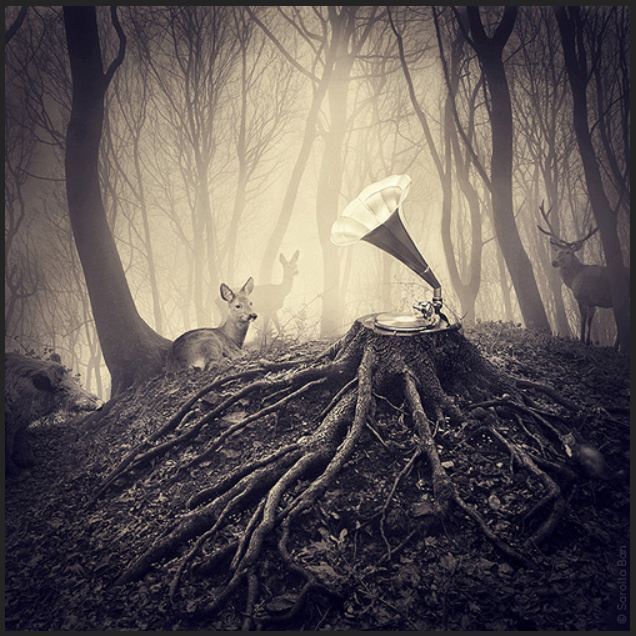
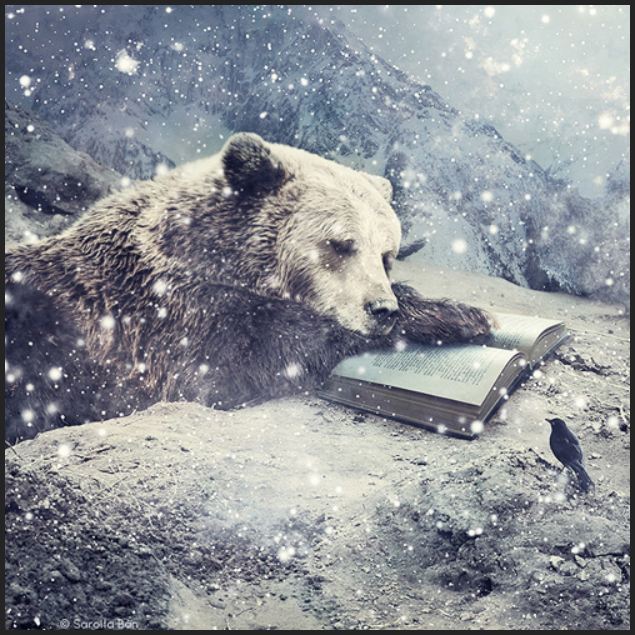
I came across some very interesting allegorical  photos  on the PhotoBotos.com site.  They are the work of a young  photographer from Budapest, Hungary by the name of Sarolta Ban, who digitally manipulates images of basically everyday items into thought-provoking scenes.  Her work reminds me very much, in tone and substance, to that of  Robert and Shana ParkeHarrison, who created the fantastic photos of the book The Architect’s Brother, which I featured here on the blog this past year. 

 The primary difference is that the ParkeHarrison work is not digitally manipulated.  They instead physically create the scenes and photograph them.  For some, especially photography purists, this is an important distinction.  But I am definitely willing to look past that and simply admire Ban’s beautiful work.  For me, it comes down to how her imagery affects me and makes me react.  And for me, her work has a dreamlike quality, filled with a quiet magic.  Peaceful but ponderous.  Just good stuff.

Read Full Post »

Most people immediately think of Roberta Flack when they think of the song The First Time Ever I Saw Your Face, and for good reason.  Her 1972 version was  truly beautiful and deserved every bit of the acclaim it earned.  But the song didn’t originate with her and has had many versions through the years, including one of my favorites from Johnny Cash, which you can see below. 

The song’s history began in 1957.  Iy was written by Ewan MacColl,  a British folk singer who is a very interesting character in his own right.  He was a married man who fell in love with the much younger Peggy Seeger, the half-sister of folk icon Pete Seeger.  He later married Seeger.  MacColl wrote the song about her and for her to perform.  She needed a song for a play she was appearing in here in the USA so MacColl wrote the song and taught it to her via the telephone as he was barred from entering the States because of his Communist ties.  As I said, he was an interesting character.   Her original version is lovely with different phrasing than the better known Flack version.  I’ve also included a similarly performed and charming version from Peter, Paul and Mary.

Cash’s version is much more ponderous.  It is from his American series near the end of his life.  His voice was weaker and even rawer than in his younger days but Cash used it in an incredibly expressive way, giving the song  the feeling of a dirge as he looked back from a point near the end of his and his wife’s life, to an earlier time in his life and the fresh discovery of love.  It is both beautiful and sad. 

Just a great song.


Read Full Post »

I’ve written here before about some of my favorite Outsider artists, those untrained artists who follow their obsessive need for expression even as they suffer hardships such as illness, extreme poverty and mental disabilities.  People like Martin Ramirez, the Mexican-born artist who was committed to an asylum in his thirties and spent the rest of his life, 30+ years, locked away as he created an amazing intricately designed world in his art. 

There was another artist years before Ramirez whose road was very similar and who work was as deeply designed and engaging.  It was the Swiss artist Adolf Wolfli who was born in 1864 and died in 1930, about the time Ramirez was committed.  Wolfli was considered one of the first acknowledged Art Brut artists, as Outsiders are called in Europe and, like Ramirez, he had a difficult life that ended with him living the greater part of his life locked away.

Wolfli, an orphan at the age of 10, was physically and sexually, abused throughout his childhood.  He suffered from severe mental illness which manifested itself in vilent outbursts and hallucinations.  It was this and a series of child molestation charges that led to his committal in 1895.  He was about 31 years old.  He never left. 

He began to draw at some point during his life in custody, it soon becoming a true obsession as his inticate drawings covered every scrap of paper he could lay his hands on.  Walter Morgenthaler, a doctor at the psychiatric hospital who documented Wolfli case in a book, wrote this about the extent of Wolfli’s obsession:  Every Monday morning Wölfli is given a new pencil and two large sheets of unprinted newsprint. The pencil is used up in two days; then he has to make do with the stubs he has saved or with whatever he can beg off someone else. He often writes with pieces only five to seven millimetres long and even with the broken-off points of lead, which he handles deftly, holding them between his fingernails. He carefully collects packing paper and any other paper he can get from the guards and patients in his area; otherwise he would run out of paper before the next Sunday night. At Christmas the house gives him a box of coloured pencils, which lasts him two or three weeks at the most.

Wolfli’s work incorporated musical notations that were woven into the designs, an odd looking notation that seemed purely ornamental but was later proven to be an actual  idiosyncratic notation sysytem that could indeed be played.  Wolfli would sometimes play the music on a paper trumpet he had crafted. 

Wolfli produced a prodigious body of work in his years in the asylum, including a semi-autobiographical epic that was a massive 45 volumes in size.  It consisted of over 25000 pages and 1600 illustrations.  His work has been largely kept together as a collection which is in the Museum of Fine Arts in Bern, Switzerland.  There is also the Adolf Wolfli Foundation which was formed in 1975 to bring his work to the attention of the public through education on and exhibitions of his works.

Like many of these artists about which I write, Wolfli’s work is new to me.  But it is so immediately grabbing in its design and its harmony of color and form that I am enthralled by it.  When I clicked on the Google images page for his work, there was such a gorgeous continuity that ran through every image on the page that I found it hard to choose which image to explore first.  Such beauty revealed in the dark recesses of a life spent locked away.

Read Full Post »

A young friend of mine posted this video online yesterday.  It’s a song that I haven’t heard in many years, Down in Mexico from The Coasters in 1956.  This was their first single and was a mild hit although ost people remember The Coasters for the string of hits that followed, all written , like Down in Mexico, by the legendary songwriting team of Lieber and Stoller.  Songs like Young Blood, Yakety Yak, Charlie Brown, Along Came Jones and Poison Ivy.  A virtual soundtrack for the young ears of the time and for a generation or so beyond. 

This made me think of my nephew and his wife who have been travelling in Mexico for last couple of months, climbing volcanos and surfing before heading further south.  I thought this would be a nice jolt to waken them and everyone else on a Sunday morning. Enjoy!

Read Full Post »

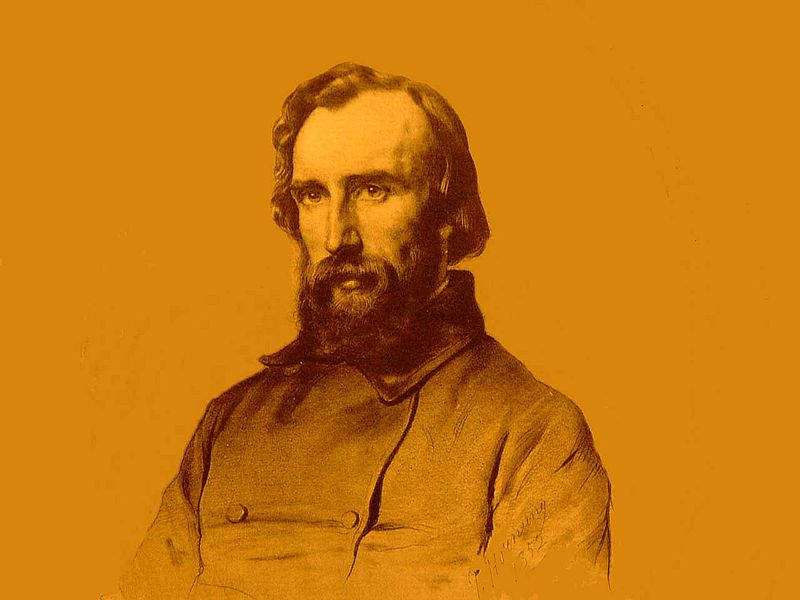
The man who insists upon seeing with perfect clearness before he decides, never decides. Accept life, and you must accept regret.

****************

One of the great things about the cyberworld is the ability to find the work, either in image or words, of those people that might easily go unnoticed in the past.  You can now come across a few words or images that intrigue  you and within moments have access to a world of information about the writer or artist.  Such was the case recently when I stumbled upon a few quotes from the writer of the words above and  shown in the portrait above, Henri-Frederic Amiel

Born in 1821, Amiel was a Swiss professor, poet and writer who died in 1881, leaving no major marks on the world before his death.  Although esteemed, his poetry was not celebrated and he made no major breakthroughs as a professor of moral philosophy in his time.  It was after his death that Amiel began to live on in the form of a personal journal that he kept from the 1840’s until the time of his death.  Called the Journal Intime, it is a wondeful inner exploration of the man, exposing a depth of thought apllied to universal truths.  His words, written over 150 years ago in many cases, seem as fresh and as true today as then, a fact that made the Journal Intime a timeless classic  in much the same manner as the essays of Ralph Waldo Emerson

However, despite its acclaim after it posthumous publishing, the book has faded from the modern consciousness  and may not grace the shelves of many libraries.  But thanks to the online world, it is a book that is now readily available to those wishing to read these thoughtful words.  It is available on most book sites and is available free at a number of sites including Project Gutenberg.

So many of the quotes that have been pulled from the Journal Intime ring true for today, including those that could be applied to subjects that are hotly debated in this country such as healthcare and taxation of the richest of us:

In health there is freedom. Health is the first of all liberties.
Sacrifice still exists everywhere, and everywhere the elect of each generation suffers for the salvation of the rest.

I was probably drawn to his words by two that said what I have said for some time.

The great artist is the simplifier.

Learn to… be what you are, and learn to resign with a good grace all that you are not.

The Journal itself is not an easy read.  It is a winding road through the life of one man and doesn’t always reveal its truths quickly.  So if you wish to quickly absorb some of Amiel’s aphorisms, I suggest checking out his pages at BrainyQuote or ThinkExist.

Good stuff…


Read Full Post »

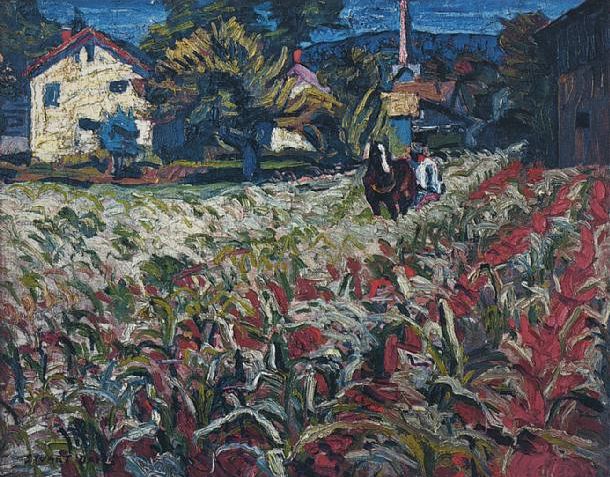
Many of us are familiar with the work of Stuart Davis (1892- 1964), the American Modernist whose paintings presaged the Pop Art of the 60’s.  They were bold and colorful abstracted collages that use imagery from the landscape of the popular culture at the time they were created, creating works that immediately evoke a time.  When I see them I a transported to the New York or Paris of the 40’s and 50’s, with Jazz and poetry blossoming in the aftermath of a devastating war that really changed our perceptions of the world.

But it is Davis’ early work that always intrigues, particularly a small group that was painted not to far from where I live.  There are three landscapes painted just over the state line  in rural Tioga, Pennsylvania in 1919 that are very different from the work for which Davis is best known.  They show a young artist still working in the style of those artists who inspired him, trying on their style and brushstrokes in an effort to find his own voice. 

You can see how  he had been affected by seeing the work of Van Gogh and Picasso for the first time at the legendary Armory Show in 1913, where his own work hung among the emerging giants of modern painting.  Davis was then a student of Robert Henri and painted in a style associated with the  NYC Ashcan school of painters , of which Henri was a leader.  These three pieces have thick. expressive stokes of paint and scream of Van Gogh and have few hints at where Davis’ road would eventually lead him.

The pieces are very accomplished and have a certain charm but it is obvious that they are still derivative and that Davis is still in the midst of his evolution from talented mimic to an original voice.  To me, they are an interesting insight to how we synthesize our broad spectrum of  influences into something truly original.  I would be hard-pressed to say that the man who painted these pieces would eventually become a leading light of abstract modernism but they somehow moved him along in his search for his own distinct voice.  It only goes to show that we should take in everything that excites us even if it seems out of our normal area of comfort.  It may open new and exciting worlds to us that we could never foresee.

Stuart Davis--Self Portrait 1919


Read Full Post »

I mentioned Woody Guthrie in yesterday’s post and it reminded me of a musical release that is coming out in the next month.  It is the release of Mermaid Avenue: The Complete Sessions from Billy Bragg and Wilco, which incorporates the remastered first two volumes from the original 1998 release with a new volume of 17 songs. 

 These sessions were the result of the Guthrie family asking singer/activist Billy Bragg along with Wilco to have a go at interpreting some of the many songs left after his death in 1967.  Guthrie didn’t read music so his unrecorded songs’ melodies were stored only in his memory, leaving only the lyrics.  But the lyrics were terrific and provided Bragg and Wilco plenty of inspiration to produce a memorable set of music.  I have used several songs here over the years and often find myself switching on Mermaid Avenue (named after the street in Brooklyn where Guthrie lived at the time of his death)  in the studio to work by.

Here’s one of my favorites, Way Over Yonder in the Minor Key.


Read Full Post »

I recently saw a short film called The Chapel which is from filmmaker Patrick Kizny.  It is a high-def timelapse film that explores the interior of a decrepit Protestant church in Zeliszów, Poland, designed by  architect Karl Langhans and built in 1796-1797.  It has obviously been in a horrible state of disrepair for many years but Kizny manages to evoke the architectural beauty of the building with his moody film.  At first, I thought it was all computer generated, like a video game, but this is real photography.  And a great and real building.  If you are a fan of the art in great architecture, this is quite striking.

If you are interested in seeing how the photography and look of this film came about, I have included The Making of The Chapel below.

Thanks to Via Lucis, a terrific  site specializing in the photography of religious architecture,  for pointing out this film. 

Making Of The Chapel from Patryk Kizny on Vimeo.

Read Full Post »

« Newer Posts - Older Posts »