Feeds:
Posts
Comments

Archive for the ‘Influences’ Category

“There is only one valuable thing in art: the thing you cannot explain.”

 — Georges Braque

*******************************


This is a quote from artist Georges Braque that I used on the first artist statement I ever wrote many years back. It still pops up in my mind on a regular basis, especially at times when I find myself looking at a just finished painting, wondering what is there that is triggering my emotional response to it.  These words from Braque reminds me that what I am trying to capture is not the subject matter, not a mere representation of reality.  I am trying to capture an indefinable feeling or spirit that is not calculable or even visible.

Definitely beyond the reach of my words.

It is the sum of color and light.

And texture and line.

And the spaces in between.

It is of the spirit and the life force.   When it is there, it is obvious and undeniable. And though I can’t explain it, I can see the purpose and value of that work.

And that is a good day…

***********

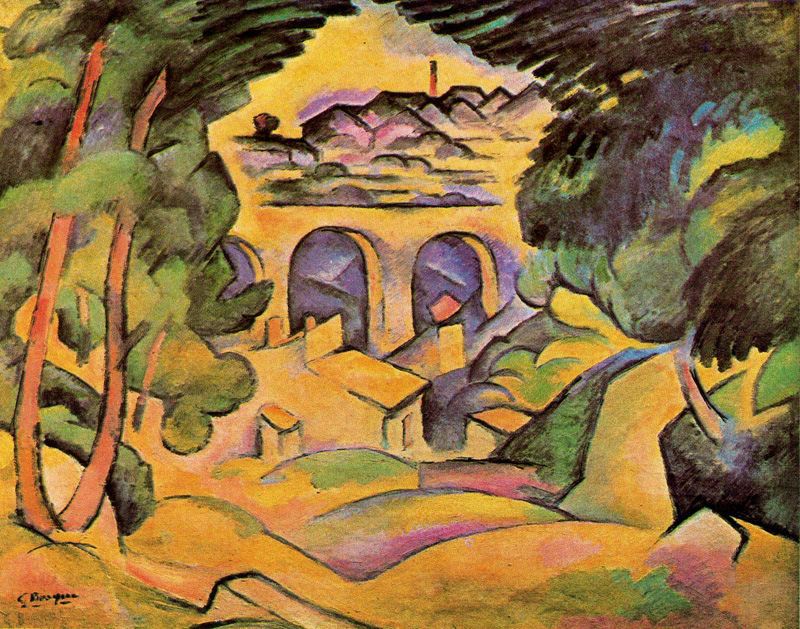
I have never really focused here on the work of George Braque (1882-1963) who is mainly known as one of the major artists, along with Picasso, of the Cubist movement. His work, through all the differing phases of his long career, is always impressive. I thought I’d share the video slideshow below of his work. It’s set to Mozart’s Piano Concerto No. 21, better known as the Elvira Madigan concerto, which makes it a most pleasant and calming thing to spend a few minutes with on the first cool morning of November.


Read Full Post »

Get yourself to a vantage point of seclusion and view the world with your eyes alone. Think of the infinite spaces of the skies and the world beneath.

Charles Burchfield

********************

Good words for a painter. Or any other human, for that matter.

Read Full Post »

The poet Robert Frost wrote a wonderful preface to the 1939 edition of his collected poems. It was titled The Figure a Poem Makes and it described how he viewed his process of unveiling the true nature of his work. Reading it, I was struck by the similarities between his work as a poet and how I view my work as painter.

For example, the following paragraph-I have highlighted individual lines that jumped out at me. I probably could have highlighted them all:

It should be of the pleasure of a poem itself to tell how it can. The figure a poem makes. It begins in delight and ends in wisdom. The figure is the same as for love. No one can really hold that the ecstasy should be static and stand still in one place. It begins in delight, it inclines to the impulse, it assumes direction with the first line laid down, it runs a course of lucky events, and ends in a clarification of life–not necessarily a great clarification, such as sects and cults are founded on, but in a momentary stay against confusion. It has denouement. It has an outcome that though unforeseen was predestined from the first image of the original mood-and indeed from the very mood. It is but a trick poem and no poem at all if the best of it was thought of first and saved for the last. It finds its own name as it goes and discovers the best waiting for it in some final phrase at once wise and sad-the happy-sad blend of the drinking song.

A painting often begin in delight. A certain tone of color, the way a line bends, the manner in which a brushstroke reveals the paint or in how the contrast of light and dark excites the eye.  The delights pull you in and keep you engaged and it is not until you have finished that you are able to understand the sum of these elements, to detect the wisdom, the meaning, behind it all. It is only then that you know what you have uncovered and how it should be named.

The work itself, if left to its own means, knows what it is and will tell you.

Then there is this gem of a paragraph:

No tears in the writer, no tears in the reader. No surprise for the writer, no surprise for the reader. For me the initial delight is in the surprise of remembering something I didn’t know I knew. I am in a place, in a situation, as if I had materialized from cloud or risen out of the ground. There is a glad recognition of the long lost and the rest follows. Step by step the wonder of unexpected supply keeps growing. The impressions most useful to my purpose seem always those I was unaware of and so made no note of at the time when taken, and the conclusion is come to that like giants we are always hurling experience ahead of us to pave the future with against the day when we may want to strike a line of purpose across it for somewhere. The line will have the more charm for not being mechanically straight. We enjoy the straight crookedness of a good walking stick.

I have often spoke of the need to be have my emotions near the surface when I work, to always need to feel excited and surprised by what I am working on. To recognize things I never knew as being part of me. If I am not moved by the thing I am working on at any given time, how can I expect others to be moved by it? This paragraph speaks clearly to my experience as an artist.

Then there is the final sentences of the essay:

Like a piece of ice on a hot stove the poem must ride on its own melting. A poem may be worked over once it is in being, but may not be worried into being. Its most precious quality will remain its having run itself and carried away the poet with it. Read it a hundred times: it will forever keep its freshness as a petal keeps its fragrance. It can never lose its sense of a meaning that once unfolded by surprise as it went.

My translation of this, as a painter, is that the work must be free to move and grow of its own volition. It tells you where it wants to go and, if you don’t constrain it and try to push it to a place where it was not intended to go, will reveal its truth to you. If you can do that, it remain always fresh, always in the present and always filled the excitement and surprise that it contained in that burst when it was created.

I don’t want to bore you too much. It’s a great essay and is a valuable read for anyone who makes art in any form. You can see ( and download) the whole book, The Collected Poems of Robert Frost, with this essay in full by clicking here.

Read Full Post »

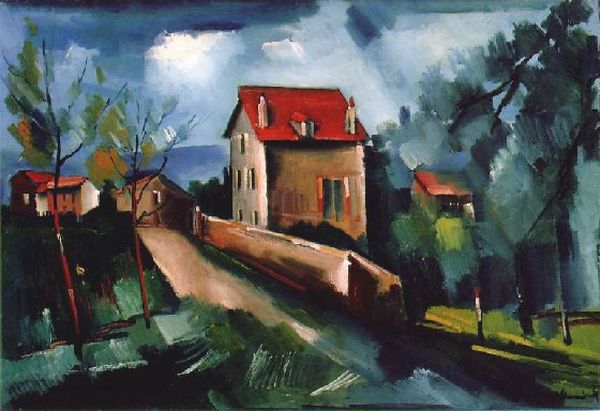
I ran the post below a few years back, mainly about the quote in it from Fauve painter Maurice de Vlaminck. His attitude as expressed in those words really resonates with me. I, too, find myself not giving a second thought to anyone else’s work when I am in my own. The only concern then is filling my space, creating my own new world. His words are in my mind this morning so I thought today would be a good day to replay this short article with the addition of a video of de Vlaminck’s work and a few more images.

Maurice de Vlaminck- Houses at Chatou 1905


When I get my hands on painting materials I don’t give a damn about other people’s painting… every generation must start again afresh.

— Maurice de Vlaminck

********************

I have to admit I don’t know much about French painter Maurice de Vlaminck (vlah-mink)  who lived from 1876 until 1958.  His work is best known for a short period  in the early years of the 20th century when he was considered one of the leading lights, along with Andre Derain and Henri Matisse, of the Fauve movement. Fauve translates as wild beast and the style of these painters was very much like  that to the sensibilities of that time. It was brightly colored with brash brushwork and little attention paid to detail. It was all about expression and emotion.

I recognize some of his early Fauvist work, mainly for the obvious influence of Vincent Van Gogh it exhibits, and none of his later which becomes less colorful and exuberant, perhaps shaped by his experiences in WW I. But his name is one that I have often shuffled over without paying too much time to look deeper.

Maurice de Vlaminck- At the Bar

But I came across this quote and it struck me immediately. It was a feeling that I have often felt  when I immerse myself in my work. All thoughts of other painters– of their influence, of comparisons and artistic relationships– fade into nothing. It is only me at that moment faced with the task of pulling something new and alive from the void. I can’t worry myself at that moment about what other painters are doing. Their what’s and how’s and why’s are all moot to me then because I am only trying to express something from within. It might only exist and live for me in that instant, though I hope it transcends the moment, but that is the whole purpose and all of the works of all the painters throughout time can’t change this singular expression of this moment.

This single, simple quote brought me into kinship with de Vlaminck and made me promise myself to explore more deeply into his work and life so that when I come across his name in the future I don’t simply skim past without a thought. But when I am painting, rest assured I will not be thinking of Maurice de Vlaminck.  And that is as it should be…

Maurice de Vlaminck-The Blue House

Maurice de Vlaminck- landscape with Red Roofs

Maurice de Vlaminck- Landscape of Valmondois

Maurice de Vlaminck- The Gardener

Mauirice de Vlaminck – La Partie de Campagne

Read Full Post »

Busy morning here in the studio but I wanted to replay a post from over eight years ago about a painter whose work always dazzles me, Joseph Stella. I’ve added a few images from the original post as well as a video that shows the wider range of his work over his lifespan. Just plain great work…

When I see the paintings of Joseph Stella, particularly his modernist work, I am immediately engaged. They seem dense and complex, almost manic in their compositional content, yet the color and symmetry have an effect that I find calming.  I often wonder how Stella viewed this work, what he felt from it. Not in an artspeak sense. Not academic jargon. Just how it made him feel.

Stella (1877-1946) was an Italian immigrant to this country who has often been linked with several movements- modernism, futurism, and precisionism among them.  There is a contradiction in this in that everything I find about him points to someone with an outsider’s mentality, someone who never felt himself a part of any group  and with an “antipathy for authority” as it has been described, with which I strongly identify.  Joseph Stella Brooklyn Bridge

Maybe that’s what I see in the work.  I don’t know. I do know that I am drawn to the boldness and beauty of it. The strength of the lines. The depth of the colors. The sheer visceral bite of the  image that when taken in as a whole seems to engulf you. Gorgeous stuff. Work that makes me feel smaller, even tiny, for a moment yet inspires me to want to move my own work further ahead. To grow and expand.

Maybe that’s how I classify other’s work in my head- by how much they make me want to do better, by the way their work’s impact becomes an endpoint for me, a goal that I hope to achieve.

The work of Joseph Stella is definitely such an endpoint. Now I must work…
_

_

joseph stella old brooklyn bridge

Read Full Post »

“When you feel colors, you will understand the why of their forms.”–Oscar Bluemner

I’ve written several times about Oscar Bluemner, an early and relatively obscure Modernist painter. Since stumbling across him a decade or so ago, I have an affinity to his work and much of his outlook on it. He worked mainly with color and shape but didn’t work in pure abstraction, believing that the subject must be based on the real world in order to fully communicate with the viewer. And the subject itself not nearly so important as the color and forms employed and the emotions they depicted. Those are things that ring with me.

***********************

I look at the work of a lot of artists and usually see something I can relate to in much of it.  It might be the way a color sings or the way the painting is put together or in the expressiveness of a line.  Or just in simple emotion.  But very seldom do I stumble upon the work of an artist who I immediately feel as though I am sharing the same perspective.

Such is the case with Oscar Bluemner.

I came across his work a few years back.  I saw an ad for a piece of his in an art mag and was captivated.  There was something very familiar to me in it which made me want to know more.  But I could find little about Bluemner.  This was strange because he was in the right circles where one would think he would get some attention even if only by association.  The German-born painter, who was born in 1867 and moved to the US in 1893, was part of the Modernist painters group of the early 20th century represented by Alfred Stieglitz , famed photographer/gallerist and husband of Georgia O’Keefe.   His work hung in solo shows at Stieglitz’s famed NYC gallery and in the fabled Armory Show of 1913.  You would think there would be no shortage of material on him or that his name would raise the image of some piece of his work.

But Oscar Bluemner had a knack for failing.  He was trained as an architect and designed the Bronx Borough Courthouse.  However, he was not paid for his services and the seven year court battle that ensued drove him away from  architecture and into the world of art,  where his paintings never garnered the attention or lasting reputation of his contemporaries.  He sold little and lived in abject poverty, which is said to have attributed to his wife’s early death and ultimately to his suicide in 1938.

But there is something in his work that I immediately identify with when I see it.  It’s as though I am seeing his subjects in exactly the same way as he did and would be making the same decision he made when he was paainting them.  His trees feel like my trees is the way they expressively curve and his colors are bold and bright.  His building are often windowless with a feeling of anonymity.  His suns and moons are solid presences in the sky, the focal points of many of his pieces.   In this piece to the right, Death,  he uses the alternating abnds of color to denote rows in the field as I often do and has his twisted tree rising from a small knoll in the forefront of the picture.

I find myself saying to myself that I could very easily have painted these same pictures.  It’s odd because it’s not a feeling that I’ve experienced before even with the artists whose work I think has most influenced me and with which I feel a real connection.  And it feels even odder because I didn’t become aware of Bluemner’s work until long after I had established my own vocabulary of imagery.

There are finally a few things out there online about Oscar Bluemener.  You can see more of his images now than you could even a few years back.  The Whitney in NYC had a retrospective of his work in 2005 (here’s a review) and that seemed to raise awareness of his work.  So maybe a few more people, a new generation, will finally see what I see in Bluemer’s work.
************

************

Read Full Post »

NC Wyeth Again

I am busy this morning but it’s never too hectic to ignore taking a look at the work of NC Wyeth. Below is a post from back in 2009 that I have updated with a few more images and a nice video of Wyeth’s painting. Just great stuff…

NC Wyeth The Giant NC Wyeth , who lived from 1882 until 1945, was the father of Andrew Wyeth and head of the artistic Wyeth family. He was also the preeminent illustrator of the early 20th century, illustrating some of the great books of the time.

Throughout his life, he wanted to be known not as an illustrator but as an easel painter, a fine artist.  There seemed to be this fine distinction that because an illustrator brought the scenes and ideas of others’ stories to life that they were somehow below the work of those who painted solely their own ideas.  I never understood that concept because it was still Wyeth who composed the paintings and created the colors and brushstrokes that distinguished the work.  Wasn’t this very much the same as many Renaissance artists who painted many of their great works for the Church?  Are they not considered fine artists?

NC Wyeth- Rip Van WinkleI’ve always been attracted to the work of NC Wyeth having seen it innumerable times in print.  There was a real dynamic quality, punch, in his paintings.  However, it wasn’t until I saw his work in person that I truly appreciated how beautiful his work truly was.

He treated many of his illustrations as fine paintings, with glorious paint appplication that created beautiful surfaces within the painting.  His colors were complex, hardly ever a pure single color.  His blues often had glazes of red, his whites tinged with yellows.  All of his colors had an  earthy base that gave them a dark edge and weight. His compositions were bold and inventive, highly contrasting and dramatic to best illustrate many of the adventure stories on which he worked.  In person, many of these paintings are even more stunning than on the printed page.

His non-illustrative work was much more mundane, less dramatic but well executed.  His real spark seemed to be from the stories he was bringing to life.  The Arthurian legends, the Leatherstocking tales of Cooper, the pirates of Robert Louis Stevenson–  all seemed fresh and new in his paintings.  Unlike many artists, I think being freed from having to create a narrative of his own actually gave him the opportunity to fully exploit all the knowledge of technique and composition he held.  As though having the decision of what to paint taken from his hands allowed that energy that would be expended to be used on making the painting stronger.  Whatever the case, whether you choose to call it fine art or illustration, the resulting work was memorable and deserves a nod.  It continues to inspire to this very day.


NC Wyeth Blind PewNC Wyeth
NC Wyeth

Read Full Post »

I was going through my files, looking at some work from several years ago. It’s something I do on a pretty regular basis as a way to charge my batteries. I see things in these older pieces that reignite ideas that have been swept away to the folds of my brain. Sometimes an idea, like a new composition, comes in a flash that seems exciting, something that tells me that I need to followup on it. Then hours later it is gone or has turned hazy, replaced by the work at hand.  

Oh, sometimes I write them down, rough sketches on loose bits of paper but more often than not they go into that heap that resides somewhere deep inside me. Sometimes they come back on their own, happily for me. Other times, they need a little coaxing, a prod of my memory that sometimes takes place when I revisit older work. Seeing this earlier work in sequence, grouped together, kicks off memories and these older ideas sometimes jump forward. Old friends.

I had that feeling just this morning. I wasn’t going to write anything, was just going to get to work on some things that needed finishing and maybe start a new piece with the hope that the work would create its own inspiration. That is often the case. But I came across a piece from a group of work that I did back in 2011, sepia toned interiors with landscape seen distantly through windows. It excited me on many levels to see the whole group together and I had flashes of other ideas that had either been hiding or were newly forming. It energized me greatly.

Here’s one of those pieces from back in 2011 and what I wrote at the time:

This is a painting I recently finished, a small piece, only 4″ square on paper.  It’s a mix of landscape and very uncomplicated still life with stark but distinct elements throughout.  There’s a simplicity that runs through this scene that covers a depth of feeling, a pang from the heart.

I sat this aside for a day or two after finishing it and found myself coming back to it.  There was a familiar tone to it that reminded me of something that I couldn’t quite identify until this morning when I walked into the studio.  I looked at it as I sat down and instantly said to myself, “Far From Me.”

It was the old John Prine song from his first album which came out forty years back, in 1971. There was something in this piece that filled me the feeling of Prine’s lyrics of gradual loss:

And the sky is black and still now

On the hill where the angels sing

Ain’t it funny how an old broken bottle

Looks just like a diamond ring

But it’s far, far from me

This piece will probably always be that song now for me, a personal avatar for a song buried deep inside and often forgotten.  Funny how things work…

Read Full Post »

Rouault

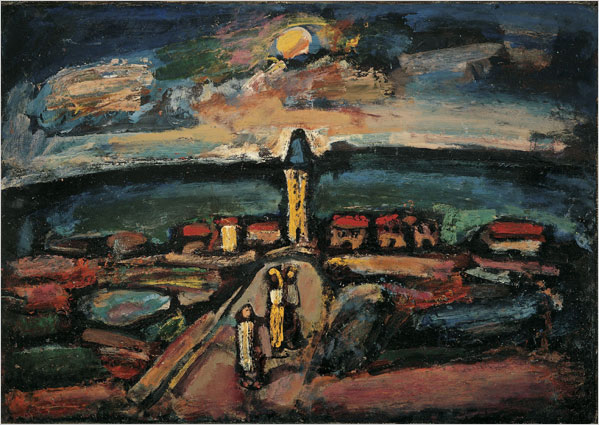
Georges Rouault -Christ in the Suburbs 1920-24I am a believer and a conformist. Anyone can revolt; it is much more difficult to obey our inner promptings.

Georges Rouault

******************

I’ve been a big fan of French painter/printmaker Georges Rouault  (1871-1958) from the moment many years ago when I stumbled across a copy of Miserere, a book of his deeply expressionistic etchings. The title translates as Mercy and it contained raw and expressive work that dealt with deeply personal and religious themes along with those inner promptingsas he calls them in the quote above. It was a work that was very influential on my early Exiles series.

His entrance into the world of art was serving, at the age of fourteen, as an apprentice glass painter and restorer which shows itself in his mature work which resembles leaded glass windows with its dark dividing lines and glowing colors that feel sometimes as though they are lit from behind with the light shining through. Both are qualities that excited me and made me want to emulate in my own work. Not to mention the purity a of the emotional feeling throughout.

Now, if only I can obey my own inner promptings…

This is kind of a replay of a blog entry from a couple of years back. I changed some of the wording and added a video that better shows the work of Rouault. Here is that video with more of his work:

Georges Rouault Sunset 1937georges-rouault-christ-and-the-fishermen-1939-Georges Rouault The Old King

Read Full Post »

You have most likely seen the work of Piet Mondrian, the Dutch painter who lived from 1872 until 1944.

Like the painting shown here. Seems so simple. Mainly black lines creating squares and rectangles that are mainly white but periodically filled with bright primary colors. Critics claim it is too simple, that it is something a grade-schooler with a ruler and some paints could replicate easily.

Maybe. Maybe not. Who cares?

But putting that side aside, his work has always remained refresh and modern through most of the last century up to this very minute. Outside of time, like it represents a future moment that exists just beyond this very moment at all times. And that factor in itself makes his work appealing to me.

I will never list Mondrian as a true influence or even a real favorite of mine, there is much to be gained as an artist from studying his work. The elegance of his structures and the space created within, for example. Or how he transformed his work through the years from a style of impressionistic realism into cubism and then into the style of his that we know so well, stripping away all detail and content down to the bare essence of being.

The video below shows that evolution beautifully, with musical accompaniment from Phillip Glass. I hope you’ll find it interesting to see how the work makes that transformation. Take a look below.

Let us note that art – even on an abstract level – has never been confined to ‘idea’; art has always been the ‘realized’ expression of equilibrium.
-Piet Mondrian

Read Full Post »

« Newer Posts - Older Posts »