Feeds:
Posts
Comments

Archive for the ‘Influences’ Category

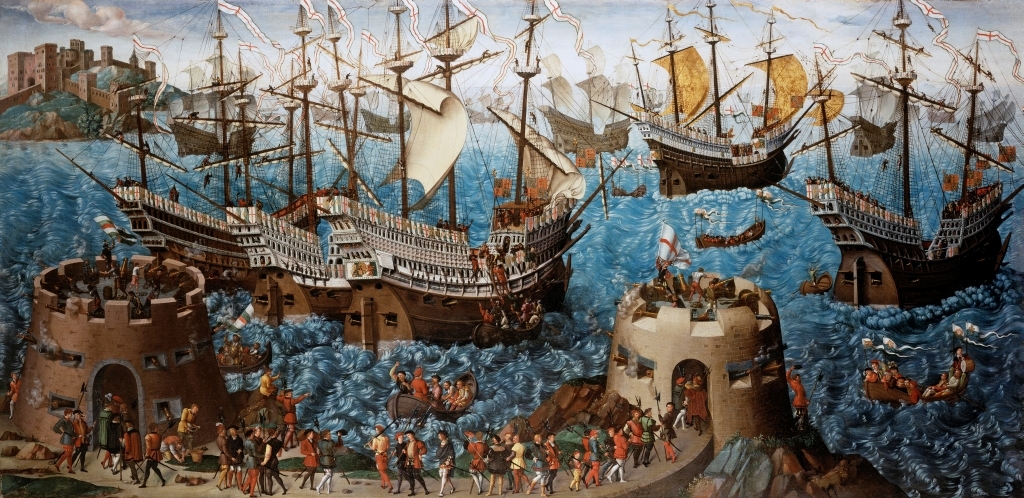
Embarkation_of_Henry_VIII at Dover- Basire PrintI saw this painting on a PBS program about Henry VIII and Hampton Court.  It’s a massive painting, nearly 5 1/2 feet tall by 11 feet  long, titled The Embarkation of Henry VIII at Dover, commissioned by the king to commemorate a 1520 meeting at Calais with him and French king Francis I.  It was a goodwill mission of sorts, trying to increase the bonds of friendship between the countries after a recent treaty.  Of course, only a couple of years later they were at war.  But while diplomacy may have failed at least an epic piece of art came from the whole thing.

The painting has been attributed to a number of painters over the ages, most notably Han Holbein, though nowadays its maker is listed as unknown.  But what a dynamic and energetic painting!  The color is bold and bright and the composition filled with movement throughout.  I love the exaggeration of size and scale, which gives the epic scene have a more personal, human feel.

I woke up thinking about this painting.  It makes me want to get out the stretcher bars and canvas and start another big piece. I know that they are not practical in many ways but there is something in the sheer size and space that just excites me and starts the creative fountain.

We’ll see…

Read Full Post »

Lately I have been thinking about how people find their individual creative voices, how it evolves and is influenced by what others think.  We all too often heed advice that fits in a one-size-fits-all world when we need direction that takes in account the singularity of our talents and our aims.  Many of us also dismiss the creative expressions of our emotional selves as somehow inferior to those from known creative talents as though they had a monopoly on the feeling and expression of emotion.  I think the individual voice grows when they transcend this feeling and realize that their point of view is as valid as that of any other person, including the greatest artists working in their field.

There is a lot more than can be said on this subject but it brings me to a post that I wrote here back in February of 2009 that describes how I came to this realization of my own validity.  I wonder how many artists, writers, musicians and other creative people have experienced this same sense of  inner intimidation and have succumbed to it, putting aside their quest for their own voice?

****************************************
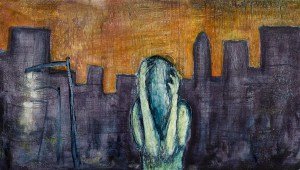
GC Myers- The AngstWhen I used to enter a gallery or museum, even up until several years ago, I would be filled with a severe sense of dread and anxiety. Angst. The knot in the stomach. The racing pulse. The whole thing. 

I would go from painting to painting and would feel lessened because in each piece I would see something that I could not do, some technique that was not in my toolbag. There were colors and forms that I could not replicate and all I could think was that I was somehow inferior. 

I didn’t belong. 

The resulting feelings would leave me reeling and sometimes angry, making me even more determined to create something that would validate my work. 

While this was a motivating force for many years, helping me actually find my voice, it gradually subsided over the years as I became more and more aware that I had been focusing on things I could not control and on being something I was not. 

I began to see what I was. I had an individual voice and vocabulary that was mine and mine alone. I began to see that other artists felt about my work as I had felt about their work. I saw that while they were doing things that I could not, the reverse was true as well. I recognized that my voice, my technique and style, was finally mine and mine alone. I saw that my form of expression was every bit as valid as any other artist hanging in any gallery or museum. 

This was a liberating feeling. It allowed me to go into galleries and museums and , instead of seeing what I was not, recognize the beauty of expression that was there and be excited and inspired by things other artists were doing. Instead of coming out saying ” I’ll show them ” I was saying “I can use that”. 

It was merely a matter of trusting that what I saw in my own work was a true and real expression and would be visible to others. I think this a lesson from which any viewer of art can benefit. They must learn to trust their own instincts and reactions when looking at art. Like my self-expression, their reaction to a work is theirs and theirs alone. Their reaction is as valid as anyone else and no critic or gallery-owner can make a person like a piece that doesn’t move them. When the viewer realizes that there is no right or wrong, that their own opinion is truly valid, their viewing pleasure will increase dramatically. 

By the way, the piece at the top is an old experiment from around 1994. I always enjoy pulling it out even though it doesn’t fit neatly into my normal body of work. No more angst. 

Well, a different kind of angst…

Read Full Post »
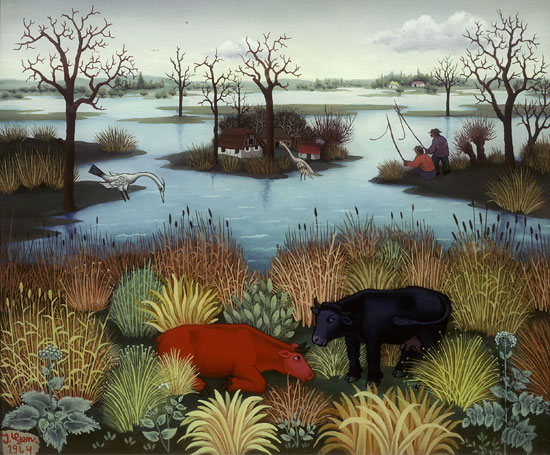
Ivan Generalic- River Landscape 1964I came across the work of the late Croatian painter Ivan Generalic (1914-1992) recently.  I had never heard of him but was instantly pulled in by his easily palatable work. It was colorful and had simple forms that fit the eye easily.  Muscular bare trees under beautifully graded skies of rich color.  Thick peasants and cows among simple square houses.  Golden fields with each stalk of grain painted individually.  It reminded me both of the gorgeous flora of Henri Rousseau’s paintings and the peasant scenes of Brueghel but still spoke in its own voice.  Simple yet not.

Ivan Generalic- Village 1954Generalic was considered a Naive Painter.  I never quite know what to make when I hear that term, whether it is disparaging or simply describing the form.  By definition, much of my own work is naive although I seldom refer to it in that way.  By naive,  I mean that I often disregard many of the elements of classical realism such as true perspective or the fading of color and detail over distance.  Plus I often leave out shadows and may have several light sources within a picture.  But it was never studied.  To me  it is simply painting as I see things in my mind, translating them on a surface in a way that makes sense.  Maybe that is why I am drawn to the work of people like Ivan Generalic who seem to make this translation seem so simple and elegant..

One of the ways I judge work of other painters now is to pull up a Google Images page of their work.  You can get a real sense of their work in this quick overview, seeing all of the paintings together playing off of each other.  It gives you a core feel  for it, what it was really about.  This definitely worked for Generalic, as you can see below.  There’s is a real sense of fullness and purpose in the work.  Certainty.

Ivan Generalic- Google Images Page

We don’t hear much about Croatian painters like Generalic here or even many Naive painters in general, which is our loss.  I find his work beautiful and intriguing and am glad to have stumbled across it.

Ivan Generalic -Cows in a Landscape 1957 Ivan Generalic-  Deer in the Forest 1956

Read Full Post »

GC Myers Life Forms ca 2004I spent yesterday working on a piece that was based on the photo from yesterday’s blogpost, one from Paul Strand that featured tiny figures on a sidewalk in a park.  I had translated the composition immediately and could see what I wanted in my head but just could not get it to translate on paper.  It was frustrating and had me flummoxed for most of the afternoon.  I just could not get to the image in my mind, could not achieve the depth and feel that I was seeing.

I wanted to taste a hearty stew  but was only getting weak broth.

I think that it came down to the fact that I had not completely absorbed the composition, had not fully made the transition from the original inspiration to a point where it became my own.  Like learning a piece of music where you are trying to discover the flow and rhythm of it, trying to see the pattern laid down by the original composer before you impose your own interpretation on it.  Making their notes your notes.

This is normally not a a problem for me.  The way I paint allows immediate transition into my own hand normally.  But sometimes when I try to force my work into a pattern that is not mine and is not fully hashed out, the results are less than stellar.


The piece at the top is not an example of this.  Rather, this is a the opposite, even though it may not resemble my normal work.  From 8 or 9 years ago, this  started as an exercise where I was just getting back to colors that I strayed from had , each little sliver being combinations of color.  Slowly,  it evolved into this fish-like swirl.  I find myself drawn into the pattern and movement of this and it works for me because it feels pure, feels as though it is my own rhythm and flow even though it doesn’t resemble my typical work.

I don’t know how to put this coherently.  It just feels natural, like writing your own signature.  I’ve down a couple of these over the years and they are among my favorites, probably because of this.  When I compare the easiness and grace of this piece to yesterday’s effort, there is a world of difference.  In this piece I am signing my own name whereas yesterday I was trying to forge a signature.  But if I can ever get to that image in my mind that changes and my signature begins to appear.

Read Full Post »


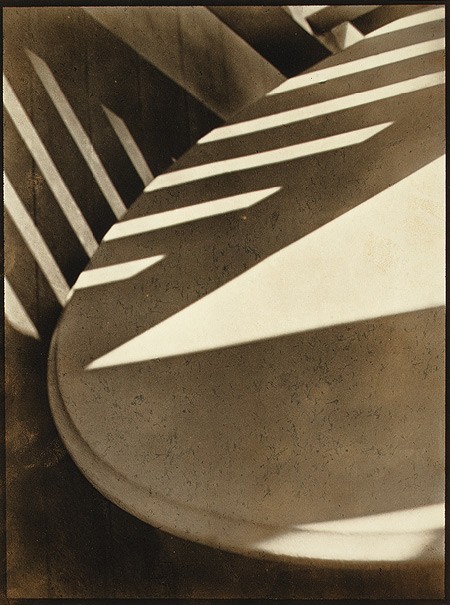
paul strand ny 1916No matter what lens you use, no matter what speed the film, no matter how you develop it, no matter how you print it, you cannot say more than you can see.

–Paul Strand

************************

I have featured the photography of Paul Strand here before, writing about his groundbreaking work in the early decades of the 20th century.  There is something about his work and his eye that is unmistakable, something that jumps from the surface.  When I saw this photo of a park in NY, here on the right, I knew immediately that it was Strand’s work.

I love this image, with the abstraction of the forms with the sidewalk forming a flowing diagonal through the picture plane.  The single figure in the lower third of the photo, cutting across the park in full stride,  becomes the focus for me, the soul of the picture.  He becomes the singular voice in a busy anonymous world.

Paul-Strand-The-Court-New-York-1924I think  the way in which he applies abstraction to the common forms in his work is wonderful and inspiring as an artist, something too many of us forget in our own work.  We become too concerned with simply capturing subject and not the emotion created in how that subject fits into its environment.  His best work speaks purely of emotion to me and he was able to find it everywhere.  As he said:  The artist’s world is limitless. It can be found anywhere, far from where he lives or a few feet away. It is always on his doorstep.

I think those are words to live by for any artist.

Paul Strand Abstraction Connecticut 1916


Read Full Post »

GC Myers Early Interior  smI have often shown early work here, stuff from when I was still trying to find a path forward.  Most of it is from before I ever thought  that showing my work in public was a possibility.  As I have pointed out, I still revisit this early work on a regular basis in an effort to stay connected with that time in which the need to create was the only motivation needed.  There’s also an element of backtracking in this as well, trying to put together how this work somehow led to what I do now.

Sometimes it is hard to see the connections as the work is so singular and never followed up on, then or now.  I think those are the pieces from that time that intrigue me the most, making me wonder how my journey forward from that time would have been different had I chosen and stayed on that path.

For example, here are three pieces from around the same time, all painted within a month or so of each other back in 1994.  None really lead directly forward but I really always enjoy seeing these three pieces, wondering what my motivation was at the time.  The first , shown above, is an interior scene that just formed on the paper.  I had no idea what was going to be there, outside of the checkered tablecloth.  I remember that the cross on the wall was a last minute addition, one that changed the whole feel of the piece.  I can understand why I didn’t follow this path but it still makes me wonder.

GC Myers Still Life smThe next was this still life, here on the left.  I remember this piece well, having ambivalent feelings about it as a whole.  I liked the clear graphic look of it but it was almost too clean, too sharp.  It had really good eye appeal but it seemed all surface to me.  I see things from this piece that  I did bring forward, such as some of the clearness of the colors which I like in some instances.  The thing that always strikes me is that I see a face in profile, looking to the right.  Faces subconsciously built into the composition are something I often look for in my work, feeling a curious satisfaction when I find them.  I wish I knew why.  Maybe that’s what draws me back to these early pieces.

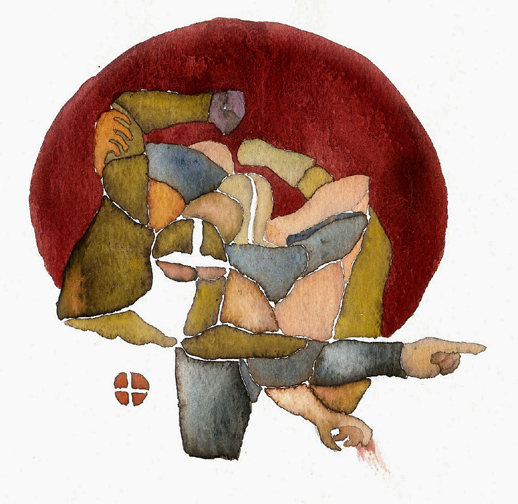
GC Myers- Doug's First day on the Job smThe last was one that had a title, Doug’s First Day on the Job.  I remember this as a piece that I viewed as an exercise even as I started, experimenting with forms and color.  The resulting scrum of arms and fists with the strange authoritarian figure in the foreground, hooded and  pointing ominously out of frame reminded me of the chaos and confusion of  a kid’s first day on a new job.  A strange environment with strange new people who struggle with each other and boss the new guy around.  I knew even as I painted this that this was not my path but I enjoyed this piece anyway.  It had a cleansing effect and was a wonderful lesson in color and form .

Plus it made me chuckle.

I don’t know that there is any great connection between these pieces or to my future and current work.  I always wonder though at how these disparate  pieces formed in such a short time, wondering if I have that same burst of energy within me still.  Maybe that is the reason for this backtracking, looking for that energy source, that fount of inspiration.

I don’t know…

Read Full Post »

Norman Rockwell- People Reading Stock ExchangePut this one in the “Even the great ones screw up every once in a while” file. This is a painting from Norman Rockwell  titled  People Reading Stock Exchange for one of his many Saturday Evening Post covers.  There appears to be nothing unique about it at first glance,  just a group of folks hunched around a wall chart that they all  find completely absorbing.  They all seem perfectly normal until you take a closer look and notice that the young man in the red shirt seems different.  You look a bit closer, maybe squint a little  until you realize you don’t need to do that to see his abnormality. Yes, he has three legs. Norman Rockwell- People Reading Stock Exchange detailRockwell apparently didn’t notice this until it was pointed out years later and it proved to be a embarrassing episode for him, especially given his reputation for capturing detail in his work.

Some people have tried to explain it away as some sort of subconscious phallic representation which seems like a stretch to me.  I think it was merely an oversight although an unusual one.   As a casual viewer, it it something that is easy to overlook but I am more amazed that in the process that it simply didn’t register for him that he was creating a most unusual young man. As an artist, it’s reassuring to see someone so meticulous make such an error.

Most artists have at least a handful of such things in their background, pieces with shadows that make no sense in nature or arms that are much too long for any living human.  Most go unnoticed.  The unfortunate thing is that once they are identified, they become the focal point of that painting forever– something once seen cannot be unseen.

I know that I have several paintings with such mistakes, pieces that, without these flaws being pointed out, are strong and full works. Few people, if any, notice these flaws but for me they are the first things my eyes rest upon in the picture. They don’t bother me as I am sure this bothered Rockwell.  I see them as symbols of our humanity, our inherent flawed nature.

We don’t need to point out our flaws.  They’re there for all to see.  We can only hope people accept us, three legs or two or one.  And the three-legged young man here is a refreshing reminder of Rockwell’s humanity.

Read Full Post »

criminals-with-forehead-tattoo-father-son

For Father’s Day-

                     Smart                         

My dad gave me one dollar bill

‘Cause I’m his smartest son,

And I swapped it for two shiny quarters

‘Cause two is more than one!


And then I took the quarters

And traded them to Lou

For three dimes-i guess he don’t know

that three is more than two!


Just then, along came old blind Bates

And just ’cause he can’t see

He gave me four nickels for my three dimes,

And four is more than three!


And I took the nickels to Hiram Coombs

Down at the seed-feed store,

and the fool gave me five pennies for them,

And five is more than four!


And then I went and showed my dad,

and he got red in the cheeks

And closed his eyes and shook his head-

Too proud of me to speak!


–Shel Silverstein


I ran this several years ago for Father’s Day but decided to run it again because I think my Dad appreciates the  humor more than the mush of most Father’s Day sentiments.  It was either this or A Boy Named Sue, a song I remember my Dad liking which is also written by Shel Silverstein.   If you want the rundown on the happy family above, just click on the picture.  Have a Happy Father’s Day…

Read Full Post »

Thomas_Hart-Benton-America_Today_ 2I had not heard until just this morning that one of my favorite pieces of public art had been removed from the walls of a NYC lobby and donated to the Metropolitan Museum of Art.  I am talking about Thomas Hart Benton‘s incredible 10 panel mural America Today which hung for nearly 30 years in the lobby of the AXA Equitable Building on 6th Avenue– the Avenue of the Americas, officially– in midtown NYC.

It’s a magnificent sweeping representation of the American epic, painted in 1930-31 for the boardroom of NY’s New School, just as the nation was entering the Great Depression. The color is deep and bold and Benton’s rhythmic linework and forms run through the various scenes of the nation at work and at play, binding it all into a piece of art that has the impact of a symphony at full crescendo. Just a great piece of work that reaches out and grabs you.

Thomas_Hart-Benton-America_Today_OilAt least that’s how it came across to Cheri and I many years ago, long before I had dreams of  painting for myself,  as we were wandering around Midtown one evening.  We found ourselves strolling up 6th Ave. in the evening darkness and through the windows of one of the large office buildings we suddenly both caught a glimpse of  bold colors that appeared to be some sort of mural running around three sides of the groundfloor lobby.  We scooted through the doors and stood in absolute awe.  It was long after the office workers had left the building so it was dead still except for a quiet conversation between the security detail at the front desk.  We stayed there for quite some time, amazed that this magnus opus was here for all to take in and see.

Thomas_Hart-Benton-America_Today_City_Activities_with_Subway It seemed appropriate.  Over the years we always made a point when we were in NYC to make a  stop and gawk with mouths open at Benton’s beautiful work.  It was always magical.

I am a bit torn about its removal to the Met although I know it is for the best, from a preservation standpoint,  and that probably more people will actually really appreciate it there.  But the idea of having it out in a public space where anyone can stumble from the street and take in its wonder really appealed to me and spoke to the democratic spirit of the work.  But it will be well cared for and hopefully always on view for those who wish to see Benton’s vision.

Below is a view of the mural installed in the Met.  This is not in HD  so its not a fantastic view but it gives you the idea of how well the work hangs together.

Thomas_Hart-Benton-America_Today_Thomas-Hart-Benton-City-Activities-with-Dancehall-from-America-Today

Read Full Post »

Charles Atlas AdI don’t know why this caught my eye this morning.  If you are of a certain age you will immediately recognize this ad that ran regularly in magazines for decades, touting the benefits of following the fitness regimen of Charles Atlas.  It was one of the longest running ad campaigns of all time and made the term 97-pound weakling  a regular part of our language.

I am instantly taken back in time by this ad, one that I read dozens– maybe hundreds of times– over the years, each time feeling Mac’s pain and anger at being pushed around and reveling in his revenge over the Bully of the Beach as a result of his simply following the way of “Dynamic Tension,” Atlas’ method of using opposing forces to create strength.

Never ordered the course, never acquired the sculpted body of Atlas or mastered Dynamic Tension, although that term has always stuck with me.  There is something in it that rings true and speaks to the polarity that I often describe when talking about my work, that energy created by contrasting forces.  For instance, the area of contrast between light and dark  is often the strongest part in a picture .

Perhaps there is something to this idea of tension and the creation of energy. Charles Atlas was trying to tell me that all those many years ago but I didn’t realize it could apply to things other than biceps, pecs or abs.  Funny how seeing something like this innocuous ad brings back memories and associations…

Read Full Post »

« Newer Posts - Older Posts »