Feeds:
Posts
Comments

Archive for the ‘Influences’ Category

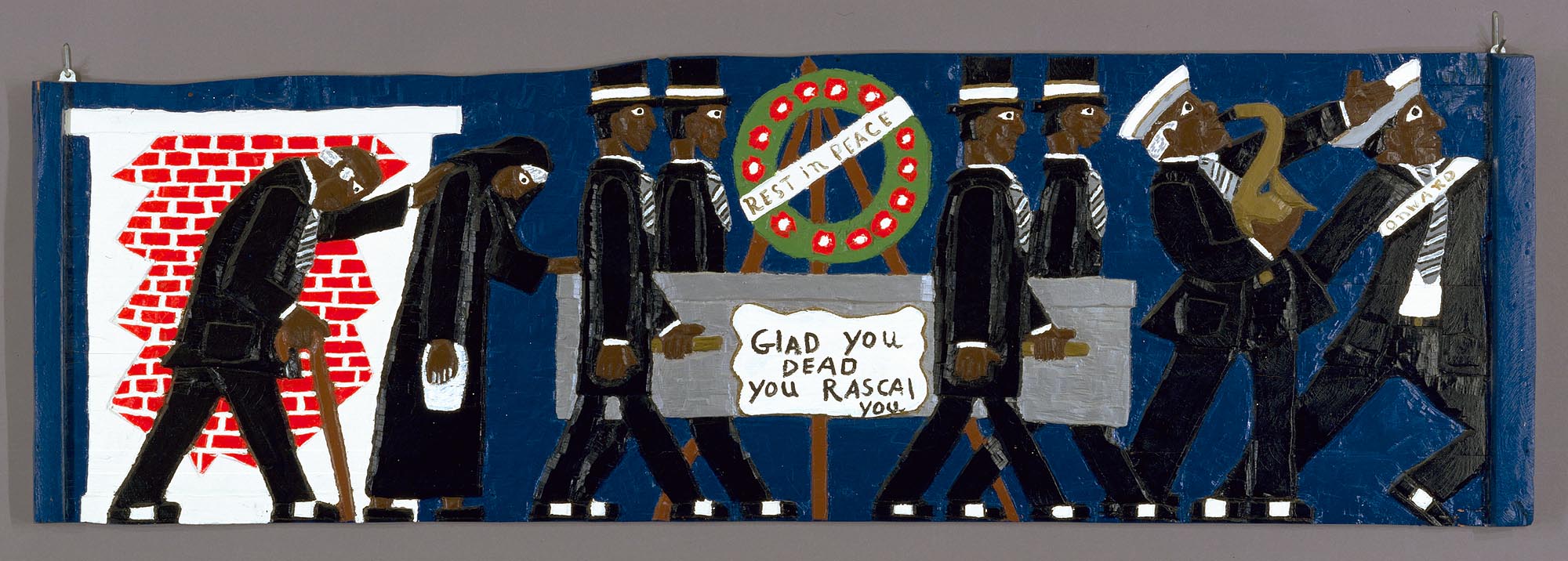
Singleton Glad You Dead You Rascal YouSome of the first things I ever did artistically as a somewhat mature person were bas-relief  carvings.  In a way, it formed the technique that I adopted as a painter.  I suppose that’s why I am so drawn to carvings when I come across them.  There’s something very appealing to me in the idea of a flat surface that has this raised, tactile surface. Like a painting that is also available in braille.  I can imagine the artist running his hands over the piece as he works, the ridges and valleys sliding gently underneath in a most comforting way.

Smithsonian American Art Museum - Donald W. Reynolds CenterI recently stumbled  across the work of Herbert Singleton ,  a New Orleans folk artist who made wonderful and colorful carvings such as the piece at the top, Glad You Dead You Rascal You, which depicts a New Orleans funeral procession.  Singleton’s life story is similar in may ways with other folk artists– a life filled with missteps and violence, run ins with the law and addictions.  He spent the better part of 14 years in prison and died in 2007 from lung cancer at the age of 62.  But in his short time here, Singleton created a powerful body of  carved work that documented his world and goes well beyond the label of folk art or self-taught art.  It is not benign work .  It often rails against social injustice and hypocrisy with great gusto.

I was first attracted to some of his Voodoo Protection Stumps, such as the one shown just below, which are carved from  half of a log with  multiple colorful faces emerging from one side and the bark remaining on the backside.  There is an immediacy and vibrancy to the images and color that make them really ring out. Singleton’s work is such a great example of   an artist who will not be held captive to their circumstance,   will not succumb to the hardships and obstacles that that they face.  They use their life and whatever means they can muster to express their place in this world.

SingletonVoodooProtectionStump 2

The piece at the top of this post, Glad You Dead You Rascal You, was based on the song You Rascal You made popular by the great  Louis Armstrong in the early 1030’s.  Here ‘s a Betty Boop cartoon from 1932 that features the song in  an interesting mix of cartoon and live action with Armstrong and his band.  Hard to believe this is from before my dad was born on this day back in 1933.  Happy birthday to my old man.
Read Full Post »

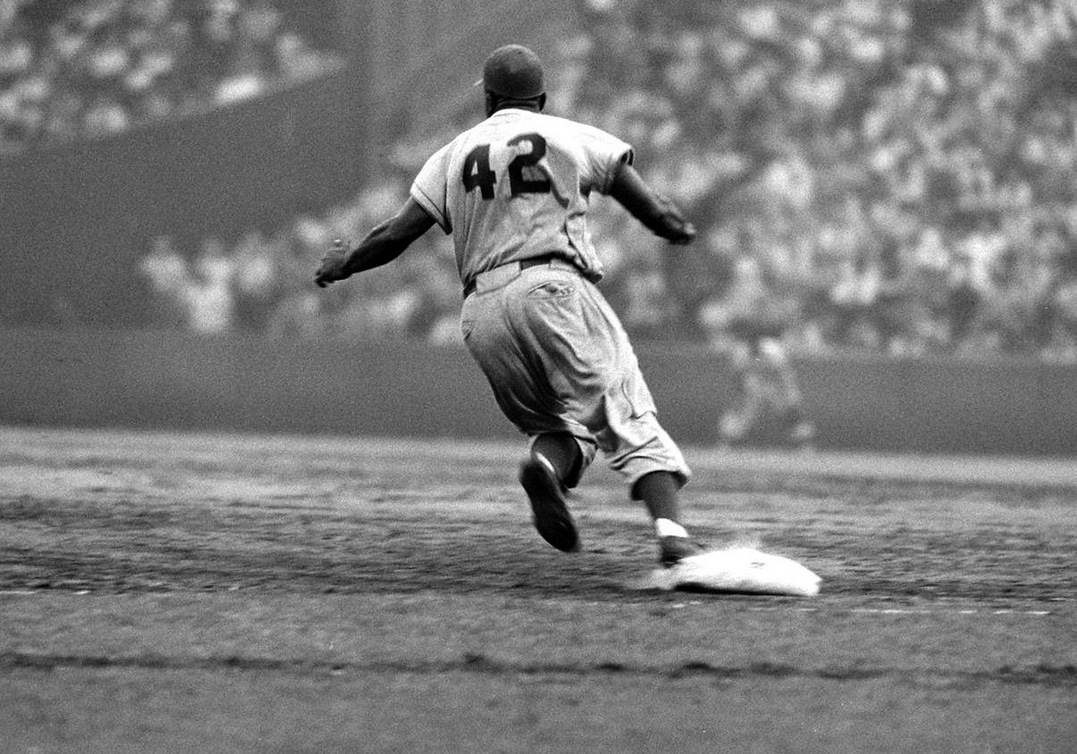
jackie-robinson-1956_April 15 means a couple of things to some people.  Of course, there is the unpleasant connotation of it as being Tax Day, the due date for income tax filing here in the USA.  But for the baseball fan, it is a date that marks the first day a black player took the field as a major leaguer, when a special player ran out to play first base for the Brooklyn Dodgers back in 1947.   This young black man was athletically gifted, smart and tough-minded.

That player was of course Jackie Robinson.

Major League Baseball now honors him on this day every year, Jackie Robinson Day, with every player on every team putting aside their own uniform numbers to wear his number 42, which is now retired throughout baseball. Currently, only Mariano Rivera wears the number 42 on his back  and after he retires at the end of this season, no player will ever wear the 42 on their back again outside of this day each year.

Retiring a number is a sacred thing in baseball.  A player’s number has an almost mystical connection with the fans.  Growing up, everyone knew that Babe Ruth was 3,  Lou Gehrig 4, Mickey Mantle 7, Willie Mays 24, Hank Aaron 44 and on an on.  Whenever I see the number 45 all I see is my hero Bob Gibson on the mound. And everyone , even Mariano Rivera fans like myself, knows that the 42 belongs to Jackie Robinson.

There is also a new movie out that bears that number and it tells the story of Robinson’s initial turbulent year with the Dodgers.  I haven’t seen it so I can’t really comment other than to say that it is a story that every child should know.  It is a remarkable story of self restraint and strength in the face of institutionalized hatred, one that made possible the  broader changes that took place in our country in the civil rights movement in the decades after Robinson’s first day on that field in 1947.

From what I have read, the biggest complaint is that the movie doesn’t really give a full accounting of Robinson’s life. Jackie was a legendary collegiate athlete at UCLA, lettering in four sports– football, basketball, track and baseball.  He was the NCAA champion in the Long Jump and could have easily played professional football.  Of course, that was impossible because  the NFL was segregated at that time as well.

Nor does it detail his military career which is of interest mainly for Robinson being court martialed for refusing to sit in the back of an Army bus at Ft. Hood, Texas.   He was eventually acquitted of all charges by an all-white panel of officers  but it was an incident that foretold of his strength and willingness to enter the fight in taking on the segregated major leagues.

Nor does it address the health problems that led to his early death.  He suffered from diabetes and was nearly blind when he had a heart attack that ended his life at the age of 53.  It was much too early for this remarkable man’s story to end.

As I said, it’s a story that every child should know and celebrate.

Read Full Post »

GC Myers- Old Studio 2007I came across this photo of the path leading up to my old studio that sits in the woods above our home.  It served me well for a decade but now sits idle, patiently waiting for Mother Nature to reclaim it as her own.  When I think of that space, I always think first of its coldness in the winter when the wood pellet stove would not quite keep it comfortably warm, my breath coming out in visible mists at times.  But I also also think of the walk from the studio to the house, how the path became ingrained, so much so that walking down the hill in the deepest darkness was no problem at all.  Each step, each footfall just fell into place.

It reminds me of an entry I made here about four years back that talked about this path, one called Setting a Path:

For ten years I walked up the road through the woods to my old studio.  It was a logging road from the two or so times the forest had been harvested over several decades and ran along a run-off creek that dries up most summers.  There were two visible tracks from the tires of vehicles that had climbed the gentle rise over the years and as the years passed, another track formed between them from my own footsteps.

This was the path I walked several times a day, up and down the hill.  At first I thought nothing of it.  It was simply a path.  But over the years I began to notice things about it. I could walk the path in the absolute black of night with no problem, each step falling in a natural way directly to this path.   If I tried to walk off the path it seemed unnatural and required a degree of attention to my stride so I wouldn’t stumble.

I came to realize that my trail was the path of least resistance.  It was the path that carried me with the least effort.  Each step fell naturally in place, accounting for the slightest change in the topography and had the same effect as water flowing down a creek.

I began to notice that the trails formed by deer and other animals were  the same.  When I followed them, they would move slightly in one direction or the other, just when your stride wanted to shift naturally and simply from gravity.  There was the same sense of rightness I talk about in my painting.  They never veer drastically, always in smooth, subtle curves.  They would always  run along the grade as though were the elevation lines on a topographical map.  Following them required little effort or thought.

Going off the path was a different matter.  It took thought, concentration and effort.  There were new obstacles to overcome.  Branches that crossed the path, blocking your view ahead and slapped the side of your head.  Downed trees that had to be climbed over.  Roots that rose through the dirt and tripped you.  It was real work.

I guess herein lies the point.  If I wanted to go where others had went before me, I could follow their trail. This would be the simple and logical way.  But if I wanted to go to a different place, one that was fresher and less visited, I might have to set my own path.  It wouldn’t be easy.  It would require more effort, more thought and the risk of not finding my way.  But if I forged ahead and found my way, there would be a new, hard won  discovery and the sense of accomplishment that comes with it.

I could blather on a little more but I think my little lesson learned from the land (nice alliteration, eh?) has come to an end.  We all choose our paths.  Some take the easier trail.  Some blaze new trails.  And some go into the woods and never come out…

Read Full Post »

genghis khan Chinggis Khaan statue horse equestrian mongolia 6I came across this photo of the Genghis Khan memorial in Mongolia, about 30 miles outside the capital city of  Ulan Bator.  I’ve always been a sucker for statues of epic proportion and I had never heard of this particular one.  It’s a pretty amazing  image, with Genghis astride his sturdy horse atop a museum,  and one can only wonder how it must appear in person in the vast open air of that Mongolian space.

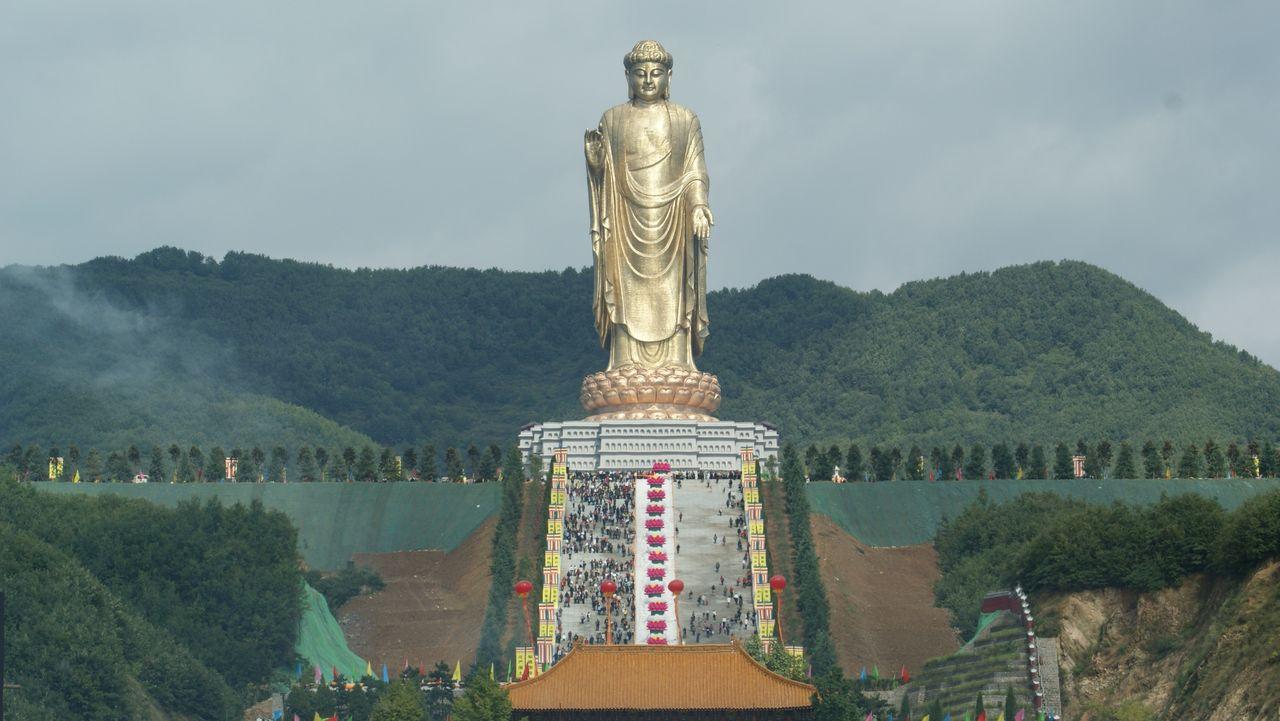
I always am inspired when I see memorials such as this Genghis Khan statue.  It makes me want to work on something epic in size or at least push the spirit of my  work even harder forward, to think in a bigger way.  Grander in thought.  Perhaps that is the purpose of such memorials, to expand our horizons and broaden our vision.  I know that when I think of some of the other monuments of this proportion, such as the  World War II war memorial featuring a sword-wielding Mother Russia near Stalingrad or the Spring Temple Buddha in China (both shown  below),   that is the feeling that comes to mind.  They push me beyond the smallness of  my inner self where  I often allow myself to retreat in my work.  And that is exciting.

So, thanks for the inspiration, Genghis Khan.  And you too, Mother Russia and Buddha.  I’ll try to be a bigger person.

Stalingrad War Memorial Spring Temple Buddha

Read Full Post »

Martin Johnson Heade Approaching Thunderstorm 1I don’t think I’ve ever mentioned Martin Johnson Heade here.  This is really an oversight on my part as some of his work was really influential on the direction of my work early on, even though our styles and methods of painting were wildly different.  The intensity of the color and contrast in his paintings of  floral subjects and tropical birds that he completed during his long and  prolific career ( born 1819- died 1904)  really made me want to push my own color ahead.  There is a , Martin Johnson Heade- The Complete Works, that has his complete works online where you can see the great quality of his color and  use of contrast.

But the painting shown at the top, Approaching Thunderstorm, from the Metropolitan Museum is my favorite Heade painting.  The forms of the  black water of the lake set against the vibrant color of the shoreline is striking and  a most ominous storm cloud churns toward the boaters who have not yet fully heeded the signs of the oncoming storm.

It was painted in 1859, in the years before our country exploded in civil war.  This painting was part of a cultural movement of the time that depicted the tension gripping our nation in metaphorical terms.    The metaphor is strong and obvious  in this painting and  several prominent abolitionist preachers owned versions of this painting , many often referring to the coming storm in their sermons.

Knowing this makes me appreciate the painting on a different level.  But it is still about the sheer emotional impact of the color and forms that hit me long before I knew its history.  There is a tension and that feeling of stillness that occurs in the moment just before action occurs, something I have tried to capture in my own work at times.  I still find this piece brilliant and inspiring.

Read Full Post »

GC Myers- Geometry of the HeartIt was Opening Day for Major League Baseball the other day, which is always  a red letter day for me.  It’s sort of like 2013 has officially began, that my day to day life now has something with which to synchronize, something to fall in rhythm with.  So, even though I have been feeling under the weather for several days,  I was able to complete a new piece, one that had been banging around in my head for a long time.  It incorporated the perfect geometry of the baseball diamond nestled among a tightly clustered neighborhood of Red Roofs.  It’s an odd piece, one that feels both typical and atypical at once.  That’s a quality that I like.

ralph_fasanella_sandlot_baseball_1373_356I have been wanting to incorporate the baseball diamond into one of my landscapes, perhaps influenced by some of the folk art paintings that did it so well.  I have featured some of these here, such as Malcah Zeldis’ Homage to Hank Greenberg, shown at the bottom of this page or Ralph Fasanella’s Sandlot Baseball,  shown here on the left.  These are paintings I like very much as much for the baseball aspect as for the wonderful folk art manner in which they are painted.  There is something in the sight of a diamond that has a hypnotic effect on me, something I hoped to capture in a painting.

I always remember the feeling when I was a kid and we went to Shea Stadium to see the Mets play, especially for night games.  You would head out from the dim light of the concourse and emerge into the brightness of the field lights.  The green of the field was so vibrant, the brownish red of the infield dirt so rich.  There was something perfect in looking down on that diamond, a design that made so much sense to a child’s mind.  A beautiful geometry, one that equalizes weaknesses and strengths.  The length of the basepaths, for example, are such that  on a hard hit  ball to the infield a fast runner can be easily thrown out at first but a slower runner can often beat out a soft groundball.

Here, a small man could easily conquer a much larger man from a distance of 60′ 6 “, the distance from homeplate to the pitching rubber.   Skill overcomes pure strength, size and athleticism.  If you ever saw Michael Jordan flailing helplessly at minor league curveballs, you’ll know what I mean.

I could write a lot more here.  And I probably should.  But I simply want to show this new piece, a 20″ by 24″ that I’m calling Geometry of the Heart.  Here, the ball park, a Little League sort of field, represents the heart of the neighborhood, the openness of the field stands in direct contrast with the cramped houses.  This is a painting that I have really enjoyed painting, one that is probably more for myself than for anyone else but one that I needed to paint.

malcah-zeldis-homage-to-hank-greenberg

Read Full Post »

GC Myers- Larger Than LifeI am currently working on a new body of work for my annual June show at the Principle Gallery in Alexandria, VA.   I am calling this year’s exhibit,  my fourteenth solo show there,  Observers, and the piece shown here is one of the pieces that will make up the show.

This painting, a 16″ by 26″ piece on paper, is called Larger Than Life.  It’s a continuation of the Red Roof landscapes that I have been showing on this blog lately.  This piece was another that came from my early morning session in the studio when I had several images come to mind during a sleepless night.  It evolved into something other than what I originally saw but I am actually more pleased with the final result than with the mental image that inspired it.  In my mind I didn’t foresee the little peninsula  that is home to the larger than life Red Tree but, as I worked along, it  just grew out of the mainland on its own.  It seemed a natural fit and I never questioned it and liked the way the causeway broke up the two blocks of color that make up the body of water depicted here.

The Red Tree is, as I pointed out, is larger the life which is obviously the basis of its title.  I really wanted to make it unnaturally large and expressive, its trunk and branches more shrub-like than one might expect from such a large tree.  I had toyed with the idea of a simpler, straighter and more sturdy tree but felt it would alter the entire feel of the piece and wouldn’t provide enough of a counterpoint to the uniformity and order of the houses that were on the opposite shore.  I see the Red Tree here a connector, the thing that binds the everyday, represented by the houses, to the ethereal that the horizon and sun represent here.  It needed to be bigger and more expressive and so it came to be.

I’ve been enjoying  taking in this piece over the last day or so.  The diagonals of color, the running ribbon of the path and the curves of the shoreline keep my eye moving through the piece.  As I said, it is more than I originally saw.

Read Full Post »

GC Myers- Not Quite an Island When I awoke in the middle of the night, as I wrote in the last post, I had a piece in my mind that I really wanted to start on.  It was simply a causeway running out to a piece of land, an almost-island.  That was all I had in mind.  I held no details on the island itself or even how the causeway would look, just an idea of a strip running outward.

This is the piece that emerged, a 16″ by 20″ canvas that I call Not Quite an Island.  The title is based, of course,  on the famed piece of writing from John Donne that begins with  No man is an island and ends with Therefore never send to know for whom the bell tolls; It tolls for thee.  It’s often portrayed as a poem but it’s part of a sermon, Meditation XVII, from a book of his sermons  titled Devotions upon Emergent Occasions. Donne was writing on the interconnected nature of the world, how one man’s suffering was the suffering of all men, that the death of any man somehow diminishes the whole of mankind.

I saw this piece as being about the impossibility of ever truly detaching oneself from the outer world.  As hard as we might desire to seek  isolation from the world, we always remain connected by virtue of our own humanity.  And the causeway here represents that connection to me, a lifeline to the larger outer world with the path that runs along it up to the Red Tree almost serving as a root nerve connected to the larger spinal cord of the world.  To cut off that nerve, that connection, is to lose all feeling.

It’s a simple painting but the simplicity of it actually reinforces the message, in that the image makes a striking and easy first impression.  There’s a meditative quality here, an easy flow and harmony to this piece that brings my eye back to it again and again.  It’s actually just as I hoped it would be when I got out of bed at 3 AM a few days ago, filled with anxiety.  In its way, it has alleviated that angst.  For the moment.

As it should…


Read Full Post »

GC Myers Studio 4 AMSometimes you can almost hear it click.

It happened this morning about 3 AM as I was laying in bed trying to convince myself that I really needed to get to sleep,  to try to grab some rest.  But my mind would have none of that.  It was spinning and snapping– things that had to be done,  ideas for upcoming shows, new compositions that I wanted to get down.  My head was racing and it felt like a big ball of anxiety was building inside of me.  In the past I might have written it off as such.

But for me it was a huge relief to have that knot in my stomach once again.  It was like the big click of a switch going off inside that was triggering some creative surge.  I had felt this before and had missing it as of late.  I know that it sounds funny to bemoan the fact that anxiety and fear have been absent in one’s mind.  But I knew from experience that this anxiety was something just trying to push itself out of me.  Something to which I had to respond, had to harness and use.  React to and express.

When I did the interview for the TV crew  last week, they asked what painting meant to me and I struggled in coming up with an answer.  I can’t remember exactly what I told them.  I guess the answer should have been that painting gave me a way to make this anxiety that has been my lifelong companion take a positive form.  I have learned to embrace it and when it comes around with that big click that is telling me there’s something on the way, I react.   So here I am at 4 AM, happily in the studio,   already having prepped new panels, jotted down the images that were dancing in my head and am getting ready to break out the paint.

Click.


Read Full Post »

Norman Rockwell- Breaking Home TiesI was looking at the shelves above my desk yesterday and spotted two books of Norman Rockwell paintings that I haven’t looked at in some time.  It made me realize that I’ve barely mentioned Norman Rockwell here on the blog which seems all too fitting– his work was so consistently brilliant and ubiquitous that it is often easy to overlook him. Or downplay his talent, as it was such a common thing to do among critics, especially in the 70’s and 80’s when Rockwell was definitely not cool in any sense of the word.

Norman Rockwell- The HomecomingThe critics of that time saw his work as often being overly sentimental and trite, a painter of  an idealized American dream that didn’t deal with the quickly changing world.  But that was merely the result of Rockwell meeting  (and exceeding) the requirements of the multitude of  illustration assignments he received throughout his career.  He painted to meet the desires of his clients and they wanted narrative images that were immediate and deep in their meaning, images that were not ambiguous in any sense.

Which is exactly what they got along with a magnificent chronicle of the last century.  Along with some incredibly beautiful painting, work that elevated these images from simple  illustration to grand art.

Norman Rockwell - The Four FreedomsI love  the immediacy of Rockwell’s work, the fact that you are easily swept into the narrative that he creates.  It is instantly accessible and speaks in a universal language of emotion.  But it’s the color of his work, the darks and lights and the way in which he handles them and places them within the compositions, that moves me.  They are something out of a rich and pure dream, colors that give me a deeply felt satisfaction.  I certainly don’t paint in any way like Norman Rockwell but I still long for his colors.

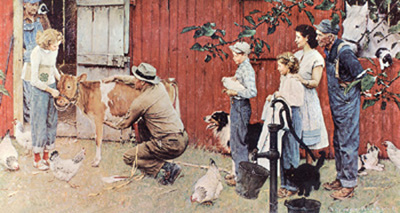
I remember seeing his scene of a farm family during a visit from the vet who is checking out the young daughter’s calf , shown below.  The painting was hanging at our local museum as part of a traveling exhibit and from a distance it was instantly recognizable as Rockwell’s work.  Tight and illustrative.  But as you came closer, you could see the beautiful marks, loose paint strokes that made up the ground on which they were standing.  It was just a wonder to see how he was able to put the piece together and have it read as it did.  It really made me more appreciate his work.

Norman Rockwell- Farm Family Scene


Rockwell’s life  (1894-1978) and long career  spanned perhaps of the great periods of change in the history of our world.   He captured us at our best and at our worst, with images that were often poignant as well as humorous.  We are so fortunate to have had such a masterful eye keeping tabs on us. Looking at his images, there are literally hundreds that I could have used for this little post.  I’m sure most of you will have images of his in your head that will immediately come forward.  It is a most remarkable body of work, one that inspires awe from my perspective as an artist.  I’m sorry it took so long to acknowledge your brilliance, Mr. Rockwell.

Norman Rockwell- The Problem We All Live With


Norman Rockwell- The Art Critic

Read Full Post »

« Newer Posts - Older Posts »