Feeds:
Posts
Comments

Archive for the ‘Influences’ Category

Yvette and Akshay at GC Myers'  JLG Show 2012Well, I’ve been back for a couple of days now and I’m still trying to recall details of our trip out to California, particularly those from the show at the Just Looking Gallery on Saturday evening.  I am trying to recollect the many faces and names and stories that flash in my memory, trying to make sure that I account them all properly.   For instance, here is a photo taken during the show  with Yvette and Akshay along with two paintings they chose from the show.   We had a lovely conversation during the show where I learned more about their lives  and their backgrounds.  While I know it’s important  to expound and to shed some light, if I can, on the work, the meaningful part of these shows for me  comes in hearing what people who find something of value in my work have to say.  I realize how fortunate I am to be in a position where I can listen, a position where people are willing to speak earnestly with me.

I really treasure getting to know more about those who collect my work.  I have often said that it comes in handy when I am working for long periods in the studio.  There are points when the whole act of painting becomes abstract to me and I begin to question the validity of what I am doing.  It can be troubling and I can begin to feel all alone in my studio, alone in my own world.  But it is at these points that I recall people such as Yvette and Akshay  or Mike and Lilia  or Marla and Josh or any of a number of other folks who I have met.   I immediately begin to feel reconnected to the work and less alone, as though there are eyes peeking over my shoulder as I work.  It’s a wonderful thing, one that has helped me many times.

Knowing this, it should be an easy thing to simply listen but at points during the show, when it is very busy and   time is very limited, sometimes I have to speak more than I listen.  I think it was Yvette who asked near the end of the reception how I was enjoying the night.  I replied that I got to talk on and on about myself so what wasn’t here to like?  I added that, unfortunately, I had to listen to that same guy talk all night and boy, was I sick of hearing him talk.

But I do try to listen if only because I think the need to be heard, the need to be recognized as part of this world,  is what drives this work.  I think many of us feel disengaged and voiceless at times in the whirl of the larger world.  My hope for my work is that it allows the viewer to feel once again connected to world, to feel as though there is someone listening to their words, their hopes, their dreams. Maybe that’s a little too much to ask.  Maybe but I can still hope.

So, to the many folks who shared a bit of themselves with me this past Saturday, I say Thank You.  You don’t know how much you’ve given me.
Read Full Post »

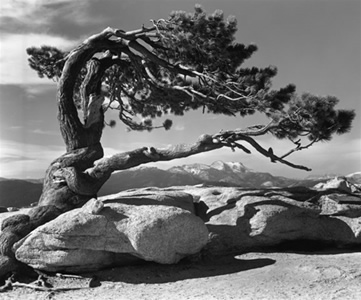
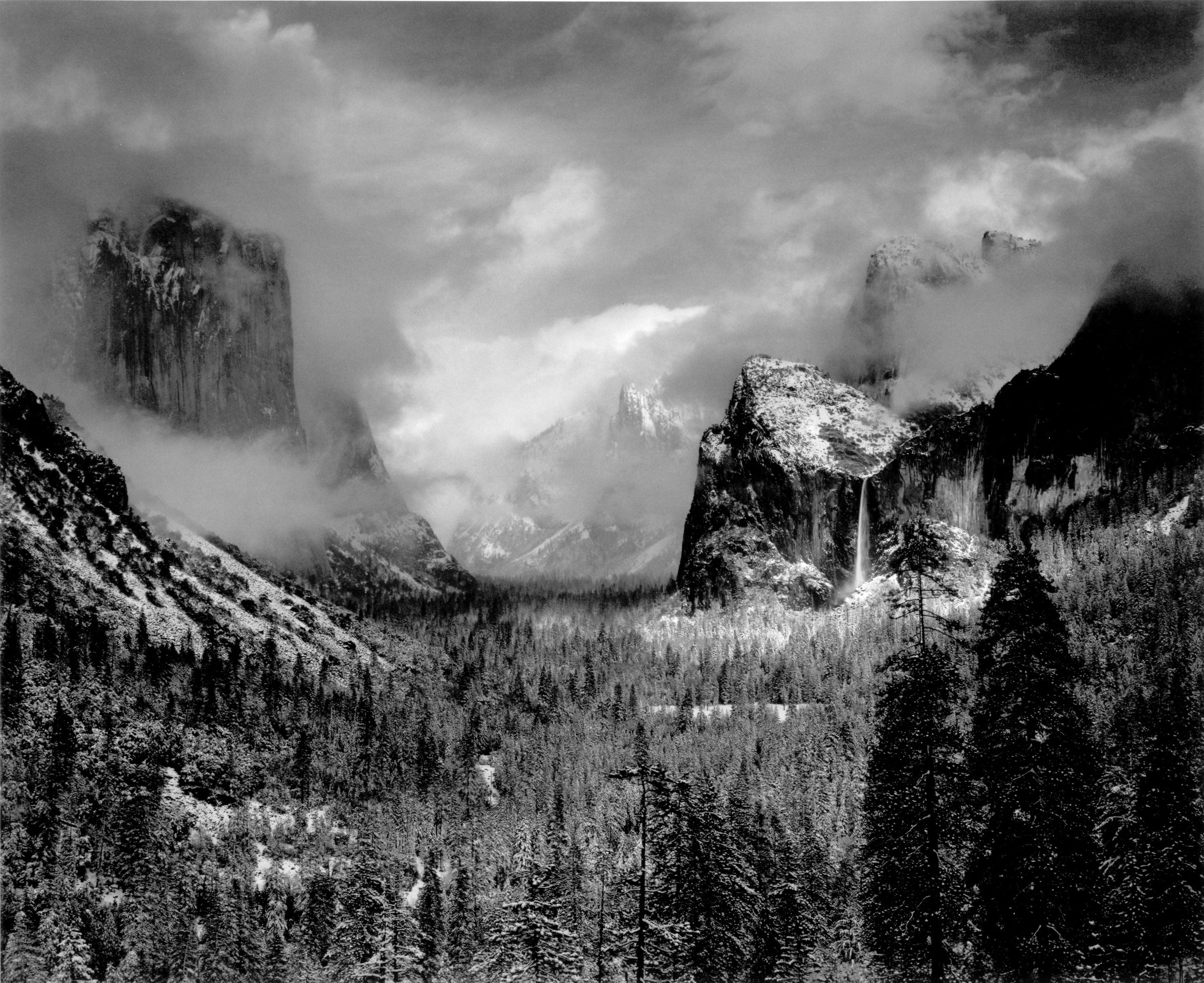
One of the things I am looking forward to next week when I head to California for the opening of my show at the Just Looking Gallery in San Luis Obispo is the couple of days beforehand that we will spend in Yosemite National Park.  I have never been there but know well the iconic images of its beauty from the photography of the great Ansel Adams.  While he is known for many photos of other locales, his images of the Yosemite Valley have come to be most closely associated with his name.

Adams (1902- 1984) first encountered Yosemite as a teen on a family excursion  on which he carried his first camera , a Kodak Brownie.  He was smittten by the spectacular landscape and the light as it filtered through the valley.  He would  return  over and over through the coming years, his prowess as a photographer growing.  He eventually married a local Yosemite girl, Virginia Best, whose father ran  Best’s Studio there.  She inherited the studio in 1935 and she and Adams ran it until 1971.  It is now called the Ansel Adams Gallery , where his work and the photos of  other great contemporary photographers are shown and sold.  The gallery  is still in the hands of the Adams family.

I’ve always loved his images of the grandeur of the Yosemite Valley and have formed my own idealized version of how the place might be in my mind through them.  I am hoping that reality lives up to expectations that have grown over many years.  I f any place can do this, I believe it might be Yosemite.

Read Full Post »

Imperfection clings to a person, and if they wait till they are brushed off entirely, they would spin for ever on their axis, advancing nowhere.

–Thomas Carlyle

****************

I was thinking early this morning about a comment made yesterday by Linda Leinen about how we go through life, starting fresh and clean, and progress as we absorb all that life deals out to us, leaving us somewhat scarred. It reminded me of  the title of  both a painting and a show that I did many years ago called Seeking Imperfection.  It remains one of my favorite titles, probably because it best describes my own relationship with perfection.

I’ve always been somewhat uncomfortable with the idea of perfection or the search for it.  Perfection is the antithesis of our humanity, at least in how I view it, and to seek it is to deny our imperfect natures.  We are flawed and scarred characters in a world that is definitely not perfect except in those rare moments when all of these flaws coalesce into instances of harmony and beauty.

That’s kind of what I hope for and sometimes see in  my paintings– harmony and beauty despite the inherent imperfections.  I can find flaws in any of my paintings but I don’t cringe at the sight of them.  Instead, they make me glad because in seeing them I recognize my connection to them, can see the struggle in trying to create these moments of harmony.  A pit here, a dot of stray paint  or a rough edge there, a bristle from a brush trapped in the paint– it all speaks to me, saying that it can be whole and harmonious-  beautiful- despite the flaws.  Perhaps not a bad way to view one’s life.

**********************

The painting at the top, In the Rhythm of the Moment, is a 16″ by 18″ piece on paper which is also part of my upcoming show at the Just Looking Gallery in San Luis Obispo, CA, opening December 1.

Read Full Post »

I came across this photo of my old studio up in the woods yesterday and remembered that I had used it in a post several years ago, back in December of 2008.   [Wow, I’ve been doing this blog for that long?]  It was a post about the role of solitude in my work.  My new studio is much more comfortable and warm, with all  the amenities , such as phone , cable TV and the  internet , that keep me  connected to the outer world.  Reading this post made me realize how less alone I am today at times in the studio and how important that time of solitude was for my work’s growth at that time.  I’m not sure that my work would have evolved in the same way in my current environment. I just thought it was an interesting post and wanted to share it again:

I’m showing the picture to the right to illustrate a bit of advice I often give when speaking with students or aspiring painters.  This is my first studio which is located up a slight hill behind our home, nestled in among a mixed forest of hardwoods and white pine.  This photo was from last February [2007].  It was a fine little space although it lacked certain amenities such as running water, bathrooms and truly sufficient heat.  However, it served me very well for about a decade.

The advice that I give to aspiring artists is this:  Learn to be alone.

The time spent in solitude  may be the greatest challenge that many artists face.  I have talked to many over the years and it is a common concern.  Some never fully commit to their art for just this reason.  To be alone with your own thoughts without the feedback or interaction of others can be scary especially for those used to being immersed in people and conversation.

I like to think that I have been prepared for this aspect of this career since I was a child.  For much of my youth we lived  in the country,  in houses that were isolated from neighbors.  I had a sister and brother, 7 and 8 years my senior,  and they were often my companions at times but  as they came into their middle teens I spent more and more time alone.  This is not a complaint.  Actually, it was kind of idyllic.  I lived a fairly independent life as a kid, coming and going as I pleased.  I explored the hills and woods around us, going down old trails to the railroad tracks and old cove that ran along side the Chemung River.  I studied the headstones at an old cemetery tucked in the edge of the woods overlooking what was then a thick glen,  filled with the family who resided at a late 1700’s homesite that had stood across the road from our home.  All that remained was a stacked stone chimney which served as a great prop for playing cowboy.

In the woods there were immense downed trees that served as magnificent pirate ships.  There were large hemlocks with thick horizontal branches that were practically ladders, easy to climb and sit above the forest floor to watch and dream.

My life would be very different without this time alone.  Sure, maybe I’d be a bit more sociable and comfortable with groups of people, something which is sometimes a hindrance.  But it prepared me for the time I spend alone and allowed me to create my own inner world that I occupied then and now.  The same world that appears in my work.  That is my work.

This is only a short post on a subject I could drone on about for pages and pages.  But, to aspiring artists, I say learn to love your time alone and realize what a luxury and an asset it can be.  Your work will grow from your time alone.

Read Full Post »

I was going to write about last week’s election here, about the runup to the election and the aftermath, particularly the awful spinning by Karl Rove and his ilk who try to justify their deceitful tactics and the ridiculous expense of these campaigns (from which they profit very nicely) with a continuance of their takers versus makers argument, one that drives me mad.  But I’m too fatigued by the whole thing.  So I set out to seek something that might catch my eye and, as I often do, headed over to Luminous Lint where I came across this striking image, a blaze of color and shape that filled the frame  like a Pop Art vision.  Indeed, in the thumbnail as it was shown I thought that it was a painting.

It wasn’t until I clicked on it to see the larger image that I realized that this was actually a person in costume.  Titled Junkanoo #1, it was an image taken by photographer Edward Yanowitz around  1979 in the Bahamas.  This image was actually used as a postage stamp for the Bahamas in 1979.  Junkanoos are street parades, much like a Mummers-type event,  that are common in the Bahamas and about which Yanowitz wrote when describing this image:

“It takes place once a year on two nights, Boxing day (26 Dec.) and New Years morning. It starts at 3 or 4 in the morning until about 8am. Groups called “gangs” compete against each other for the best costume designs and rhythm sounds, there are hundreds of people dancing around, playing on goat skin drums, beating cow bells together, whistles and various instruments. It’s a very powerful sound. When I photographed it during the seventies there were very few street lights so it was in complete darkness. I had to wait for the slides to come back just to see if I got anything, and if you discovered something in your work, you had to wait another year before you could utilize it the next time.”

I immediately thought Pop Art at first but the more I looked at this the more I realized that this really reminded me of some pieces by one of my favorite Modernist painters, Marsden Hartley.  His Portrait from around 1914 is shown here.  He did several of these colorful pieces with strong shapes and lines that are juxtaposed on dark backgrounds.  As I was searching for my own voice, these pieces were deeply influential.  The darkness underneath  both gave the color a boost and created a different subtext for how the viewer might take in these colors,  not simply as being bright and joyous.  This was one of the things I wanted so much in my own work.

Maybe that’s why this image of the Junkanoo parader stopped me in my tracks.  I don’t know for sure.  But it is definitely a great image.

Read Full Post »

Painting is a blind man’s profession.  He paints not what he sees, but what he feels, what he tells himself about what he has seen.

–Pablo Picasso

********************

I love this quote.  I think that is what all art really is– an expression of  feeling.  Emotion.  I know my best work, or at least the work that I feel is most directly connected to who I truly am as a human being, is always focused on expressing emotion rather than depicting any one place or person or thing.  At its best, the  piece as a whole becomes a vehicle for expression and the subject is merely a focal point in this expression.  The subject matter becomes irrelevant beyond that.  It could be a the most innocuous object,  a chair or a tree in my case.  It doesn’t  really matter because the painting’s emotion is carried by the painting as a whole-  the colors, the texture, the linework, the brushstrokes, etc.

In other words, it’s not what you see but what you feel.

I think many of  Vincent Van Gogh‘s works are amazing example of this.  They are so filled with emotion that you often don’t even realize how mundane the subject matter really is until you step back to analyze it for a moment.  I’ve described here before what an incredible feeling it was to see one of his paintings  for the first time, how it seemed to vibrate with feeling, seeming almost alive on the wall.  It was a vase of irises.  A few flowers in a pot.  How many hundreds of thousands of such paintings have been created just like that?  But Van Gogh resonates not because of the subject matter, not because of precise depiction of the flowers or the vase.  No, it was a deep expression of his emotion, his wonder at the world he inhabited, inside and out.

I also see this in a lot of music.  It’s not the subject but the way the song is expressed.  How many times have we heard overwrought , schmaltzy ballads that try to create overt emotion and never seem to pull it off?  Then you hear someone interpret a simple song with deep and direct emotion  and the song soars powerfully.  I often use Johnny Cash‘s last recordings, in the last years  and months before his death, as evidence of this.  Many were his  interpretations of well known songs and his voice had, by that time, lost much of the power of his earlier days.  But the emotion, the wonder, in his delivery was palpable.  Moving.

Likewise, here’s Chet Baker from just a few months before his death.  He, too, had lost the power and grace of youth due to a life scarred by the hardship of drug abuse and violence.  But the expression is raw and real.  It makes this interpretation of  Little Girl Blue stand out for me.

Read Full Post »

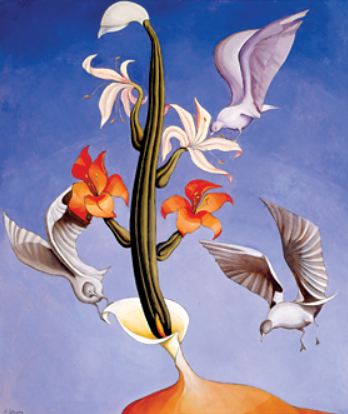
This is  a very famous photo by Edward Weston of a nautilus shell that is considered one of the jumping off points for the Modernist movement in art back in the first quarter of the 20th century and one of the great photos of all time, selling a few years back at auction for over a million dollars.  It’s a beautiful and simple image that transcends itself.  I came across it recently along with a mention as to how it came about  when  Weston, on a trip to California,  encountered a painter whose work, particularly in some close up pieces of shell, greatly stimulated him.  Her name was Henrietta Shore.

It was not a name I had encountered  and doing a quick Google search came across a number of striking images that reminded me of Georgia O’Keeffe.   It turns out that she was a contemporary of O’Keeffe and  it was said that Shore’s work had eclipsed O’Keeffe’s when they were exhibited together, something which happened a few times.  Shore also had an incredible painting pedigree, training with the likes of William Merritt Chase, Robert Henri and even John Singer Sargeant.  She had lived in London and New York before moving to California, settling in Carmel around 1930.  Once there, she didn’t show her work much outside of the Carmel/Monterey region  and never really gained the notoriety that came to O’Keeffe.  It was another one of those cases where I have come across amazing talents who have fallen off the wider map for some reason that remains a mystery to me.

There is great sensuality in her work, for instance the human-like twist and feel of her Cypress trees, that I found really appealing, something I try to work into my own paintings.  Looking at Weston’s body of work, I can see the similarity in how he portrayed many of his subjects, finding wonderful beauty in simple twists and curves.

I also liked that she stopped dating her paintings because she  didn’t want them categorized into time frames in her career because she viewed her work and her life as being part of a continuum  that transcended time.  Again, something I hope for in my own work.  How had Henrietta Shore escaped my notice for all these many years?

There’s not a lot of data out there about Shore, at least with a quick search.  She didn’t have a long list of exhibitions after the 30’s and those that she did have were in the Monterey area, so became a sort of regional painter which doesn’t take anything away from her great talent.  It only deprives the rest of us from finding her and finding something for ourselves in her work.  Thankfully, modern technology and the web allows us to stumble across such a wonderful painter long after she has faded from the national stage, even though her work will always live on in the continuum.  Just plain good stuff…


Read Full Post »

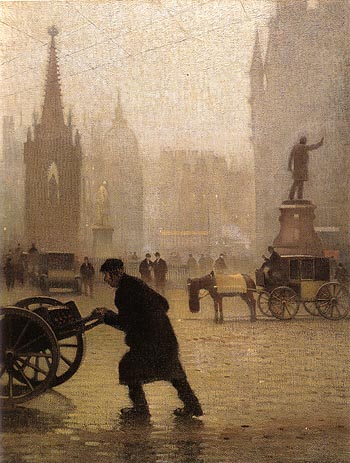
Adolph Valette- Albert Square 1910

I’m always interested in how artists of all kinds use their influences, about they evolve their own style from the sources of their inspiration.  Back in August, I wrote here about the British painter L.S. Lowry, the man best known for his matchstick men figures and the urban landscapes of his native Manchester.  He is generally considered a self-taught painter despite the many years he spent taking evening classes at the Manchester Municipal School of Art while he worked his days as a rent collector. It’s even more surprising that the critics still attach this self-taught tag to Lowry once you begin to look at the work of the primary influence on him, Adolphe Valette.   In looking at Valette’s paintings, you can see how Valette’s style and eye had a tremendous influence on Lowry.

Valette was a Frenchman who arrived in England in 1904, carrying with him the influence of the Impressionist movement that was in full bloom in France at the time.  He eventually ended up in the north of England, to Manchester, a city at the center of the British industrial revolution.  It’s smoke-filled and foggy landscape provided the perfect inspiration for the hazy and  evocative paintings of Valette and his student, Lowry.  Valette taught for many years there until returning to France in 1928, where he died in 1942 at the age 0f 66.

I’m  surprised that Valette didn’t gain more notoriety for his work , that his name and work wasn’t well known before Lowry’s popularity brought him to light.  The images that I can find are beautiful and strong, rivaling much of the work of his better known Impressionist contemporaries.  I suppose that painting and showing in Manchester in the early 1900’s didn’t provide much access to the salons and museums of the greater art world.  At least Lowry’s recognition has pulled him into the present, giving his influential works greater influence and making them the subject of study.

As it should be.


Read Full Post »

Landscape painting is the obvious resource of misanthropy.

— William Hazlitt, in The Edinburgh Review, 1824

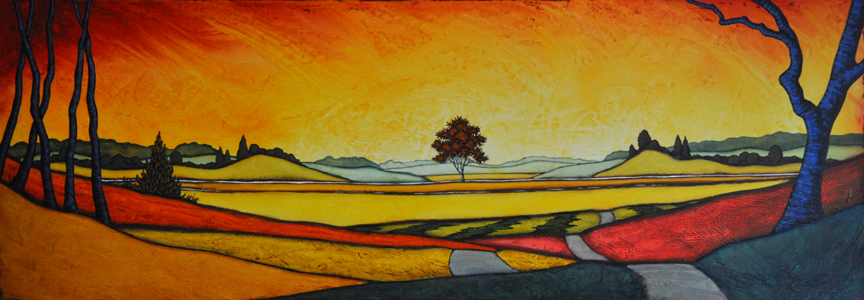
I consider myself primarily a landscape painter.  Oh, I periodically have done some figurative work, some still lifes and even some purely abstract work but I always gravitate back to the landscape.  I think the attraction comes from the universality of the landscape as a genre and a visual language.  It crosses all barriers and seldom needs context or explanation for anyone to fully understand it.  A Maori tribesman might as easily appreciate a landscape such as the painting above as you or me.  We  all have an intimate relationship, our own dialogue, with the landscape around us.  It defines our world.

I tend to think of landscape painting in these terms rather than as William Hazlitt, the British art and literary critic of the 19th century, portrays it in the quote above although maybe there is a certain misanthropy involved on some days.  I know that I prefer the company of the landscape over that of most people on many days.   I also know that there are collectors who were disappointed when the paths that lead into my paintings began to first appear, feeling that any sign of man in the landscape only diminished the piece.   But the paths stayed because I still relate to the landscapes in my paintings as thought they are representative of the human race’s emotional relationship with the land rather than mere  pretty pictures of places of a world devoid of humans, as appetizing as that may sound.   It comes down to the fact that we are part of the land.  We  shape it  and are shaped by it. We rise from it, live off it and ultimately return to it.  We are the landscape.

The painting at the top is Where the Road Ends, a 20″ by 60″ canvas that is part of my show at the Kada Gallery which opens October 20th.

Read Full Post »

Summing Up/ Redux

I am on the road today so I went into the archives and came across this post from two years ago.  I had just received an inquiry from the Fenimore Art Museum which eventually led to my exhibit which hangs there currently.  It’s always difficult to summarize yourself.  People at shows and talks ask quite often for a way to categorize  the body of my work, to give a few words which adequately describe it, and I am  always at a total loss for words.  It just is to me.  

Here are my thoughts from a couple of years ago on this subject:

I had an inquiry yesterday from a museum, asking for more photos and information on my work in order to give them a well-rounded sense of my work. So, I sat down and began going back through my work over the years, trying to determine how I might encapsulate what I do in a condensed manner that gives them a complete look and satisfies me.

I struggled with the task. Choosing work that sums me up was difficult. Can I sum up my work in one or two or twenty or a hundred images? How do you define yourself at what you yourself consider a midpoint?

For me, it all feels the same, as though it is part of a continuum. I see differences through the years but I know that each painting was done with pretty much the same mindset and the same critical eye during the process which makes them equal in my mind which gives them the consistency for their audience that I seek. Maybe it’s that word egalitarian coming up again, but I want there to be no difference in the quality and emotional impact between the smallest, most affordable painting and the largest, more expensive work.

And then there are the series I’ve done through the years. Obviously, the ubiquitous Red Tree. But there is also the Red Roofs. Red Chairs. Archaeology. And many other less organized, recurrent groups of work featuring sailboats, cityscapes and small, lone figures. Or the other figurative work featuring what I call the Outlaws or the early Exiles. How many of these pieces fall into the category of rounding out an overview of the work?

How do you completely sum up yourself in the most condensed way?

I had this come up a few years back in nother way. After a very nice, well written article in the local newspaper, I was contacted by the producers of a national talk show set in NYC on one of the major news networks. They had seen the article and the host felt I would be a perfect fit for the show which featured a panel of guests from various fields in a fast-paced, short sound bite-y format. The host would shoot out a question and go quickly to a guest who would have 15 or 20 seconds to give a full answer.

So, the producers interviewed me separartely then finished with about 20 minutes of the main producer pretending to be the host and throwing questions at me quickly. After we had been doing this for the 20 minutes, with her constantly urging me to be faster with my responses, I was pretty frustrated and finally asked her what she wanted from me.

She said she wanted to summarize what my career was about in 15 seconds.

That pretty much ended the interview and, needless to say, I didn’t go to NYC for the show. I was actually relieved but it made me wonder how someone could adequately sum up themselves in such a short manner. I still haven’t figured it out and I guess I’ll have to think about this some more.

Read Full Post »

« Newer Posts - Older Posts »