Landscape painting is the obvious resource of misanthropy.
— William Hazlitt, in The Edinburgh Review, 1824
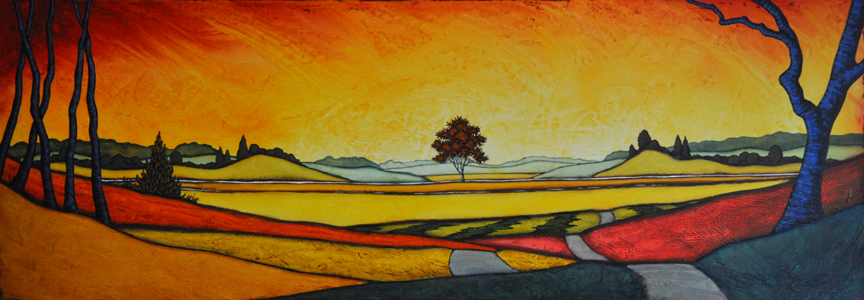 I consider myself primarily a landscape painter. Oh, I periodically have done some figurative work, some still lifes and even some purely abstract work but I always gravitate back to the landscape. I think the attraction comes from the universality of the landscape as a genre and a visual language. It crosses all barriers and seldom needs context or explanation for anyone to fully understand it. A Maori tribesman might as easily appreciate a landscape such as the painting above as you or me. We all have an intimate relationship, our own dialogue, with the landscape around us. It defines our world.
I tend to think of landscape painting in these terms rather than as William Hazlitt, the British art and literary critic of the 19th century, portrays it in the quote above although maybe there is a certain misanthropy involved on some days. I know that I prefer the company of the landscape over that of most people on many days. I also know that there are collectors who were disappointed when the paths that lead into my paintings began to first appear, feeling that any sign of man in the landscape only diminished the piece. But the paths stayed because I still relate to the landscapes in my paintings as thought they are representative of the human race’s emotional relationship with the land rather than mere pretty pictures of places of a world devoid of humans, as appetizing as that may sound. It comes down to the fact that we are part of the land. We shape it and are shaped by it. We rise from it, live off it and ultimately return to it. We are the landscape.
The painting at the top is Where the Road Ends, a 20″ by 60″ canvas that is part of my show at the Kada Gallery which opens October 20th.
 Redtree Times
That ambivalence about the pathways or roads in your paintings is interesting. I knew a guy who picked up and moved several times. Every time, he said the reason was that things were “getting too civilized” in the neighborhood. The last time he sold, he was in the middle of 35 acres at the end of a road, but when he began hearing chainsaws, “they” were too close.
Sometimes I think sentimentality about nature plays as much a role as misanthropy. There are plenty of folks who want to “get back to the Garden”, and who confuse the natural world with paradise. Nature’s a lot of things, but it’s not that.
Boy, do I understand that guy who felt the world was closing in when he heard the chainsaws. I cringe every time I hear a chainsaw or a gunshot coming from the neighboring woods, feeling as though I would like to be farther and farther away.
“there are collectors who were disappointed when the paths that lead into my paintings began to first appear, feeling that any sign of man in the landscape only diminished the piece” seems like the visual counterpart of a tree not making a sound unless someone is there to hear it fall. Where is the beauty in the landscape if man (or woman) is not there to see/perceive?
Good point, Gary. I think the beauty comes from our emotional response to the landscape.