Feeds:
Posts
Comments

Archive for the ‘Influences’ Category

I was talking to a younger friend last night at an opening of an exhibition.  I have known this person since she was quite young and have always admired her native talent in many disciplines that she has chosen to follow over the years.  She has shown great ability in painting and drawing but also craves to create in video, music and dance.  She said she wants to paint but feels that she wants to equally do all these other things as well.

We talked about whether it was possible to do everything and still reach the highest peak of your potential in any single endeavor.  I cited other artists I had known who had this immense talent and felt the need to go in several different directions with their creative energy.  As a result they never achieved maximum focus in any single creative area and, while the work was good, never felt like it reached as far as it might have with a more singularly focused effort. 

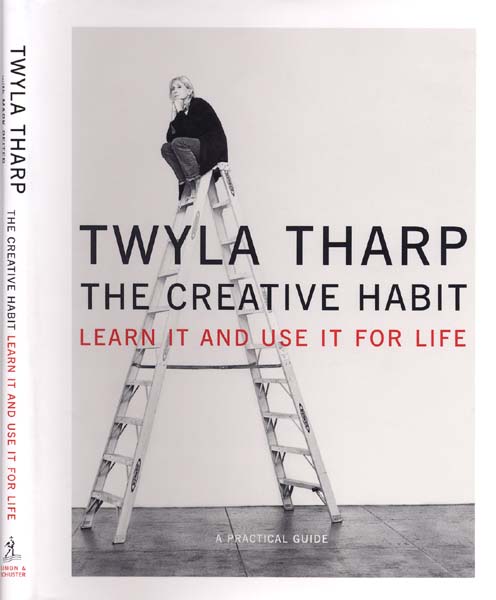
She said she had been thinking about just that thought, that just because you can do everything doesn’t mean you should do everything.  She spoke about Twyla Tharp, the famous choreographer whose 2003 book on creativity  is shown above, and how she had written that sometimes the artist must choose a single route even though they have wide talents in order to achieve the greatest focus.

I joked with her that I felt lucky to be so limited  in talent that I only wanted to paint.  But I wasn’t completely kidding.  I understood early on in this process that I had to choose and focus fully.   I somehow felt that if I went in too many directions my message, my expression of self, would go from being a focused and resonant single note to a cacophony of disparate notes.  That single, shining note would be lost in the chaos, never to be clearly heard. 

I got up this morning and thought about that conversation and about her words about Tharp.  I felt lucky that my choice was made and hope that thoise lucky talented folks, like my young friend, can someday find their own clear resonance.  I found this clip of an interview with Tharp and much of what she says here can be transferred to any endeavor of effort.  It’s worth a listen.

Read Full Post »

Blue II- Joan Miro

When I’m painting, which is most of the time, there are occasional shifts in the work from day to day.  Sometimes they just happen without any forethought, an adding of an element here or there to change the balance of a composition or the touch of a color that may have been absent from the palette for some time. 

 
Then there are conscious decisions made in advance of coming work, such as the decsion ot work in a certain size or medium.  I came across some older work lately in my archives that made me make such a consious decision.  It was a group of  mainly nocturnal scenes done in deep gem-like transparent  blues.  They have a stark and moody feel and, while I always have really thought highly of them, have been out of my repertoire for some time. I’ve got to make an effort to revisit this work and see what emerges.  There’s something different in approaching a painting as an examination of  solely color rather than as harmonizing a landscape’s composition.  The focus on color seems to create its own mood and drama, one that comes across off the wall even in the starkest of compositions.
 
We shall see.  For now, here’s a video that speaks to the subject for me.  It’s Dave Brubeck’s Bluette played over the wondeful work of Joan Miro.  Enjoy.


Read Full Post »

Self Portrait-- Jon Sarkin

I was sent a link by a friend in response to yesterday’s post that really sparked some thought early this morning as I read it.  It was a story about author Amy Nutt’s book, Shadows Bright as Glass, which concerns itself with the story of Jon Sarkin.

  Sarkin had been a chiropractor until a day in 1988 when he experienced a stroke which transformed his life in a way.  He began to paint voraciously,  trying to express somehow the new self he suddenly identified in the aftermath of the damage done to his brain by the stroke.  He knew that he was somehow changed, could sense that there were parts of his mind that had transformed him into what he felt was a completely different person.  Painting allowed him a vocabulary to express the new sensations he was experiencing.

It made me think about my own accident years ago and the transformation that has taken place in the time since.  I often think of my life before that time as almost another life in another person’s mind, even though I still feel the continuum of my existence.  I am the same but different.   I can’t put my finger on it exactly but  know that  it has been the seed for much of my work over the years, a seeking and expressing of true identity. 
 
In the Ken Burns’ documentary Baseball, which I’ve been viewing this week in the studio, someone described Babe Ruth after his death as the most natural, unaffected person he had ever met.   He was what he was.  This made me think of this same concept of identity.  How many of us are perceived as what  we really are?  Does anyone ever really know anyone’s true and central self?  I wondered how many of us live in lives that are counter to our inner identities, constantly struggling in our minds, perhaps on a very subconscious level, with maintaining an outer face that we sense is not our true self?  It seems to me that this conflict in ourselves would be the source of much unhappiness in this world.  I know it was for me.
 
I don’t know if there are answers to be found.  Yet.  We still seem to be in the earliest stages of knowing how the brain and  the mind connect and  interact but given the acceleration of  discovery and technology over the past few decades, we may know more soon.  For now, we are who we are.  Or at least, who we appear to be.

Read Full Post »

Work by James Castle, Self-Taught Artist

I came across a very interesting website, The Foundation for Self-Taught American Artists .  I have featured a number of self-taught painters here, always finding their will to create and find a form of self-expression a truly fascinating thing.  I love how they overcome their lack of training or lack of materials to form a vocabulary that speaks of their own unique place in the world.  This site is dedicated to these artists who overcome.

James Castle

On the opening page of the site was a trailer for a documentary featuring the work of James Castle, who was born in 1899 in Idaho and lived there until his death in 1977.  Profoundly deaf since birth, Castle never learned to sign or even read or write but instead found expression in the drawings he created from a mixture of soot and saliva that he applied to scraps of paper with a sharpened stick that acted as a crude ink stylus.  Over the course of his life he created thousands of drawings, collages and other constructions that make up a truly unique and wonderful body of work.  He gained some regional recognition for his work but it wasn’t until after his death that he gained a wider audience.

I find great inspiration in seeing the work of artists like James Castle and hearing their stories.  Their work is a triumph of the creative spirit and I am grateful for the people and institutions that keep the work alive.  If you feel the same, The  Foundation for Self-Taught American Artists is a great site to visit.

Here’s the trailer for the Castle documentary, James Castle: Portrait of an Artist.   I’ll be looking for it.

Read Full Post »

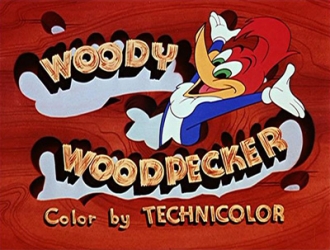
We have quite a few pileated woodpeckers that call our woods home.  They’re a very large bird, about the size of a crow, and the clatter of their pecking echoes loudly through the forest as does their distinctive cackle.  They do a hell of a lot of damage to the white pines but I love seeing and hearing them, which  always reminds me of the Woody Woodpecker cartoons from my childhood.  I was a big fan for a short time but moved on eventually to what I felt were more sophisticated cartoons, such as the Warner Brothers work of Chuck Jones and Tex Avery.  But I still have warm memories when I hear that crazy woodpecker laugh clatter through the trees.

I was also reminded of Woody when my friend Brian recently sent me an interesting link to a New York Times article that talked about one of his animators, Shamus Culhane.  During a scene depicting an explosive moment, Culhane inserted cels into the film that contained art that more resembled that of the abstract expressionists that that of a traditional studio cartoonist.  There is a multimedia link on the page that shows the sequence in a frame by frame breakdown and amid the very smooth edged cartoon rendering there suddenly appears a  short series of frames with raw, rough brushstrokes.  When you see it in slow-motion, you realize how different htis was for normal cartoon fare. 

The article points out that this was not Culhane’s only foray into the edgier side of cartooning, describing other cartoons where other abstract imagery is inserted and a prankish few that contained bawdy hidden humor such as doorways  in an Eastern castle being phallic shaped.  Maybe theose caartoons really were a bad influence after all?

Anyway, it was an interesting article and one that will come to mind whenever my pileated woodpeckers send their shrill laughs through my woods.

Read Full Post »

A friend wrote to me recently, telling me of speaking with an elderly relative who told him about his earlier career as a graphic designer and how he had worked on a number of movie posters.  It made me think of all the great old movie posters I had always seen and enjoyed over the years.  I particularly liked the early ones, pre-computerization, that featured  great graphics and wonderful illustration art.  They were meant to grab the passerby’s eye and quickly give an impression of the film.  Some are quite beautiful and stand up as objects of art in their own right.

Doing a little digging  brought me to a book, Starstruck, by collector Ira Resnick that has about 250 images of posters from his large collection.  There is a nice feature on his website that allows you to browse the first several pages of the book to give you a feel for the artwork shown.  It has some great imagery which puts it on my list of books to get.

Page from "Starstruck" by Ira Resnick

I definitely have been influenced by popular entertainment and advertising in my own work.  It would be easy to deny it but we are so bombarded in our culture that to do so would be disingenuous.  I remember stopping and looking at movie posters in the lobbies of theatres from an early age, pulled in by the colors and images.  There was a poster shop in downtown Elmira (actually a front for their adult books and material in the back) that I used to frequent as a teen.  The posters hung from the ceiling like stalactites, hundreds of them in all sorts of styles.  Some were funny, some were racy and some were plain stupid.  But my faves were the movie posters.  I can still see many of them in my memory.   As I said, they definitely inspired how I see color and shape.

Read Full Post »

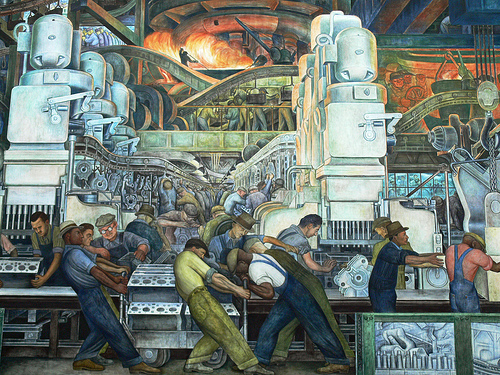
Yesterday, I wrote about the mural controversy in Maine where the work depicting the history of labor was removed from a state building.  It made me think of other murals and immediately brought to mind the work of Diego Rivera,who I have written briefly about here before and who was arguably the greatest muralist of recent history.  Rivera’s work often focused on the struggle of the worker. 

The Mexican Rivera (1886-1957) was an ardent Marxist who saw the mural as a way to to make expressive art available to the masses, away from the confines of museums and galleries which he saw as elitist.  But it took money to commission his masterpieces so he was often working with those powerful forces that he often eyed with suspicion.    There were episodes where the two sides bumped heads, the most famous coming when his mural at Rockefeller Plaza in NYC was destroyed because of his inclusion of Lenin in the mural and his subsequent refusal to remove it.

The work he considered his finest was centered around the worker and the industry of America.  In 1932-33, Rivera painted , under the auspices of Henry Ford (who is depicted in the mural) and at the height of the Great Depression, an epic mural at the Detroit Institute of Arts.  Covering more than 447 square yards, Detroit Industry is massive.  It is filled with vibrant imagery depicting the worker, in both a heroic and subservient manner, as integral cogs in the rhythmic throb of the busy industrial world.  It is a feast for the eyes.

I have always been drawn to Rivera’s work on a gut level, drawn in by his gorgeous color and exciting composition.  When I see his grand murals I am deeply humbled and this work is no different.  I am pleased that it has survived the changing tides of political favor without somebody suggesting it be painted over.  If anything, it should remain if only as a reminder of the part the worker has played in building the wealth of this country at a time when the American worker is quickly overlooked by industry in favor of cheaper, unregulated labor on distant shores.

Here’s a video showing the scope of Rivera’s work.  As an artist, I am both inspired and intimidated by the sheer amount of amazing work here. 

Read Full Post »

I woke up in the dark this morning after a fitful night of sleep filled with horrible dreams.  I don’t want to go into the details but they were awful and constant, each sweeping from desperate scene into yet another.  Dark and tinged in deep colors of black and red.  Hopeless in the scope of their finality and, though I am hesitant to use the word, there was a sense of apocalypse.  I was shaken.  I’ve had many horrifying dreams over the years but they seldom felt so vast and desperately final. 

 As I trudged down to pick up my newspaper I tried to sort out the dream and try to find an equivalence in imagery that I know that captured in some way the feel of these dreams.  As I neared the studio the dark paintings of George Grosz done in Germany in the years before World War I came to mind.  They were forebodingly dark and angry and just the overall look of them made me think of the darkest corners of man’s mind.  The red tones and the way they filled the picture plane along with the chaotic nature of the compositions brought to mind the nightmarish feel of my dreams.

Grosz’s work changed over the years, especially after moving to the New York in the 1930’s where he lived until the late 1950’s when he returned to Berlin, dying there in 1959.  His American work is often considered the wekest of his career, less biting and more esoteric.  There were exceptions such as 1944’s  Cain, Or Hitler in Hell, shown here, which reverts back to the colors and nightmare feel of his early work.  Very powerful work that may not sooth one’s soul but rather documents the darker aspects of human existence. 

I don’t know if my own nightmares have an effect on my work.  Perhaps they come out in work that seems the antithesis of them, work that seeks to calm and assure.  I don’t really know to be honest.  I know that I want to put last night’s visions behind me.  To that end, I think I should get to work and let my nightmares dwell in the work of Grosz for now.

Read Full Post »

“Then who do we shoot?”

These five words uttered by Muley the sharecropper being thrown from his family farm by bankers near the beginning of The Grapes of Wrath echo in my head.  He is frustrated by the seemingly crooked game of cards his world has become and wants to know who has been dealing him these losing hands from the deck of life that is so stacked against him.  And all he gets is anonymity and buck-passing.  He is flailing at boogeymen.

I had John Ford’s classic film of John Steinbeck’s novel on in the studio as I worked yesterday, a ritual I perform at least once a year.  I never cease to be amazed at the topicality of the film in almost any hard time and am moved by scene after scene in the film, even after all these years.  It has long been one of my favorites and has shaded my view of the world since I was a child.

I remember distinctly the first time I saw the film.  It was a very snowy day during our Christmas break.  I couldn’t have been more than 10 years old and my brother and I sat down to watch Ed Murphy’s Hollywood Matinee, a daily showing of a film from the Syracuse TV channel that we were able to pick up with our antenna that laid on the roof of the the old farmhouse in which we lived.  Ed Murphy was a boozy white-haired local TV/radio personality who introduced the movies, which were usually cut haphazardly to fit in extra commercials.  Murphy also presided over the Dialing For Dollars portion of the show where he would pull a telephone listing ( a Syracuse phonebook cut into pieces) and call a lucky listener for a cash prize.  I can’t remember exactly how the rules worked but I remember a lot about watching that particular movie.

I remember thinking how Tom Joad was not a particularly good man, especially as a hero.  He had just been released from prison and talked about killing a man with a shovel in a fight.  He had a quick and angry temper but a tenderness when dealing with Ma Joad and his family.  I also remember seeing in the faces of the bank men and the bosses at the farms and orchards that same mean-spirited bully attitude I  could see in the faces of bullies at school.  actually, there was a great familarity in the whole movie.  I could see traces of my family and many people I knew in the Joads.  People pushed and prodded and never quite able to gain their footing, never in control of their situation.  We weren’t Okies but these people were everywhere–average people who struggled on small farms or worked long hours in factories.

This observed familiarity with these characters has only grown over the years.  I recognize more and more people in the faces of those downtrodden Joads and see many scenes in the film that are  analagous to situations in our times.  It’s a movie that I feel is a must-see for everyone.

Here’s a nice review of the film from the New York Times (short ad at the beginning-sorry!) that includes a couple of clips including Muley with the bankman and Tom’s farewell to Ma, which may be my favorite scene in amy film.

Read Full Post »

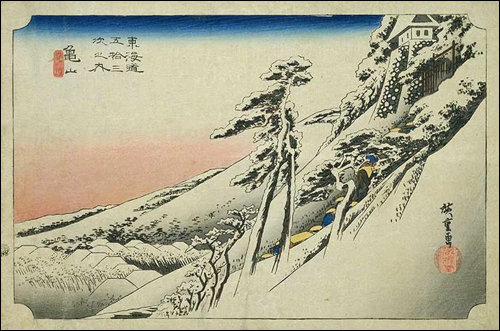
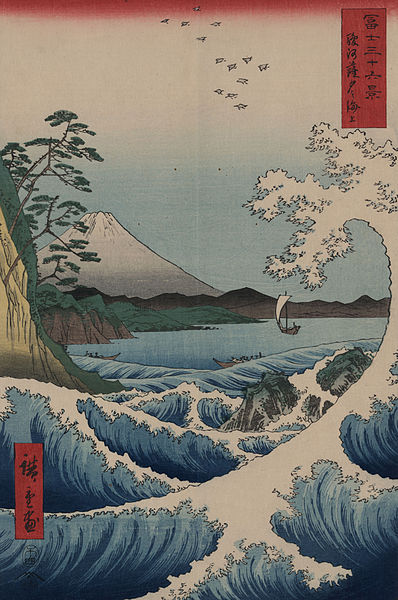
Watching the coverage of the disaster taking place in Japan has brought to mind the many Japanese influences on my work.  I have always been drawn to the work of the Japanese print masters such as Hokusai, who I have written about before, and Hiroshige.  I was influeneced by their work before I was even aware of it, mostly through their influence on the European artists in the late 19th century.  Artists like Whistler and Van Gogh were enthralled by the beauty of their woodblocks, Van Gogh even going so far as simply copying them for some of his earlier paintings.

When I began to look more closely at the work of Hiroshige, I too was captivated.  There is great unity and totality in the work, a harmony of color and line rhythm that fills the picture frame.   The colors are softly graded yet there is deep saturation  that is like a feast for the eyes.  The landscapes seem to grow organically with lovely curves and lines that evoke that sense of rightness I have often struggled to describe here.  They have a great polarity as well.  They are bold yet subtle.  They are quiet yet not timid.  they are simple yet complex. They are both earthly and ethereal. 

In short, they are just wonderful.

Take a look at this beautiful work and how it reflects its homeland.  If you can, take a few minutes and donate what you can to relief organizations whose help a great part of this nation is desperately desiring in this time of disaster. 

Read Full Post »

« Newer Posts - Older Posts »