Feeds:
Posts
Comments

Archive for the ‘Influences’ Category

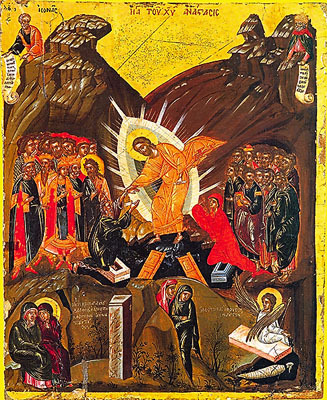
Whether you have a belief system that encompasses the resurrection story of Christ, the basis for the Easter holiday, or you don’t, there is great potency in the symbolism of this story.  The idea of the death of one self and the rebirth of another transfigured self is perhaps one of the most powerful paradigms of mankind and personal evolution.

I am drawn to the resurrection imagery used in religious icons from the medieval time to the present.  There is a great beauty and power in these images and a consistency in the placement of the symbols used, as though the constant  use of a formal pattern  hints at the universality of the story’s transformative power as a possible template for every person’s life.  We all have the possibility of change, of transfiguration, within our own lives.  It may not entail literal death and rebirth,  but it can be a transformation of the self and spirit.  This is not about religion but about a sea change in the way we view and live in this world.

Personal resurrection.

Read Full Post »

The other day I wrote in this blog about the process of painting which brought a comment about appreciating the physicality of painting in person.  It immediately brought to my mind the paintings of Joan Miro, the great Catalan painter/sculptor.

I have always been greatly attracted to his paintings having seen them countless times in books and in popular culture, such as on the cover of Dave Brubeck’s  jazz classic Take Five.  There was something very enticing about the imagery and the geometry of his work, something that that was symbolic and beautiful at once.  However, I never wanted to know too much about the paintings, never wanted to try to read into every symbol.  I just loved the way they felt on the eye.

Dark joy.

But my main memory, and the one I returned to when I read the comment about seeing the physical nature of work in person, is of seeing a Miro painting in person for the first time.  When I saw it across the museum hall, I was excited.  It was like seeing an old friend after a long time, even though I had only seen the work in print.

But as I got closer I began to feel a dull pang of disappointment.  Up close, the surfaces were flat and dull, the paint thin.  It was still striking imagery but the feel on my eye was different and I left feeling a little different about his paintings.  A feeling that has remained with me even though I rationally accept it as his style and have come to more fully appreciate it.

I suppose it was simply the difference between expectation and the reality of actually seeing the work.

As I said, I have come to terms with the way they appear up close and understand that was how he worked, how his mind best translated to his chosen media.  That’s enough for me and far outweighs my own initial expectations and reaction.

The imagery still stuns me.

Read Full Post »

Kuna Molas

Traditional Kuna Mola

Sometimes you’re reminded how expansive this world is and how little you know about so many things in it.

This is a good thing.  It reawakens the curiosity.  Makes you want to spackle over the cracks and gaps in your knowledge with new information.  And gaining new knowledge is never a bad thing.

A few days ago I presented a new painting, Through the Labyrinth, and a reader commented that it reminded her very much of the molas of the Kuna people.  To my dismay, I realized I had never heard of the Kuna people of Panama nor was I familiar with their brightly colored and intricately patterned shirts, which are called molas.

So, this morning I have been taking a crash course on the molas and culture of the Kuna people, who are an indigenous people living in Panama and Colombia.  The molas evolved from a traditional form of body painting into the present textile versions with the coming of the Spanish colonizers and missionaries.  They often use geometric patterns as well as colorful representations of tropical birds and animals.

I was most taken with the geometric patterns of the molas.  They have a great sense of completeness about them.  I can’t fully explain what I mean by that.  It’s as though, while being representative of things in the Kuna world, the patterns are a complete world  unto themselves.  Maybe I simply mean that they have universal meaning.

I don’t know.  They’re just wonderful to look at and take in.  And I’m sure you’ll see elements from these creep into my work at some point soon.  It can’t be helped.

Kuna Flag of 1925

Now, if the pattern directly above reminds you of  the swastika, don’t be alarmed.  The swastika was and is a symbol for many cultures throughout all the world, including the Kuna people, often symbolizing stability and harmony.  It was actually used in the flag which was used as a symbol of their autonomy in a revolt against the Panamanian government in 1925.  They changed the flag less than two decades later when the Nazis forever altered the world’s perception away from the swastika’s true meaning.  But for the Kuna the swastika still holds its ancient meaning and, hopefully, always will.

Hopefully, always in peace in their native land…

Read Full Post »

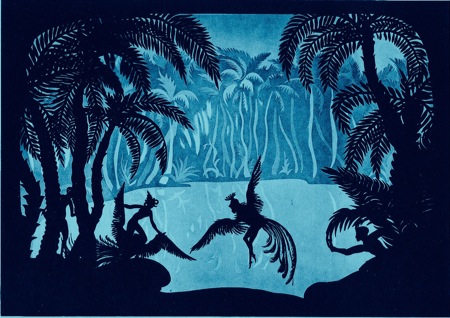
The Adventures of Prince Achmed (1926)

I first saw a film, The Adventures of Prince Achmed,  from Lotte Reiniger several years ago in a series about early silent films.  It was made in 1926 Germany and was one of the first animated films made.  It’s a form of animation that Reiniger pioneered and mastered, based on Eastern shadow theatre.   Using silhouette figures, each is painstakingly cut and hinged then  filmed in small movements with time lapse photography to produce motion in the film.  This film took three years to complete.

Lotte Reiniger At Work

In this telling of the Arabian Nights stories, I was immediately struck by the beauty and movement of the colors in the film.  Each cell was tinted by hand to produce intense bursts of color that gave the film a gorgeous surreal quality.  The movements of the figures in the film are smooth and natural,  very subtle.  I found myself so taken with watching the movements and changes that I found myself not following the story.  But I didn’t care.  It was beautiful to see and sparked the imagination.

Lotte Reiniger (1899-1981), born in Germany and living most of her post-WW II life in Britain,  left quite a body of work from a career that spanned over 50 years, including one of the first film versions of Hugh Lofting’s Doctor Dolittle. She’s pretty much unknown in popular culture which is a great shame.  Her work is marvelous and deserves to be seen.

Here’s a small clip of Prince Achmed:

Read Full Post »

I’ve been exhibiting at the West End Gallery for over 15 years now and have benefitted in many ways. It was the first place I showed and sold my first piece of work. It was the first place my work was showcased. It was the place that first gave me hope of doing what I love as a career and has served as a jumping off point to other galleries.  So many other things as well. But perhaps the greatest benefit may have been what I have gained from observing the work of the other artists there over the years.

I’ve talked here and in my own blog of how artists from the Corning area such as Mark Reep, Marty Poole and Dave Higgins,  have shaped how I work and how I see my own work. Another such artist is Treacy Ziegler who has shown her collagraphs and, more recently, her paintings at the West End for many years now.

From the moment I saw Treacy’s work many years ago, I was intrigued. I instantly recognized that she was doing with her work what I wanted and didn’t have in my work at the time. Her prints had great areas of dark and light contrast and even in the lightest sections, a sense of darkness was always present which gave every piece real weight. Her bold colors and striking contrasts gave even the simplest compositions a deeper feeling.

They were also immediately identifiable as Treacy’s work. You could see a piece from across the street and you knew whose work it was. She has a very idiosyncratic visual vocabulary and her shapes and forms react beautifully with one another in the techniques she uses in producing her work.

At the time, my own work was still very transparent and very much watercolor based. With Treacy’s work in mind I started adding layers of darkness in my own way. Simplifying form. Enhancing contrast and color. All the time searching for my own vocabulary, my own look.

I’ve always maintained that artists are often more like synthesizers than creators. They absorb multiple influences and take what they see in these influences, merging them together to create something that is completely different than the original. Sometimes not even reminiscent of the influencing work.  For me, the West End has always been a great source for ideas and concepts to absorb. It may be in a certain brushstroke or the way a painting’s composition comes together or just in being exposed to a certain artist’s body of work for a long period of time. Whatever the case, I always find something in the work there that sparks new ideas within me.

And that has been a great benefit…

Read Full Post »

Yesterday I wrote about how I have often used in my own work the composition from the James McNeil Whistler painting popularly known as Whistler’s Mother.  I did so without illustrating the point so I thought I’d take quick moment to show how I might block in my own work with Whisyler’s composition.

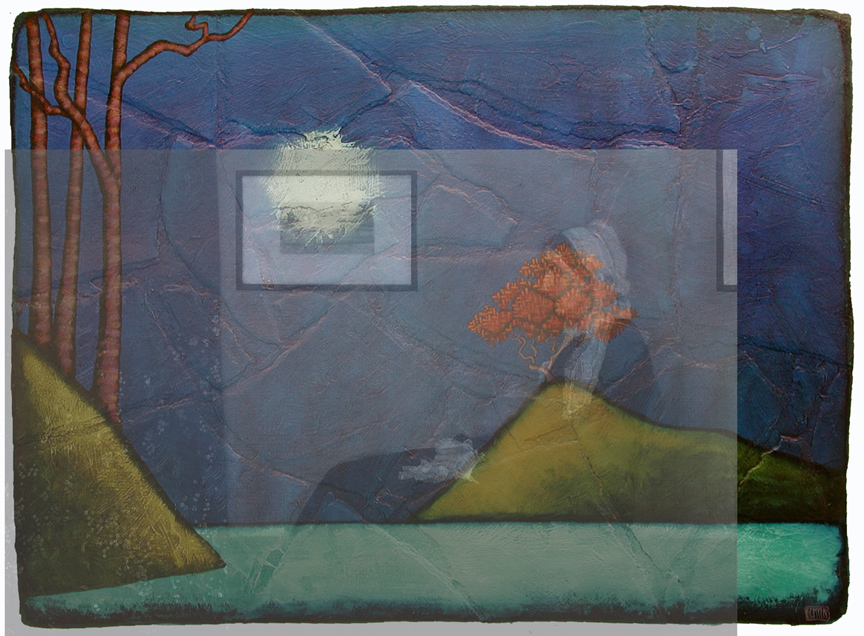
Going into my archives, one of the first things I look at is a painting from a few years back, The Way of Light.  At first glimpse, this piece has nothing in common with the Whsitler piece.  First, it is not portraiture ( although I often view my trees as such) and it is a landscape.  It is obviously a different palette of color than that of Whistler and the elements are rendered in a less realistic fashion than you would see in Whistler’s work.

But if you put those differences aside and quickly take in the shape and form of each piece, you can begin to see the similarity.  The line of trees on the small mound of land in my piece take the place of Whistler’s dark curtain on the far left.  The water in mine becomes the floor of his. The body of his mother is replaced by my island and her head becomes my red tree.  The framed print is now my moon.

Here, I overlaid my piece with the Whistler piece to further illustrate the point.  Obviously, there are worlds of differences separating the two pieces, as I pointed out above.  But the composition and use of blocking and light help us each achieve a sense of mood that is the primary goal in both cases.  Like Whistler, I am often more concerned with the mood and emotion of a piece of work than the actual subject matter.  In this pursuit I have come to view much of my work as Whistler did his, as musical compositions rather than merely representative images.

In color and shape there is rhythm, tempo and tone.  The placement of the compositional elements of a piece are much like the placement of individual notes in music, each affecting and reacting with those around it.  All trying to evoke feeling, response.

Well, there’s my illustration of how Whsitler’s iconic piece fits in with what I try to do with my work.  Hope you can now see the connection…

Read Full Post »

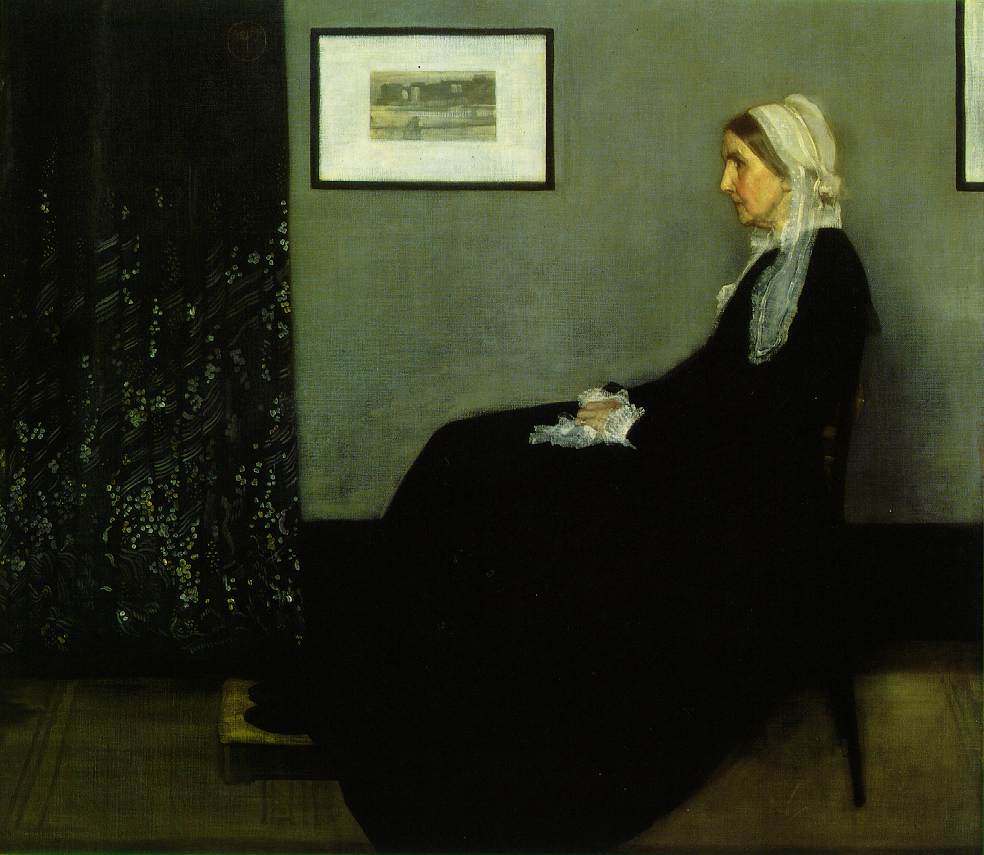
This is James McNeil Whistler’s most famous piece, Arrangement in Grey and Black, No. 1:  Portrait of the Painter’s Mother.  It is, of course, better known as Whistler’s Mother.  It was a painting that I was casually familiar with as I grew up but it wasn’t until I looked more closely at it after I had started painting that I saw the brilliance of it’s composition.

Whistler always asserted that the painting was not about his mother but was more concerned with creating mood with color and composition, which the primary focus of almost all his work. This piece achieves it’s mood with beautiful diagonal lines formed by the woman’s form and contrasting verticals and horizontals that create great visual tension and energy.  The stark whiteness of the matted print on the wall behind shines like a full moon against the pale blue-gray sky that is the wall itself.  The head of the old woman seems to be almost lit by the light from the moon/print.

This is not a portrait of an old woman.  It’s a nocturnal landscape.  That’s what I saw when I looked at it as a painter trying to glean what I could from it for my own use.  This was a composition that had a geometry that just felt so right immediately.  It had such a sense of perfection in the way color and form combine with sheer simplicity that I knew I would have to use it for myself.

And I have, quite a few times over the years since I first really looked at it, sometimes with slight variations in the placement of the elements but still basically with the same compositional base.  And inevitably, they are pieces that great immediacy in their impact, pieces that carry great mood whatever their subject matter.

And for that I thank you, Mr. Whistler…

Read Full Post »

I’ve written quite a bit lately about the concept of home and the search that many of us go through in defining what home truly means.  It’s all part of a process of determining who we really are as individuals and what our place is in the grand scheme of things.  Home and family are the two fundamental building blocks upon which we build our own definitions of self.  Home is where we are and feel we belong in the present and family is where we have been in the past, the basic bloodlink that has carried us to this point in time.

I’ve written about my research into my family and that of my wife so it was with some interest that I watched a new program last night called Who Do You Think You Are? that traces the lineage of celebrities on a weekly basis.  I really couldn’t  care less about the celebrity part (in fact, this show might be more interesting if they randomly chose to trace the roots of some very everyday folks) but am always interested in seeing how a person is affected when finding a new depth and understanding of their distant past.  Such was the case with last night’s subject, Sarah Jessica Parker.

Parker, like many of us, knew little of her past and felt that her family was only on the fringe of the American experience, that they had little to do with the events of the past that shaped and made this country.  I knew that feeling well .  In her case, her past easily revealed itself with just a bit of research and she was able to find a great-grandfather who from several generations back who left home and family in Ohio and crossed the country via wagon train, questing for fortune for his family in the gold mines of California.  Part of the Gold Rush and staking a claim with partners, he worked the mine and died of illness within a year.  His story is emblematic of the American push into the west.

Going back further, she found her family in the center of the Salem witch trials of the 1690’s, with a great-grandmother who, as a young woman, was accused of witchcraft but was spared from the death by hanging that all other who had been previously accusedsuffered as the trials were halted before her case came before the court.   Without the stoppage of the trials, Parker’s very existence would be in doubt.  Again, she finds herself in the middle of events that shaped the narrative of our country.  Going further, I’m sure she will find her family in the midst of events that shaped history in the countries of her ancestors.

Such is the case with us all.  It was interesting to see her story and to see how she was moved by and connected with the stories of her ancestors, how she gained insight and appreciation for the journey that led to this very moment in time.  Her’s is a wonderful story but not a rare one.  All of us have a rich heritage if we only choose to look, a wealth of information that winds through and connects us with the annals (yes, annals) of history.  We all are more than we seem and all are alive as the result of  many amazing sets of circumstance.

I have often thought if we all comprehended what it took to get us as a people to this point, how those ancestors who came before us risked and sacrificed for home and family, then we might take more pride in who we are and take more personal responsibility for our future.

Read Full Post »

Keeping Hope

To be hopeful in bad times is not just foolishly romantic. It is based on the fact that human history is a history not only of cruelty, but also of compassion, sacrifice, courage, kindness.

What we choose to emphasize in this complex history will determine our lives. If we see only the worst, it destroys our capacity to do something. If we remember those times and places — and there are so many — where people have behaved magnificently, this gives us the energy to act, and at least the possibility of sending this spinning top of a world in a different direction.

And if we do act, in however small a way, we don’t have to wait for some grand utopian future. The future is an infinite succession of presents, and to live now as we think human beings should live, in defiance of all that is bad around us, is itself a marvelous victory.

——Howard Zinn

***************************************************************************

I failed a month or so back to mention the death of historian Howard Zinn, author of  A People’s History of the United States and many other books.  In much of his work, he sought to bring a sense of hope and a reason to believe to his readers even when chronicling the darkest times.

The last paragraph of this writing says it all…

Read Full Post »

Sitting here as the first light of morning reveals snow falling, piling quickly and coating the limbs of the trees in the forest.  Truly beautiful.  However, we’re expecting a foot or so and, while I really love the snow, I am reminded of the tropical watercolors of Winslow Homer.

Homer, perhaps best  known for works such as The Gulf Stream which is  the second image from the bottom of this post, fled the cold of winter starting in the 1880’s, travelling and painting in such places as the Bahamas, Bermuda and Florida.  Because of their convenience, he chose to paint in watercolors for his travels.  The results were stunning pieces with rich colors and an feeling of immediacy and spontaneity in the way they were painted.  They have a really modern yet timeless feel, as though you could be looking at something painted just yesterday.  They were unlike anything being done at the time and have been highly influential to generations of  artists.

Despite less than flattering comments from the critics of that time, Homer knew they were special and has been quoted as saying, “You will see, in the future I will live by my watercolors.”  In fact, his watercolors were extremely popular with his collectors and provided a great portion of his income.  But I think with this quote he also alluded to his name living through future generations via this work, which has been the case.

On this snow-filled day, I am momentarily transformed by these pieces to warmers climes…

Read Full Post »

« Newer Posts - Older Posts »