Feeds:
Posts
Comments

Archive for the ‘Influences’ Category

The American poet Mary Oliver died yesterday at the age of 83. I can’t claim to know much about poetry but I always found her work engaging and enlightening. There was a plain-spoken quality to her work that gave her musings the feel and clarity of newfound wisdom. She is gone but her voice will carry on. Here’s a post from a couple of years ago that was about the relationship of a painting of mine to one of her better known poems, Wild Geese.

**********************

GC Myers- The Singular HeartYou do not have to be good.
You do not have to walk on your knees
For a hundred miles through the desert, repenting.
You only have to let the soft animal of your body
love what it loves.
Tell me about your despair, yours, and I will tell you mine.
Meanwhile the world goes on.
Meanwhile the sun and the clear pebbles of the rain
are moving across the landscapes,
over the prairies and the deep trees,
the mountains and the rivers.
Meanwhile the wild geese, high in the clean blue air,
are heading home again.
Whoever you are, no matter how lonely,
the world offers itself to your imagination,
calls to you like the wild geese, harsh and exciting —
over and over announcing your place
in the family of things.

Mary Oliver

****************

A while back, a person interested in my work sent me the poem above, Wild Geese.  It was written by the esteemed Pulitzer Prize winning poet Mary Oliver. This person wanted to know if I would be interested in translating this poem into into one of my paintings for them. I replied that when I had some time I would gladly do that as I think the poem strikes a chord that very much resonates in my work.

After a short while, this person contacted me again and said they had been looking at my work and had found a painting that they felt captured the spirit of the poem. The painting is the one shown at the top, The Singular Heart.

I was thrilled by the choice. It had the feeling and message of the poem without being absolutely literal.  It’s exactly how I wanted to portray it. And the message and title of the painting fell perfectly in line with Oliver’s poem.  The Red Tree stands, singular and alone, with the realization that it has a unique place, as does every being, in the family of things.

I told this person a bit about this painting and an experience I had with it that stuck with me.  Once it hung in my home area gallery, the West End Gallery, and I met with a local college art class there. One of the questions was which of the pieces there was my favorite. I normally don’t answer that question because I have always felt that any painting that I decide to show has something unique to it, some quality that makes it special to me. Kind of like a parent with their kids.

But on this occasion I didn’t hesitate and pointed at this painting.  I told them if I were to try to describe in one painting what I wanted to say with the body of my work and what I hoped for myself as a person, that this piece would summarize it perfectly.

I told this person that I felt it was perfect choice and was pleased when they chose this painting to represent the poem in their home. It means a lot when any painting finds a home but is even more special when I know that it resonates on many levels with its owner, that it goes deeper than the surface.

Here’s a clip of Mary Oliver reading her poem, Wild Geese:

Read Full Post »

*****************

All that is necessary to paint well is to be sincere.

–Maurice Denis

*****************

In my opinion, sincerity is a huge part of how an artist’s work comes across, perhaps even more than the actual ability of the artist. Sincerity carries the emotion, the sensation, of the work of art.  It is the part of art that moves and speaks to you.

I guess that is why I was drawn this morning to the simple quote above from painter Maurice Denis (1870-1943). I’ve been an admirer of his work for some time and for some reason have yet to mention him here. He was not one of the bigger names of art in his time but was important in that era that encompassed the transition from traditional representation to impressionism then on to modern art. He was part of Les Nabis which translates from both Hebrew and Arabic as The Prophets. It was a group of young French artists who followed in the artistic footsteps of Paul Gauguin.

As Denis wrote about Gauguin’s influence:
We learned from Gauguin that every work of art is a transposition, a caricature, a passionate equivalent of a sensation which has been experienced. He freed us from all restraints which the idea of copying naturally placed on our painter’s instincts. All artists are now free to express their own personality.

That basically deals with the same sort of sincerity mentioned at the top f the page.

Denis had a long career that moved through a number of different phases, all done well and with sincerity. There is much in his work that speaks to me, things that I wish to carry into my own work. Things I have already used, in some cases. I urge you to check out his wiki bio or some other reference sites to find out more.

A parting line from Denis:  Don’t lose sight of the essential objectives of painting, which are expression, emotion, delectation; to understand the means, to paint decoratively, to exalt form and color. 


Read Full Post »

A number of artists, take Picasso and De Chirico for examples, talk about about trying to maintain the mind of a child in order to create art. I think there is definitely something to that.

I know that I feel best about my work when kids are attracted to it and know a work is at its best when a kid gives it their approval. They look at it without preconceptions and biases, judging it solely on how it speaks to them personally. They often can read the emotional tenor and meaning of the work without needing explanation of any sort. They seem to have a built-in ability to read the innate symbolism of art.

How to stay in that dreamlike state, that mind of a child? That is the real question and I don’t know that there is an answer. Maybe not trying to answer the question is part of the answer. Just do the work with the trust that you are being open and honest without condescending your message to anyone. Perhaps then the work may approach that goal, might speak with and to the mind of a child.

Or so I hope.

Read Full Post »

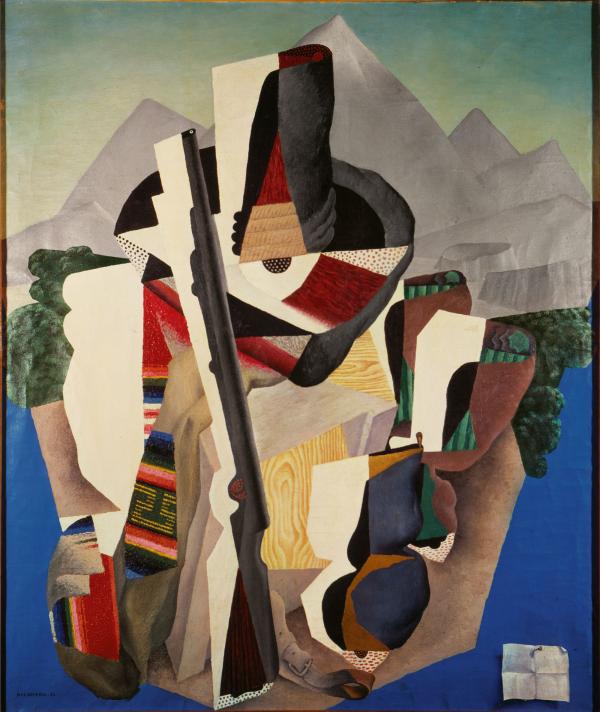
Diego Rivera- Zapatista Landscape 1915


++++++++++++++++++

As an artist I have always tried to be faithful to my vision of life, and I have frequently been in conflict with those who wanted me to paint not what I saw but what they wished me to see.

–Diego Rivera

++++++++++++++++++

Big fan of the work of Diego Rivera (1886-1957), the great Mexican painter/muralist and husband of Frida Kahlo. There is much I love in his work such as the way his colors harmonize and soar off the surfaces, the sheer brilliance of his compositions, the scale and breadth of his murals and the fact that his work was beautiful and powerful in whatever genre or style he chose at any given moment. He was also fearless in expressing his political and philosophical beliefs in his work, often becoming a strong element in his work.

I also admire his absolute devotion to his own voice in his work, as noted in the quote above. He painted his own vision, not what others desired him to see. That’s a big thing for any artist and not something easily done. Too often artists try to work for the approval of other eyes, for people who want their work to remain as they have always known it.

It’s understandable from the perspective of a viewer to want an artist to remain in that space that first attracted the viewer. They know and like the work as it is and perhaps can’t imagine it becoming more than it is if it somehow evolves or changes. Or they fear it will become less or something that doesn’t speak to them in the same way. As I said, it’s understandable.

But from the artist’s point of view this present a threat in that this may stop them from expanding their creative vision. They begin to be afraid to go off their own beaten path, to try new things, to move out of their comfort zone to challenge themselves, and to grow their self-created universe. They remain in a known space and may never know how expansive their vision might be if they only tried.

From what I know, Diego Rivera always moved to new creative spaces with his work. He painted with his own voice, even in his commissioned murals. I still stumble on pieces of his that surprise me.

A true inspiration.

++++++++++++++++

Diego Rivera’s Mural at the City College of San Francisco

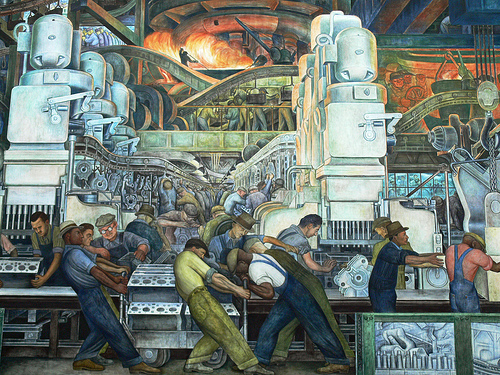
Detroit Institute of Arts Mural Segment

Diego Rivera- Flower Seller

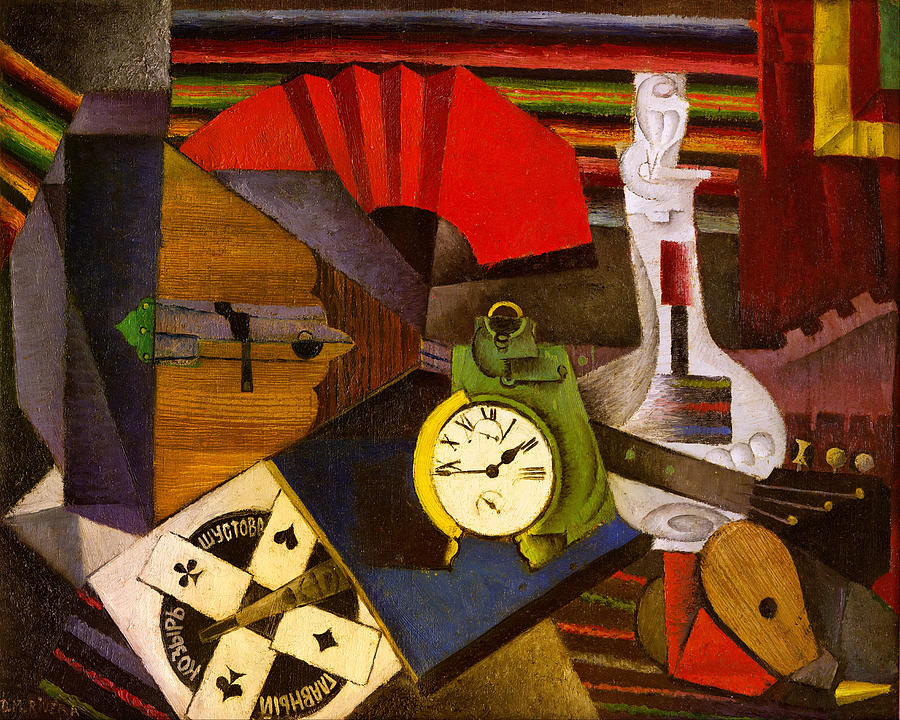
Diego Rivera- The Alarm Clock

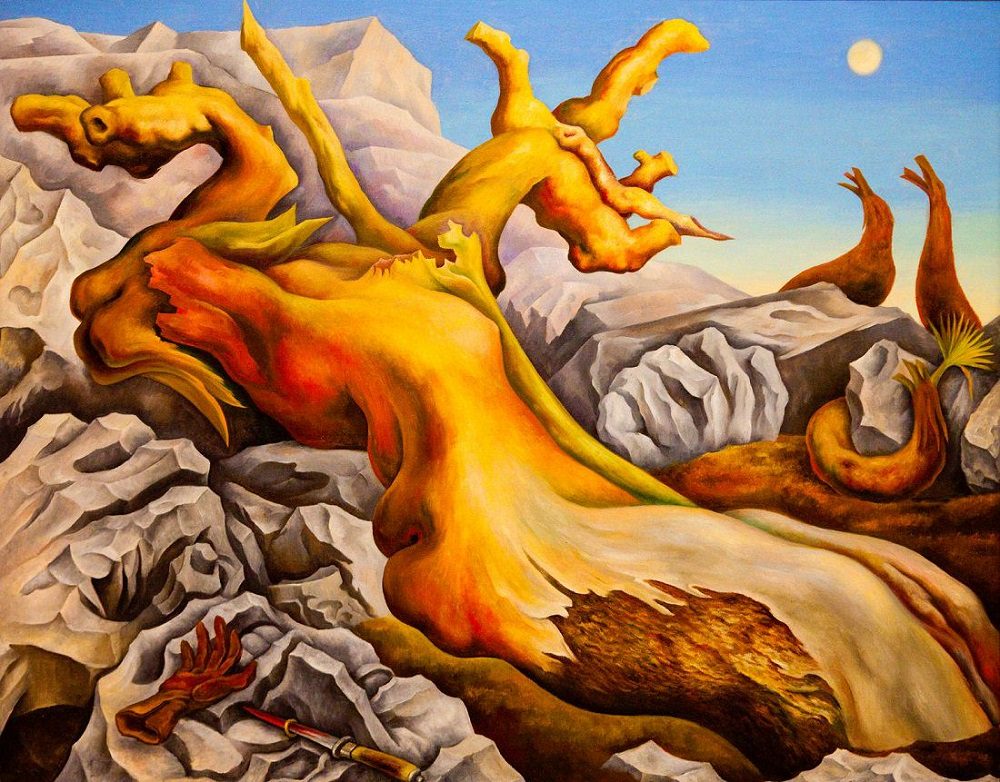
Diego Rivera- Nocturnal Landscape 1947

Diego Rivera- Symbolic Landscape 1940

Diego Rivera- View of Toledo 1912

Detroit Institute of Arts Mural Segment

++++++++++++++++++

Read Full Post »

++++++++++++++++++++++

….This is what you shall do: Love the earth and sun and the animals, despise riches, give alms to every one that asks, stand up for the stupid and crazy, devote your income and labor to others, hate tyrants, argue not concerning God, have patience and indulgence toward the people, take off your hat to nothing known or unknown or to any man or number of men, go freely with powerful uneducated persons and with the young and with the mothers of families, read these leaves in the open air every season of every year of your life, re-examine all you have been told at school or church or in any book, dismiss whatever insults your own soul, and your very flesh shall be a great poem and have the richest fluency not only in its words but in the silent lines of its lips and face and between the lashes of your eyes and in every motion and joint of your body….

—Walt Whitman, Preface to Leaves of Grass

+++++++++++++++++++++++

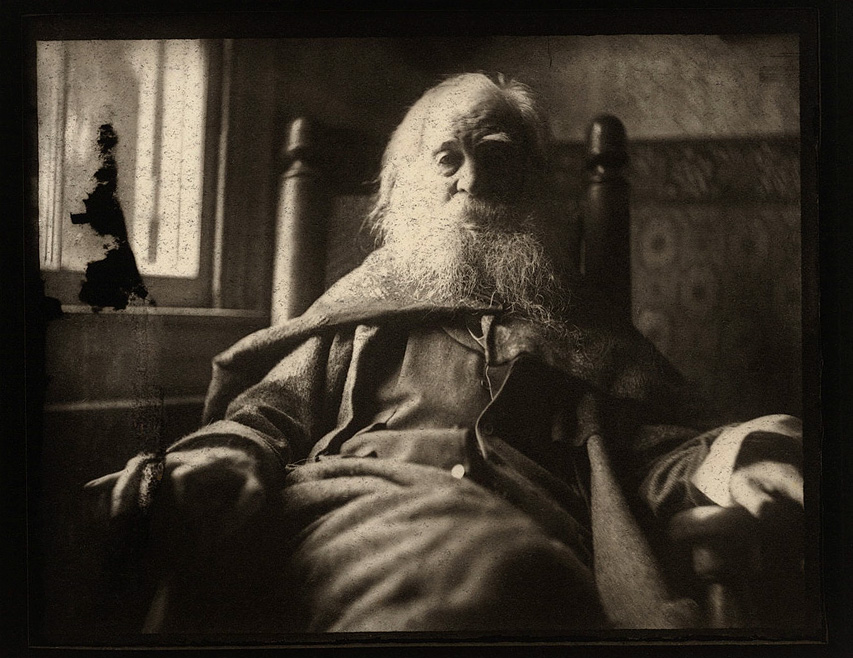
I have always been moved and inspired by the writings of the American poet Walt Whitman. I can find something that speaks directly to me in almost everything of his I come across. For me, he remains one of the most intriguing and unique characters in the American experience in so many ways.

This comes across in the photos of him, including the remarkable portrait above that was taken by the great American painter Thomas Eakins in 1891, a year before Whitman’s death. It has a remarkable feeling of earned wisdom and understanding.

I had always felt a familial bond with him anyway, having called him Uncle Walt for as long as I can remember. He seemed like he was the wise old uncle I wanted growing up, someone who watched over me and imparted bits of wizened advice to me from time to time. So with this great reverence for the man, you can imagine how excited I was when my genealogy revealed that we were related.

Not an uncle.

Cousins.

Okay, 6th cousins. We share a grandparent going back to the early 1600’s, five generation before Whitman and nine generations before me. So, that makes us 6th cousins, 5 generations removed.

That’s like being in the furthest reaches of relationship in the game of 6 Degrees of Kevin Bacon. Sure, we’re related by these tenuous bonds but it is so far removed that it is academic at best. There are probably several hundred thousand, if not a million or more, people with this same bond. So it is certainly no big deal. Interesting but absolutely meaningless and without value.

But when I read a line from Whitman that makes my heart race a bit, that makes my brain and soul stir, I have to admit that it makes me happy that we share that silly, insignificant bond.

I just call him Cousin Walt now.

Read Full Post »

+++++++++++++++++++

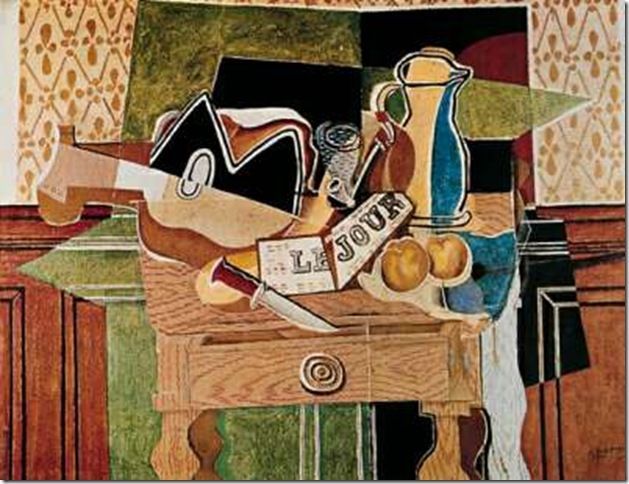
I have made a great discovery. I no longer believe in anything. Objects don’t exist for me except in so far as a rapport exists between them and myself. When one attains this harmony, one reaches a sort of intellectual non-existence, what I can only describe as a sense of peace, which makes everything possible and right. Life then becomes a perpetual revelation. That is true poetry.

Georges Braque

+++++++++++++++++++

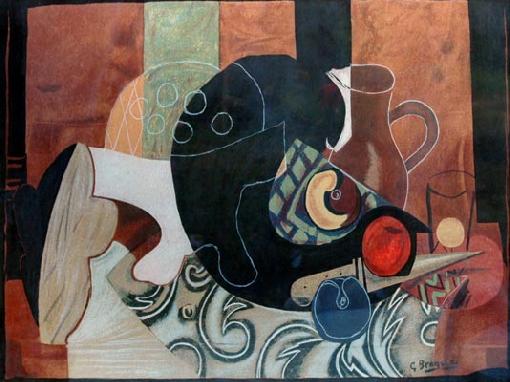
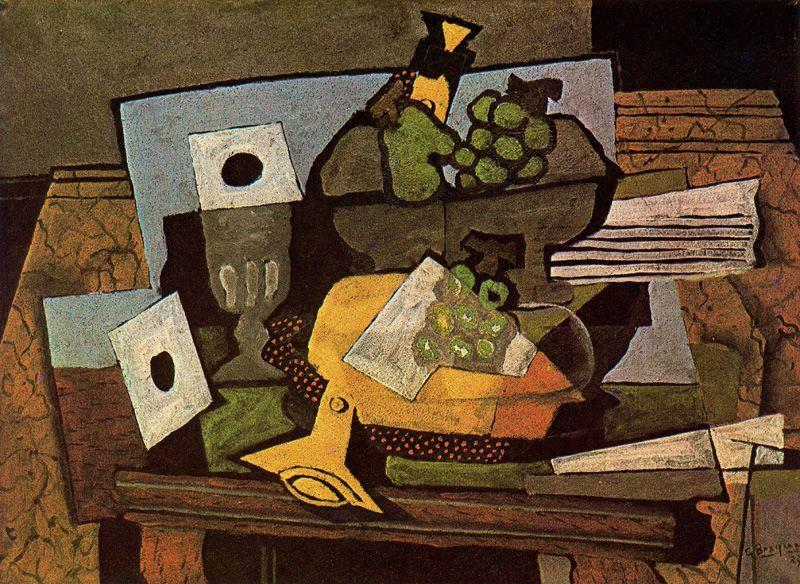
Just about anything I read  from Georges Braque (1882-1963) makes me stop and think. I am still trying to digest this. In one moment it makes perfect sense and aligns with my own thoughts while the next it confounds me, like I’ve turned down a street that is totally unrecognizable. Not sure which way to turn.

But there is something in the pondering that makes me think it might be worthwhile.

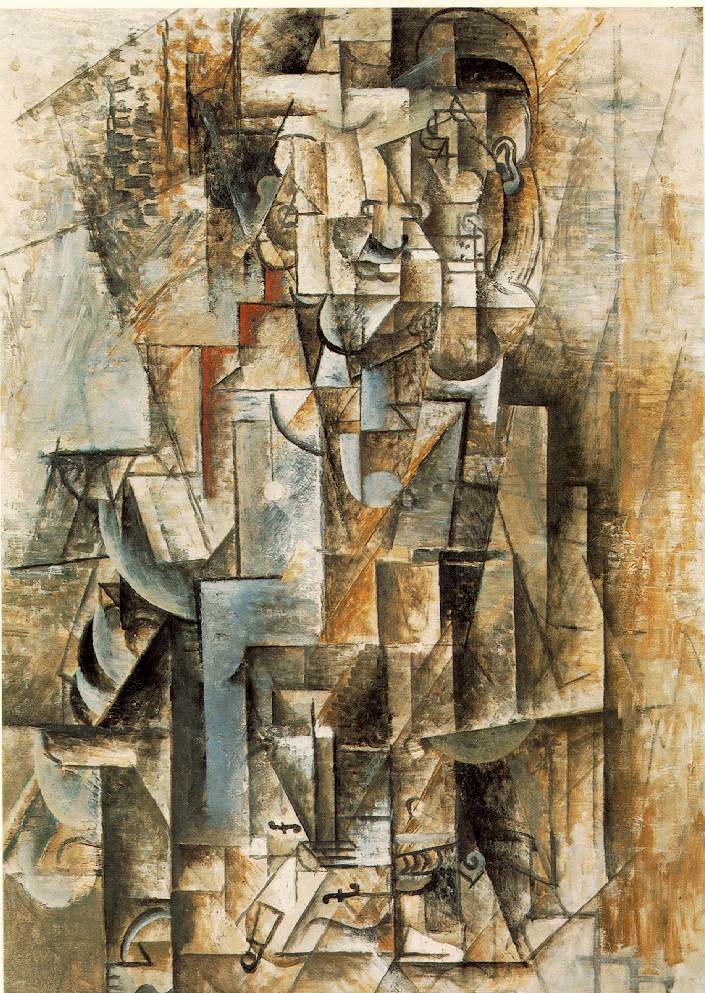
Braque had a pretty amazing career, moving from Impressionism to Cubism to Fauvism and Expressionism with his own unique voice. Here are some of my favorites.

Read Full Post »

+++++++++++++++++++

.

It is my dream to create an art which is filled with balance, purity and calmness, freed from a subject matter that is disconcerting or too attention-seeking. In my paintings, I wish to create a spiritual remedy, similar to a comfortable armchair which provides rest from physical expectation for the spiritually working, the businessman as well as the artist.

.

–Henri Matisse

.
+++++++++++++++++
.
I have read (and shared) a different translation of the quote above from the great Henri Matisse. It aligns perfectly with my own hopes for my work and stands almost as a credo. At the end of the day, I am trying to create work that allows any viewer, no matter how much or how little they know about art, to withdraw into their own inner space while at the same time feel a sense of communion with a greater whole. To move into a place that feels safe and comforting.
.
A spiritual remedy, as he calls it.
.
It’s not something you can have in mind, however. It only comes in the process, as the thoughts that may have been pressing on my mind are set aside and my own emotions are leveled off to a state of calm. It has to be my own spiritual remedy before it becomes that of anyone else.
.
When it happens, it is a lovely thing and the world seems somewhat right.

Read Full Post »

++++++++++++++++

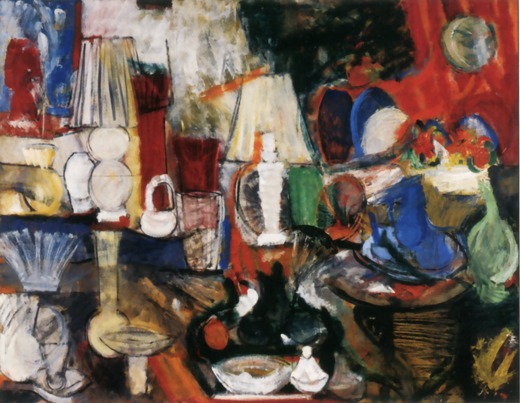
I perceive the world in fragments. It is somewhat like being on a very fast train and getting glimpses of things in strange scales as you pass by. A person can be very, very tiny. And a billboard can make a person very large. You see the corner of a house or you see a bird fly by, and it’s all fragmented. Somehow, in painting I try to make some logic out of the world that has been given to me in chaos. I have a very pretentious idea that I want to make life, I want to make sense out of it. The fact that I am doomed to failure – that doesn’t deter me in the least.

–Grace Hartigan
.
+++++++++++++++++
.
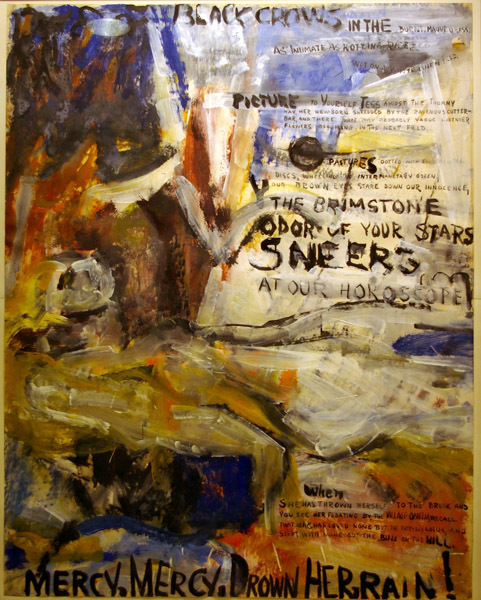
Grace Hartigan (1922-2008) was a painter based in NYC. She often called herself a second-generation Abstract Expressionist because she used the influence of the major artists of the genre as a jumping off point for her own distinct work.
.
While we certainly work in different forms of expression, I admire the strength and vibrancy of much of her work. I also like her work, such as some below from her Oranges series, that incorporate the written word, in this case the poems of her close friend, poet Frank O’Hara. And I certainly understand her own words above, especially about perceiving the world in fragments and trying to put that chaos into some coherent form of logic. And the doomed to failure part, as well.
.
I think that sense of failure, that goal that always move out of reach, is the compelling part of painting. If you felt you reached that desired endpoint, there would be no point in continuing.
.
++++++++++++

Read Full Post »

+++++++++++++++++

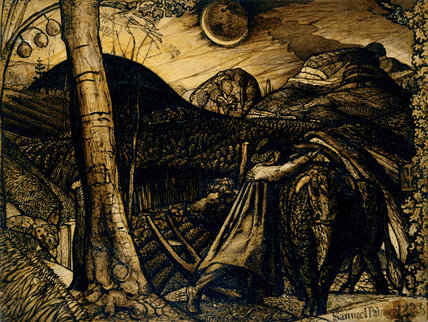
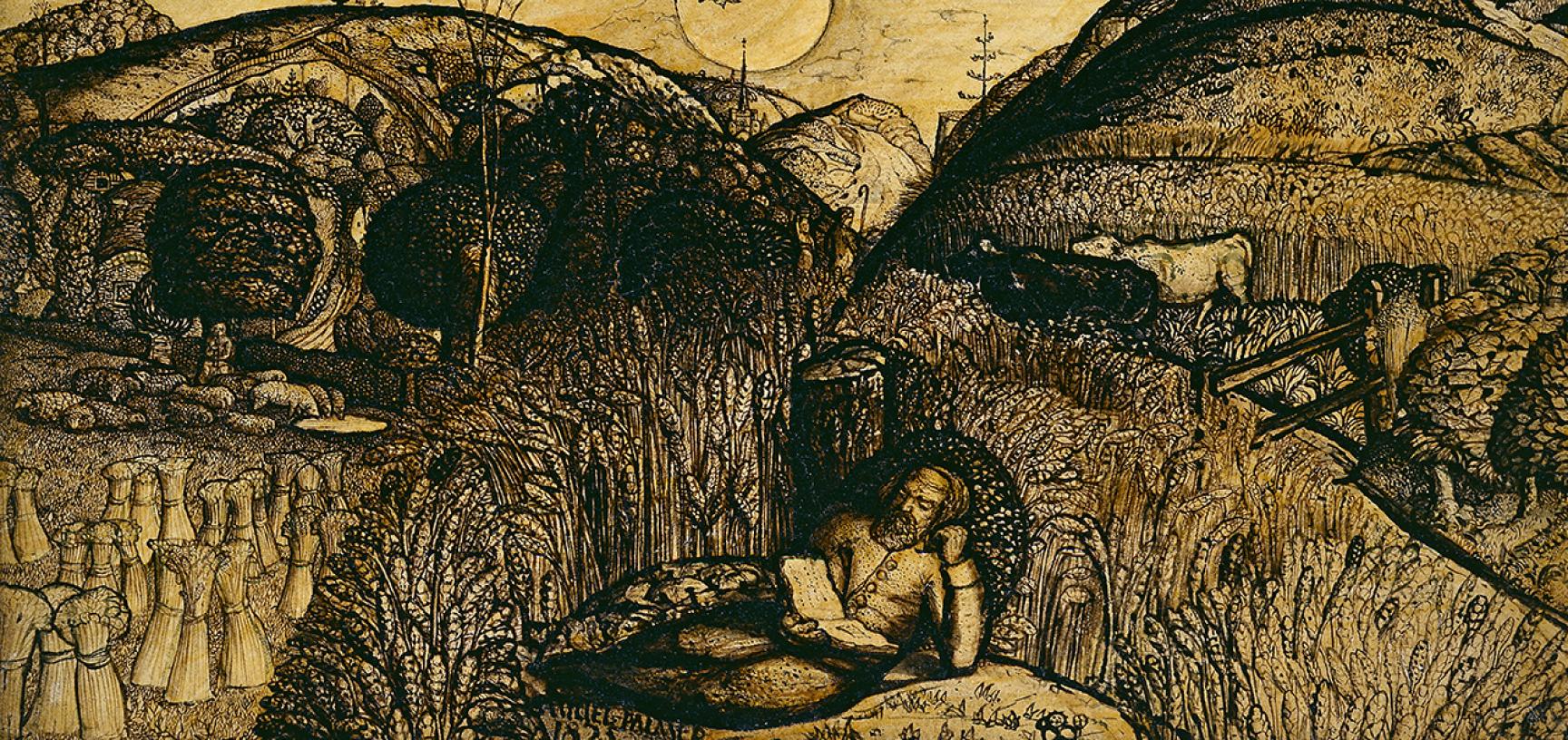
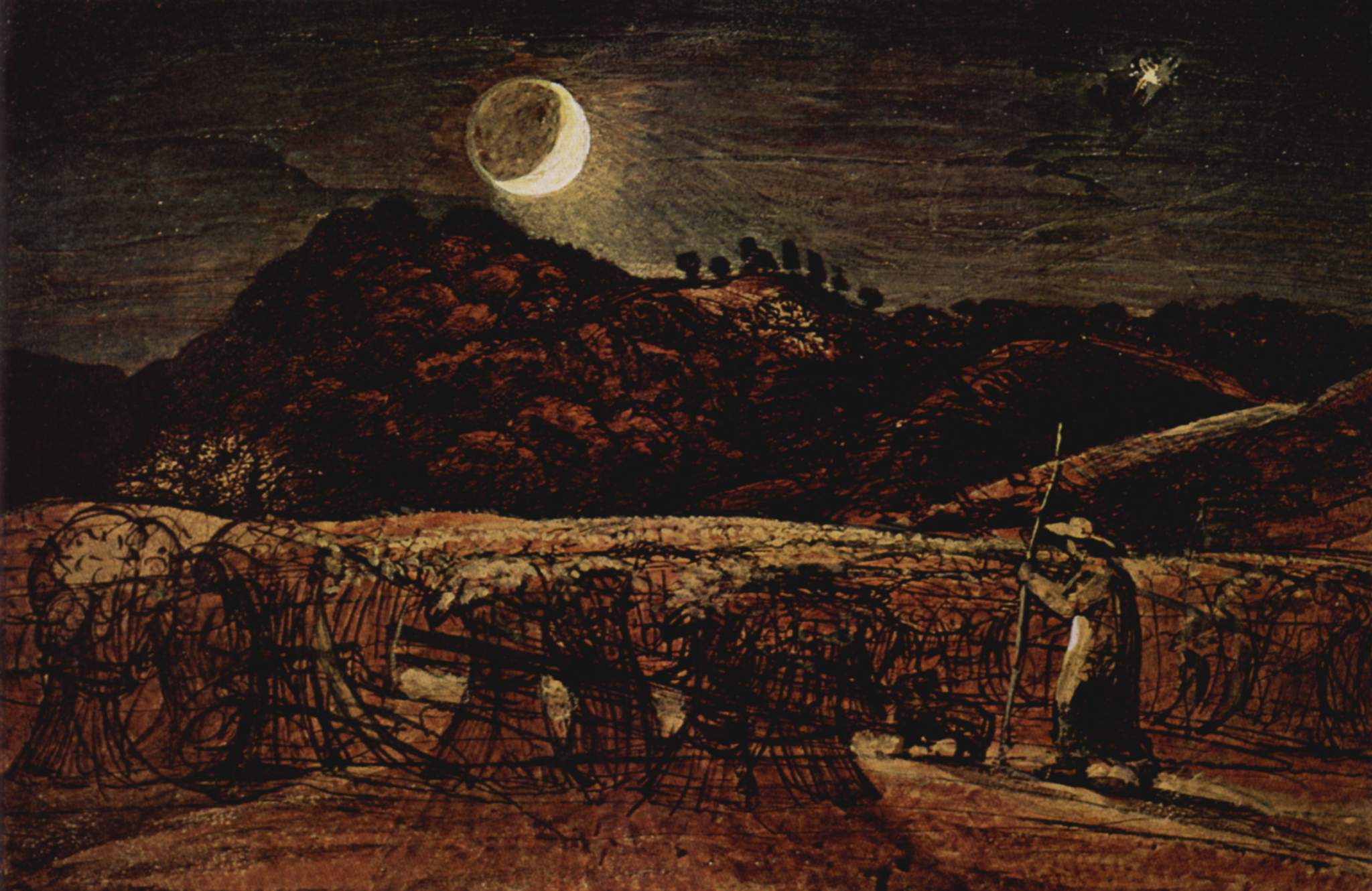
When less than four years old I was standing with my nurse, Mary Ward, watching the shadows on the wall from branches of an elm behind which the moon had risen. I have never forgot those shadows and am often trying to paint them.

-Samuel Palmer

+++++++++++++++++

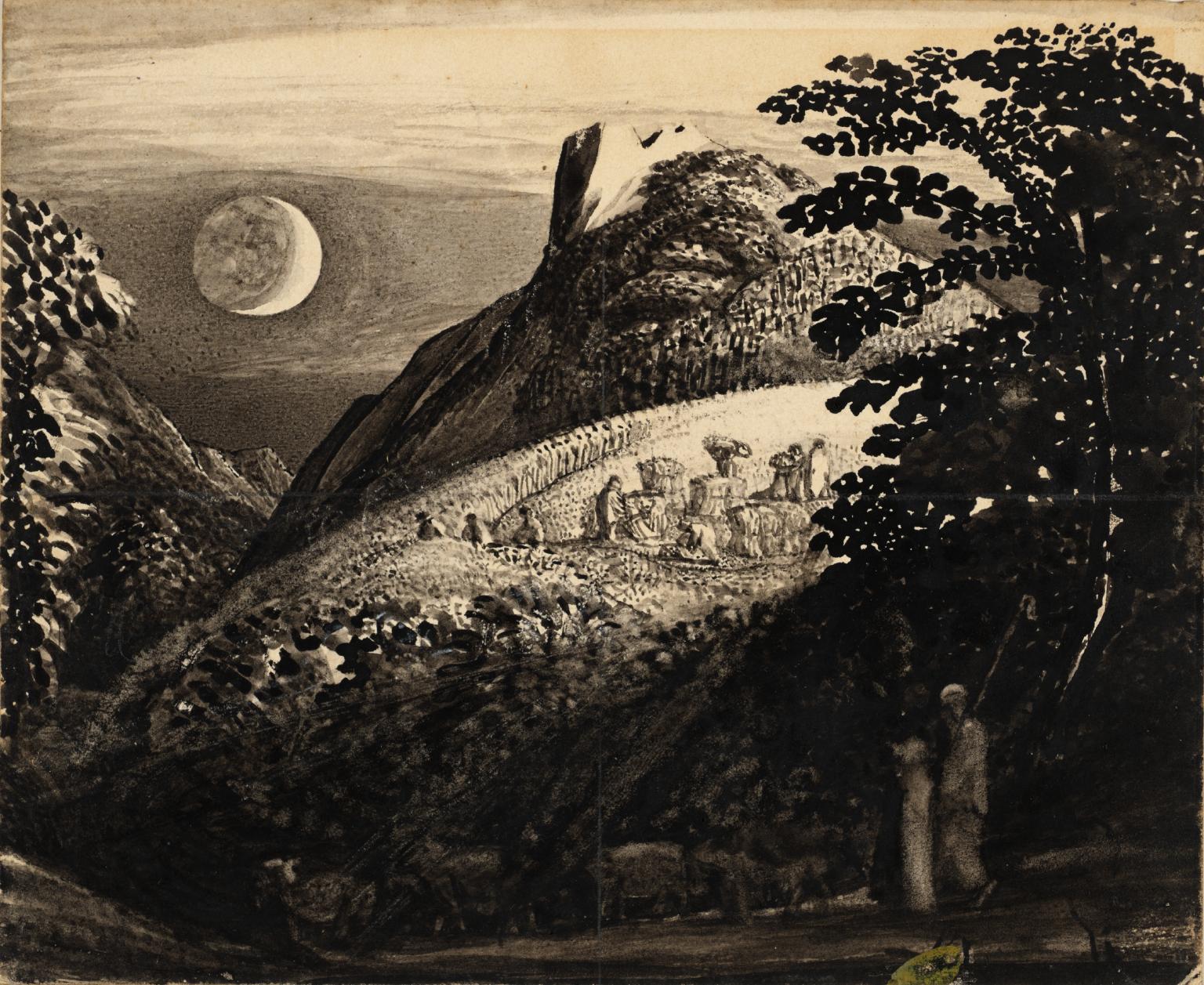
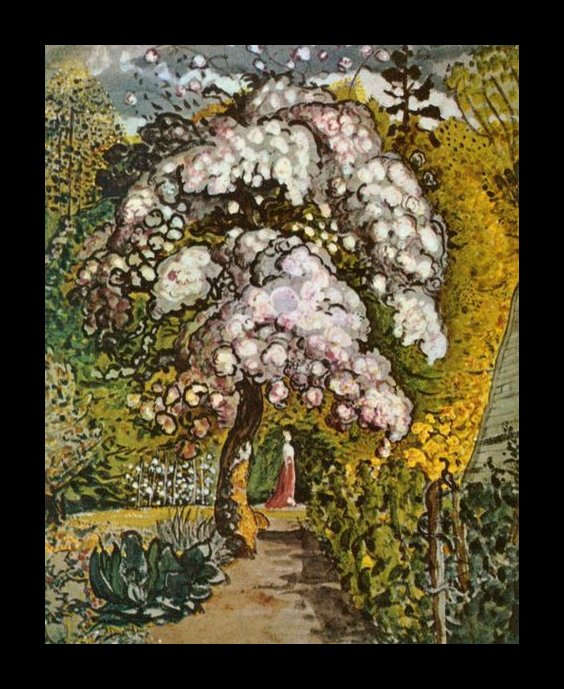
I have long admired the work of the British painter Samuel Palmer (1805-1881).  He is sometimes called the British Van Gogh even though he painted much of his work much of his work before Van Gogh was even born. There’s a wonderful darkness underlying much of his work that no doubt relates to the shadows from his childhood that he mentions in the quote above. Interesting how things from our childhood that might be easily overlooked or downplayed affect us throughout our lives.

His compositions have a very unique quality, one that strives to create a sense of fullness in the view he is revealing. It is very stylized and personal, more so than most artists of the first half of the 19th century. His often condensed compositions create an air of unreality but nevertheless make sense and translate easily in the journey from the eye to the brain. This really appeals to my own sense of composition and I find myself relating easily to his work, almost sensing how he was putting his pieces together.

Many of you have probably never heard of Samuel Palmer but he certainly has had my attention and respect for some time. Here’s a short video of his work and a few more of my favorite pieces.

The Harvest Moon: Drawing for ‘A Pastoral Scene’ c.1831-2 Samuel Palmer 1805-1881 Purchased 1922 http://www.tate.org.uk/art/work/N03699

Read Full Post »


You can’t force inspiration. It’s like trying to catch a butterfly with a hoop but no net. If you keep your mind open and receptive, though, one day a butterfly will land on your finger.

–Chuck Jones
++++++++++++++++++
I came across the quote above from the great animator/artist Chuck Jones and it made me think of a blog post I wrote back in 2009, citing him as an influence. Nine years later, I still feel that way as strongly as ever. I still see hints of his landscapes in my own. His strong visuals, along with those of the early Max Fleischer Popeye cartoons, really imprinted on me. I thought it deserved a second run. Actually, I just wanted to show Marvin the Martian again.
++++++++++++++++++


Marvin the Martian and Daffy
I have cited artists here who have been influences on my work, people who are often giants in the world of art and sometimes lesser known but equally talented artists. But sometimes you overlook the obvious, those ones who have always been right in front of you.

What's Opera DocLast night [from 2009], TCM honored the great cartoonist Chuck Jones by showing a documentary and some of his landmark cartoons starring Bugs Bunny, Elmer Fudd and Daffy Duck. He also did the Roadrunner/ Wile E. Coyote cartoons as well as the seminal holiday favorite, How the Grinch Stole Christmas. His work was and is a vivid part of an incredible number of people’s childhoods. His What’s Opera Doc? with Bugs and Elmer in a Wagnerian setting with a tragic ending is classic and might be the only exposure to higher culture that many viewers may get.chuck_jones-opera-set

For me, I was always so drawn to the color quality that Jones had in his cartoons as well as the way he interpreted the landscape with a form of artistic shorthand that cut out extraneous detail yet never took away from the feeling of place, unlike some of the lower quality cartoons from Hanna-Barbera in the early 60’s. Don’t get me wrong. I loved those cartoons as well but even as a kid I was really distracted by the poor quality of the landscapes that scrolled continuously behind their characters. With Chuck Jones, it always felt fresh and real, as though there was thought given to every detail in every frame. Who else could put imagery like the above scene from What’s Opera Doc? before the eyes of impressionable children? Probably only the artists from Disney can match Jones’ work at Warner Brothers, but that’s another post.

His work also treated you, as a kid, like you had intelligence. They were smart, clever and nuanced. They never talked down to you.

For a kid this was potent stuff. Scratch that- it’s just potent stuff. Period.

Read Full Post »

« Newer Posts - Older Posts »