Feeds:
Posts
Comments

Archive for the ‘Influences’ Category

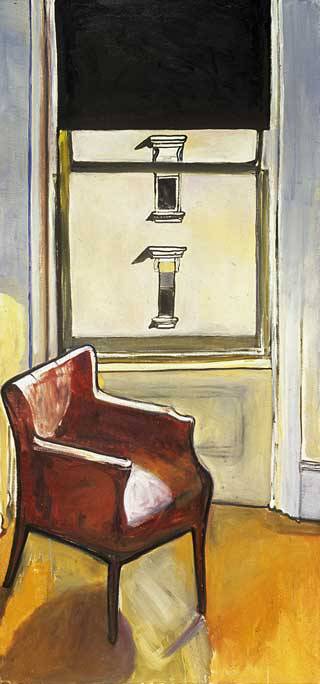
While searching for a piece of music to feature here this morning, I found myself looking over at this new painting shown here as I listened to the music. As usual, the search had me running down rabbit holes that sent me in all different directions, none that satisfied me enough to want to share it.

Then I somehow ended up on this modern classical piano piece from composer Phillip Glass, Etude No. 14, played by pianist Vikingur Olafsson. There’s a part in it, starting at about 1:15, that the sound and this painting just seemed to mesh for me, filling out the feeling that I was experiencing as I was taking it in.

It is a painting that is still on the easel, near completion or so I think. I am in that part of the process where I am still examining it, absorbing it to see what it has for me, what it’s trying to say to and for me. And here, the music created a narrative line that pulled me and the image together.

It’s hard to explain. Everybody sees art differently, having different expectations of what they hope to extract from it, if anything. I think a lot of folks don’t even think about those expectations and just react to what is before them. I do that as well and it is generally gives a true response.

But more often I see art as an existential puzzle with pieces that provide clues as to our meaning and purpose. There are works that attract me and I search them for these clues, trying to figure out if there are answers or where it will send me next in my search. In this painting, the Glass music helped me see what I had only sensed before.

As I said, it’s hard to explain.

Anyway, give a listen and have yourself a good Sunday. By the way, I am calling this painting Etude No. 14.

Read Full Post »

Once the object has been constructed, I have a tendency to discover in it, transformed and displaced, images, impressions, facts which have deeply moved me.

–Alberto Giacometti

+++++++++++

There is a film out currently called Final Portrait which is about the writer James Lord, played in this film by Armie Hammer, sitting for a portrait with artist Alberto Giacometti, played in the film by Geoffrey Rush.

Taking place in 1964, a couple of years before Giacometti’s death, the sitting is initially supposed to last for a few hours but stretches for weeks as Giacometti agonizes and constantly alters the painting. The movie is based on Lord’s perspective, one that has him confused and frustrated until at last seeing how Giacometti has transformed his image into something beyond what he himself saw in it.

I haven’t seen it but imagine it to be a quiet but intense film. I’ve had some fascination for Giacometti’s work and writings for many years, intrigued by the singularity of his vision and his dedication to bringing it to light. I find myself often nodding in agreement, as I did with the quote here at the top, when reading his words from interviews and his writings.

Here’s a short film that the Christie’s auction house put together several years ago about the painting of this portrait when it came to auction, selling for nearly $21 million. It’s provides the basis for Final Portrait.


Read Full Post »

Look up at the stars and not down at your feet. Try to make sense of what you see, and wonder about what makes the universe exist. Be curious.

–Stephen Hawking

++++++++++++++

I’ve been working on a series of paintings recently for my June show at the Principle Gallery that feature fragmented skies with stars appearing at their junctures. Some are very geometric and angular while some– like the one, In the Stars, shown here–have more organic shapes with more randomness in their arrangement.

Both satisfy some part in me, in their creation and in the appreciation for them I feel once they reach a point of completion. Maybe it’s that there is a meditative stillness in both aspects. Painting them definitely creates a deep sense of quietude for me that I also find in studying them after they are done.

It is the kind of stillness that spurs wonder and curiosity, the kind that makes one look into the night sky with hopes that extend beyond our present time and place. Are we alone in this vast universe or are we the end-product– the flowers, perhaps — of one of those shining stars?

I don’t know and most likely will never know. But I will always have the need to wonder…


Read Full Post »

Ad Marginem C 1930 Painting by Paul Klee; Ad Marginem C 1930 Art Print for salePaul Klee On Modern Art 1924This excerpt from On Modern Art, the 1924 treatise from the great Swiss artist Paul Klee is a bit more than a quote but since this is about art we’ll be a little flexible in our definition. And that, I believe, would please Klee, whose works often defied definition.

I know for me, he was a big influence if only in his attitude and the distinctness of his work. I always think of his work in terms of the color– sometimes muted yet intense and always having a melodic harmony to it.

It always feels like music to me.

I like his idea that the world is in the process of creation, of Genesis, and that it is not a final form. It allows for visionary work, for imagining other present worlds that extend beyond our perception because, as he writes, In its present shape it is not the only possible world.

And to me, that is an exciting proposition.

Read Full Post »

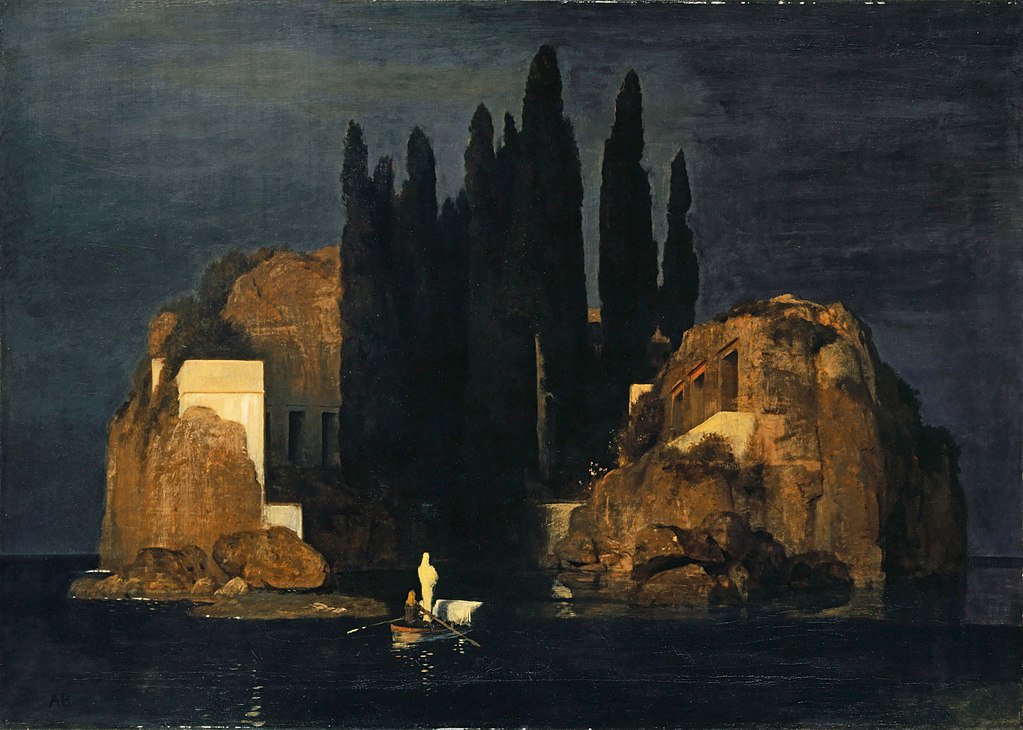
Isle of the Dead – Arnold Böcklin- First Version

I am a fan of the Symbolist painters from  around the end of the 19th century, artists like Edvard Munch, Gustav KlimtOdilon Redon. and many others created incredible works that were just a little beyond reality but beautiful and with a presence that lingered with the viewer. There are many great examples but one of those paintings with a lingering effect is the Isle of the Dead from  Swiss painter Arnold Böcklin (1827-1901).

Depicting an island where the bodies of the dead were interred, it is a powerful and somber image. Several locations are reputed to be the inspiration for this painting, including several tiny Mediterranean islands with similar cypress trees and chapels. Some believe it to be based on a cemetery in Florence, Italy near the artist’s studio where his infant daughter was buried.

Böcklin lost 8 of his 14 children to death, so the concept of death was something that was always near. This was not that uncommon in that time. Most families lost one or more children in early childhood and death was an accepted part of this world. During this time, at the end of the 19th century, it wasn’t unusual for a family to take portraits of their loved ones soon after they died.

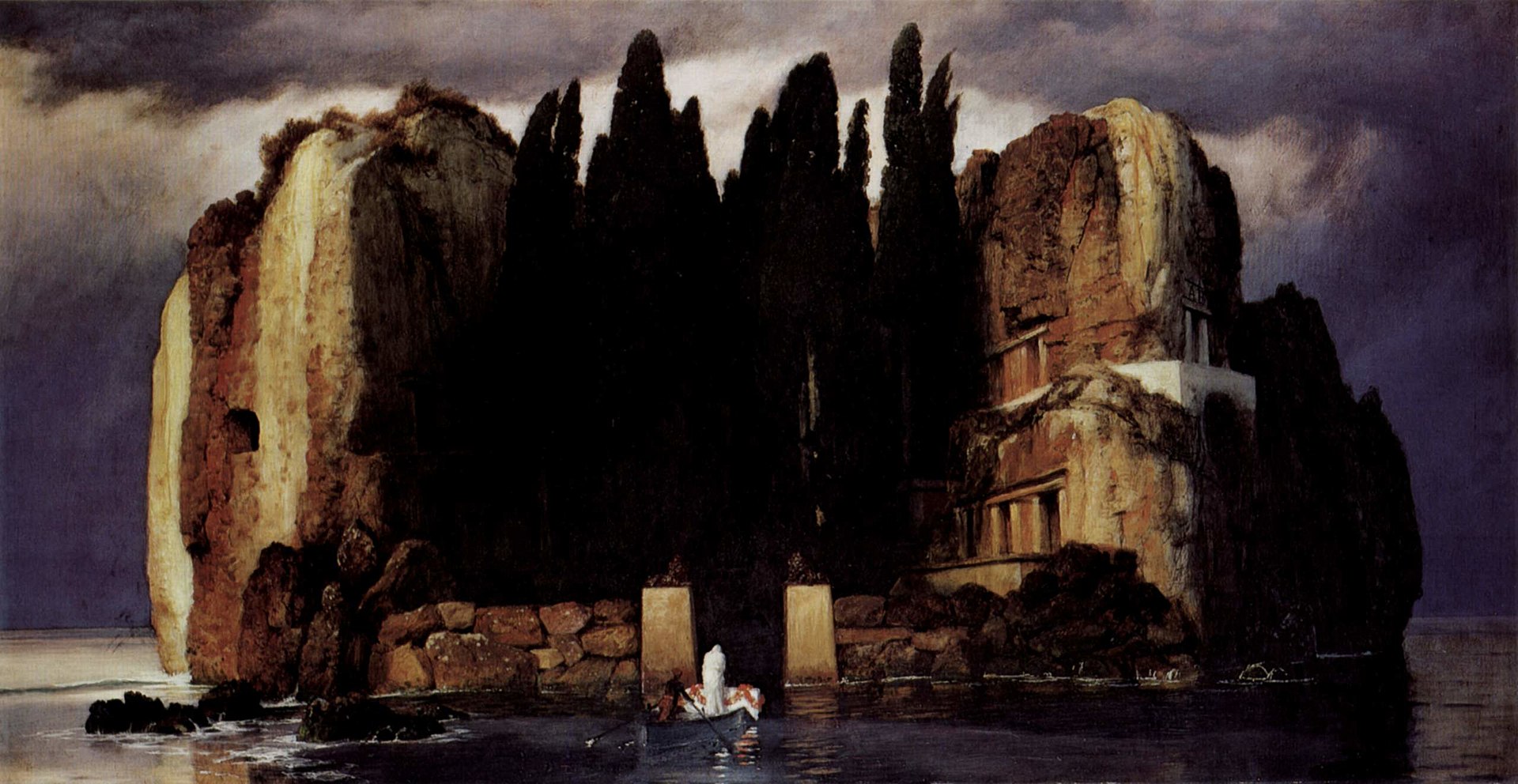
Böcklin painted five versions of this instantly popular work for collectors. One version, the third, was bought by Adolf Hitler in 1933 and now hangs in the National Gallery in Berlin. Another, the fourth, was destroyed by a bombing raid in World War II and only exists now as a black and white photograph.

This painting had something  with which people deeply identified and it was the new popularity of mass produced lithographic prints in the time that gave it staying power. It was said that one couldn’t enter a Berlin home at the turn of the century without coming across a print of the painting on the wall. This image has maintained quite a bit of its following through the years, even having websites dedicated to it.

As I said, it is a powerful image that lingers in your mind long after you see it. I know it does for me. It has definitely been a huge influence on a number of painters and other artists.

In 1888, Böcklin created a painting, Isle of Life (see below), that he considered the converse image to his now famous Isle of the Dead.  It has living people, animals, greenery and a generally more upbeat appearance. But it certainly doesn’t come close to the soul jolting impact of its antithesis.

But you be the judge…

Isle of the Dead – Arnold Böcklin- Fifth Version

Isle of the Dead – Arnold Böcklin-Second Version

Isle of the Dead – Arnold Böcklin-Fourth Version Destroyed

Isle of Life – Arnold Böcklin

Isle of the Dead – Arnold Böcklin- Third Version

Read Full Post »

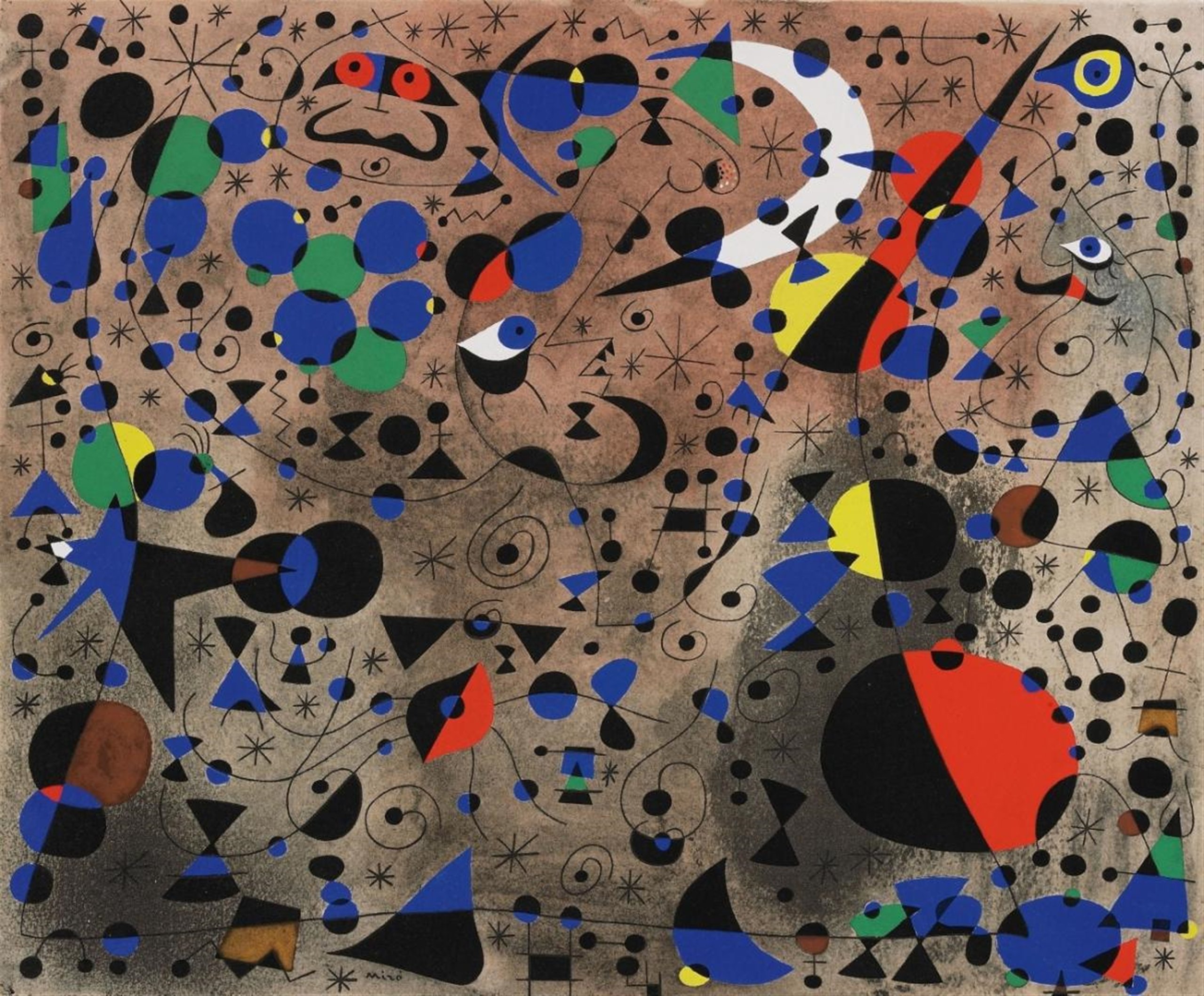
Joan Miro, Constellations 1959

———————-

The older I get and the more I master the medium, the more I return to my earliest experiences. I think that at the end of my life I will recover all the force of my childhood.

–Joan Miro, from 1960 at age 67 

———————–

It’s the young people who interest me, and not the old dodos. If I go on working, it’s for the year 2000, and for the people of tomorrow.

–Joan Miro, from 1975 at age 82

————————-

There are two quotes here from the great Spanish painter Joan Miro (1893-1983) that really strike a chord with me. Both come from him when he was older and both speak very much to the way I feel about my own work.

In the first he speaks about gaining more mastery over the medium through the years while simultaneously moving closer to the vibrant energy that one has in their youth. I have felt the same feelings. The more one gains control over their form of expression, the more they are freed from the constraints of conscious thoughts and decisions. The work becomes reactive to the feel and emotion of the moment.

Now, I will add that with this acquired mastery there is also a new barrier erected to overcome. Well, at least, in my experience. I have found that with years of work, which is, in effect, rehearsal and practice, there is sometimes a loss of spontaneity and passion in the actual making of the marks. They become a little too precise, a little too mannered and a bit too clean and neat. They don’t have that feeling of wanting to burst off the surface. I have found ways to get past this–using bigger brushes and making strokes quicker with more urgency, for example– but every so often I will get near the end of a piece and it just feels too neat, too precise, for the underlying emotion.

It needs the innate exuberance of a child at play.

The second Miro quote, made when he was 82, speaks of painting not for those of his age but for the younger and the future generations. I certainly understand this sentiment. I am most thrilled when children react to my work, knowing then that it is speaking to the aforementioned innate exuberance.

It means I am not dealing with intellect or acquired knowledge or conscious thought. It is a pure and uninformed reaction. It means the work is communicating emotionally across and out of time.

And I think this is important because I believe most artists wants to break free from their own era, to not be consigned to any single period of time. To be known for what they were at their inner and eternal core, not where or how they were categorized in their time.

Maybe like the Miro painting at the top, a single small voice among the multitude of stars and constellations in the universe.

I don’t know but that might be my primary goal in doing what I do.

Read Full Post »

Do not try to do extraordinary things but do ordinary things with intensity.

–Emily Carr
*****************
Emily Carr was one of the first artists that came to mind when I saw the question last week that asked if you name five female artists. She is most likely off many of your radars but I am sure some of my friends to the north in Canada recognize her name very well.
 –
Carr was born in 1871 and died in 1945 in Victoria in British Columbia. Aspiring to be an artist, she was trained in the tradition of classical painting methods early in her life. But the first decade of the 20th century saw her work take a radical turn. After a period of time in Paris, influenced there by the Fauvist and Post-Impressionist with which she met and painted, her work took on bolder colors and more expressive brushwork.
 –
She took this new found energy back to Canada where she opened a gallery in Vancouver in 1912. The gallery faltered as she failed to see the response that she had hoped for. Dejected, she basically put down her brushes for the next 15 years, doing little painting.
However, some influential people were aware of her work, especially paintings she had executed with the native tribes of Canada as her subjects, and in 1927 she was invited to show a group of work in an exhibit about the tribes of the West Coast at Canada’s National Gallery in Toronto. It was here that she met Lawren Harris and  other painters who made up the fabled Group of Seven, which were several great Canadian painters of the time who had distinct modernist styles. I have featured the brilliant work of Lawren Harris here several times.
 –
Encouraged by Harris, who proclaimed her as one of that group, Carr was rejuvenated and for the remainder of her life worked with great vigor, trying to capture the spiritual essence of her native homeland. Like Maudie Lewis, Carr is a Canadian national treasure.
 –
I am enchanted by much of her work and the spirit that is imbued within it. This has been a very cursory look at her life with just the highlights and a few images and a video. Please do some research on your own. It’s well worth the time.


Read Full Post »

I don’t paint like a woman is supposed to paint. Thank God, art doesn’t bother about things like that.

Alice Neel

******************

Thursday was International Women’s Day and I saw an article on social media that asked if you could name five female artists. It wasn’t difficult for me but this is what I do so I am regularly scanning the work of others, past and present. I see a lot of work by women that is incredible and have been directly influenced by many of these women.

But I could imagine for the casual observer it might be a difficult thing to name five female artists. Any honest person that does a quick scan of the history of art can plainly see that this field has long been dominated by males. But this makes it like most other fields of endeavor and reflects a societal bias that has often long placed less importance on the accomplishments and the self-expression of women.

It is something that must and will change. It is changing before our eyes.  I say that because I have had the great fortune to be associated with a number of galleries that feature increasingly large rosters of female artists. This is not by design. It’s just that more and more interesting and wonderful work is being done by female artists who have finally realized that their voice, their expression, should be secondary to no one.

I have seen the numbers grow substantially over the years and am excited by it, mainly because the things that I see in the art that attracts me are usually perspective dependent, not gender dependent. Anything that broadens the field and gives a wider range of viewpoints and more options is a good thing in my opinion.  The gender, or race or nationality, of the artist should not play a role in our perception of their work unless that work deals directly with these subjects.

Hopefully, soon an artist will simply be an artist. Not a female artist or a black artist or a Latino artist or whatever subtitle people choose to attach before the word artist.

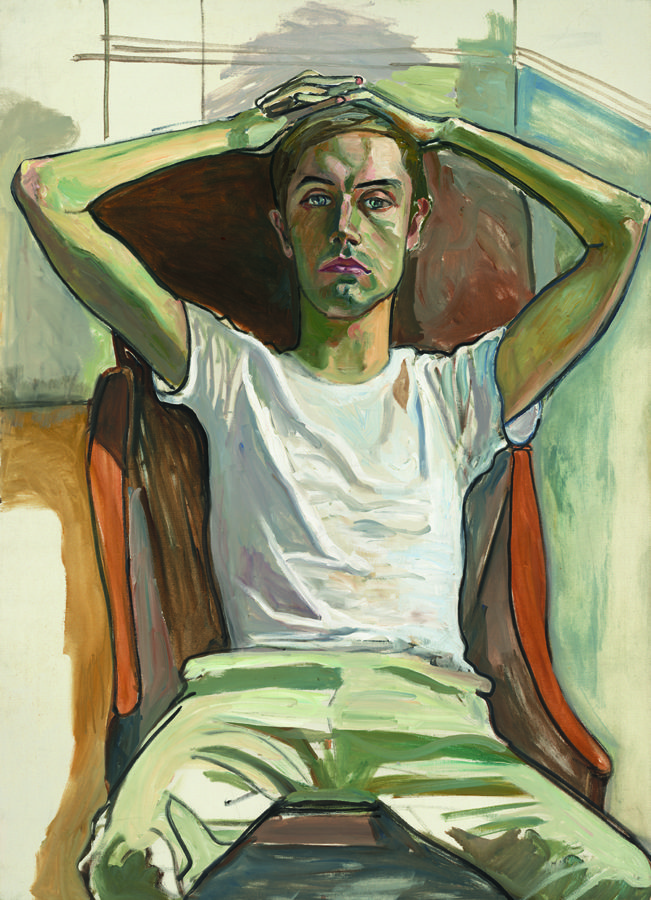
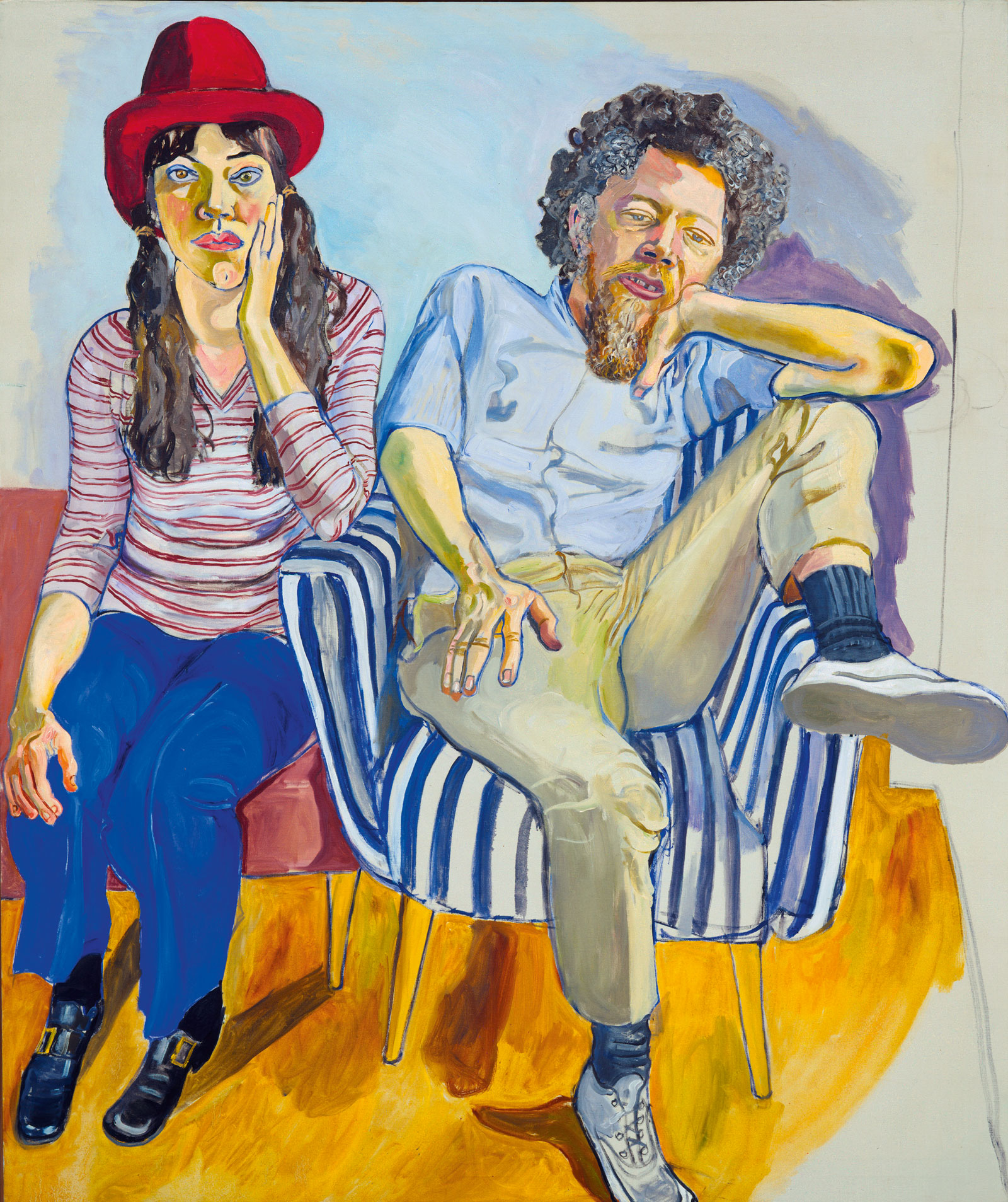
One of the artists that jumped to mind for me when I read the question about naming five female artists was Alice Neel (1900-1984) who was famed for her portraiture. She had a very distinct way of using color and always followed her personal muse, never adhering to any particular genre or school. She was a bold painter in a time when the female artist was still very much underappreciated. In the years since her death she has gained great recognition for he work. I urge you to take a closer look at her work and her life.

Alice Neel. Hartley. 1966. oil on canvas. 127 x 91,5cm. gift of Arthur M. Bullowa. National Gallery of Art Washington.

Read Full Post »

Edward Hopper- Pennsylvania Coal Town

***********************

I believe that the great painters, with their intellect as master, have attempted to force the unwilling medium of paint and canvas into a record of their emotions. I find any digression from this large aim leads me to boredom.

Edward Hopper

***********************

Emotion is that intangible quality that separates art from craft. Emotion does not have to be at the extremes of rage or depression or giddy elation. It is often subtle and calm or densely introspective. Hopper’s work was imbued with quiet emotional undertones that make his paintings, even those scenes of the most seemingly mundane moments, truly memorable.

Art is, at its foundation, emotion.


Read Full Post »

Woke up late this morning, at least by my standards. I bolted awake directly coming out one of those weird dreams that seem like something out of a dystopian novel like 1984 or Brave New World.

Or taken from any recent newspaper.

I wanted to go back to sleep just to try again, maybe come out this sleep with something better. Second times a charm, you know.

But I couldn’t so I headed over to the studio for my morning rituals. But that feeling from my dreams lingered, like a foreboding prophetic omen that is always at the edge of my thoughts and my vision.

I have a floater in my right eye that sometimes, when I am looking straight ahead, will dart across the far right periphery of my field of vision. It’s been there a while now but I often still finding myself jerking my head reflexively to see what is there. Of course, there is never anything there yet its continued presence gives me an unsettling feeling as though something could be there when I look the next time.

Uncomfortable dream or terrible omen? I’m rooting for uncomfortable dream but who knows what our subconscious is up to these days.  So much of the info, the indicators, the patterns it selects to process from the outside world enter without our knowledge.

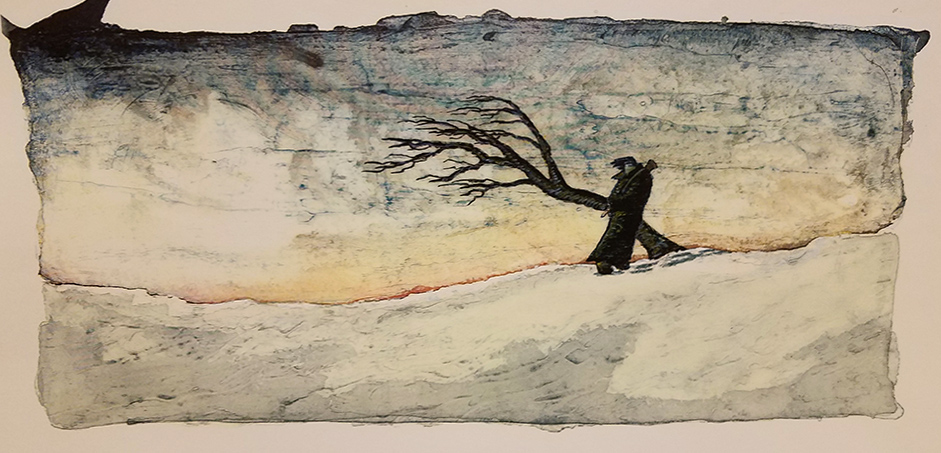
It all reminds me of the image at the top, a painting from back in 1996 or thereabouts. I can’t locate a slide of this piece but came across an old photocopy yesterday and was really taken with it. It’s called Strange Victory II designed as a kind of companion to Strange Victory which was an early painting that I showed here and was based on a favorite poem of mine with that title from Sara Teasdale.

There is a lot that I like in this painting– the subtlety of the colors, the textures and the contrast of the figure and the tree against the backdrop. It is so simply constructed but has a fullness that is often elusive to me as an artist.

I think it’s a great companion piece for this week’s Sunday Morning Music. This week I chose Don’t Give Up, the Peter Gabriel song from back in the 1980’s. This version is from Willie Nelson accompanied by Sinead O’Connor, from his 1996 album, Across the Borderline. I think it’s a first rate cover of the song and I can envision the image of this painting when I listen to it.

Take a listen and have good day and better dreams.

Read Full Post »

« Newer Posts - Older Posts »