Feeds:
Posts
Comments

Archive for the ‘Motivation’ Category


Whether this matters in the long term, I do  not know. But for the time being, it gives me the feeling that I am somewhat in control of my narrative. Here’s a post from a few years back that speaks a bit more about artists speaking about their work and the difference between doing so with words that actually say something substantive and those that are mere fluffy word clouds.

.

David Hockney- Mulholland Drive 1980

It is very good advice to believe only what an artist does, rather than what he says about his work.

 –David Hockney

*************************
.
When I first read this quote from the great British artist David Hockney, a painter whose work I admire and always find very interesting, I wanted to be offended. After all, I am an artist who has said plenty about his work through the years– this blog and gallery talks being evidence of that– and have tried to be always transparent and forthcoming when talking about my work. But even so, I nodded in agreement when I read his words.
.
Part of my own desire to be honest and open about my work came from the frustration I felt in reading other artist’s writings that were filled with ArtSpeak, that way of seeming to say something important and meaningful without really saying anything at all. The words danced around all form of meaning and never fully jibed with the images that accompanied the words, leaving me with a single word resonating in my mind.
.
Bullshit.
.
And I know bullshit. I was a longtime bullshit artist. I sold swimming pools and automobiles– yes, I was even a used car salesman!– to the public for quite some time. I knew that you could sell by focusing on the strengths of the product and by dancing around questions about its drawbacks. Fill any voids with words that sounded like they were filled with meaning but really made no commitment to anything.
.
For me, there came a time when I was determined to not deal anymore in that manner of speaking and when I finally came to painting, I knew I didn’t want my work to fall into that pool of bullshit.  I wanted to tightly control how I represented my work and to be completely open about it.  It’s whole purpose for me was my own honest expression and I want

David Hockney- Arranged Felled Trees

ed people to be able to witness that without a crap filter between them and the work.

.
For the most part, I feel that I have been able to maintain that through these last several years.  Oh, occasionally I feel myself straying off the path but I simply remind myself that the product I am representing is the core of my self and once I cross that line I would be betraying everything art has provided for me.
.
But these are just words and maybe you should take them with Hockney’s advice in mind.

Read Full Post »

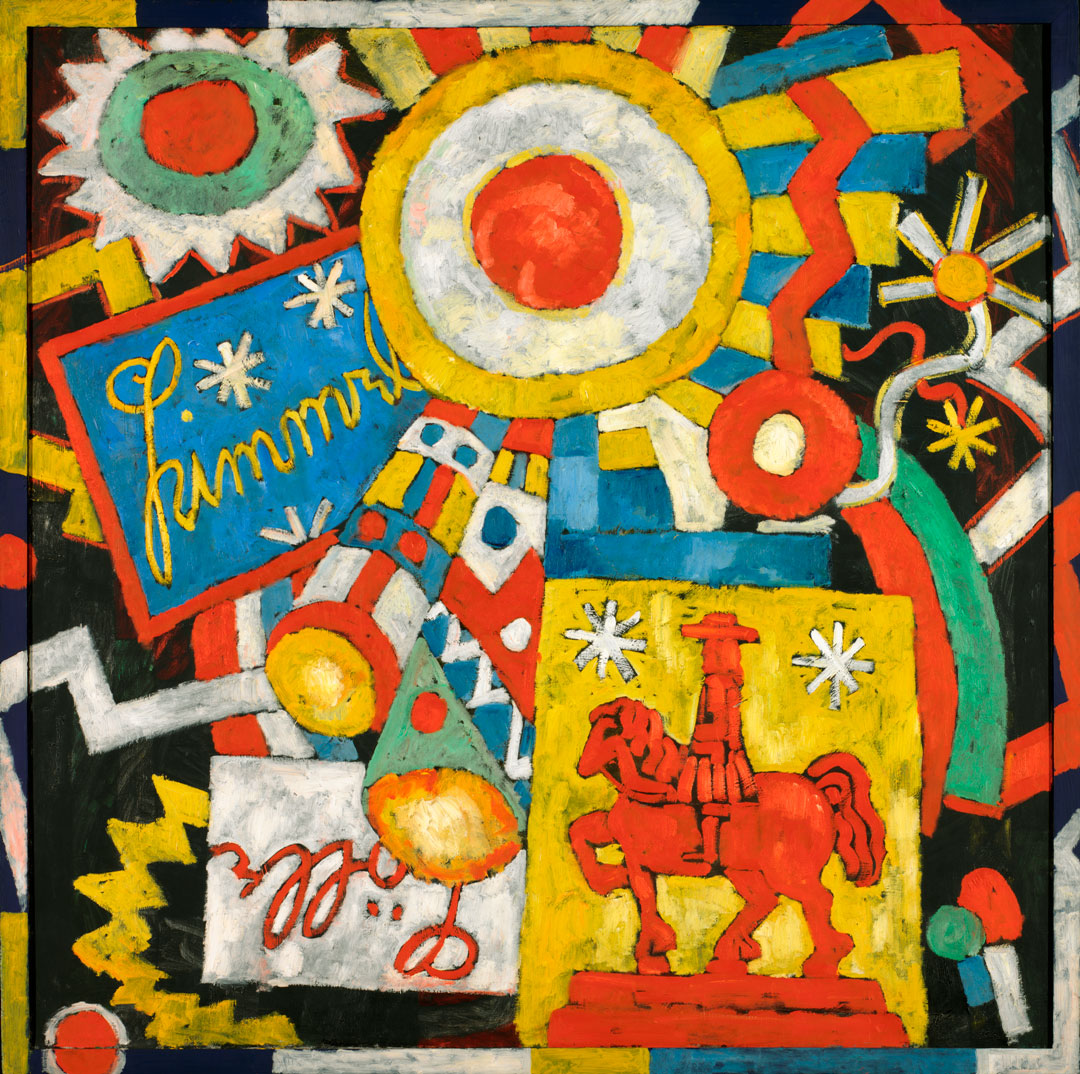
Marsden Hartley- Himmel 1915

++++++++++++++

I have come to the conclusion that it is better to have two colors in right relation to each other than to have a vast confusion of emotional exuberance. . . I had rather be intellectually right than emotionally exuberant.

–Marsden Hartley
++++++++++++++
I have been a fan of the paintings of Marsden Hartley (1877-1943) for some time now. I was reading about him earlier and came across this quote  that caught my attention, making me think about what I hoped to accomplish in my own work.
.
I often speak about creating work that has an immediate emotional impact achieved with colors and forms. But maybe, as Hartley’s words have prompted me to think, this first purely visceral and emotional impact is pure exuberance. Just a gut reaction that comes in that instant before the mind has time to engage.
.
A shout that makes you turn and look.
.
While that is good and desired, it’s doubtful that it can stand by itself and have a lasting effect unless it has an intellectual aspect to engage the viewer’s mind. There needs to be a balance between the mind and the gut.
.
If you turn at hearing a shout and the person doing the shouting is shouting just to make you turn and has nothing more to say to you, you keep moving and soon forget that person. But if you turn and the shouter has something more to offer, you might linger a bit to consider what is being said and engage in a conversation.
.
When you do move on, you take something from this engagement with you, something that will stay with you.
.
I am not sure this an apt analogy but it immediately came to mind on reading Hartley’s words. I don’t exactly know how this mind/gut balance works or how it can be accomplished in reality. Maybe even consciously trying to do so throws the whole thing off kilter.
.
It’s early in the morning and I am just thinking here. Time to go try to put it into action…

Marsden Hartley- Portrait of a German Officer 1914

Read Full Post »

This morning, I am taking the advice below from Ray Bradbury and simply doing things.I can tell you from my own experience that his words ring true. All too may times I have started a painting based on an idea, some novel concept that was I believed to be well thought out. Those paintings are usually the ones that die on the easel. The best work, the stuff that seems to have its life force, comes outside of thought. So, my thinking goes on a hiatus starting now. Here’s a replay of a post from several years back on the subject.
ray-bradbury-on-creativity-famous-quotes

I came across this quote from famed sci-fi writer Ray Bradbury on a post on the  TwistedSifter site that featured quotes on creativity. This struck close to the bone for me as I have proudly not thought for years now. I have long maintained that thinking usually inhibits my work, making it less fluid and rhythmic.

It’s a hard thing to get across because just in the process of doing anything there is a certain amount of thought required, with preliminary ideas and decisions to be made. I think that the lack of thought I am talking about, as I also believe Bradbury refers, is once the process of creating begins. At that point you have to try to free yourself of the conscious and let intuition and reaction take over, those qualities that operate on an instantaneous emotional level.

I can tell instantly when I have let my conscious push its way into my work and have over-thought the whole thing. There’s a clunkiness and dullness in every aspect of it. No flow. No rhythm. No brightness or lightness. Emotionally vacant and awkward. Bradbury’s  choice in using the term self-conscious is perfect because I have often been self-conscious in my life and that same uncomfortable awkwardness that comes in those instances translates well to what I see in this over-thought work.

So what’s the answer? How do you let go of thought, to be less self-conscious?

I think Bradbury hits the nail on the head– you must simply do things. This means trusting your subconscious to find a way through, to give the controls over to instinct.

And how do you do that? I can’t speak for others but for myself it’s a matter of staying in my routine. Painting every day even when it feels like a struggle. Loading a brush with paint and making a mark even when I have no idea at hand. Just doing things and not waiting for inspiration.

You don’t wait for inspiration– you create it.

So, stop thinking right  now and just start doing things.

Read Full Post »

I am really busy this morning but wanted to replay the post below from a few years back. I am currently at a point where I am just emerging from a period of great uncertainty and doubt, which had me questioning the path I had followed. But with each painting comes a bit more confidence, a bit more energy and a renewed sense of purpose. It makes me realize once more that the work itself is a sort of perpetual motion machine– it produces energy beyond that put into it.
The trick is in simply trusting the work and just doing it. Which is what I must do right now.

Paul Gauguin- Where Do We Come From? What Are We? Where Are We Going?What still concerns me the most is: am I on the right track, am I making progress, am I making mistakes in art?

Paul Gauguin

******************

At one of my gallery talks a year or two ago, I was asked about confidence in my work. I can’t remember the exact wording but the questioner seemed to imply that at a certain point in an artist’s evolution doubts fade away and one is absolutely certain and confident in their work.

I think I laughed a bit then tried to let them know that even though I stood up there and seemed confident in that moment, it was mere illusion, that I was often filled with raging doubts about my voice or direction or my ability. I wanted them to know that there were often periods when I lost all confidence in what I was doing, that there were days that turned into weeks where I bounced around in my studio, paralyzed with a giant knot in my gut because it seemed like everything I had done before was suddenly worthless and without content in my mind.

I don’t know that I explained myself well that day or if I can right now. There are moments (and days and weeks) of clarity where the doubts do ease up and I no longer pelt myself with questions that I can’t answer. Kind of like the painting at the top, Where Do We Come From? What Are We? Where Are We Going?, the masterpiece from Paul Gauguin. Those are tough questions to answer, especially for a person who has little religious belief.

And maybe that’s the answer. Maybe my work has always served as a type of surrogate belief system, expressing instinctual reactions to these great questions. I don’t really know and I doubt that I ever will. I only hope that the doubts take a break once in a while.

There was another quote I was considering using for this subject from critic Robert Hughes:

The greater the artist, the greater the doubt. Perfect confidence is given to the less talented as a consolation prize.

I liked that but it felt kind of self-serving, like saying that being aware aware of your own stupidity is actually a sign of your intelligence. I would really like to believe that all those times when I realized I was dumb as a stump were actually evidence of my brilliance. I think many of us can  claim that one.

Likewise, if Hughes is correct  then I may be one of the the greatest artists of all time.

And at the moment, I have my doubts…


Read Full Post »

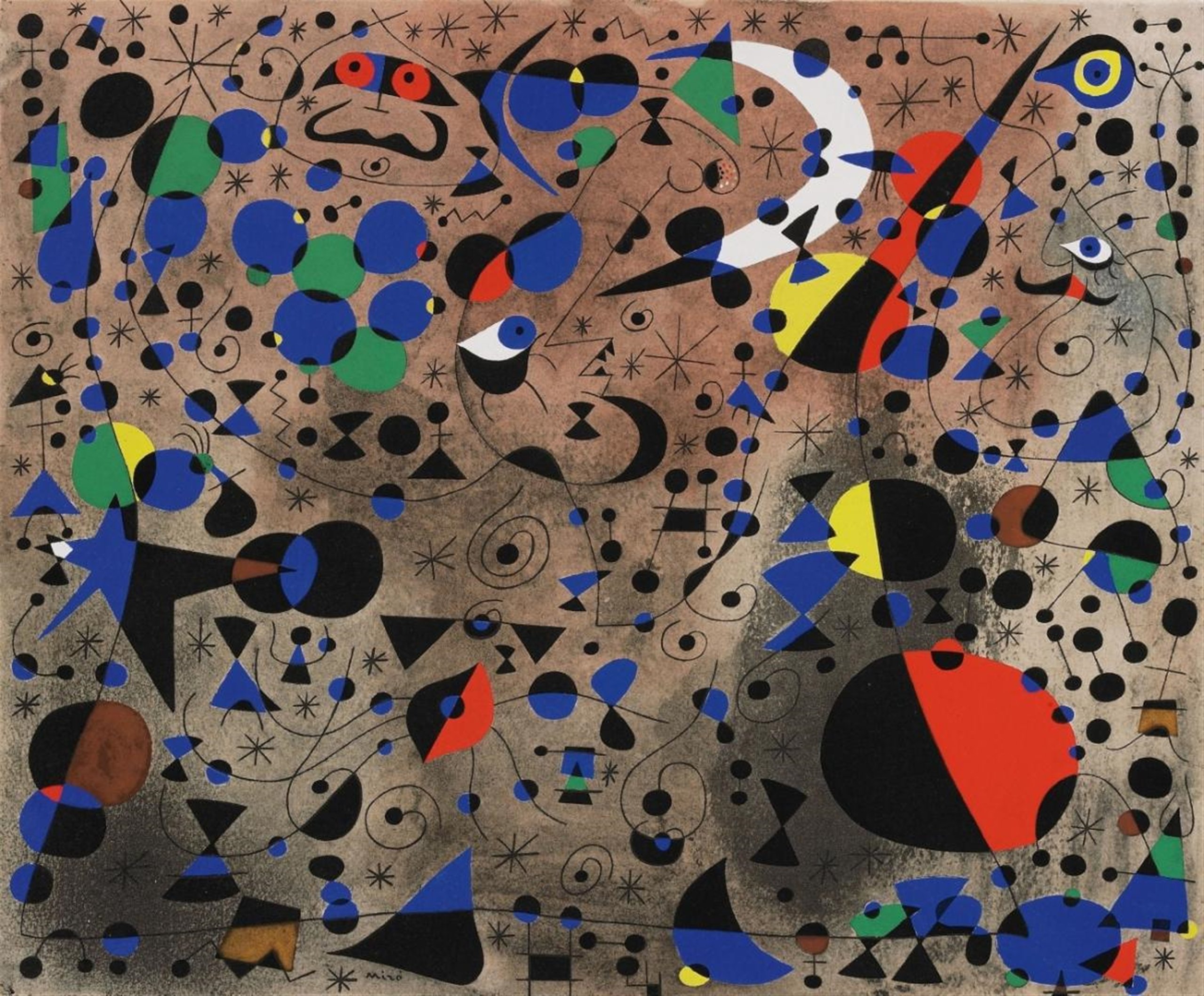
Joan Miro, Constellations 1959

———————-

The older I get and the more I master the medium, the more I return to my earliest experiences. I think that at the end of my life I will recover all the force of my childhood.

–Joan Miro, from 1960 at age 67 

———————–

It’s the young people who interest me, and not the old dodos. If I go on working, it’s for the year 2000, and for the people of tomorrow.

–Joan Miro, from 1975 at age 82

————————-

There are two quotes here from the great Spanish painter Joan Miro (1893-1983) that really strike a chord with me. Both come from him when he was older and both speak very much to the way I feel about my own work.

In the first he speaks about gaining more mastery over the medium through the years while simultaneously moving closer to the vibrant energy that one has in their youth. I have felt the same feelings. The more one gains control over their form of expression, the more they are freed from the constraints of conscious thoughts and decisions. The work becomes reactive to the feel and emotion of the moment.

Now, I will add that with this acquired mastery there is also a new barrier erected to overcome. Well, at least, in my experience. I have found that with years of work, which is, in effect, rehearsal and practice, there is sometimes a loss of spontaneity and passion in the actual making of the marks. They become a little too precise, a little too mannered and a bit too clean and neat. They don’t have that feeling of wanting to burst off the surface. I have found ways to get past this–using bigger brushes and making strokes quicker with more urgency, for example– but every so often I will get near the end of a piece and it just feels too neat, too precise, for the underlying emotion.

It needs the innate exuberance of a child at play.

The second Miro quote, made when he was 82, speaks of painting not for those of his age but for the younger and the future generations. I certainly understand this sentiment. I am most thrilled when children react to my work, knowing then that it is speaking to the aforementioned innate exuberance.

It means I am not dealing with intellect or acquired knowledge or conscious thought. It is a pure and uninformed reaction. It means the work is communicating emotionally across and out of time.

And I think this is important because I believe most artists wants to break free from their own era, to not be consigned to any single period of time. To be known for what they were at their inner and eternal core, not where or how they were categorized in their time.

Maybe like the Miro painting at the top, a single small voice among the multitude of stars and constellations in the universe.

I don’t know but that might be my primary goal in doing what I do.

Read Full Post »

It was not hard to see the contrast yesterday between the attitude of the oceans of youth that swarmed cities around this country during the March For Our Lives and that of the nation’s current governing party.

These kids are amazing. Stunning, really. They are smart, focused and savvy in the ways of media that goes well beyond their years. They have boldness and strength, a clear-eyed vision of rightness and a true sense of serving the greater good. There is a guileless purity to them that is refreshing and clarifying.

Now contrast that to the politicians who stand opposed to their agenda. The words that spring to my mind are words like cowardly and greedy and self-serving and evasive and deceptive and amoral. Corrupt in every sense of the word. Their craven attitude is bringing this country to the brink of a disaster, enabling a transformation of our democracy that may be difficult, if not impossible, to reverse.

As Andrew Sullivan deduces in his review this week of the book Can It Happen Here: Authoritarianism in America, it may already have happened and we just haven’t recognized it yet.

It’s hard for me to not think that we at this moment in history are standing on the middle of the yin yang symbol above and we could go either way, into light or into darkness. We need to decide right now whether we want concede our future to those who think nothing of selling that future to the highest bidder and lying to us about doing so.

If the great numbers of people somehow are offended by these kids’ call to action, if they prefer to stand behind the craven cowards in congress and in the white house — neither deserve capital letters in my opinion–then I fear we have already moved into the darkness.

But for today, in the wake of yesterday’s demonstration, I see a little light. I have always been disappointed by the youth vote in this country but I have hope that these kids can take the lead to make it the force it should be. If they can unite behind a few issues they have the numbers and power to change this country. The future is their’s if they choose to take it.

I hope yesterday was the beginning of that recognition in this new generation, as well as in the older generations, like mine, who have been asleep at the switch for much too long.

Okay, for this week’s Sunday morning music I am going back to another turbulent point in our history, the 1960’s and anti-war movement in the wake of the assassinations of MLK and RFK. Here’s some Canned Heat from Woodstock in 1969 doing A Change Is Gonna Come.

Have a good day. But think about which way you want things to go and do something to push it that way. Take a page from these kids– get off your butts and make the world the way you want it.

Read Full Post »

Read Full Post »

Edward Hopper- Pennsylvania Coal Town

***********************

I believe that the great painters, with their intellect as master, have attempted to force the unwilling medium of paint and canvas into a record of their emotions. I find any digression from this large aim leads me to boredom.

Edward Hopper

***********************

Emotion is that intangible quality that separates art from craft. Emotion does not have to be at the extremes of rage or depression or giddy elation. It is often subtle and calm or densely introspective. Hopper’s work was imbued with quiet emotional undertones that make his paintings, even those scenes of the most seemingly mundane moments, truly memorable.

Art is, at its foundation, emotion.


Read Full Post »

Art is a lie that makes us realize the truth.

Pablo Picasso

****************

Many of my favorite artists worked and produced their greatest works in times where the world was under great stress. World wars and– in the case of Picasso’s painting, Guernica, shown above– Civil Wars. The Great Depression. Times of social transformation. Even when the work didn’t overtly deal with the events of the day, much of the work reflected on the collective consciousness of that time.

I think that is so because art is, just as Picasso so succinctly states, a lie that makes us realize the truth.

Artists fabricate, often creating work that is on its surface pure fantasy with little relation to the world as others might observe it. But their fabrication is made up from everything that impacts them– their knowledge, their observations, their opinions and emotions. Artists take in the world and create something that seems like a pure fabrication.

A lie.

But what seems the lie often proves to be built of ultimate truths, just constructed in a manner that allows others to see this truth clearly.

I don’t know that we artists always succeed. I certainly don’t feel that I do as often as I would  like. But so long as we feel deeply and create our lies, we will at some point reveal a truth.

Got to get to work now…


Read Full Post »

It’s a busy morning with much to do so I am running the post below from several years ago that deals with the indifference that so many of us exhibit about so many things. If something doesn’t impact us directly, we tend to shrug our shoulders and say “Oh, well.” The passive acceptance of this sort of  indifference has been the great enabler of many of  history’s darkest eras. We live in a time where we cannot afford to be indifferent or we will again find ourselves in another dark place sometime soon. The anecdote I share below is no doubt trivial in the greater scheme of things but indifference is an insidious thing at any level.

A little  indifference can lead to greater sorrow…

GC Myers Memory of Night sm

“The opposite of love is not hate, it’s indifference. The opposite of art is not ugliness, it’s indifference. The opposite of faith is not heresy, it’s indifference. And the opposite of life is not death, it’s indifference.”

-Elie Wiesel

*************

I’ve been sitting here for quite some time now, staring at the quote above from Elie Wiesel. I had planned on writing about how my work evolved as a response to the indifference of others but now, looking at those words and putting them into the context of  Wiesel’s experience, I feel a bit foolish. Wiesel, who had survived the Holocaust and crusaded so that it might never happen again, was eyewitness to indifference on a grand scale, from those who were complicit or those who did not raise their voices in protest even though they knew what was happening to the personal indifference shown by his Nazi guards, as they turned a blind eye to the suffering and inhumanity directly before them on a daily basis, treating their innocent captives as though they were nothing at all.

The indifference of which he speaks is that which looks past you without any regard for your humanity. Or your mere existence, for that matter. It is this failure to engage, this failure to allow our empathy to take hold and guide us, that grants permission for the great suffering that takes place throughout our world.

So you can see where writing about showing a picture as a symbolic battle against indifference might seem a bit trivial. It certainly does to me. But I do see in it a microcosm of the wider implications. We all want our humanity, our existence, recognized and for me this was a small way of  raising my voice to be heard.

When I first started showing my work I was coming off of a period where I was at my lowest point for quite some time. I felt absolutely voiceless and barely visible in the world, dispossessed in many ways. In art I found a way to finally express an inner voice, my real humanity, that others could see and feel a reaction. So when my first opportunity to display my work came, at the West End Gallery in 1995, I went to the show with great trepidation.

For some, it was just a show of  some nice paintings by some nice folks. For me, it was a test of my existence.

It was interesting as I stood off to the side, watching as people walked about the space. It was elating when someone stopped and looked at my small pieces. But that feeling of momentary glee was overwhelmed by the indifference shown by those who walked by with hardly a glance. That crushed me. I would have rather they had stopped and spit at my work on the wall than merely walk by dismissively. That, at least, would have made me feel heard.

Don’t get me wrong here– some people walking by a painting that doesn’t move them with barely a glance are not Nazis. I held no ill will toward them, even at that moment. I knew that I was the one who had placed so much importance on this moment, not them. They had no idea that they were playing part to an existential crisis.  Now, I am even a bit grateful for their indifference that night because it made me vow that I would paint bolder, that I would make my voice be heard. Without that indifference I might have settled and not continued forward on my path.

But in this case, I knew that it was up to me to overcome their indifference.

Again, please excuse my use of Mr. Wiesel’s quote here. My little anecdote has little to do with the experience of those who suffered at the hands of evil people who were enabled by the indifference of those who might have stopped them. The point is that we all want to be heard, to be recognized on the most basic level for our own existence, our own individual selves. But too often, we all show indifference that takes that away from others, including those that we love. We all need to listen and hear, to look and see, to express our empathy with those we encounter.

We need to care.

Maybe in that small ways the greater effects of indifference of which Elie Wiesel spoke can be somehow avoided.

We can hope.

The painting at the top is a new piece [at the time this was written] that I call Memory of Night, inspired by Wiesel’s book, Night.

Read Full Post »

« Newer Posts - Older Posts »