Feeds:
Posts
Comments

Archive for the ‘Motivation’ Category

Paul Gauguin- The Painter of Sunflowers 1888

*************************

What still concerns me the most is: am I on the right track, am I making progress, am I making mistakes in art?

-Paul Gauguin

*************************

I am in the last day of prep before I deliver my show to the West End Gallery. I am in my 25th year at this gallery where I first started publicly showing my work and this is what I believe to be my 18th solo exhibit. But even with all that experience there is always an element of doubt present when I am getting ready to deliver paintings to a gallery.

It’s just a natural state of being. At least, for me.

I used to worry that my own judgement of the work was flawed and that this would be obvious once it was hung on a wall outside my studio. My inadequacy would be on public display for all to see.

That feeling never fully goes away and on these last days of prep, this insidious doubt always creeps back in.

But time has made me adhere to the words above from Paul Gauguin, under his 1888 painting of Vincent Van Gogh.

You do what you can do. You try to do a bit better each time. You discard those things that don’t work and grow the things that do.

And you live with that.

Okay, got lots to do this morning so I am out of here. And I think I am leaving my doubts right where they are. Don’t need them today.

Read Full Post »

**********************

“A man must dream a long time in order to act with grandeur, and dreaming is nursed in darkness.”

― Jean Genet

**********************

I came across this quote and it made me stop. When he said that dreaming is nursed in darkness, was Genet saying that we must sleep more in order to be able to dream more? That didn’t sound right to me.

More likely he saying that we must stumble through much darkness, not sure of where we are or where we are headed, in order to achieve our dreams. Maybe it is this time spent maneuvering in darkness that gives us the courage to act on our dreams.

That makes more sense. Following that dream for a long time, never seeing it fully in the darkness, makes that elusive dream more precious and gives one a sense of urgency in achieving it. When the possibility of the dream coming to fruition is finally upon them they are not afraid to take action. They can then act with grandeur, as Genet put it.

That sounds better but what do I know? It’s 6 AM, I am tired to the point I can feel the dark rings under my eyes, and I am thinking about Jean Genet and dreams. Even the tiniest act of grandeur doesn’t seem too probable at this point.

But I think I understand this struggle to follow our dreams, to become what we truly want to be. It’s easy to lose sight of our dreams when we are stumbling in the inky darkness. Once they move away from us, they often are lost forever.

That’s sort of what I am sensing in the new piece above that is included in my upcoming West End Gallery show. It’s a smaller painting, 6″ by 10″ on paper, that I am calling Dream in Sight. It’s one of the pieces from this show that are a nod back to my earlier work. Perhaps the moon represents the dream here, rising and falling through the darkness. Sometimes it doesn’t show at all. Other times, it only shows a smaller part of itself.

And it always seems so distant yet so near.

Hmm, I have to think on this. Or take a nap and dream a bit more.

Have a great day.


Read Full Post »

Got way too much stuff to get at it this morning to write. But I thought I’d share a post from back in 2010 that I like a lot. Take a look.

Southern Gardens- Paul Klee

I was asked yesterday if I talked to my paintings.

Interesting question.

I talk to animals. I talk to trees and plants. I talk to my car. I talk to my studio, which actually has a name. I talk to ghosts, present or not. Whether any of these things or beings listens is another matter.

But talk to my paintings?

It immediately brought to mind a section of a famous lecture that I had been reading recently and had really resonated with me. It was On Modern Art,  delivered in the 1920’s by Swiss artist and a personal favorite of mine Paul Klee:

May I use a simile, the simile of the tree? The artist has studied this world of variety and has, we may suppose, unobtrusively found his way in it. His sense of direction has brought order into the passing stream of image and experience. This sense of direction in nature and life, this branching and spreading array, I shall compare with the root of the tree.

From the root the sap flows to the artist, flows through him, flows to his eye. Thus he stands as the trunk of the tree. Battered and stirred by the strength of the flow, he guides the vision on into his work. As, in full view of the world, the crown of the tree unfolds and spreads in time and space, so with his work.

Nobody would affirm that the tree grows its crown in the image of its root. Between above and below can be no mirrored reflection. It is obvious that different functions expanding in different elements must produce divergences. But it is just the artist who at times is denied those departures from nature which his art demands. He has even been charged with incompetence and deliberate distortion.

And yet, standing at his appointed place, the trunk of the tree, he does nothing other than gather and pass on what comes to him from the depths. He neither serves nor rules–he transmits. His position is humble. And the beauty at the crown is not his own. He is merely a channel.

This very much sums up how I’ve always felt about art, especially my place as an artist– a mere channel or transmitter.  And when I look at my paintings, the crown of my tree, it is not in the form of a conversation so much as listening to what the paintings have to tell me. I paint because I question and, at best, the paintings provide some answers and insight that I might not find or see otherwise.

So, do I talk to my paintings? Not so much. But do they talk to me? Yes. And I do my best to listen…

.

Read Full Post »

*****************************

There are very few human beings who receive the truth, complete and staggering, by instant illumination. Most of them acquire it fragment by fragment, on a small scale, by successive developments, cellularly, like a laborious mosaic.

-Anais Nin, Journals of Anais Nin, Vol 3

*****************************

I see in the new painting above, Illumination, a moment when all the fragments of that mosaic, as mentioned in the words of Anais Nin, come together. That moment when we are no longer seeing only individuals pieces of the mosaic, those bits and pieces of acquired information and observations we gather over a lifetime. That moment when we suddenly see those gathered bits as a complete image of a greater truth in all its wholeness.

That moment which reveals the why of the universe after a lifetime of showing us only the whats.

Does such a moment ever come to us, do we ever receive true illumination?

I certainly don’t have that answer.

I am still in the process of gathering bits of the mosaic as I see it. Some days, the various pieces I’ve put together seem to show a glimpse of a pattern of the image of a greater whole. Those are inspiring and hopeful days.

But often, I can’t find that same pattern on the next day. Those days have less hope and have me questioning whether all these mosaic pieces ever come together to create a fuller image. Is there a purpose to this all?

Again, I can’t say. But I’ve got too many mosaic pieces before me now to not want to keep moving forward. Too many to not keep trying to assemble them in the hopes of receiving some sort of illumination that gives me the peace that comes with understanding.

And that may be the purpose of art– gathered bits of a mosaic that allows us to see a greater whole and gain some vestige of understanding.

Hmmm. Sounds good right now. Ask me in 15 minutes and I may see it in a different light. But for this moment, I feel hopeful in simply looking at this painting.

[The title of this painting was later changed to Solitude’s Rapture]

Read Full Post »

********************************

“You study, you learn, but you guard the original naïveté. It has to be within you, as desire for drink is within the drunkard or love is within the lover.”

Henri Matisse

*******************************

I can always turn to Henri Matisse for something interesting, either in his work or in his words. While he was prolific in his painting there is also a wealth of quotes, interviews and essays from him that give insight into a warmly wise and giving spirit. I will admit that there are painters whose body of work more readily excite me but the words of Matisse never fail to provide inspiration and reassurance when I am seeking some form of validation of what I am doing.

For instance, he speaks of maintaining one’s own original naïveté as one learns and grows as an artist. That rawness and the natural sense of excitement that comes with it, is something I have also felt was important to maintain even as my craft has grown. I see the raw energy of naïveté as the blood that gives a painting its life force, that allows the viewer to see past the improbabilities and imperfections and see the beauty and truth being presented.

Maintaining that naïveté is much more difficult than you might think. You sometimes have to fight against the proficiency gained through years of practice and trade the reality of the world shared with everyone else for the reality contained within yourself, trusting that this inner world, imperfect as it is, will have a commonality that might speak to similar inner worlds among some of those who view it.

And that  brings us to another favorite Matisse quote, below. The link to the universe he mentions is very much the same thing that links one’s inner world to that of another. At least that’s how I see it. This seems like a good spot to end this. Have a great day

***************************

“We ought to view ourselves with the same curiosity and openness with which we study a tree, the sky or a thought, because we too are linked to the entire universe.”

― Henri Matisse

***************************

Read Full Post »

***********************************

A little busy this morning but never too busy to stop for a brief moment to consider an image or a few words from Andrew Wyeth. The words and image above are a good example. I just love this quote. It’s an idea–that a piece of art should not be judged on its craftsmanship but on how well it conveys emotion and beauty– that has always rang true for me.

Craftsmanship should not be seen as the goal but rather as a means, the handmaiden as Wyeth terms it, to get there.

Got to get to work now. Have a great day!

Read Full Post »

************************

Men, it has been well said, think in herds; it will be seen that they go mad in herds, while they only recover their senses slowly, one by one.

Charles MacKay,

Extraordinary Popular Delusions and the Madness of Crowds

**************************

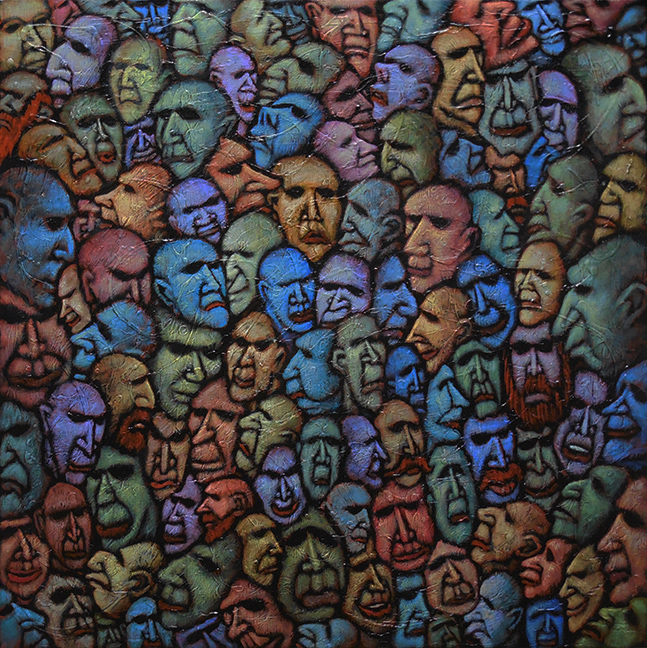
I am still in the midst of a frenzy of faces.

I call this group of work, like the newer painting above, a 20″ by 20″ canvas, Masks or Multitudes. This particular piece is still untitled although I am seeing it as The Crowd for the moment.

Still not sure what the meaning is behind these pieces.

Maybe there is no meaning. Maybe they are just familiar shapes and it is a matter of color and form that is attracting me.

Maybe attracting is the wrong word because it is not really attraction that has me painting them. A better word might be compelling. I feel compelled to paint these at this time.

Why is another thing altogether.

On one hand, I see it in the terms of Walt Whitman‘s voice in Song of Myself, as I wrote here recently– I am large, I contain multitudes. In this rationale, the faces are part of me, individual pieces of a whole. It makes sense as I have been seeing these faces all my life. They seem part of me.

Maybe that is what these paintings are.

But then sometimes I see something different in them and think that they are quite something else. Something less benign. Something more strange.

Strange because I have become more and more averse to crowds, especially the collective behavior of crowds. While I try to subscribe to Will Rogers‘ mantra of I never met a man I didn’t like, I find myself leery of crowds. I would change Roger’s line a bit, to something more like I never met a crowd I liked with one caveat–I only feel somewhat comfortable with crowds at my gallery talks or openings. I don’t fear and sort of understand the common denominator of those groups.

But mob thought in general worries and alarms me. It seems too easy for one to be swept up in the frenzy of a mob, to sacrifice aspects of yourself for a collective aspect that might not normally be seen in you when you as an individual.

That might even apply to the overall intelligence of a crowd. You would think the level of intelligence would rise with the inclusion of more minds but actually it seems to lower to compensate for the common denominator. As the late writer Terry Pratchett put it:  The intelligence of that creature known as a crowd is the square root of the number of people in it.

As a result the crowd is subject to manipulation, to being led astray from what the individual knows is right when they really consider it in solitude. It becomes easy to believe things that might otherwise seem ridiculous or outrageous.

We have plenty of examples of that in our current state of affairs here in the USA.

Sometimes I see this work in that way, as representing the mob. But then again when  look deeper and see the faces individually, they seem less threatening and more along the lines of Whitman’s thought.

I just don’t know. That they compel me might be all I can say with any certainty. I find myself being both uneasy and comforted by this work. And there’s something to be said for that paradox and contrast. They are important aspects of art, the part that imparts meaning.

Hope that is what I am looking at.

Read Full Post »

*****************************

“Masks beneath masks until suddenly the bare bloodless skull.” 
 Salman RushdieThe Satanic Verses

*****************************

This was a small piece that was began yesterday. I had finished a new painting that very much pleased me but left me feeling that it was not a jumping off point to immediately begin another piece in that same vein. In short, it left me feeling a bit blocked.

So, this piece, a 12″ square canvas, was started as a palate cleanser, something where I could just makes marks and shapes and color to fill some space, hoping that it somehow sparked something. This was basically how the Archaeology series began back in 2008. At the time, I was stumped and felt that I was at the end of my creative surge. I began working from a method taught by my 5th grade art teacher where we would simply take large blank sheets of paper and, using pen and ink, fill them in anyway we could. It’s something that I often turn to when I am feeling uninspired and it often bears interesting results.

Here, it started with a face, quickly slashed in with loose strokes, just trying to make a form with as little fuss or detail as possible. Then came another and another and so on. Each inspired the next. They went down in my normal red oxide at first then I went back at each face with quick, rough strokes of other colors, letting the tones and shapes play off one another. It was meant to be coarse in its execution, done fast and without much conscious thought, giving it a bit more expressionistic feel.

What they are, I don’t know. I wasn’t trying to represent anyone I knew or had seen. Just the general faces that have often popped out in my drawing over the years. But many of them have been with me for many years now. Some of them appeared when I was a small child and would try to find them in wallpaper patterns or in the edges of curtains. Everything could be made into a face, so it seemed.

And some I see as being from images culled from medieval texts, even down to the way the lips are modeled. Not done purposely, but they appear that way to me.

But most I recognize here  have been with me since my childhood, some that are friendly and some that deeply bother me, leaving me with an uneasy feeling as though I recognize them from past unpleasant personal experience.

Maybe from this life or some other earlier incarnation, if there are such things. Maybe it’s just a matter of facial and image recognition present in us all that pulls from sort of collective consciousness, that makes us respond to certain shapes and forms. Like I said, I don’t know.

Or maybe it’s just a psychological biopsy of the facets of a personality. Again, I don’t know.

But as a palate cleanser, it has served its purpose. It has amped me up a bit and I could see this small piece growing into larger painting, say 4 or 5 foot square. I could see that having a great impact on the wall, even if it’s only the wall here in the studio. But I don’t know if it will go anywhere beyond this.

Don’t even know if I will completely finish this particular or if I should even try to put eyes in the dark holes where they should be in these faces. I like the feeling that the dark pits give the piece. It gives the faces the appearance of being masks.

And maybe that is what our faces really are- masks.

As always, I don’t know if that’s true. But I do now that if this piece transforms into a larger series I will call it the Masks.

We shall see.


Read Full Post »

***************************

The best reason to paint is that there is no reason to paint… I’d like to pretend that I’ve never seen anything, never read anything, never heard anything… and then make something… Every time I make something, I think about the people who are going to see it and every time I see something, I think about the person who made it… Nothing is important… so everything is important.

Keith Haring

***************************

I can’t say that I was ever a huge Keith Haring fan. Maybe it was because his Graffiti-based Pop Art imagery seemed to be everywhere all of the time  through most of the 80’s and 90’s. It seemed like you couldn’t turn around without seeing his images. But I have to admit that I have come to have an appreciation of his work, especially the prodigious output he produced in his short life. He died at the age of 31 and created a pretty amazing body of work in the limited time he spent on this planet. Even if you don’t recognize the name, you most likely have seen and recognized his imagery at some point.

Part of my newfound appreciation comes from the fact that I am able to look at his work now and find things in it that I may be able to transfer in some way to my own work. Take for instance, the rhythms of some of his black and white pieces shown below. I see something in them that speaks to me and might work in my voice, as well.

I also like the attitude he took with the quote at the top. The idea that the importance of art comes from the fact that we see something in it that makes it important to us is a striking and sometimes abstract concept. It’s one that has struck me at times in the studio when I am suddenly hit by the absurdity of the idea that I am standing there smearing paint of a piece of board. In that moment I can’t think of a reason why I should be doing this thing.

And maybe it is that absurdity that makes it worthwhile. Perhaps to continue to do something that seems so unimportant in the grand scheme of things creates its own importance.

A sort of testimony to both the futility and significance of our existence.

And maybe that is art’s true purpose, to let us feel both humble and expansive.

Something to think about while I am wondering what the hell I am doing here in the studio today.

*******************


Read Full Post »

Was looking through some images of work from around 2006 and 2007 and came across this painting, The Middle Way. It really jumped out at me so thought I’d share it along with a blogpost from back in 2009 about a Henry Miller essay. The painting and the essay seem to fit together well.

*****************

 ***************************

    From the very beginning almost I was deeply aware that there is no goal. I never hope to embrace the whole, but merely to give in each separate fragment, each work, the feeling of the whole as I go on, because I am digging deeper and deeper into life, digging deeper and deeper into past and future. With the endless burrowing a certitude develops which is greater than faith or belief. I become more and more indifferent to my fate, as a writer, and more and more certain of my destiny as man.

      – Henry Miller, Reflections on Writing

****************************

This is a fragment of an essay, Reflections on Writing, from a book of essays, The Wisdom of the Heart, by Henry Miller, the great and controversial author. When I was young his books such as Tropic of Cancer and Tropic of Capricorn were still being characterized as “smut” and many libraries didn’t have them on their shelves for fear the morality police would swoop in and raise a fuss. Probably many only know the existence and influence of his books from their use in a memorable Seinfeld episode, the one with Bookman the library cop whose hard-boiled dialogue still makes me hoot.

For me, I wasn’t so much attracted to his books by the raciness of the stories but rather by his way of speaking through his words and expressing views that I found at once to be compatible with my own. He observed and said the things that I  wished I could say with a voice and power I wished I possessed. I can pick up one of his books and open to a page anywhere in the book and read and be fascinated without knowing the context of what I’m reading, just from the sheer strength of his writing’s voice.

I see a lot of things in this particular essay that translate as well for painting or any other form of creation. It opens:

Writing, like life itself, is a voyage of discovery. The adventure is a metaphysical one: it is a way of approaching life indirectly, of acquiring a total rather than a partial view of the universe. The writer lives between the upper and lower worlds: he takes the path in order to eventually become that path himself.

Substituting artist for writer, I was immediately pulled in. The path he refers to is the path I often refer to in my paintings, the path we all walk and struggle along on, trying to find the middle way between these upper and lower worlds.

It’s a good essay and one I recommend for anyone who creates in any form and struggles with the meaning of their work beyond its surface. For anyone seeking that path…

_________________________________________________________

Read Full Post »

« Newer Posts - Older Posts »