Feeds:
Posts
Comments

Archive for the ‘Motivation’ Category

**************************

In these gaudy times, we think we will shortly reach the point where everything is known, but the fact is we are ignoring the essential, which is love of all living things, of all beauty both visible and hidden.

–Georges Rouault (France, 1871- 1958)

**************************

Looking at the work of Georges Rouault, I am as excited by it now as when I first encountered it many years ago. It is fearlessly painted and brimming with the fervor with which he imbued all his work. It makes me want to do better, makes me want to make marks that are absolute expressions and proof of my being in this world.

Inspiring stuff, indeed.

Read Full Post »

The American poet Mary Oliver died yesterday at the age of 83. I can’t claim to know much about poetry but I always found her work engaging and enlightening. There was a plain-spoken quality to her work that gave her musings the feel and clarity of newfound wisdom. She is gone but her voice will carry on. Here’s a post from a couple of years ago that was about the relationship of a painting of mine to one of her better known poems, Wild Geese.

**********************

GC Myers- The Singular HeartYou do not have to be good.
You do not have to walk on your knees
For a hundred miles through the desert, repenting.
You only have to let the soft animal of your body
love what it loves.
Tell me about your despair, yours, and I will tell you mine.
Meanwhile the world goes on.
Meanwhile the sun and the clear pebbles of the rain
are moving across the landscapes,
over the prairies and the deep trees,
the mountains and the rivers.
Meanwhile the wild geese, high in the clean blue air,
are heading home again.
Whoever you are, no matter how lonely,
the world offers itself to your imagination,
calls to you like the wild geese, harsh and exciting —
over and over announcing your place
in the family of things.

Mary Oliver

****************

A while back, a person interested in my work sent me the poem above, Wild Geese.  It was written by the esteemed Pulitzer Prize winning poet Mary Oliver. This person wanted to know if I would be interested in translating this poem into into one of my paintings for them. I replied that when I had some time I would gladly do that as I think the poem strikes a chord that very much resonates in my work.

After a short while, this person contacted me again and said they had been looking at my work and had found a painting that they felt captured the spirit of the poem. The painting is the one shown at the top, The Singular Heart.

I was thrilled by the choice. It had the feeling and message of the poem without being absolutely literal.  It’s exactly how I wanted to portray it. And the message and title of the painting fell perfectly in line with Oliver’s poem.  The Red Tree stands, singular and alone, with the realization that it has a unique place, as does every being, in the family of things.

I told this person a bit about this painting and an experience I had with it that stuck with me.  Once it hung in my home area gallery, the West End Gallery, and I met with a local college art class there. One of the questions was which of the pieces there was my favorite. I normally don’t answer that question because I have always felt that any painting that I decide to show has something unique to it, some quality that makes it special to me. Kind of like a parent with their kids.

But on this occasion I didn’t hesitate and pointed at this painting.  I told them if I were to try to describe in one painting what I wanted to say with the body of my work and what I hoped for myself as a person, that this piece would summarize it perfectly.

I told this person that I felt it was perfect choice and was pleased when they chose this painting to represent the poem in their home. It means a lot when any painting finds a home but is even more special when I know that it resonates on many levels with its owner, that it goes deeper than the surface.

Here’s a clip of Mary Oliver reading her poem, Wild Geese:

Read Full Post »

Came across this post from six years back this morning and it made me stop. Reading it again, I realized it was what I was looking for this morning– a reminder of the why, the motivation behind what I am trying to do here in the studio. Thought it was a worth running here again.

*************************

All day I think about it, then at night I say it.
Where did I come from, and what am I supposed to be doing?
I have no idea.
My soul is from elsewhere, I’m sure of that,
And I intend to end up there.

— Rumi, 13th century Persian poet

************************

The other day, while going over some very early posts from this blog, I came across this short poem from Rumi.  It had been passed on to me by my friend Scott Allen from the Cleveland area after my 2008 show at the Kada Gallery. He told me that it was what he himself had felt in my work. The poem had, I’m sorry to confess, slipped my mind over the years and coming across it again immediately rekindled my  original reaction to it. Then and now, I felt as though this little wisp of a poem captured the motivation behind what I was trying to do in my work.

Like Rumi’s voice in this poem, I have spent most of my life in an existential quandary, filled with doubts about who I am and what I should be doing. I often felt like a stranger in a strange land, ill at ease in my surroundings and feeling, like Rumi, that my soul is from elsewhere. Initially, I felt as though my uncertainties and doubts could be allayed externally. I was simply not in the right physical location. But it was apparent after a time that it was not an external problem. Regardless of the location, I would not be at ease on the outside until I sought and found where I needed to be internally.

That’s where the act of painting came in and to fill this void in my life. If life were an ocean, painting gave me a hope, an endpoint for which to navigate. Without it, I would still be rudderless in an ocean of doubt. With it and through it, I feel that my soul is headed in the right direction.

I don’t know exactly why I feel the need to share this intimacy with you this morning. Perhaps that openness is part of the journey or even the destination. But for me, seeing this poem again reconnected me to the journey at a point when it felt as though I was going slightly off course. Sometimes in the process of seeking one forgets why they set out on the journey in the beginning. And that why, that motivation, sometimes needs to be revisited during the journey. It gives the destination definition and immediately puts you back on course.

This morning, I feel like I am sailing on smooth seas again, knowing why I am going forward.

*****************

Read Full Post »

A Way to Work

I have been saddled with a chest cold for several days that is severely limiting my activities and making work feel like a real chore. In need of a little pick-me-up I came across this very early post from back in 2008 that is a good reminder of what I consider my work ethic. Reminds me that I need to dig a little deeper on days like this. See what you think:

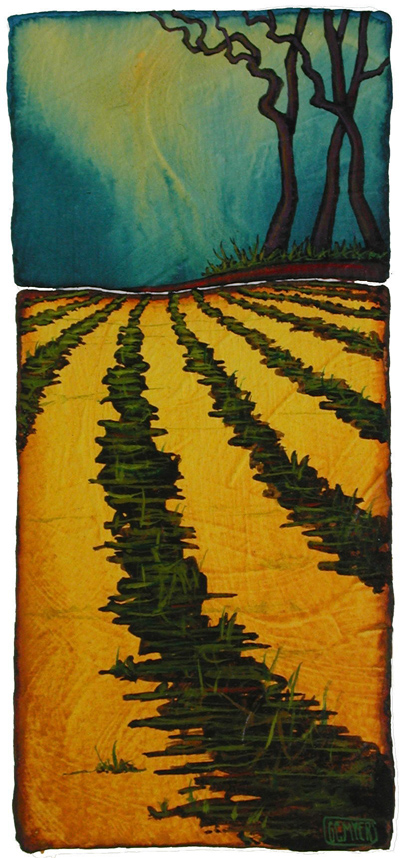
997-341-labor-to-light-4001This is a piece called “Labor to Light”, a smaller piece that is at the West End Gallery in Corning. It features one of what I call my icons, the field rows running back to the horizon. To me, they represent the act of labor and the results derived from it.  The ability to work hard has been very important to me in this career and something I stress to kids whenever I get to talk to them.

I remember years ago reading an interview with author John Irving (of “The World According to Garp” and “The Cider House Rules” fame) where he talked about his work routine. He talks quite a bit about wrestling in his writing as he was a high school and college grappler and he used a wrestling analogy to describe how he approached his writing.

He said that if he aspired to compete and win at the highest level as a wrestler, which would be an Olympic or world  champion, he would have to train harder and longer than the men he would be competing against. If a wrestler in Bulgaria or anywhere else in the world was training 7 hours a day, he would need train at least that much and maybe more. He knew he would be basically competing against every wrestler in the world.

He then turned this mindset to writing.

His writing became a competitive effort of Olympic proportion, where he saw himself as competing with every other writer in the world for each reader that came into a bookstore. If you were buying someone else’s book, you weren’t buying his and in his mind, he had lost. So he began to train himself as a writer with the same effort as though he were an Olympic athlete, writing 7-8 hours per day, forcing himself to forge ahead even on days when it would be easy to just blow it off and do anything else.

When I read this it struck a chord. I realized that in order to reach my highest level I would have to be willing to devote myself to working harder and longer than other artists and be willing to spend more time alone, away from distraction. It would require sacrifice and hard, focused labor. But Irving’s example gave me a path to follow, a starting point.

I have since realized that there is a multitude of talented people out there, many with abilities and knowledge far beyond mine. But art is often more than sheer ability. It is the communication of an idea, a feeling, to others. And to do this successfully with your art you need to push that ability fully, in order to go beyond what your mind sees as an endpoint. I see this as my goal everyday in the studio. Sometimes I succeed and sometimes I come up short but I’m out there competing everyday.

Thanks, John Irving

Read Full Post »

***************************

Discipline in art is a fundamental struggle to understand oneself, as much as to understand what one is drawing.

–Henry Moore

***************************

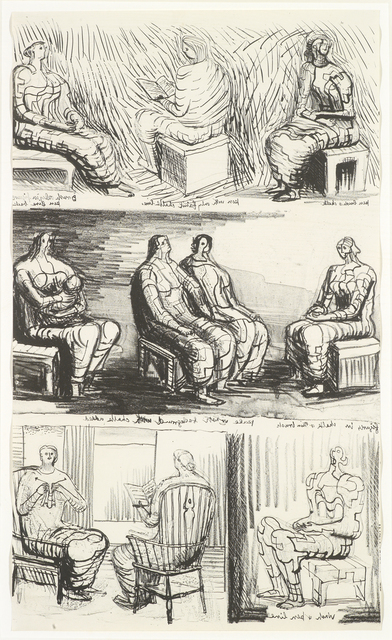
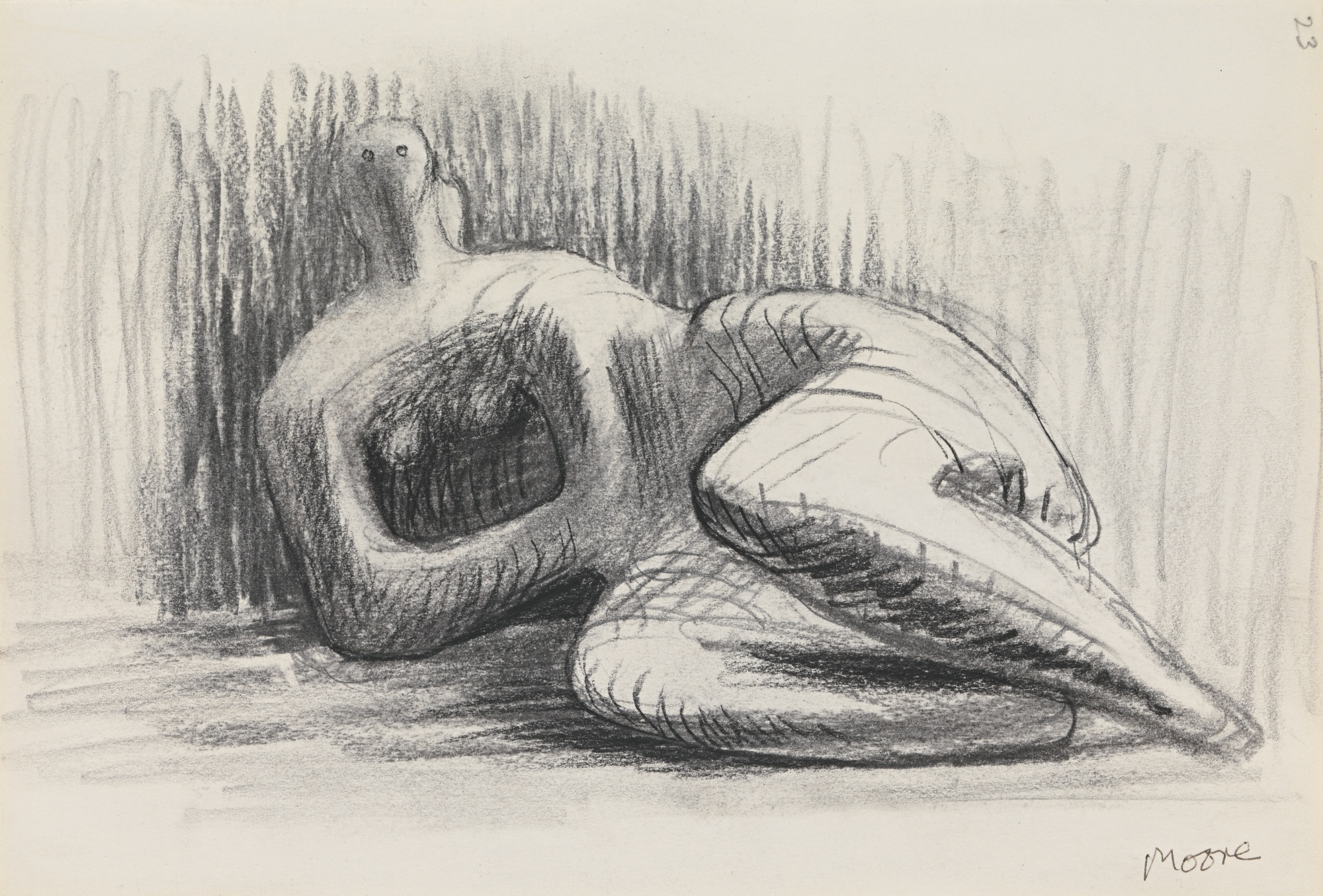
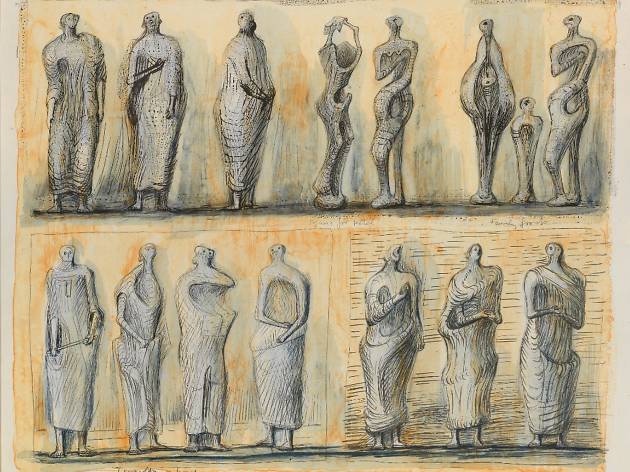
First day of work in 2019 and I am looking to the great sculptor Henry Moore for some guidance. I understand his idea that discipline in art comes with the need to understand oneself, as though the image or object created reveals as much about the artist’s inner self as it does about whatever it supposedly represents. The discipline to continue bringing oneself to that act of self-revelation is certainly a fundamental struggle, one where the artist is constantly presented with diversions, most of their own making, to keep them from the task.

Today I return to that discipline.

Figures in Settings & Sculptural Ideas 1949 Henry Moore OM, CH 1898-1986 Presented by the artist 1976 http://www.tate.org.uk/art/work/P02354

Read Full Post »

*****************

All that is necessary to paint well is to be sincere.

–Maurice Denis

*****************

In my opinion, sincerity is a huge part of how an artist’s work comes across, perhaps even more than the actual ability of the artist. Sincerity carries the emotion, the sensation, of the work of art.  It is the part of art that moves and speaks to you.

I guess that is why I was drawn this morning to the simple quote above from painter Maurice Denis (1870-1943). I’ve been an admirer of his work for some time and for some reason have yet to mention him here. He was not one of the bigger names of art in his time but was important in that era that encompassed the transition from traditional representation to impressionism then on to modern art. He was part of Les Nabis which translates from both Hebrew and Arabic as The Prophets. It was a group of young French artists who followed in the artistic footsteps of Paul Gauguin.

As Denis wrote about Gauguin’s influence:

We learned from Gauguin that every work of art is a transposition, a caricature, a passionate equivalent of a sensation which has been experienced. He freed us from all restraints which the idea of copying naturally placed on our painter’s instincts. All artists are now free to express their own personality.

That basically deals with the same sort of sincerity mentioned at the top f the page.

Denis had a long career that moved through a number of different phases, all done well and with sincerity. There is much in his work that speaks to me, things that I wish to carry into my own work. Things I have already used, in some cases. I urge you to check out his wiki bio or some other reference sites to find out more.

A parting line from Denis:  Don’t lose sight of the essential objectives of painting, which are expression, emotion, delectation; to understand the means, to paint decoratively, to exalt form and color. 


Read Full Post »

I was going through the blog from a few years back and came across this post, one that had slipped my mind. Reading it again was what I needed this morning. Sometimes you need a reminder to just sit down and be quiet. Thought it might be a good replay for these hectic days..
GC Myers- Trio:Three Squares
I came across this poem from author Wendell Berry on Maria Popova‘s wonderful site, Brain Pickings. It’s a lovely rumination that could apply to any creative endeavor or to simply being a human being. I particularly identified with the final verse that begins with the line: Accept what comes from silence. I’ve always thought there was great wisdom and power in silence, a source of self-revelation. Perhaps that is why so many of us shun the silence, fearing that it might reveal our true self to be something other than what we see in the mirror. Berry’s words very much sum up how I attempt to tap into silence with my work.

At the bottom is a recording of Wendell Berry reading the poem which gives it even a little more depth, hearing his words in that rural Kentucky voice. It’s fairly short, so take a moment, sit down, be quiet, and give a listen.

HOW TO BE A POET
(to remind myself)

Make a place to sit down.
Sit down. Be quiet.
You must depend upon
affection, reading, knowledge,
skill — more of each
than you have — inspiration,
work, growing older, patience,
for patience joins time
to eternity. Any readers
who like your poems,
doubt their judgment.

Breathe with unconditional breath
the unconditioned air.
Shun electric wire.
Communicate slowly. Live
a three-dimensioned life;
stay away from screens.
Stay away from anything
that obscures the place it is in.
There are no unsacred places;
there are only sacred places
and desecrated places.

Accept what comes from silence.
Make the best you can of it.
Of the little words that come
out of the silence, like prayers
prayed back to the one who prays,
make a poem that does not disturb
the silence from which it came.

Wendell Berry

Read Full Post »

A blog post that ran here a couple of years back with some advice from poet e e cummings is consistently one of my most popular, always getting a number of hits. For example, there was quite a pop in its numbers yesterday. I don’t know what brought it on but it made me want to revisit the post. Reading it again made me appreciate even more the words. Even though it was aimed at potential poets it rang equally true for me as a painter, especially when I substituted the word painter for poet, paint for words, and painting for poetry.

I thought I’d replay it today doing just that. Where there is a word like [thiswith brackets, I have substituted an equivalent word. And if you’re not a painter, feel free to use any word that describes what it is you do to express yourself.

I think you might find it inspiring.

+++++++++++++++++

Whenever I am asked to speak with students I usually tell them to try to find their own voice, to try to find that thing that expresses who they really are. I normally add that this is not something that comes easily, that it takes real effort and sacrifice. It is a never-ending struggle.

The great poet e e cummings (you most likely know him for his unusual punctuation) offered up a beautiful piece of similar advice for aspiring poets that I think can be applied to most any discipline.

Or to anyone who simply desires to feel deeply in this world.

I particularly like the line: To be nobody-but-yourself in a world which is doing its best, night and day, to make you everybody else-means to fight the hardest battle which any human being can fight; and never stop fighting. That line alone speaks volumes.

Take a moment to read this short bit of advice and see what you think– or feel.

*******************

A [Painter’s] Advice To Students

Borrowed from (e e cummings)

A [painter] is somebody who feels, and who expresses his feeling through [paint].

This may sound easy. It isn’t.

A lot of people think or believe or know they feel-but that’s thinking or believing or knowing; not feeling. And [painting] is feeling-not knowing or believing or thinking.

Almost anybody can learn to think or believe or know, but not a single human being can be taught to feel. Why? Because whenever you think or you believe or you know, you’re a lot of other people: but the moment you feel, you’re nobody-but-yourself.

To be nobody-but-yourself in a world which is doing its best, night and day, to make you everybody else-means to fight the hardest battle which any human being can fight; and never stop fighting.

As for expressing nobody-but-yourself in [paint], that means working just a little harder than anybody who isn’t a [painter] can possibly imagine. Why? Because nothing is quite as easy as using [paint] like somebody else. We all of us do exactly this nearly all of the time-and whenever we do it, we’re not [painters].

If, at the end of your first ten or fifteen years of fighting and working and feeling, you find you’ve [painted one part of one real painting], you’ll be very lucky indeed.

And so my advice to all young people who wish to become [painters] is: do something easy, like learning how to blow up the world-unless you’re not only willing, but glad, to feel and work and fight till you die.

Does this sound dismal? It isn’t.

It’s the most wonderful life on earth.

Or so I feel.

Read Full Post »

**********************************

“The world concerns me only in so far as I owe it a certain debt and duty, so to speak, because I have walked this earth for 30 years, and out of gratitude would like to leave some memento in the form of drawings and paintings—not made to please this school or that, but to express a genuine human feeling.”

Vincent van Gogh, The Letters of Vincent van Gogh

**********************************

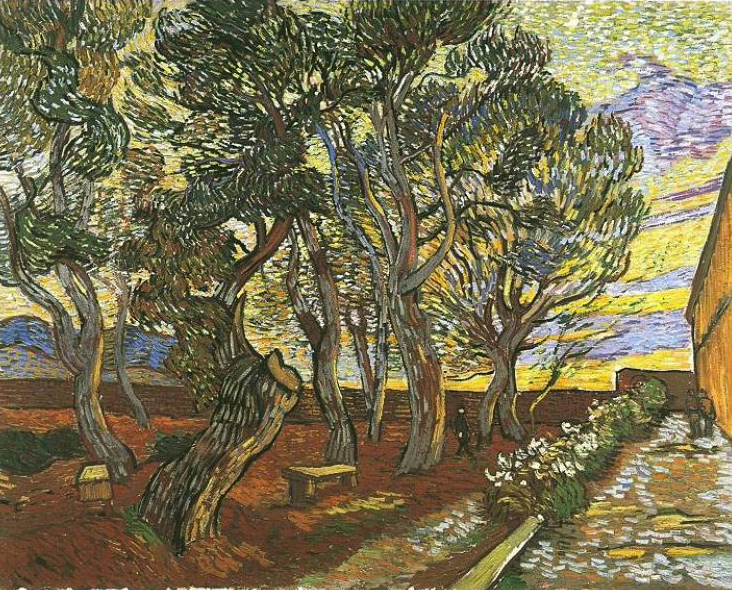
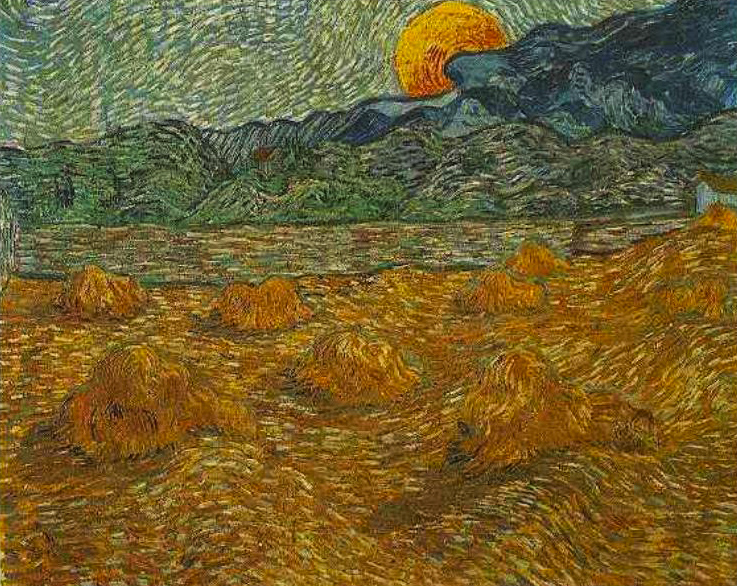
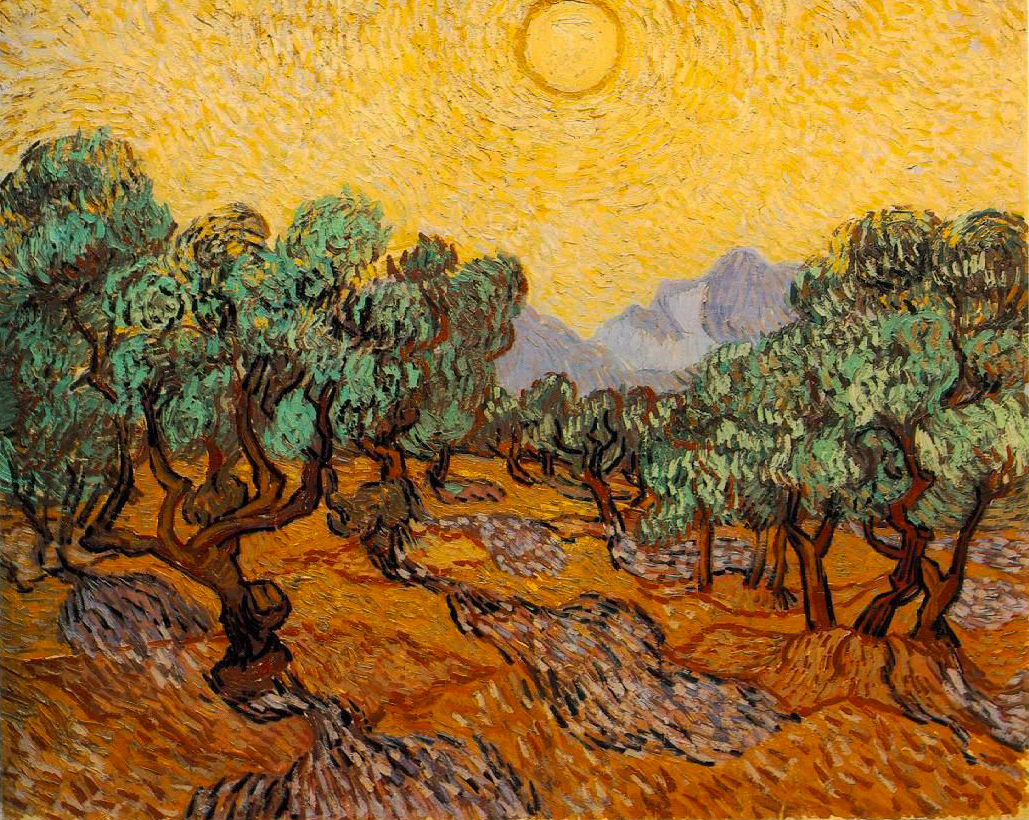
Thought a good way to kick off this week might be to share a few paintings from Vincent van Gogh along with a quote from one of his letters that speaks very much to my own feelings about my own reasons for doing what I do. These are not his better known paintings, though some of you may well know these pieces. They’re pieces that speak to my own personal inclinations. You might notice that most of these paintings have his ball sun/moon.

The idea of feeling a need to leave a memento behind that expresses one’s gratitude and one’s expression of self is one that is not foreign to me. I often think about how my work will speak for me after I am gone. Actually, if it will speak into the future at all and if so, will it be an honest reflection, a true representation of my voice.

I know that an artist, for all of the ways they try to guide the narrative about their work and life, have little control on the future.

What will be, will be.

Their voice might echo but it is always just that, an echo, a one-sided conversation from the past. Hopefully, what is said in that echo reverberates and speaks to someone of that future time so that they can fully understand and connect to the feeling behind it. And if so, with the hope that they might respond to that voice in some small way that continues to give life to it.

As I said, an artist has little control over this outside of doing their work with honest efforts and emotions. It’s obvious this was the case in the work of van Gogh and we continue to have a conversation with his echoes from the past, his mementos of gratitude.

Read Full Post »

+++++++++++++++++++

“In ordinary life we hardly realize that we receive a great deal more than we give, and that it is only with gratitude that life becomes rich.” 

― Dietrich Bonhoeffer

+++++++++++++++++++

I thought for this installment of Gratitude Week, I would start with the quote above from Dietrich Bonhoeffer.

The name might be familiar. I featured him a post last year, On Stupidity, that has been pretty popular, consistently getting quite a few views each week. He was the German pastor who spoke out against the Nazi regime throughout the 1930’s, later being sent to a concentration camp before being sent to his death on the gallows in the last days of the war. On Stupidity described the sort of blatant ignorance that led to the rise of the Nazis and seems to exist here today in forms. Bonhoeffer also coined the term Cheap Grace which also seems abundant these days. It’s a post that is worth another look.

But the words above from Bonhoeffer offer a different and positive thought, that we receive much more from this life than we ever give in return. Understanding this concept and living with a sense of gratitude gives our lives a richness beyond material wealth.

In that vein, I want to point out that there is a political/economic philosophy that has been out there for some time now, one that has led to the increasing disparity of wealth between those at the top and those in the middle and at the bottom.

It basically labels people as Makers and Takers. In the eyes of those at the top, the Makers are those who control the wealth and means of production and the Takers are everyone else. They believe that no matter how integral a person might be in assisting the Makers amass their wealth, they are only there to take from them.

They see the world as a zero sum scenario where there are only winners and losers. Those at the top are winners and anyone below them are losers. The loser Takers are tools at best to be used in their view. When their usefulness has went away, they are nothing more than dead weight.

It’s a distressing idea, one that I would love to say couldn’t exist, but there is ample evidence to support that this belief is flourishing.

I would like to offer a counter-thought.

In my eyes I see the Makers described above as the real Takers. By doing all they can to gain and gain at the expense of others, they extract joy and compassion from this world, along with dignity,respect, and honor. They take away from the humanity of all people with an extreme selfishness that creates a world of solely winners and losers.

But in my worldview anyone can be a Maker because wealth is not the only factor that makes for a better world. Anyone who acts to better people’s lives is a Maker. Those who inspire, those who teach, those who heal, those who put their own lives on the line to rescue those in harm’s way, those who come to the aid of others in need, those who give what little they have until it strains their budgets, those who volunteer, those who work to least the least among us a voice, those who stand up to power so that our air is clean and our food safe, along with so many others—these are the people who make this world a better place, who bring a sense of dignity to all people.

These are the true Makers. These are the people who create the richness of this world.

Please understand that what you have in this world is the result of being assisted by others. You may be the most fabulous, self-sufficient being in the universe but you have done nothing absolutely on your own.

We are the beneficiaries of the work and care of others.

Let us acknowledge that and be grateful. Be a Maker.


Read Full Post »

« Newer Posts - Older Posts »