Feeds:
Posts
Comments

Archive for the ‘Neat Stuff’ Category

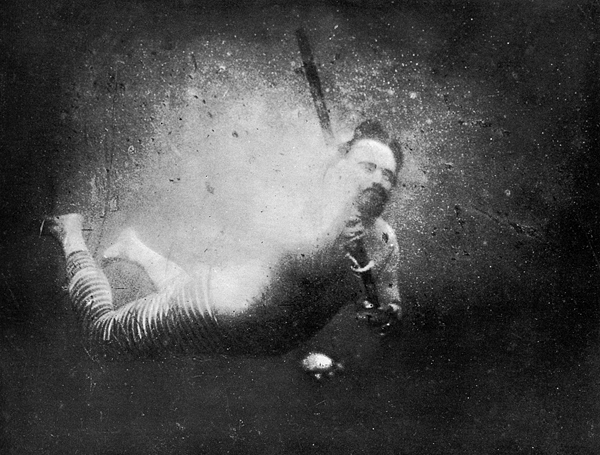
Louis Boutan- Underwater Photo ExperimentA friend of mine had a picture on Facebook yesterday that was taken underwater.  It was bright, clear and detailed, full of the color of the sea.  The fact that anyone can easily take such sharp underwater photos made me wonder about how underwater photography had evolved.  Doing a little research I came across the photo shown here on the left that really caught my eye.  It has a real magical quality to it with the light burst at the center and the diver appearing like some odd creature in mid-birth.  It was by a French marine biologist, Louis Boutan, from the early 1890’s and is one of the earliest surviving underwater photos.

There had been an earlier photo,  from 1856 by William Thompson in the waters of Dorset in the UK.  It was taken by a camera attached to a pole and showed the underwater plant growth of the shallow sea bottom. The photo has been lost  however which  and it takes almost forty years into the future before Boutan takes up the quest for documenting what he was seeing under the sea as a marine biologist.  You have to realize the difficulties he faced in achieving this goal.  First, diving and photography were in their early stages and the equipment for both was large and cumbersome.  It would be decades before scuba gear was introduced and cameras were large boxes with long exposures and flash systems that consisted of burning magnesium.  You couldn’t just whip out your iPhone and snap some pix.
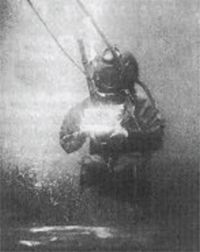
Louis Boutan in his Diving SuitBut Boutan persevered and with the aid of his engineer brother devised systems, that would be enormous by today’s standards, allowed him enough mobility to move them to the sea bottom and photograph.  His experiments included shallow shoots such as the one featuring the diver above and, ultimately, dives that descended to 164 feet beneath the sea in a diving suit.  The image to the right is one of these first deep images.  As I said, the exposure were long, up to 30 minutes for the film of the time at such low light, and Boutan would sometimes suffer nitrogen narcosis– the rapture of the deep.  It was a dangerous effort to document the world he loved.
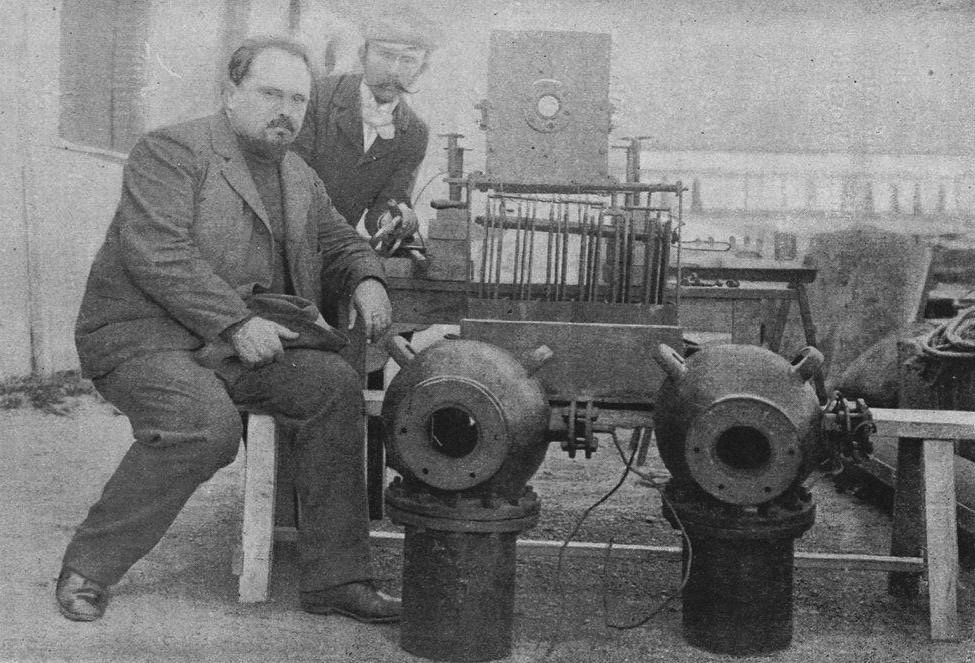
Louis Boutan on left with his Dual Carbon LampsThis a photo of Boutan (on the left)  and his equipment at one of the later stages of his 1890’s experimentation.  Even though it looks huge to us, this was pretty compact for the time.  The two steel orbs in the forefront are carbon arc lamps that he developed to replace the earlier system which was a huge wooden barrel with a large glass globe affixed to the top that encased a ribbon of burning magnesium.  Portability was not its big strength.

I like this photo of Boutan and his equipment because there is a feeling of the past and the future in it.  He appears so modern in contrast with his appearance, with his sport coat and haircut when compared to his assistant standing behind him who is obviously a product of his age with handlebar moustache, necktie and cap.  Boutan could walk into the room today and be contemporary.  I think that speaks to his drive to evolve his process.  He would not be tied to the static present and the lingering past.

Boutan also published a book in the 90’s that featured many of his images and documented his work.  Below is a group of these images.  So, when you pull out your compact camera the next time and dive into the water to snap a shot of the kids or some colorful fish, remember Louis Boutan.  He set the whole thing in motion.
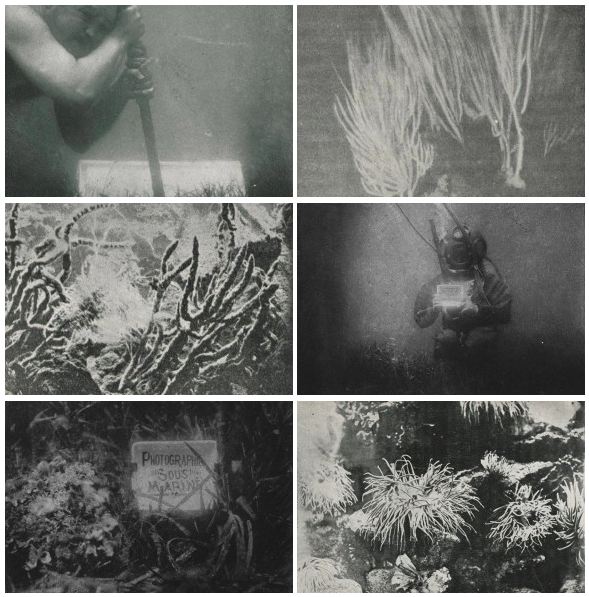
Louis Boutan Group of Photos from his 1890s Book

Read Full Post »

Steven Wilson- The Raven That Refused to SingMy friend Scott Allen from the Cleveland area sent me a link to a video the other day.  It was an animation of a song from Steven Wilson, a British progressive rock musician who is the lead singer for Porcupine Tree.  The song is titled The Raven That Refused to Sing and Scott said that he felt reminded by it of my Exiles/Outlaw series, both in tone and imagery.

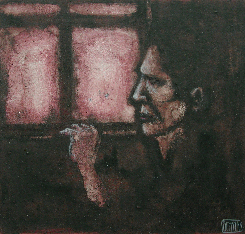
It’s a dark and sad storyline that runs through the video as an old man deals with the grief of loss and memory.  But I could definitely see the parallels that Scott hadGC Myers- Followed observed , especially in certain scenes.  For example, the scene where the old man sits in his bed in front of the windows  ( shown above) instantly reminded me of my characters as they peer out their own windows with that same haunted look.  Perhaps their fear is much like this old man’s grievous fears.

The video was made by British animators Jess Cope and Simon Cartwright who have a real knack for incorporating this type of dark and mysterious subject matter in their works.  Their The Astronomer’s Sun is a much celebrated short in the same poignant vein. It’s definitely worth a look, as is this video.  Thanks, Scott.

Read Full Post »

Out of Bounds with Tish PearlmanLast week I went to REP Studio in Ithaca to record a radio interview with Tish Pearlman for her Out of Bounds show.  It’s a show that airs on several public radio stations around the country and features the affable and inquisitive Pearlman sitting down with people from a wide range of backgrounds with a purpose “to forge understanding among people of diverse backgrounds through thoughtful, in-depth conversations that educate and enlighten.”    Pearlman has been doing this show since 2005 and has featured interviews with many national and regional  figures, all of which can be found archived on the show’s website.  It’s a pretty impressive list that has many names that will be familiar to many of you.  So I was surprised, and honored, when she invited me to sit in for an interview.

Our half hour passed in the blink of an eye with Tish asking questions about my work and technique, as well as inquiring as to how I came to painting which is a story familiar to those of you who read this blog regularly or have came to one of my gallery talks.  Beyond that, my memory of what I said is a blur.  I can only hope that I was somewhat coherent and didn’t make a fool of myself.

When the session ended,  Tish clapped her hands and said that it had went really well and asked how I felt about it.  I said I was pleased but knew that, based on past experiences, that I would be beating myself up in the car on the way home, second-guessing what I had said and what I hadn’t said.  Every time I do an opening or a talk, I inevitably go through this process of regretful recollection , wishing I had made a point or agonizing over something that just didn’t come out right or over not being able to speak with someone who was in attendance.  Or that I just came off as some sort of jerk or pompous twit.

She said that I surely wouldn’t do that over this interview and I laughed and said that I knew that I would.  And, of course,  I did.

But my recollection of the interview is a very pleasant one.  Tish has an easy, friendly manner that puts you at ease and you begin to forget that you are in a small room with a microphone in front of you instead of a comfortable  living room having a pleasant conversation.  Of course, it’s a one-sided conversation.  I actually wish I had been able to ask her about some of her interviews and some of the people behind them.  I bet she has some great insights.

The show will air on the following channels:

Thursdays at 7pm WEOS-FM (NY)
Sundays at 11:30am WSKG-FM (NY)
Fridays at 3:30pm on WRNC-FM (WI)
Wednesdays at 11am on KKRN-FM (CA)
I believe that all of the channels have a live online stream for the show.  I know that WEOS-FM  and WSKG-FM do stream  the show.  I am not positive about the channels in Wisconsin or California.  And if you miss it, the interview will be on the Out of Bounds site within a month or two.
Thanks, Tish, for the opportunity to speak with you.  It was a pleasure and an honor.

Read Full Post »

Chester Cornett  CrucifixChester Cornett  CrucifixI came across an image of a hand-carved crucifix that caught my eye.  it had rough craved ribs and was painted in a haphazard fashion and adorned with human hair.  The photo made it look small and intimate but it was huge, about eight  feet tall and four feet wide.  It would be a truly dynamic thing to see.  I knew nothing of its maker,  Chester Cornett.  This wild expression, while effecting in its presence,  didn’t give me any real idea of the story behind the name or of the nature of his true special talent.

You see, Chester Cornett was born and raised as a traditional chairmaker from the hills of Kentucky, learning at the knees of his grandfather and father.  He was born in 1912 and died in 1981, living a life filled with hardship as the  world surged progressively into the modern era,  moving further and further away from the need for the handmade.  But Chester persisted, perhaps because he knew no other way or because his special talent, his genius, was too great to forsake.

Chester Cornett Rocing Chair BookcaseHe made all sorts of chairs, simply built traditional chairs and rockers.  But it was when he moved beyond that form that his genius manifested itself.  Folding chairs with eight legs.  Rocking chairs with bookcases built around them.  They were masterfully crafted with innovative joinery and intricate engineering.  Just amazing creations.

I’m just learning about Chester Cornett so I’m not going into much depth here.  There’s not a wealth of info out there outside of a film, Handcarved, from 1981, and a book that features him among other mountain craftsmen, Craftsmen of the Cumberlands.  But I find his work and his life captivating.  There’s something special in seeing ingenuity show itself in unlikely places and conditions.  And Cornett seems to me an unlikely genius that deserves greater examination.

I like this exchange from the book, Craftsmen of the Cumberlands:

Chester Cornett Snake Chair“Do you think it takes a special talent to be a chairmaker?” I asked Chester. 

“I don’t b’lieve so,” he said. 

“You think anybody could be a chairmaker?” 

“No, I don’t b’lieve just anybody could… too hard a work.” 

“Does it take some special skill?” 

“Yes sir, it does. It takes a skill specially for, uh, you got to learn how to use that drawin’ knife—use it just right to take off hick’ry bark with or whatever you’re making.” (Though other chairmakers used a drawing knife much less frequently and for fewer tasks than Chester did.) 

“Can anyone learn how to use a drawing knife?” 

“I’d say so, excepting uh, you got to learn to get interested in anything to learn it… you have to learn to get interested in a thing like that before you could learn it. And anyway, I b’lieve anyone could learn how to use a drawin’ knife and do that work.” 

“Anybody could learn how to be a chairmaker, then?” 

“Well, yes, they could, but they’d have to learn to be interested in that first.”

Maybe that’s the whole point of life– finding that thing that we can learn to be interested in.

Read Full Post »

hunter s thompson anthony hope-smithThe Edge… There is no honest way to explain it because the only people who really know where it is are the ones who have gone over. The others — the living — are those who pushed their luck as far as they felt they could handle it, and then pulled back, or slowed down, or did whatever they had to when it came time to choose between Now and Later

*******************************

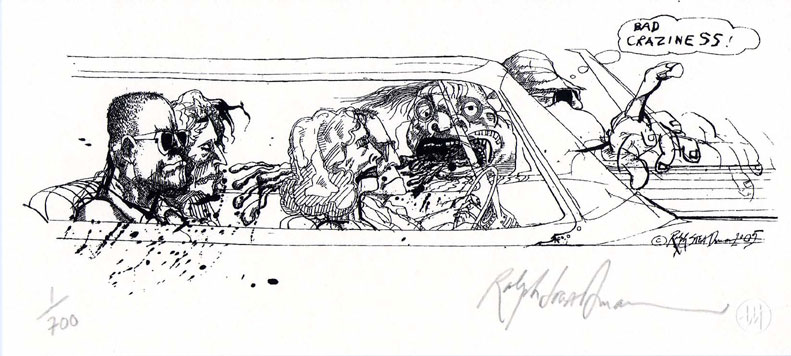
The quote above is taken from Hunter S. Thompson’s 1966 book , Hell’s Angels: The Strange and Terrible Saga of the Outlaw Motorcycle Gangs.  I read that book and most of his other work , including that from his  longtime union with Rolling Stone magazine,many years ago with great glee but never really got caught up in the whole gonzo mania that sprung up in later years as he became an almost mythic figure.  No, I just loved the Ralph Steadman -Bad Crazinessway his journalism, if indeed it was that or purely fictional, took on sometime serious subjects with a skewed and jaded eye.  And it was just laugh out loud funny at times with imagery that is as vivid in my mind as when I first read it oh so many years ago.  Plus, it usually was accompanied by the ink-splattered artwork of Ralph Steadman, including this drawing shown here taken from a memorable incident in  Fear and Loathing in Las Vegas.  I think Steadman’s manic drawings of Thompson’s adventures were a major force in the  building of the Thompson legacy and legend.

And for some, Thompson is a legend, an icon, a caricature that still lives on.  There have been numerous books and films on his life including a graphic novel last year, Gonzo: A Graphic Biography of Hunter S. Thompson , illustrated by Anthony Hope-Smith.  I don’t know if I’m still buying in but some of the imagery is wonderful and the early stories are still great reads.

Here’s a video from artist Piotr Kabat that is his graphic interpretation of the quote at the top of this post.  Well done.

Read Full Post »

Richard lindner Double PortraitI’ve been going through some books on my shelves that I haven’t looked at for some time and came across a smallish book on the work of Richard Lindner, who was  a German born  (1901)  painter who moved to New York during World War II.  He taught at the Pratt Institute then later at Yale before his death in 1978.

His work was obviously a big influence on the Pop Art movement of the 60’s.  If you remember the artwork for the Beatles’ Yellow Submarine film,  you can easily see how Lindner’s work Richard Lindner The Coupleguided the hand of the film’s  artist who most people think was Peter Max.  However, the artist was Heinz Edelman .  This misconception probably shows Lindner’s influence on Max as well.   I also can see Lindner in some of Terry Gilliam‘s animations for Monty Python.  The Beatles  paid tribute to Lindner  by inserting his image  in the group of figures on the cover of their classic Sgt. Pepper’s Lonely Hearts Club Band album.  He’s  between Laurel and Hardy in the second row.

I am really attracted to Lindner’s colors and use of forms.  His colors have gradations and complexities that give his work added dimension.  His shapes and lines are strong and sure.  It’ demands an immediate response, even if it’s negative, and I really respect that.

Richard Lindner  FBI On East 69th StreetOne of my favorites is shown to the left here,  FBI On East 69th Street.  I have no idea whether he was influenced by Lindner’s work (although I wouldn’t be surprised), but when I look at this painting I can only think of  David Bowie, especially in the early 70’s in the Glam era.  Again, the strength of the color and shape,s as well as how his figures fill the picture frame, excite me.  How I might take this excitement and make it work within my own work is something that remains to be seen.  It may not be discernible but seeing work that makes your own internal wheels spin will show up in some manner.  We’ll have to see if this comes through in the near future.

Richard Lindner The Meeting

Richard Lindner Rock-RockRichard Lindner Telephone

Read Full Post »

Allendale Parade, Northumberland Homer Sykes 1972I came across some photos online some time ago from British photographer Homer Sykes.  They were taken in the early 1970’s and were images of traditional British countryside celebrations throughout the year.  One in particular  from  Northumberland  caught my eye.  In black and white, it showed a group of people in capes and cloaks and all manner of costume carrying flaming short barrels as they marched.  Without knowing anything about what or where it was from, you had the sense that this was derived from some sort of pagan ritual celebration.  It piqued my interest.
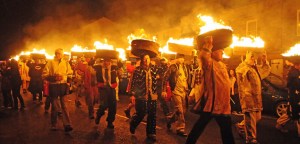
Turns out it was from the village of Allendale and, while it has the appearance of some Norse festival of fire, dates back to 1858.  It turns out that a band used to  parade on New Years  and used candles to light their music.  But the winds of the season made this impractical and someone suggested using these tar lined barrels which would give off great light and be portable as well.  Plus, it looked a  pretty kickass thing to do to bring in the new year.

Allendale Tar BarrelsOver the decades it has turned into tradition.  There are 45 marchers, called guisers,  who maintain their positions hereditarily.  They assemble early in the evening, adorned in all manner of costume,going  from pub to pub in a Mummer-like procession.  In the hour or so before  midnight , they gather in the town square to have their annual roll call and prep their barrels.  At 11:30, the barrels are lit and they begin their fiery march through the village, led by a small band of drums and brass.  It is said to resemble a river of fire moving through the village.

They return to the town square and gather around a 14 foot  mound of  fir branches and with  the words “Be damned to he who throws last” hanging in the air, they heave their 45 flaming barrels into it, setting it into a giant bonfire as the last seconds of the old year pass away.

Maybe this tradition doesn’t date back to the ancient times but the idea of  of the old being burned away and the new rising from its ashes certainly is timeless.  Set the past afire tonight.  Have a happy New Year.


Read Full Post »

St. Nicholas Face ReconstructionWe call him Santa Claus mainly but sometimes we still refer to him as old St. Nick or St. Nicholas,  who was actually a 4th century Greek who served as a bishop in Constantine’s church of that time.  Called Nicholas the Wonderworker and sainted in the church,  his fame spread throughout Europe through  the ages and evolved in story and form into the jolly, bearded fellow that we call Santa Claus today.

His bones are buried in the crypt of the Basilica di San Nicola in Bari, Italy.  During repairs made in the 1950’s, his bones were temporarily removed during which time they were measured and photographed with great precision.

In 2005, it was determined that a reconstruction of old St. Nick’s face might be made using today’s cutting edge forensic technology.  An excerpt from an article from the St. Nicholas Center, which is a fascinating site on the history and legend of  St. Nick evolution into Santa Claus, describes the process:

The current professor of forensic pathology at the University of Bari,  Francesco Introna, knew advancements in diagnostic technique could yield much more from the data gathered in the 1950s. So he engaged an expert facial anthropologist, Caroline Wilkinson, at the University of Manchester in England, to construct a model of the saint’s head from the earlier measurements. 

Using this data, the medical artist used state-of-the-art computer software to develop the model of St. Nicholas. The virtual clay was sculpted on screen using a special tool that allows one to “feel” the clay as it is molded. Dr. Wilkinson says, “In theory you could do the same thing with real clay, but it’s much easier, far less time-consuming and more reliable to do it on a computer.” 

After inferring the size and shape of facial muscles—there are around twenty-six—from the skull data, the muscles are pinned onto the virtual skull, stretched into position, and covered with a layer of “skin.” “The muscles connect in the same place on everyone, but because skulls vary in shape, a different face develops,” Wilkinson comments. The tangents from different parts of the nasal cavity determine the length of a nose. This was difficult because St. Nicholas’ nose had been badly broken. “It must have been a very hefty blow because it’s the nasal bones between the eyes that are broken,” she continued. 

“We used clay on the screen that you can feel but not physically touch. It was very exciting. We did not have the physical skull, so we had to recreate it from two-dimensional data. We are bound to have lost some of the level of detail you would get by working from photographs, but we believe this is the closest we are ever going to get to him,” Wilkinson concluded. 

Next the three-dimensional image went to Image Foundry Studios where a digital artist added detail and color to the model. This gave it Greek Mediterranean olive-toned skin, brown eyes, and grey hair and beard, trimmed in 4th century fashion. 

The result of the project is the image of a Greek man, living in Asia Minor (part of the Greek Byzantine Empire), about 60-years old, 5-feet 6-inches tall, who had a heavy jaw and a broken nose.

So, there we have the face of our Santa Claus.  It doesn’t seem so really different from the evolved version although that broken nose makes me wonder who popped Santa. Disgruntled elf?  Or maybe just a mishap with a reindeer.  Even the best forensics won’t tell us that tale.

Read Full Post »

Monkey Soap Christmas 1895And we thought that the commercialization of Christmas was a new thing.  Here’s a great image from  Victorian era  England circa 1894 featuring Father Christmas as portrayed by the Brooke’s Monkey Brand Soap monkey.  Actually, this simian huckster was quite a regular in the print ads of the time.  If you click here it will take you to the Google Image search page with a large group of this great imagery.

Read Full Post »

William Miller's 1843 ChartWell, I got  up this morning and, outside of a light layer of snow on the ground, it looked pretty much the same as yesterday.  The world is still here and the Mayans have got some explaining to do for getting us all worked up.  Or were the Mayans just pulling our leg the whole time?

I’m not sure about that but I am pretty sure that this won’t be the last time someone predicts that the end of the world is upon us.  It’s happened on a regular basis throughout the history of civilization.  We seem to have some sort of predisposition for doomed thought that pops up in a big way every generation or so,  a doomsayer getting everybody’s panties in a knot with their what-seems-rational-at-the-moment reasoning  for the coming apocalypse.

One of my favorite apocalypses (how often do you get to say that?) was the End of the World of 1843 and 1844 as predicted by William Miller right here in the state of  New York, which was fertile ground at that time for new religion movements. Mormonism and Seventh-Day-Adventism, which sprang from Miller’s preaching, are the two best examples.

Miller was a preacher who came to the conclusion that the end was near through a complex system of mathematical calculations  based on his readings of the Old Testament.  He traveled throughout the northeast through the 1830’s and 40’s, preaching his prophecy of the coming end of the world.  It’s said that he spoke to over a million people during his promotion of the event and that over a hundred thousand actually chose to follow his instructions to sell their worldly possessions and gather on the hilltops with him, all dressed in white robes,  in March of 1843 to await the coming of the the lord and their rapture from this doomed place.   A great testament to the persuasive power of Miller’s preaching of his rationale for the prophecy.

It was a big deal at the time, with headlines carrying news of the prophecy and the hordes gathering for the end. But the day came with  a fizzle, not a boom.   When nothing happened at this event, an embarrassed Miller ran the numbers again.  I think he forgot to carry the seven as he added one column.  Whatever the case, he revised the date to a day in October of 1844.

I’m told that the world didn’t end on that particular day.  It was called The Great Disappointment and many of Miller’s followers abandoned him.  Some went on to form the Seventh Day Adventists.  Miller never gave up his belief in the ultimate truth of his prophecy, dying a few years later in 1849.

The chart at the top is one that Miller published to illustrate how he came to his conclusion.  Much of  the design and artwork was done by one of Miller’s followers,  William Matthew Prior, the famed American folk portrait painter who I featured in a post on his work recently.  You can see this amazing sheet at the Fenimore Art Museum in Cooperstown along with two portraits of Miller done by prior.  One is a spirit portrait, done afterMiller’s death.  It is Prior’s interpretation of Miller’s essential spirit, not the physical entity he inhabited while alive.

The Prior show, along with my own exhibit there, closes at the end of next  Sunday, December 30.  So time is short– for these shows, not this world.

Read Full Post »

« Newer Posts - Older Posts »