Feeds:
Posts
Comments

Archive for the ‘Neat Stuff’ Category

GC Myers/ Art in Embassies Catalog 2016 a smI wrote last year about a couple of places where my work has ended up in one way or another.  Recently, I received some material from a couple of these places that show how my work is being used.

The first came in the form of a catalog from the Arts in Embassies Exhibition at the United States Embassy in Kuwait.  My painting that hangs at the Embassy, The Way of the Master, was chosen to adorn the cover.  This was a surprise and a thrill,  especially given the quality of the work from the other artists in the exhibit, including Helen Frankenthaler.

Archaeology: Rooted in the Past

Archaeology: Rooted in the Past

The second was a calendar from the Spanish Society of Soil Science that featured one of my Strata pieces on the cover and Archaeology: Rooted in the Past inside for the month of May.  I didn’t know anything about this calendar other than the fact that my pieces were involved.  I was pleasantly surprised to discover the company I was keeping. Spanish tapestry artist Carles Delclaux and myself were the only living artists involved and among the others were some of my heroes, Vincent Van Gogh and Pieter Brueghel, and some of the finest classic painters from Spain. 

Besides my obvious favorites in Van Gogh and Brueghel and one of the Limbourg Brothers‘ gorgeous plate from Les Tres Heures , one of my favorites from the calendar is shown at the bottom,  titled O Paraño.  It is painted by an interesting character, Alfonso Daniel Rodriguez Castelao, who is better known for his political works and writing in Spain than for his obvious talent as a painter.  This piece was painted in the 1920’s and it’s use of color and form really connected with me.

I realize that in the big scheme of things, these little moments of having my work included in such projects don’t really matter all that much.  But on some days, when things aren’t going too well, there is something reinforcing in seeing them and feeling that my work somehow fits into the larger puzzle.

And that is gratifying.

Castelao- O Parano

Alfonso Daniel Rodriguez Castelao- O Parano

Spanish Soil  Society Calendar Cover 2016 a sm


Read Full Post »

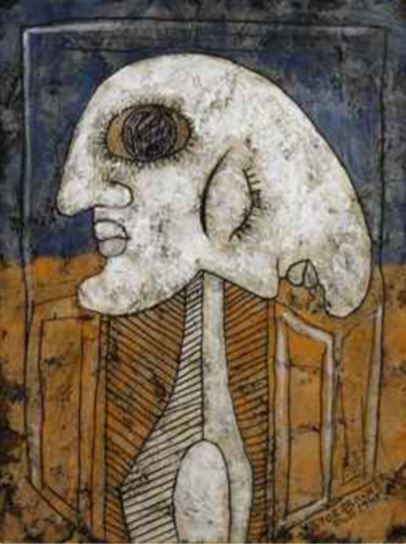
Victor Brauner- "Signe" 1942- Mounted on his tomb in Montmartre

Victor Brauner- “Signe” 1942- Mounted on his tomb in Montmartre

Painting is life, the real life, my life.

Victor Brauner, epitaph on his grave in Paris

*************************

The sculpted piece above is part, along with the quote above,  of the Montmartre tomb of Victor Brauner, a Romanian Jewish painter/sculptor who lived from 1903 to 1966, spending most of his life in France.  It depicts the heads he often portrayed in his Surrealistic paintings.

I can’t quite remember how I first came across the work of  Brauner.  I think it might have been in an article that had anti-Nazi art from the 1930’s.  He had painted a couple of paintings in 1934 and 1935 during Hitler’s rise, one depicting a fantasy portrait of Hitler with his head being pierced with all sorts of implements.  A knife in the eye , for example.  The other depicted a German military figure standing atop a swastika that is crushing the bodies under it. Both are powerful propaganda images and are shown below.

But I stumbled across his other work apart from these images and they caught my attention on their own.  They are surreal images that often have a Paul Klee-like mysticism in them that I am drawn to.  Maybe I also identify with something Brauner once wrote in his notebooks: Each painting that I make is projected from the deepest sources of my anxiety…

Whatever the case, I find them interesting, something more to delve into.  Take a look.

Victor Brauner- The Surrealist 1947

Victor Brauner- The Surrealist 1947

Victor Brauner- Hitler 1934

Victor Brauner- Hitler 1934

Victor Brauner- Untitled 1935

Victor Brauner- Untitled 1935

Victor Brauner- La Petrification de la Papesse

Victor Brauner- La Petrification de la Papesse

Victor Brauner- Prelude to a Civilization 1954

Victor Brauner- Prelude to a Civilization 1954

Victor Brauner- Consciousness of Shock 1951

Victor Brauner- Consciousness of Shock 1951

Victor Brauner- Antithesis 1937

Victor Brauner- Antithesis 1937

Victor Brauner- The Triumph of Doubt 1946

Victor Brauner- The Triumph of Doubt 1946

Read Full Post »

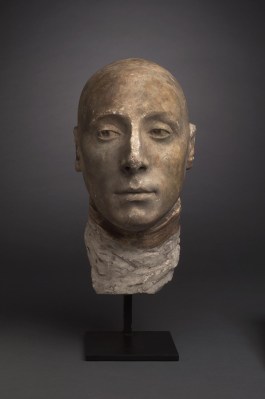
Lafayette Life Mask- Johnson Museum Cornell University

Lafayette Life Mask- Johnson Museum Cornell University

When the Paris attacks occurred I was just finishing up the latest book, Lafayette in the Somewhat United States, from the always entertaining and informative Sarah Vowell.  It tells the story of the love affair between the French boy general and the then forming United States.

I was interested in Lafayette because I have a great-grandfather down in my line who had served as an aide-de-camp to Lafayette and had also hosted the general in his home.  He was given a signet ring that Lafayette placed on his hand and he never removed it, eventually being buried with it.  It is also known that he also gave my ancestor a court vest that was eventually cut into pieces and made into pincushions so that all the members of the family would have a bit of the icon.

And Lafayette was an icon.

Lafayette loved the American people and the idea of America that was formed at that time, defying his family and his government to steal across the Atlantic to engage himself in our Revolutionary War.  Without his ardor and efforts, we would have never gained the backing of the French government in the form of money, troops, ships and arms that were absolutely responsible for our eventual victory and independence.

And I mean absolutely.  At the Battle of Yorktown which brought the surrender of the British and General Cornwallis, there were more French than American troops.  And in the Brits loss in the preceding sea battle at the Chesapeake Capes which allowed us to surround Cornwallis’ troops and make that ultimate battle possible, there was not a single American present.  All French ships and sailors provided by the government that was the first to recognize us as a free and independent country and the first to join us as an ally.

The Americans of that era and in the years after recognized the importance of Lafayette’s love for this country and returned the love.  His return to America in 1824 was like the tour of a gigantic rock star or the Pope.  When his ship came into NY harbor it was met by a throng of 80,000 people at a time when the population of NYC was only about 125,000.  Wherever he traveled massive crowds turned out to see Lafayette.  There were commemorative items of all sorts produced that were sold for a number of years after the tour.

And time didn’t entirely dim the affection.  When General Pershing marched into Paris in WW I, he went to the grave of Lafayette, where he was buried under dirt from Bunker Hill, and placed an American flag.  His aide, Charles E. Stanton, said the following words, although they are often mistakenly attributed to Pershing:

America has joined forces with the Allied Powers, and what we have of blood and treasure are yours. Therefore it is that with loving pride we drape the colors in tribute of respect to this citizen of your great republic. And here and now, in the presence of the illustrious dead, we pledge our hearts and our honor in carrying this war to a successful issue. Lafayette, we are here.

And the American flag has flown ever since over the grave, reportedly even during the Nazi occupation.  Every year on the Fourth of July there is a ceremony to change the flag.

There have been many terrible things happening lately along with the Paris attacks– the downing of the Russian airliner and the suicide bombers in Beirut, for example.  But I think it is the depth of our historic bonds to France that makes these attacks hit us even harder.  While there has been some Franco-bashing in recent years, we recognize their freedom in the same way we view our own, drawn from the same well.  An attack on their way of life might as well be attack on ours.

Read Full Post »

Crooked Forest Poland photo by Kilian SchonbergerAt a show many years ago, I had an old woodsman jokingly tell me that my trees were so twisty and crooked that he could barely get a board foot of lumber from them.  I can’t imagine what he would do with the trees that make up the Crooked Forest located in a corner of western Poland.

It is a group of about 400 trees all bent at 90 degree angles at the base of their trunks, creating a large timber “C” or “J” depending on how you look at them.  They are surrounded by a larger forest of straight trees.  They are believed to have been planted around 1930 but how and why they obtained their unique shape remains a mystery, one no doubt lost when the Nazis invaded Poland in the years after their planting.  The local village was decimated and not really repopulated until the 1970’s so there wouldn’t be any long lived locals to tell the tales of the trees.

Some theorize that German tanks somehow crushed the young trees but that doesn’t explain the surrounding forest that is undamaged.  Plus the idea of a group of trees uniformly surviving such a trauma seems pretty far fetched.  Others say it is the result of some strange gravitational anomaly but that sounds kind of iffy at best.

Snow? Again, why just this smaller group of trees of the same age as their neighboring trees?

Aliens?  Now, you’re talking.

Okay, maybe not aliens.  Actually, the most widely accepted theory is that the trees were deformed to provide curved timber for either furniture or, more likely, boat-building.  There is written documentation of trees being grown specifically to be compass timbers, which provide bracing for the inner curve of a boat’s sides.

Whatever the case, they make a unique and eerie sight.  The photos here are from photographer Kilian Schönberger.  For more of her visually striking views of nature please visit her site by clicking here.

Crooked Forest Poland 2 photo by Kilian Schonberger Crooked Forest Poland 3 photo by Kilian Schonberger

Read Full Post »

GC Myers- Blocked 2015 smIsn’t it strange how princes and kings,
and clowns that caper in sawdust rings,
and common people, like you and me,
are builders for eternity?

Each is given a list of rules;
a shapeless mass; a bag of tools.
And each must fashion, ere life is flown,
A stumbling block, or a Stepping-Stone.

–R. L. Sharpe

*****************

I came across the short poem, Bag of Tools, above recently and it caught my eye with its simple yet insightful message.  Looking deeper, into it, I found that it is often quoted and there are even videos of people reciting it, including one with Maggie Smith that was used in an ad for a large bank.

But who was the author , this R. L. Sharpe and when was it written?

There is little info on the poet and I have seen the poem dated 1890 as well as 1809, although I felt the earlier date was just a misinterpretation of the 1890. date.  So after a bit of digging, I came across  one little blurb on a forum that stated about the poet:

He was born in the 1870s and died in the 1950s.
For years he worked with his father, Edwin R. Sharpe,
who owned The Carrollton Free Press and a printing shop in Carrollton, Georgia.
In his later years he traveled a lot, mostly freelancing for magazines
of the ’20s and ’30s.

I can’t vouch for the accuracy of the info although I have seen a number of references from books of the early 20th century with attributions from an R’L. Sharpe in Carrolton , GA.  I wonder if he ever realized the possibility that his words would one day become so widespread?  He obviously fashioned a stepping-stone.

The painting at the top is a new piece, 8″ by 8″ on paper, that I call Blocked.  It seems to fit…

Read Full Post »

Fraser Smith -The Lake

Fraser Smith -The Lake

These quilts will keep you warm on a cold night– if you burn them in your fireplace.

You see, they are elaborate trompe l’oeil  ( it means fool the eye) sculptures from artist Fraser Smith.  Starting with large glued slabs of basswood, Smith carves quilts, coats, shirts, robes and other textile items, finishing them off with paints that add a layer of reality that completes the transition from a block of wood to something that convinces your mind that it is soft and cuddly.

I am amazed at the detail work and can only conclude that Smith has an amazing obsession for this.  Check out the examples below as well the short film that shows how the piece at the top metamorphosizes.  Interesting stuff.   Also check out his website by clicking here.

Fraser Smith Improv 7 2009 Carved Wood and Silk Dyes Fraser Smith Finding Beauty in Bad Things 2013 Carved Wood and Silk Dyes Fraser Smith American Jacket 2010 Carved Wood and Silk Dyes

Read Full Post »

flying-angel-3This is basically a rerun of a story that I first posted back in 2009.  I’ve mentioned before that I enjoy doing genealogical research, digging back through layers of history, trying to put together a sometimes very complicated puzzle to reveal certain connections.  Sometimes it can be relatively boring, going through generations without finding a visible compelling story.  But once in a while you stumble on an ancestor with heroic traits and an exciting story to tell.  Or one who is a scoundrel who makes you wish you hadn’t found out so much about them.  But one of the great pleasures I take in doing this is coming across the life stories of ancestors that are just plain good tales.

One such is from my wife’s family, the story of the lady they called the Flying Angel.  Her maiden name was Magdalena Dircksen Volckertsen and she was born in New Amsterdam (now Manhattan) in the 1630’s, her father a builder of the earliest homes there for the Dutch West Indies Company.

Her first husband ( not in my wife’s family line) was a privateer for the Dutch West Indies Company.  That is to say, he was a pirate hired by the company to attack foreign ships and competitors in the area.  Called “Captain Caper” for his daring, he was killed in an Indian attack that was the beginning of the Indian Wars of 1655.  Magadalena was left a young widow with an infant child.

Two years later she married Herman Hendricksen Rosenkrance, called “Herman the Portuguese.”  The name came not from his nationality ( he was from Norway) but from his service as a mercenary for the Dutch company in Brazil where they forced their way into sugar growing areas controlled by the Portuguese.  Finally forcibly repelled from Brazil, Herman and his cohorts were sent to New Amsterdam to engage the Indians there.  Herman stayed on as a settler, supposedly running a tavern of low repute called the Flying Angel, the origin of Magdalena’s nickname.

Magdalena had quite the temper.  On her wedding day to Herman, after downing multiple beers, she was walking with her sister just above what is now Wall Street in NYC when she passed and insulted the fire warden.  What was termed a street riot broke out and several weeks later  she was yellow-carded by Peter Stuyvesant, meaning she was expelled from the settlement, sent back to Holland where she and Herman bided their time for two years until they were finally allowed to come back, provided they did not open a tavern or sell spirits.

The following years were a series of adventures involving Indian Wars  (one that had Herman being captured and staked out in the sun before he was able to escape), various  legal troubles, some involving Magadalena throwing beer in the faces of a number of  men, stabbings and accusations of selling liquor to the native Indian population.  They ended up living up the Hudson, near Kingston, where Magdalena lived into her 90’s.

It’s rumored that in her later years, she would chase Indians from her property by running out at them, yelling and shaking a large goiter on her neck at them.  How could she not live past 90?

It’s just an interesting footnote in our history and the early settlement of NY, one that you don’t hear much about.  I’m always excited when I come across such stories, especially when there is a small personal connection.  Magadalena and Herman would be my wive’s 8th generation grandparents.

I’m not sure how proud she is…

Read Full Post »

Stan Herd's Take on Van Gogh

Stan Herd’s Take on Van Gogh

Stan Herd is an an American artist who uses the land as his canvas, creating large earthworks that reveal themselves from great heights.  He has been at this for over 40 years, beginning in 1981 after a short and less than satisfying career as an abstract expressionist painter.  Working in the tradition of other great earth artists such as Robert Smithson and Christo, Herd has traveled around the globe for his art and has been tabbed as the  “Father of Crop Art.”  He has even been the subject of an acclaimed movie, Earthwork, that tells the story of a 1990’s project where he creates an environmental artwork on a NYC property owned by Donald Trump— yeah, that guy.

His most recent is a project from this year that he took on in conjunction with the Minneapolis Institute of Art (MIA) that had him replicating Van Gogh‘s famed painting, Olive Trees, in plantings.  It was situated so that fliers arriving at the Minneapolis airport would be able to see it as they were landing.  There’s a great short film below that shows a little of the process and gives you a better idea of the artist.

Take a look at Stan Herd’s website by clicking here.  Great stuff…

Stan Herd  NYC- CountrysideStan-Herd-art2-Stan Herd Land Crop Art

s

Read Full Post »

West End Childrens Center Party 2015 Charlotte Royal

I was the guest speaker last night at a private event held at the West End Gallery.  It was a combination dessert /wine tasting with a bit of a gallery talk thrown in to break up the great flavors, all of which was an item offered in a charity auction to benefit the Children’s Center of Corning that was held earlier in the year.  The generous winning bidders, Chris and Darryl Heckle, and a group of their friends were treated to four incredible desserts and their appropriate wine accompaniments provided by Susan Barbosa, the executive chef at Corning Inc.

Oh, best of all– I got in on the goodies as well.

The one shown above was the first of the night, an exquisite Charlotte Royal.  It was a beautifully crafted dome of two cool and creamy mousses under a covering of thin sponge cake slices.  Wonderful flavors.

Profiterol Cheesecake WE 2015My favorite was the finale offering was this monster, a base of chocolate cheesecake filled with profiteroles (creme puffs!) that was topped with a deep chocolate ganache.  Long story made short– I cleaned every drop of it off my plate.  I could have eaten that until my eyes popped but decorum dictated that I just eat the large piece I was given.  I don’t know how decorum judged me licking my plate clean but that’s the risk you take when you let a guy like me into an event like this.

All kidding aside, it was a lovely evening with a very congenial and interesting group of people.  I gave an abbreviated version of my gallery talk and answered a number of questions from the group.  I also talked a bit about  a few other artists in the gallery, pointing out the influence of the late Tom Buechner on the many artists of this area.  Hopefully, they found something of interest in much of this.

A hearty “Thank You” to the Chris and Darryl Heckle for their generous bid.  Also, many thanks to Peigi Cook of the Children’s Center for her coordination of the auction and this event and to Susan Barbosa for the meticulous preparation and service of her wonderful goodies.  And to Jesse and Linda at the West End Gallery for opening their gallery to this event.

It was a pleasure.  And tasty, too!

Read Full Post »

Hiroshima Survivor Bonsai US National Arboretum

Today is the 70th anniversary of the atomic bomb being exploded over Hiroshima.  I am not looking to get into an exploration of whether it was right or wrong, don’t want to justify or condemn the decision.

It happened.  And with horrifying effectiveness.

No, instead of focusing on our ability to destroy I would rather today feature a story of natural endurance and beauty.  I am talking about the now 390 year-old bonsai tree, shown above, that now resides at the U.S. National Arboretum in Washington, DC.  It has made it intact through the centuries of history including surviving the Hiroshima blast which took place less than two miles from its then home.

It started its life on the Japanese island of Miyajima back in 1625.  Think about that.  Here, we were five years into the Plymouth colony, still struggling to gain our footing in this land while on an island half a world away this tree was beginning its life.  And since that time, this tree has received constant daily care, allowing it to thrive and live well beyond the life expectancy of a normal bonsai.

At some point in its life, this rare tree came into the possession of the Yamaki family which ran a commercial bonsai nursery for several generations near Hiroshima.  It was at this location when the bomb exploded.  The tree was sheltered by a wall and the blast fortunately only caused minor injuries to the family, mainly lacerations from flying glass.

In 1976, bonsai master Masaru Yamaki donated the prized tree as part of the Japanese people’s gift to the U.S. in recognition of our Bicentennial.  It has lived the last 39 years, one tenth of its existence, at the National Bonsai & Penjing Museum at the National Arboretum. It has witnessed the world changing in so many ways yet it stands still.

Serene and beautiful. With our care.

Let us hope that we begin to realize that we gain so much more by nurturing this world than through destruction.

Just look to the tree…

Read Full Post »

« Newer Posts - Older Posts »