Feeds:
Posts
Comments

Archive for the ‘Painting’ Category

No Mail?

I shake my head a lot these days.

And swear. I have always cursed a lot, probably much more than is necessary under any circumstance. But these days, it’s been an unending torrent of blue language. I feel like a gunfighter with my hand forever resting on the six-shooter hanging at my side, all six chambers loaded with curse words of all sorts and in every imaginable combination. Hey, just because I’m crude doesn’t mean I can’t be creative.

But the past day or two, the thing that had me shooting that six gun into the sky is the current president*** and his desire to see the US Postal Service fail, saying that he will veto any emergency bill that adds funds for this most essential service, one that has seen a number of its employees stricken with the covid-19 virus.

There has long been a desire among some on the right to privatize the postal service. In fact, in 2006 under the second Bush administration that was gung ho on privatizing as many government services as possible, they enacted a mandate for the USPS that required them to prefund the employee retirement fund for the next 75 years with a ten year period. It was a measure that added $5-6 billion to the USPS budget each year, sending a service that ran, for the most part, profitably for ages into a financial freefall.

This mandate of funding retirements for 75 years– basically for a generation not yet born– is not done nor required by any or other government agency or any private company. Can you imagine a private company having to pay for the entire retirement of a new employee within the next few years? It is a ridiculous requirement and one that is intended to drive the USPS into insolvency, as it would do for any other company required to follow it.

Why would they do this? Privatization, as I said. There is a firm belief in many on the right that government is inherently inept and can do nothing efficiently. This always strikes me as being funny because these same people often believe that big government is involved in conspiracies that would require it to be the exact opposite of that. Privatization takes them off the books and, sadly, would make them a new vehicle for corruption.

The USPS is often maligned but they are still a wonder of efficiency in my eyes. Throw a letter in an envelope, jot down an address and add a stamp and stick it in the box at the end of the driveway. A person picks it up and a day or two later it is delivered anywhere in this country for 55 cents. The people who complain about this are the same people who bitch that gas doesn’t cost thirty cents a gallon anymore. To me, accessing the infrastructure that can do such a thing for less than buck is perhaps the best bargain around.

The infrastructure to do this is incredible, a force of 600,000 employees who have been the lifeline for many for most of the time as a nation. Some say that most of our messaging can be done via the web now or through private carriers such as UPS or FedEx. Of course, there is a profit necessary in order to accomplish it with private companies. FedEx would certainly never be able to deliver a letter for 55 cents. So, any increase in the price of doing such would be a de facto tax.

I am one of those people who have always loved the idea of mail. It has always been a part of my life, a first life line to the outside world when I was child living in the relative isolation of our rural home. I have friends that I still write to overseas that I befriended through the mail. While we now email more, the hand written letters and notes that I still receive mean so much more to me than a n electronic message read on a screen. The fact that the sender put it in the envelope and addressed it and a different person picked it up and inserted it into this incredible system to get to me makes it a small miracle.

The USPS can easily be saved. Of course, the forces that be and their wealthy friends see it as a cash cow to be exploited. Whether we let that happen is up to us. Call– or better yet, write– your representatives in congress and tell them to keep their hands off the post office.

Here’s an older blog entry about the prospect of receiving mail as a kid. I have done a few paintings that reflect this memory, including the one at the top from back in 2009.

***************************

For me, this painting reminds me of my childhood and the house I consider my childhood home, an old farmhouse that sat by itself with no neighbors in sight. Specifically, this painting reminds me of exact memories I have of trudging to the mailbox as an 8 or 9 year-old in the hot summer sun. There’s a certain dry dustiness from the driveway and the heat is just building in the late morning. It’s a lazy time for a child. Late July and many weeks to go before school resumes. The excitement of school ending has faded and the child finds himself spending his days trying to find ways to not be bored into submission.

The trip to the mail box is always a highlight of the day, filled with the possibility that there might be something in it for me. Something that is addressed only to and for me, a validation that I exist in the outside world and am not stranded on this hot, dry summer island. Usually, the tinge of excitement fades quickly as I open the old metal mailbox and find nothing there for me. But occasionally there is something different, so much so that I recognize it without even seeing the name on the envelope or package label.

It’s mine, for me, directed to me. Perhaps it’s my Boy’s Life or the Summer Weekly Reader. I would then spend the day reading them from front to back, reading the stories and checking out the ads in Boy’s Life for new Schwinn bikes. Oh, those days were so good. The smell of the newly printed pages mingling with the heat and dust of the day to create a cocktail whose aroma I can still recall.

But most days, it was nothing. Just the normal family things– bills, advertisements and magazines. Or nothing at all. The short walk back to the house seemed duller and hotter on those days.

That’s what I see in this piece, even thought it doesn’t depict everything I’ve described in any detail. There’s a mood in it that recalls those feeling from an 8 or 9 year-old, one of anticipation and one of disappointment.

Childhood days with no mail.

Read Full Post »

*******************

I dare not speak much further;
But cruel are the times when we are traitors
And do not know ourselves; when we hold rumor
From what we fear, yet know not what we fear,
But float upon a wild and violent sea
Each way and none.

William Shakespeare, Macbeth, Act 4, Scene 2

*******************

The piece at the top is a new work on paper, one that I am calling Wind Tossed. It was painted this past weekend and it very much mirrors the feelings that ran through me in the studio.

Dark and turbulent, trying to find something onto which I could grab hold and find direction. A source of light for which I could set a course.

Much like the lines from Macbeth above, I felt like a cork on a wild sea, my emotions thrown in all directions and none.

Feelings of worry and concern for those I know at risk. Fearful and anxious ones, as well, for the future. My own and that of our country.

And anger. Plenty of anger. Buckets of it, most of it directed at what as I see as a betrayal of our population by our titular leaders’ denial and refusal to accept early guidance on what the health experts and intelligence community saw coming our way. Their cavalier attitude toward this pandemic in the months leading up to this was an egregious act of irresponsibility, one that borders on malevolence and criminality.

I didn’t find a lot on which I could grab in these past few days outside of the small comfort that comes in knowing we are isolated and relatively safe, with adequate supplies and each other in which we can find some support.

But,oddly enough, there is something gained from this uncertain time. I find that that this anxiety and anger turns into something much greater than both– a defiant determination to persevere.

And that, no doubt, is what I am seeing in this painting, why it speaks so clearly to me in this moment. we may be wind tossed but the skies will one day clear. The seas will settle then and we will find our way to solid ground.

I am not one to hold much certainty in anything but of this, I am certain.


Read Full Post »

*********************

There is only one day left, always starting over: it is given to us at dawn and taken away from us at dusk.

Jean-Paul Sartre

*********************

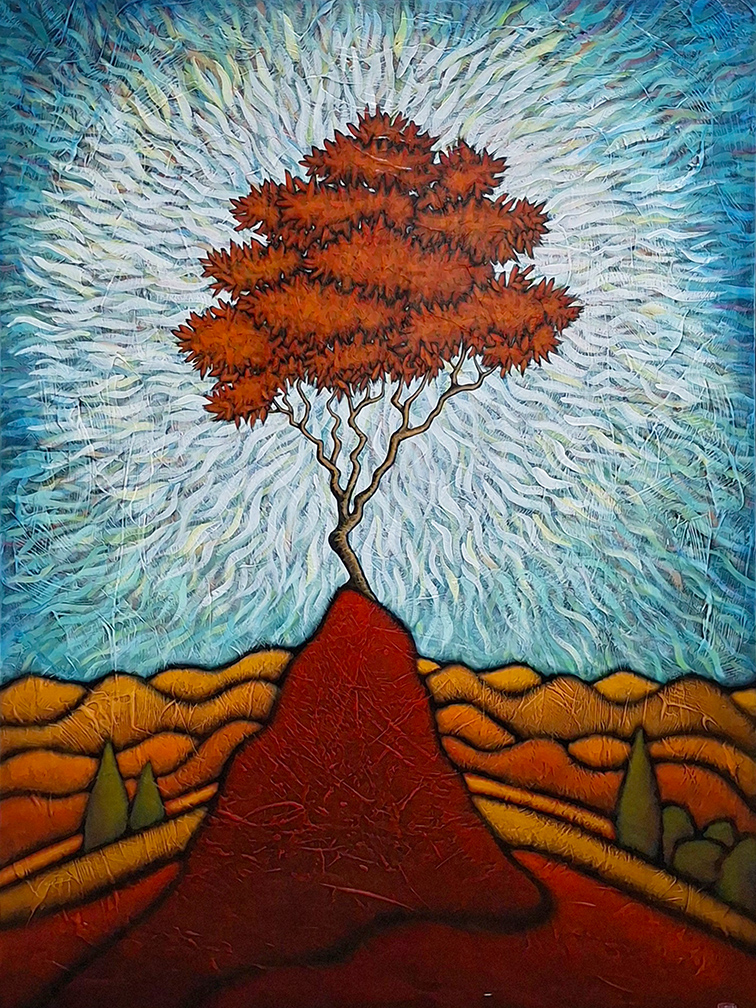
This is a new painting, a large canvas measuring 30″ high by 48″ wide, that is scheduled for my annual show at the Principle Gallery, this year called Social Distancing,which is tentatively scheduled to open on June 5.

I call it And Dusk Dissolves.

It’s a very soothing painting here in the studio, with a lot of warmth and light in its colors. I believe that is because it needed to be that in this moment.

I was trying to ease my mind in some way.

Trying to push away anger and fear, to push away anxiety and despair. To find a place in which I could rest my mind, if only for a brief moment.

And I think I find that place in this piece. In it, the Red Tree feels safe and at peace.

Yet at the same time, there is a somber wistfulness in it, as though the Red Tree is already missing the day that is still just leaving, regretting what little it has done with that precious time. As the Sartre words above attest, the day is a gift that is given to us each dawn and taken away each dusk.

This day’s gift is nearly gone.

The next dawn will bring a new gift but before that sunrise arrives there is a long dark night to be endured. Lately, it is filled with restless sleep and dreams with nightmarish imagery and intense feelings of alienation and betrayal.

Though the dawn brings a sense of joy and potential that comes with it as a gift, the ever lengthening nights begin to slowly diminish this optimistic outlook.

Maybe that’s the strength of this piece, that tension between its gratitude for the gift of the day that has passed, its peaceful acceptance of the present  moment, and its apprehension of what the new day may bring.

The current time often informs and defines my own readings of my work. Sometimes the piece translates differently over time and sometimes they emote in the same way, tell me the same story. I can’t tell on this painting right now. It’s still too close, too deeply embedded.

But I have a feeling that years from now — if that turns out to be the case– I will look on this piece and remember the comfort and reassurance it offered in a terrible time.

And that will comfort me then, as well.

Have a good day. Remember, it’s a gift.

Read Full Post »

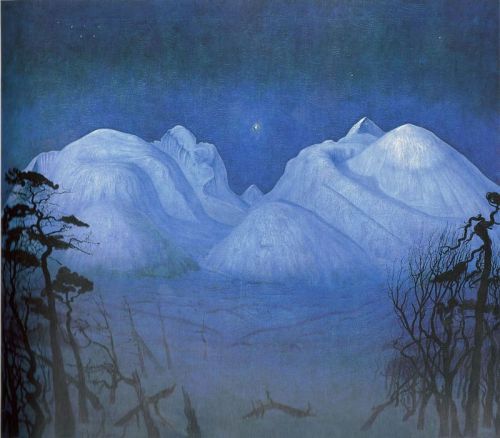
Harald Sohlberg-Night 1904


***********************

I was in the studio even earlier than normal this morning. I watched the news for a bit only to hear that some hospitals in the NYC/ Tri-state area were already near the point where doctors were going to have to decide who would be put on a ventilator and who would not. Basically, who would live and who would die. And the soulless clown in charge keeps saying that Ford and GM are manufacturing thousands of these much needed items when, in fact, they are not and that he wants to end the shutdowns in a week or so. He is willing to sacrifice lives, perhaps large numbers of them, for a stock market bump and for the fiscal wellness of multinational corporations that were as recently as a month or two ago sitting on a mountain of cash, something like $1.7 trillion.

It’s okay to let grandma die alone in a hospital so long as there’s a profit to be made.

I had to turn the news off and find something to quell my rising ire. 

Something tranquil and far removed from this horror show.

I thought I’d share a post from several years ago about a somewhat overlooked artist with whom I feel a real kinship, Harald Sohlberg, sharing many of his artistic goals and way of looking at the landscape. Like him, I seek consistency and a union of pictorial and spiritual values.

I’ve added a number of images to the original post. Take a look. Hopefully, you’ll find some tranquility in them. Have a good day.

***********************

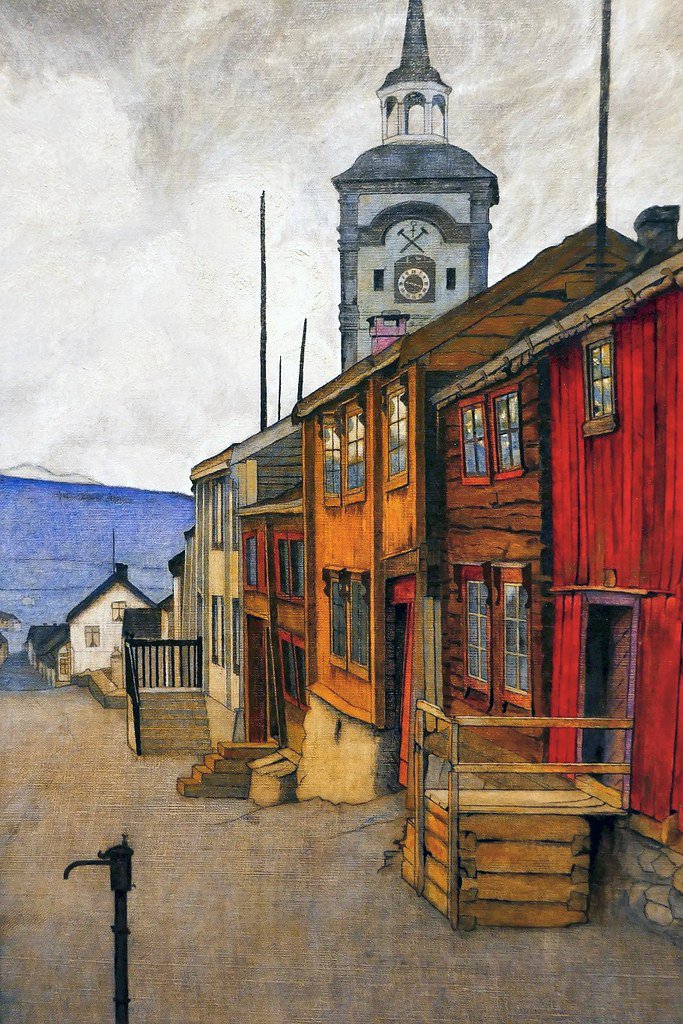
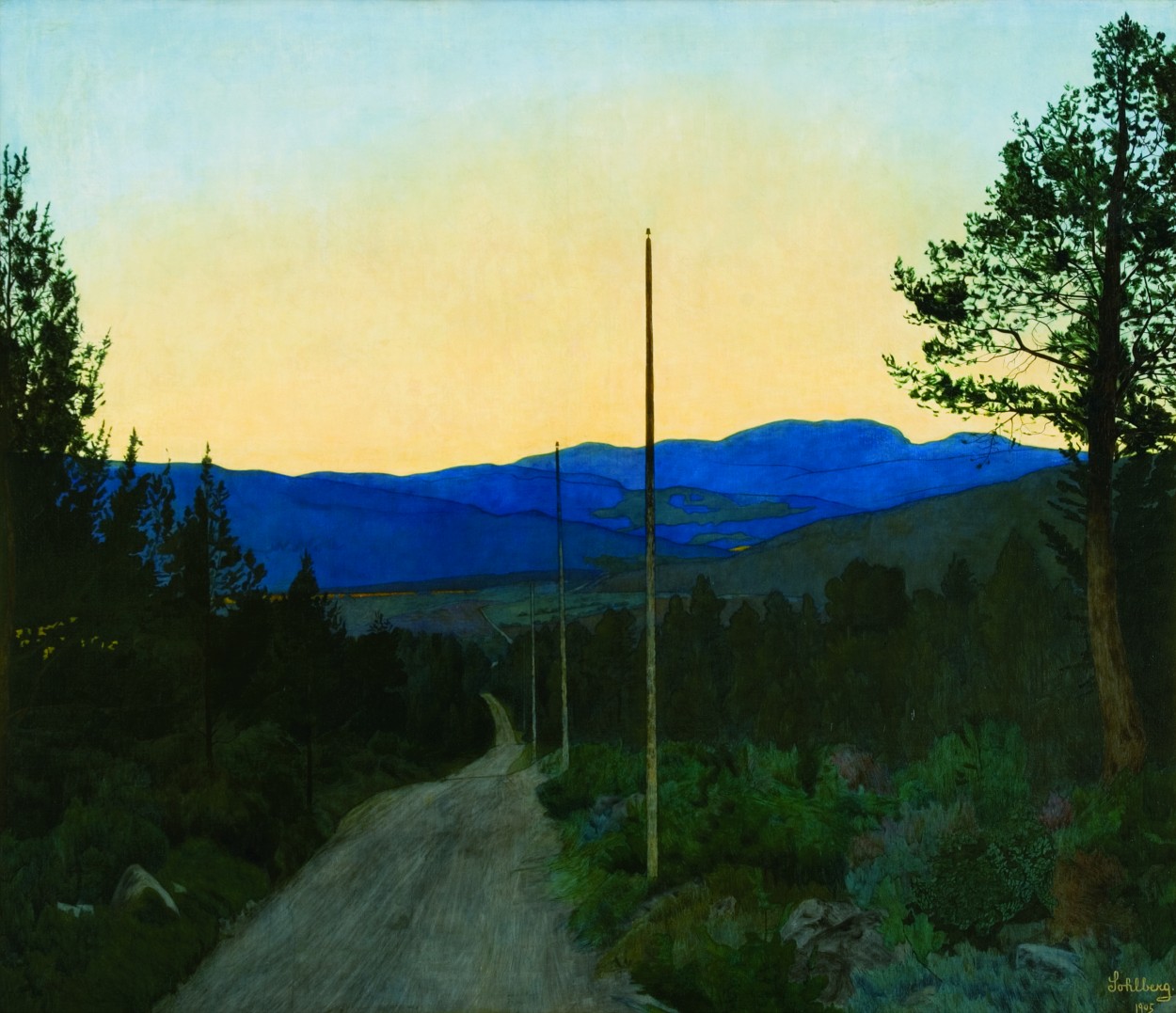
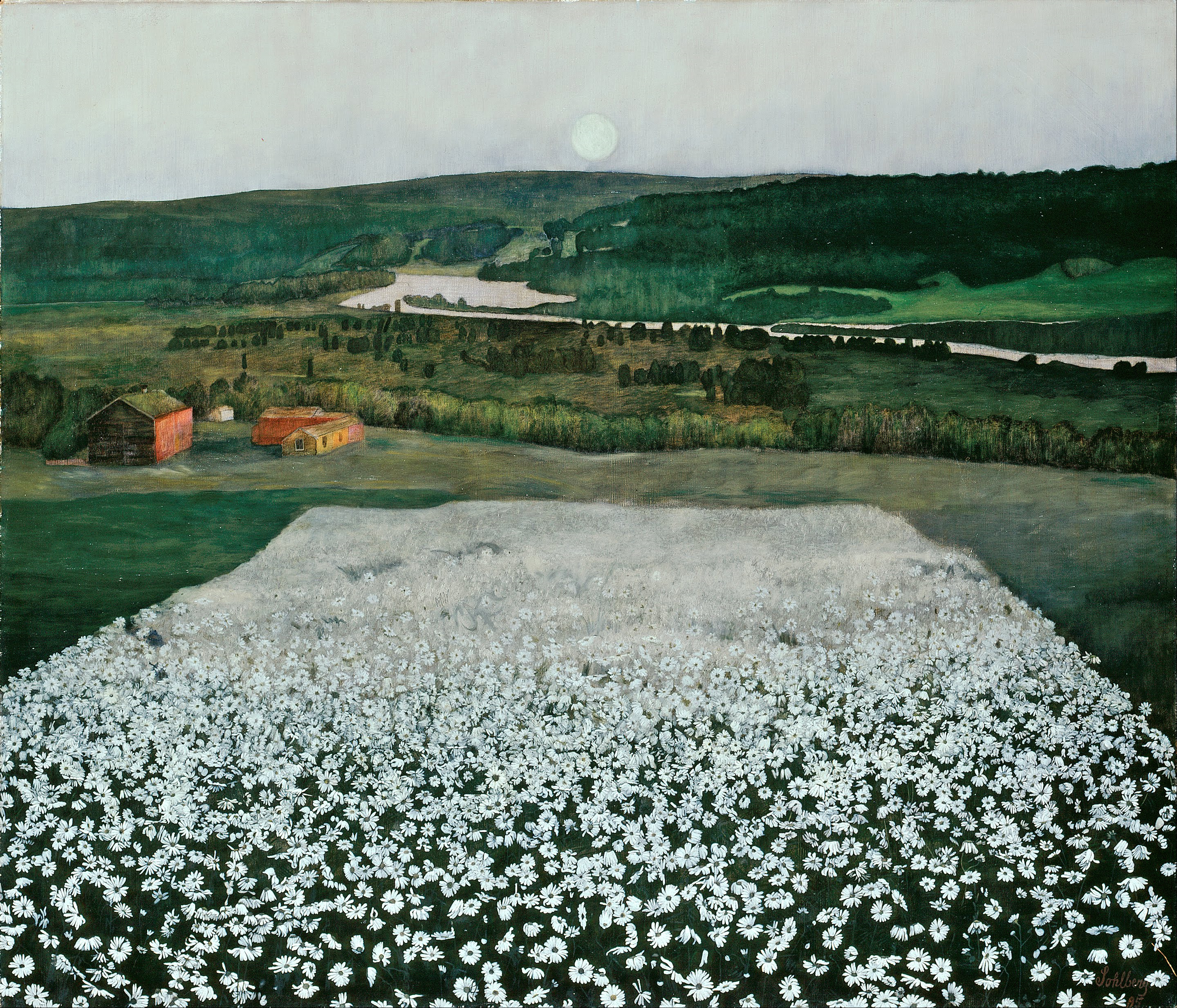
There’s a good possibility that you haven’t heard of Harald Sohlberg, a Norwegian painter who lived from 1869 until 1935. I know he was not on my radar until I stumbled across a few of his images. In fact, there is not a lot of info about him outside of a short perfunctory bio.

This kind of stumped me but it wasn’t until I came across the short essay shown below that this made sense, giving me a lot more insight into the man behind the work. I particularly identified with his connection with the landscape and his feelings as expressed in the final paragraph where, as an old man, he desired that people see his work not for the simple scenes they seemingly portrayed but ” for the pictorial and spiritual values on which I have been working consistently throughout the years.”

As an artist, that is your greatest hope– that people will look beyond the surface and see the emotional and spiritual content that the artist uses as a catalyst. Take a moment and read this essay from a 1995 exhibit at the National Academy of Design in NYC that featured the work of Sohlberg and Edvard Munch. At least take a moment to give these few Sohlberg’s paintings a good look.

In an obituary, Pola Gauguin [son of Paul Gauguin and a painter and art critic of the time] wrote that as an artist, Harald Sohlberg was alone and forgotten: “A name which was famous in its day.” Now that Sohlberg was dead, Gauguin thought, “the coldness which he helped surround it with, will thaw.” Sohlberg’s isolation was partly the tragic result of his wholehearted endorsement of the myth of genius as formulated by Romanticism and adopted by the Symbolists. Like Munch, he was obsessively preoccupied with denying that the influence of other contemporary artists had been important to him. He dissociated himself from the discussion about where he belonged in the history of art, relegating the origins of his artistic awakening outside of art to his own psyche.

Sohlberg wrote that his form sprang forth subconsciously from his first awareness of the landscape. The difference in texture of the sky and earth gave him a sense of standing on a heavy and firm planet gazing out into boundless space. He attributed the simple forms and great lines of his pictures to this first awareness of the landscape. The point of departure was the personal experience. Thus, the artist’s experience of his subject preceded the picture. Sohlberg was preoccupied with the concrete local landscape that surrounded him and his emotional reaction to it. The place, in itself, was charged with meaning. For this reason, where he sought his subjects was important. He experienced the landscape in Norway as nature in strong and intense moods and gave form to the echoes of these moods in his mind. He agreed with many of his generation who, taking their point of departure in Andreas Aubert’s writings about Norwegian art, were of the opinion that there existed distinctive, Nordic colors, clear and strong colors created by the clear, intense light of the North. Once artists realized this, it would be possible for an independent Nordic art to develop. Sohlberg believed that, along with the unique construction of the Nordic landscape, local color ought to result in a style of its own. Experience and interpretation of nature determined the choice of colors. For Sohlberg, the main color should assemble the picture and be as strong as possible.

The function of line in painting according to him was to express feelings. It could be lonely, down to earth, or melancholy. It could be willful and persevering as required. It should be developed according to the nature of the subject and the artist’s dialogue with nature. Because the picture was bound by a perceived reality, Sohlberg paid tribute to reality by portraying it naturalistically. But his gaze carried with it the legacy of picture formulas that transformed and adapted nature. He was an artist who rarely put a stroke on the canvas before the picture was clear to him in his imagination. As an artist, he was a substitute viewer. What interested him was his own experience and interpretation, regardless of how naturalistic his pictures appeared to be. Ideally everything in the picture was controlled by his will.

As an older man, Sohlberg longed for confirmation that the public saw the values he wished to impart: “it is probably true that for simple and naive reasons my works have aroused sympathy. But I maintain that they have by no means been properly understood for the pictorial and spiritual values on which I have been working consistently throughout the years.” The quotation contains three words which are keys to an understanding of Sohlberg: “Pictorial,” “spiritual,” and “consistently.” The pictorial is means for expressing the spiritual, and one was obliged to stick to the spiritual values one held true.

– From Ivind Storm Bjerke, Edvard Munch, Harald Sohlberg: Landscapes of the Mind

Harald Sohlberg-A Street in Oslo 1911Harald Sohlberg-Night in the Mountains 1914Harald Sohlberg- After The Snowstorm Harald Sohlberg-Storgaten_Røros_1904

Read Full Post »

*****************************

Acquainted with the Night

I have been one acquainted with the night.
I have walked out in rain—and back in rain.
I have outwalked the furthest city light.

I have looked down the saddest city lane.
I have passed by the watchman on his beat
And dropped my eyes, unwilling to explain.

I have stood still and stopped the sound of feet
When far away an interrupted cry
Came over houses from another street,

But not to call me back or say good-bye;
And further still at an unearthly height,
One luminary clock against the sky

Proclaimed the time was neither wrong nor right.
I have been one acquainted with the night.

― Robert Frost, West-Running Brook

***************************

The painting at the top is called Socially Distant. It’s a 20″ tall by 60″ wide canvas (much larger than it appears on the screen) that is part of my annual solo show, Social Distancing, scheduled to open June 5 at the Principle Gallery. Of course, I say scheduled because of the uncertainty for anything in the near future given our current situation.

The series of cityscapes I am doing in recent months was began just as Covid-19 was just taking hold in Asia. Not many here were following it closely or, at least, closely enough. I can say with all certainty that when I started painting these pieces they were not intended to be a commentary on this situation. I saw them as being both about its constructed form– its shapes, colors and contrasts– and the feeling of anonymity and separateness that the crowded streets and looming structures that a city offers.

But sometimes the work and the times converge. As the crisis has unfolded these paintings seem more and more prescient with their empty streets and vacant windows. The anonymity that I initially saw transformed into the social distancing required to combat the spread of this virus.

Even the colors seemed to point to this crisis. The reddish skies suggest the the warmth and fetid fertility of the hot zones that have often spawned outbreaks.

This particular painting has one differing feature from the others in the series –a lone figure standing in a second story window, just to the right of center. I wasn’t sure about this and left the figure out of the painting for weeks as I mulled it over. But as the current situation unfolded and grew, the figure loomed larger in my mind and I finally relented.

In a way, its inclusion makes the vacant city seem even emptier.

To accompany this piece, I’ve included a Robert Frost poem that I have liked for a long time, Acquainted With the Night. In this context, I especially like the last four lines of the poem and their convergence with the empty clock face high atop a tower in the center of the painting that serves as a false moon and creates a strong diagonal in the picture plane between it, the moon and the lone figure.

Take care today and have as good a day as possible.


Read Full Post »

It seems a little silly to write about my work while what is happening in the outer world beyond my studio goes on. I would prefer to give air to my anger at the gross incompetence and irresponsibility displayed by our government in its handling of the current crisis. Or to voice my anxiety for the health of my family and friends, as well as my own. Or my fears about the almost certain loss of the better part of my livelihood for at least the near future. And maybe well beyond.

Who knows how this ultimately shakes out?

So, writing about painting seems grossly insignificant, even trivial, at the moment.

But it’s what I do.

I am painting diligently now with the hopes that soon there will be a return to normalcy.

It’s what I do.

It also keeps me from thinking too much about the current situation, keeps me as sane as I can be. Now, where that falls on the sane to insane spectrum, I can’t tell you. But while it provides me with an escape route, the outer world often finds its way in.

Take the piece at the top, a new painting on paper that’s 18″ by 24″. It’s a real throwback to my earlier work with transparent color washes with hard edges and a sparseness of detail. Painting it was a joy, like meeting an old best friend once more and recognizing all those things that made that person important to you at one time. There was an inherent comfort in it for me, one that allowed me to forge ahead, finding focus even though my mind was still partially distracted.

The sky in these works always seem to dominate whatever element I choose to serve as the central character in the composition, here the house and the adjacent Red Tree. This domination provides evidence for me of our frailty, our relative smallness in the greater scheme of things in this world, in this universe. But at the same time it provides affirmation of my own existence, standing alone under the dome of the sky.

It just felt good. Feels good. The image above is not perfect, needs a little tweaking as I just noticed a shadow on the foreground. But for the moment, it’s good enough. But even though it, for the most part, takes me away from the now, the current situation always seems to creep back in. When I was finishing this piece the idea of social distancing as a way of mitigating exposure to the virus was on my mind. This piece, like much of my work, has a sense of isolation.

I decided to call it Keep Your Distance, the title taken from a Richard Thompson song from one of my favorite albums, Rumor and Sigh.

Here’s the song. Give a listen and keep your distance, okay?


Read Full Post »

Social Distancing

******************

Through vigilance, restraint and control the wise will construct an island that no flood will overcome.

Gautama Buddha

******************

Being stranded on this island is looking pretty damn good right now.

Be careful out there, folks.

Read Full Post »

**************************

“For the first time in years, he felt the deep sadness of exile, knowing that he was alone here, an outsider, and too alert to the ironies, the niceties, the manners, and indeed, the morals to be able to participate.”

― Colm Tóibín, The Master

**************************

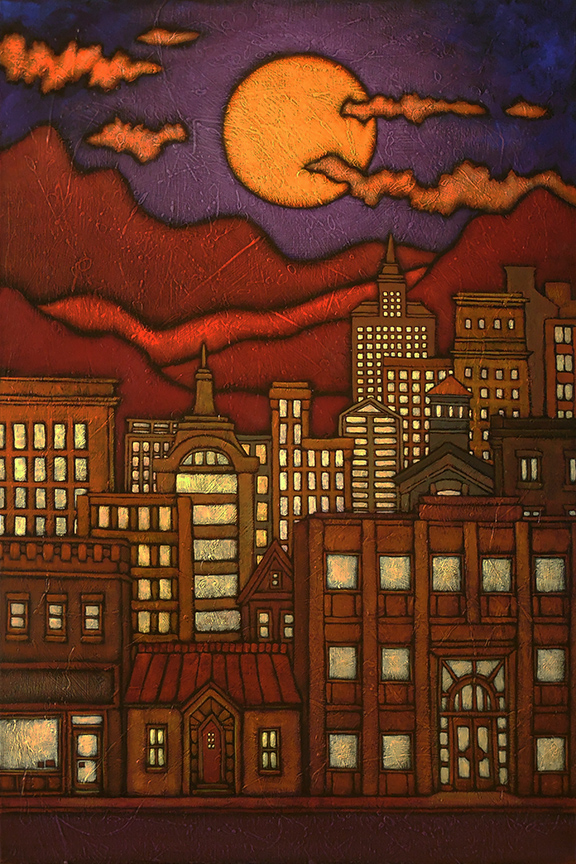
Another new cityscape, this one a 36″ high by 24″ wide canvas that I am calling The Exile’s Wilderness.

I’ve written a couple of times here about these new pieces and the anonymity provided by the looming buildings, shadowy streets and empty windows. It’s the perfect environment for the Exile, one that allows a person to slip by unheeded, almost as if invisible.

Like a ghost.

There but not really there. Constantly observing but never engaging or participating. Just as the words above from Colm Tóibín point out– the outsider who is so aware of the manners and niceties of this place that they are never comfortable enough to participate.

The odd thing about this form of exile is that the exile becomes comfortable in their isolation, their separateness. It becomes their comfort. And I think that level of comfort is what I see in this piece. It represents a feeling of estrangement yet it also feels warm and familiar with little menace. The mountains looming in the background represent the Exile’s desire for solitude and distance. They are hope.

The moon looking down on it all, for me, represents a spirit companion of some sort for the Exile, a distant presence that observes and enlightens without passing judgement. It, too, is a comfort for the Exile.

It’s a striking piece here in the studio, with the dark warmth of its colors and the Morse code-like feel, dots and dashes, of the windows’ lights. I have it in a central spot where I can see it most of the time I am at work at the easel or at my computer.

I find it comforting.

But, then again, maybe I am the Exile here.

Read Full Post »

Jean Arp- Torso of a Giant 1964

Jean Arp- Torso of a Giant 1964


*****************

Soon silence will have passed into legend. Man has turned his back on silence. Day after day he invents machines and devices that increase noise and distract humanity from the essence of life, contemplation, meditation… tooting, howling, screeching, booming, crashing, whistling, grinding, and trilling bolster his ego. His anxiety subsides. His inhuman void spreads monstrously like a gray vegetation.

–Jean Arp

**************

GC Myers- Quiescence

****************

I had a quote on the last post with a quote from artist Jean Arp about man turning his back on silence. Rather than savoring the quiet, he runs from it, instead distracting himself with all manner of noise. Anything to keep him from facing the fears that the quiet represents to him.

It’s a theme that has been large in the background of my work. Early on, when I felt that I wanted to be a writer, I would find myself writing about large open spaces and the caverns of silence that rested in these places. I called it the Big Quiet. Of course, it’s a pretty limited subject and there is a certain redundancy in writing about silence and stillness. I mean, how can you use the noise of words to aptly describe the absence of noise?

So I gave up writing about it and went on with my life, always with an eye out for this Big Quiet. I don’t know that I was craving it or fearing it at most points. My life was pretty much filled with the noise of the world, all the snaps and pops of sound and distraction that creep into every living space. I was like so many others who needed the security blanket of sound to protect them from what they might discover if they were forced to face the silence.

But the sounds that I hoped would lessen my anxiety only seemed to feed it.

However, painting gave me a path to finding this Big Quiet. It was wordless and calm, creating an inner space absent of the sounds of the world that I was and am still occupying. It became a destination, an oasis to turn to when the din of world became too loud, too overbearing. It eased my fears of looking inward and allowed me to savor the quiescence of the brief moments I actually myself there in those scenes of stillness and calm. It became real and necessary to me.

I don’t know where this going, this wordy noise I’m creating about the stillness I find now. I just felt that I should add a bit of context to my work, to give a an understanding of what I hope to take from it for myself. This moment came about from running across the image above, a piece from several years ago that is called, fittingly, Quiescence. It’s a piece that brings me quiet immediately and seeing it at any time makes me again think of the main reason that I paint.

So, I am going to be quiet now…

********************

The post above is comprised of two posts that ran here on consecutive days back in 2013. They served a great purpose for me this morning when I read them again for the first time in many years which made me think they were worth sharing.

Read Full Post »

Corona


I have a large painting, 36″ wide by 48″ high, here in the studio, one that was done a couple of years back and which has had limited exposure in being displayed. I was surprised to find that I haven’t written about it or even shared its image here in the past. I say surprised because it’s one of those pieces that feels immediately at home with me.

I would consider it prototypical of my work, a single Red Tree pushed forward in the picture, almost a portrait rather than a landscape. There is a burst of light that appears in the sky behind it, creating an aura-like appearance around the Red Tree’s crown. This led to its title– Corona.

Unfortunately, this word, corona, has taken on a new meaning as most of you know. That poor Mexican beer of the same name is being blamed by some folks — those with small and defective brains, I would suspect– as the cause of the outbreak. They probably believe there are junkyards filled with old Toyota Coronas that are radiating the virus outward 24/7.

Even though this is just gross ignorance, it makes me think I might have to rename this piece. Maybe something close in sound?

How about Corrina? You know, like the old song Corrina, Corrina?

Hmm. Have to give that some thought.

As for the song, it’s an old chestnut that was written in 1928 and has been recorded by scores of artists in a wide variety of styles. It seems to work in every genre mainyl because it’s just a very good tune. Here’s a version of the song with kind of a Latin swing from Lloyd Price, who is best known for his big hit from the 1950’s, Stagger Lee. This is not the best known version but I’ve liked it since I heard it many years ago on a Lloyd Price tape that I found in a bargain bin at a discount department store.

When I think of this song, this version always comes to mind. Have a good day and stay away from that beer.

Read Full Post »

« Newer Posts - Older Posts »