Feeds:
Posts
Comments

Archive for the ‘Painting’ Category

In My Life

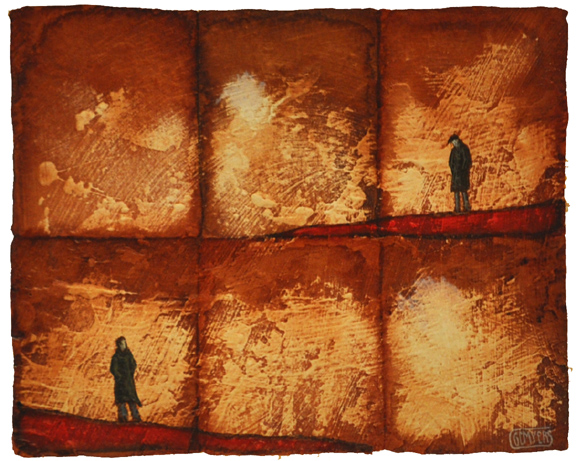
I thought I would show a little piece I recently finished.  It’s 5″ by 6″ and is on paper.  I finished the blocks that make up the background almost a year ago and it has sat on a cabinet behind my painting table ever since.  I would periodically pick it up and study it, trying to decipher what it was and where it was going but always put it back in place without doing any more to it.  There was a moodiness in its tone that made me wary of how I completed it.

But the other day I finally began to see where it was headed.  Simple. let the piece be about the texture and light.  let the figure be mere counterpoints to the drama of the environment.

I always like these pieces but am sometimes surprised when others do as well.  I consider my little figure paintings to be for my own viewing pleasure so I never have high expectations that others will find anything in them.

Still don’t have a title for this one.  I’m considering calling it In My Life, after the great  Beatles’ song.  In case you’ve forgotten, here’s how it goes:

happy birthday, linda


Read Full Post »

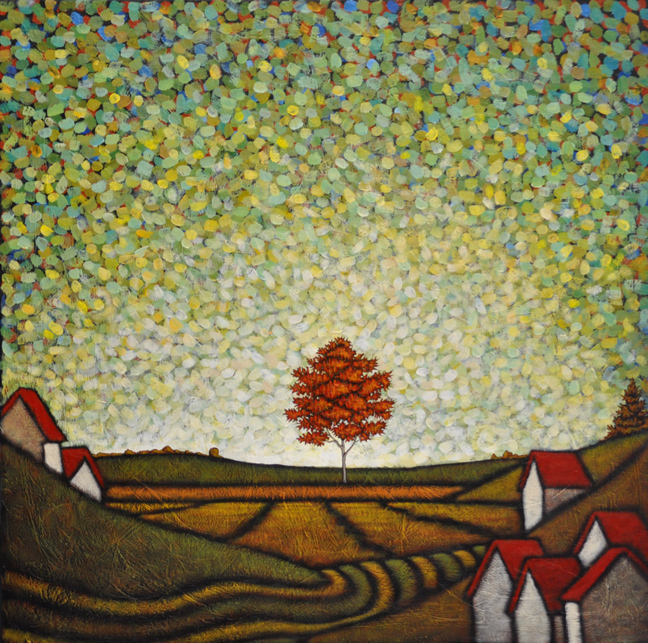
I call this recently finished piece Between Worlds.  It’s a 12″ by 24″ canvas and contains several of the elements I often use in my work.  The omnipresent red tree.  The simple red roofed house without window or door.  The patterned patchwork of the fields.  The curling path leading into the landscape.

I like the feel of this piece.  I find a great calmness and comfort in the colors of the sky even though it appears to be composed of chaos in the form of the short, choppy strokes used.  The fields below have a greater formality and order, a different sort of calmness than the sky above.  This is what brought the title to mind.

I see the orderliness of the fields and the the chaos of the sky as one might view the two side of the brain.  The sky is the creative side; the fields the logical, more rational side.  The sky is intuitive, emotional.  The fields are based in empiricism, fact.  The house denotes  the security of residing in this orderly landscape, of living in a world of fact and logic.

The tree, however, lives in both worlds.  It is rooted in the earth, the soil of logic yet grows toward the free-moving sky.  Unlike the straight and stoic lines of the house, the tree is organic and reactive as it grows, always adjusting to support itself and growing towards that which nurtures.

It is between worlds.

Read Full Post »

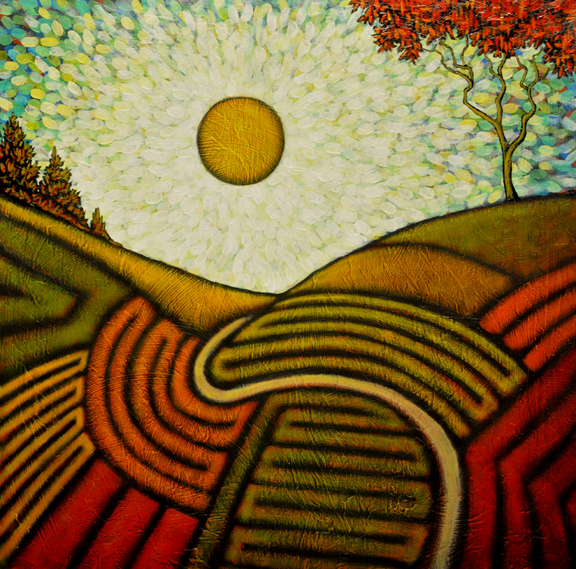
This is a painting that I’ve been working on for the past several days that I’m calling Through the Labyrinth for the time being.  This piece, a 24″ by 24″ canvas, is part of what may be a new series for this year.

I see this series progressing as a group featuring the look of my typical landscape with a patchwork of fields consisting of blocks of saturated color and random geometric patterns.  I really want to maintain  a rhythm in these fields and make them feel natural and easily translatable to the eye.

By that, I mean I want to take something that when looked at from a purely analytical stance may not be totally natural or rational and make it appear to be so within the framework of the painting.  There’s an example of this in this painting, one that I have used in the past.  If you look at the sun, you recognize it as the sun.  But when you stop and think about it, this sun defies logic.  It is darker than the light emanating from it.

This was initially done without forethought and didn’t even occur to me until a couple of other painters pointed it out.  It always translated naturally in my head as the sun, the light source, despite its comparative darkness.

This is the type of visual translation I want to continue with this next possible series. At this point, it’s still only a possibility.  I’ve worked on a couple and have another one, a large piece, taking shape in my mind.  It’s all a matter of maintaining a natural, organic flow through the piece that creates an environment where the viewer is made comfortable and secure, allowing them to accept it as a credible reality.  This sense of trust allows the piece to take on a real sense of place.

We’ll see how this goes.  This piece is a good step forward.

At least, I think so…

Read Full Post »

The Arrival

Maybe it’s the coming of spring and the later daybreaks caused by our recent shift in the clocks that remind me of how the first light of each day holds so much promise and potential.  Maybe that’s why I’m calling this smaller new painting  The Arrival.  It’s a 9″ by 12″ canvas and is a continuation of my Red Roof series.

I’ve always been enticed about the promise of potential in many things and often find myself wondering why we so often fail to take full advantage of the opportunities that sometimes rise before us.  How many of us have failed to follow their desires, choosing security first?  This always comes to mind when I spend some time doing the genealogy of my family.

So often these people, unheard names from distant times and places who become my family with the turn of a page, packed up and headed for a new horizon, leaving behind the security of  home and family.  Some sought freedoms.  Some sought wealth.  Some, just an opportunity. 

I’m not sure how many of them felt they ever captured the potential of their new land’s potential but that may not be the point.  Perhaps it is in just seeing the potential and following it that matters.

And that’s kind of what I see in this small piece.  While others sleep in their secure homes, the seeker is awake and awaiting the potential of the new day.  The new opportunity’s arrival.

Read Full Post »

This is a new painting, a 16″ by 2o” canvas.  It has a darker feeling than a lot of the recent work and has a much more ominous tone.  I think a lot of that comes from the chaotic nature of the sky and the darkness that rises up from between the field rows.

What’s this painting about?  I don’t know actually.  Like most of the work I do, there’s not a lot of predetermination in the way I paint so sometimes my paintings probably reflect my mood or state of mind from the particular time frame in which a piece is painted.  I guess I was a bit more worried than usual when I was painting this.

Or maybe this piece just worried me a little.  The chicken and the egg thing.

I often wonder if a piece reflects how I’m feeling at the moment of painting or has more effect on me after it’s done.  Maybe they’re the same thing and it’s just a matter of recognition.

I don’t really know.  I just paint.

This painting is still untitled.  I’m still trying to gauge what I see and feel in it so a title is still sort of nebulous for me.  If you have any suggestions, I’d like to hear them.  I may have another contest like the one I held last year to name a painting so use this as a warm-up, okay?

Read Full Post »

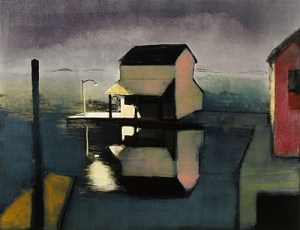
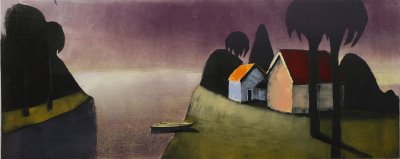
I’ve been exhibiting at the West End Gallery for over 15 years now and have benefitted in many ways. It was the first place I showed and sold my first piece of work. It was the first place my work was showcased. It was the place that first gave me hope of doing what I love as a career and has served as a jumping off point to other galleries.  So many other things as well. But perhaps the greatest benefit may have been what I have gained from observing the work of the other artists there over the years.

I’ve talked here and in my own blog of how artists from the Corning area such as Mark Reep, Marty Poole and Dave Higgins,  have shaped how I work and how I see my own work. Another such artist is Treacy Ziegler who has shown her collagraphs and, more recently, her paintings at the West End for many years now.
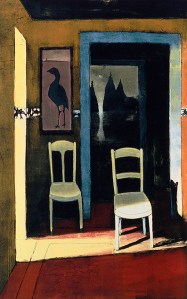
From the moment I saw Treacy’s work many years ago, I was intrigued. I instantly recognized that she was doing with her work what I wanted and didn’t have in my work at the time. Her prints had great areas of dark and light contrast and even in the lightest sections, a sense of darkness was always present which gave every piece real weight. Her bold colors and striking contrasts gave even the simplest compositions a deeper feeling.

They were also immediately identifiable as Treacy’s work. You could see a piece from across the street and you knew whose work it was. She has a very idiosyncratic visual vocabulary and her shapes and forms react beautifully with one another in the techniques she uses in producing her work.

At the time, my own work was still very transparent and very much watercolor based. With Treacy’s work in mind I started adding layers of darkness in my own way. Simplifying form. Enhancing contrast and color. All the time searching for my own vocabulary, my own look.

I’ve always maintained that artists are often more like synthesizers than creators. They absorb multiple influences and take what they see in these influences, merging them together to create something that is completely different than the original. Sometimes not even reminiscent of the influencing work.  For me, the West End has always been a great source for ideas and concepts to absorb. It may be in a certain brushstroke or the way a painting’s composition comes together or just in being exposed to a certain artist’s body of work for a long period of time. Whatever the case, I always find something in the work there that sparks new ideas within me.

And that has been a great benefit…
Read Full Post »
Reign of Light

This is a new painting that I’m calling Reign of Light for the time being.  It’s a 30″ square canvas, a size that is large enough to give the piece real impact in a space.  I’m finding that it has a very commanding presence in the studio, one that immediately pulls the eye to it and holds it.

For me, there’s an ethereal quality in the sky, as though all the many strokes of color represent the deconstruction of time as we know it.  Time breaking apart into fragments of color and light of which we can see only a portion from our earthbound positions.  On one hand, I see the tree in this piece as the seeker, the dreamer.  The climber who is driven by a longing to find a new and higher position from which to see and better understand the world.

But another part of me thinks that maybe that’s too romantic a view for this piece because it seems also like a statement of power, as though the tree is holding court and the multitude of lights that gather above are at it beck and call.

An interesting pull between two separate viewpoints, one of strength and command and the other of wonderment.  Perhaps there is room for both viewpoints here in this painting.  Maybe it comes down to one seeking power from understanding the patterns and processes of the universe and passing that power on to others so that all can benefit.

But then again, maybe it’s just a painting of a tree out in some fields.  Nothing more.

Such is art.

Read Full Post »

Yesterday I wrote about how I have often used in my own work the composition from the James McNeil Whistler painting popularly known as Whistler’s Mother.  I did so without illustrating the point so I thought I’d take quick moment to show how I might block in my own work with Whisyler’s composition.

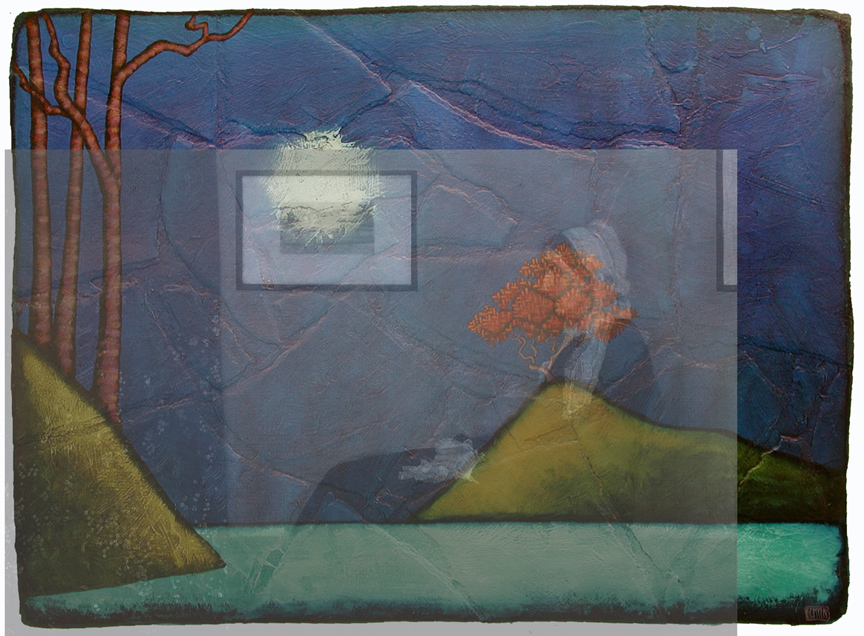
Going into my archives, one of the first things I look at is a painting from a few years back, The Way of Light.  At first glimpse, this piece has nothing in common with the Whsitler piece.  First, it is not portraiture ( although I often view my trees as such) and it is a landscape.  It is obviously a different palette of color than that of Whistler and the elements are rendered in a less realistic fashion than you would see in Whistler’s work.

But if you put those differences aside and quickly take in the shape and form of each piece, you can begin to see the similarity.  The line of trees on the small mound of land in my piece take the place of Whistler’s dark curtain on the far left.  The water in mine becomes the floor of his. The body of his mother is replaced by my island and her head becomes my red tree.  The framed print is now my moon.

Here, I overlaid my piece with the Whistler piece to further illustrate the point.  Obviously, there are worlds of differences separating the two pieces, as I pointed out above.  But the composition and use of blocking and light help us each achieve a sense of mood that is the primary goal in both cases.  Like Whistler, I am often more concerned with the mood and emotion of a piece of work than the actual subject matter.  In this pursuit I have come to view much of my work as Whistler did his, as musical compositions rather than merely representative images.

In color and shape there is rhythm, tempo and tone.  The placement of the compositional elements of a piece are much like the placement of individual notes in music, each affecting and reacting with those around it.  All trying to evoke feeling, response.

Well, there’s my illustration of how Whsitler’s iconic piece fits in with what I try to do with my work.  Hope you can now see the connection…

Read Full Post »

This is a new painting I’ve been working on for the last couple of days.  It’s a 14″ by 18′” piece on ragboard and fits well in my Archaeology series.  The upper and lower sections of this piece are painted in two different styles, with the upper being painted by adding layers of paint ( what I call my obsessionist style) and the lower painted in a predominately transparent fashion but with quite a bit of opaque touches.

Shown at the top, I wanted to show the lower section of this piece in a little more detail, to give a better idea of how this section is put together.  It’s  a chance for me to paint spontaneously, but in detail.  I  start at one corner and bounce all over the section, basically using my brush to draw the small items.  As I’m moving along, I’m constantlly weighing each new artifact against those around it then against the section as whole.  This weighing process has to do with color and shape, not what the item actually is.  I don’t really think about what the items will be in these pieces.  I prefer to let them take shape as the piece progresses although I do fall back on a number of recurring artifacts.  Some of these are the peace symbol, my initial, a shoe, a mask of some sort, books and a few others.  This particular piece also has a self-reference in the form of a small painting.

This is only the second piece in this series that has the upper section painted in this way,  showing the simplified  roots of the tree and having the sky painted with multiple layers of rough strokes.  So far I am liking the contrast between the top and bottom.  I may lighten the foliage of the tree and adjust a few parts of the sky but I’m not sure yet.  This is at a point where it requires a little time to sit and be taken in, almost with a peripheral view.  With paintings like this, with a lot of detail and action in the color and forms, I find that I need to see it but not focus on it completely to get the best overall feel for it.  That’s the real test.

So, with this piece, we’ll see over the next several days in the studio.

Read Full Post »

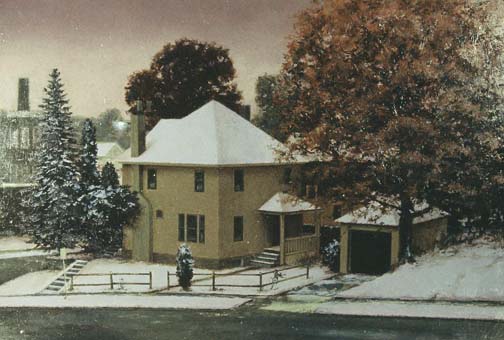
This is the view of a house that Dave Higgins, one of my favorite painters,  used to see from his bedroom as a child growing up in Binghamton.  This scene and that yellow house made quite an impression because over the years Dave has painted this particular house over a hundred times.

I mention this today to illustrate a point about how artists will often paint in series or repetitively, often using the same compositional elements again and again.  For some painters, it might become an exercise in copying each detail so that eventually the very life is squeezed out of the scene  but in the hands of a talented artist with a truly probing mind such as Dave, it becomes a study in finding nuance and dimensions that make each new version take on a new and different life.

Painting repetitively allows a painter to free their mind from trying to compose and focus on pure execution, letting them spend more of their mental effort on the surfaces they’re creating.  The less time spent on capturing the basic form of the subject  results in a scene that changes subtly with new version, revealing more depth and feeling.

Think of it as musician with a new song.  The first several times through they are focused on learning the basic construction of the composition but it’s not until it becomes ingrained in their muscle memory and they can play the composition with little thought that they are free to find and express real feeling within the piece.

This bottom piece is an early version from Dave and you can see how Dave has evolved over  the years by examining the ones above this.  He paints the scene from memory and adds and subtracts small elements to fit each new piece.  Whatever is needed to fulfill what he sees in that new version, to give the depth he’s seeking in it.  If you’ve been fortunate enough to see some of the Yellow House paintings from Dave Higgins over the years, you’ll know what I mean.

Great stuff…

Read Full Post »

« Newer Posts - Older Posts »