Feeds:
Posts
Comments

Archive for the ‘Personal Mythology’ Category

I’ve always been a fan of graveyards, a fact that I’ve proclaimed here in the past.  The monuments and tombstones are an unceasing source of fascination, both in the data provided and the design of the stones. 

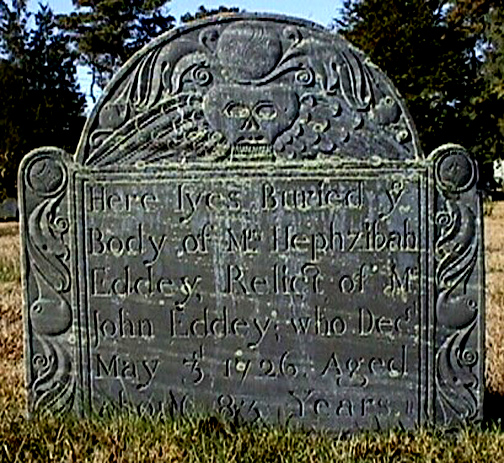
 So you can imagine how happy I was to stumble across a relative who also has a great tombstone.  Such is the case with this particular stone, one that marks the grave of my tenth great grandmother on Martha’s Vineyard.  Died in 1726 at the age of 83.  Her name was Hephzibah Doggett who was married to John Eddey.

Hephzibah Doggett.  Got to love that name.

   Before I started venturing into genealogy a few years back I had no idea of any family before the last two or three generations, and even then the history was sketchy at best.  On my mother’s side, it was almost non-existent.  So, to turn previously unturned pages in the family history is exciting and gives a new perspective on how we arrived at this place.  It also provides an opportunity to imagine how the thoughts and mind of a person like Hephzipah relate to your own, to wonder if their eyes saw things in a way that I could understand.

Of course, I will never know the answers to such questions but at least I know that she existed and has left a wonderful monument as her marker on time.

Read Full Post »

Dreaming

Woke up late this morning, tired from a night filled with irritating dreams.  Not horrifying.  Not filled with tension.  Just irritating.  Many, many fast-paced scenarios of things that just bugged me but were of no consequence, like trying to rake leaves with a rake whose handle keeps coming loose.   I woke once after one such episode and was angry for having been disturbed from my sleep for such an irksome little nothing.

As a result, I find myself here this morning with little to say but still a little peeved about my dreams of last night.  I wish I had experienced better dreams, even scary ones, so my mind would be at least somewhat sparked.  I’ve had some great dreams over the years but I can’t share them.  Too personal and in some cases, too startling  and a bit disturbing.

The one dream that still lingers in my memory is one that occurred many years ago when I was a child, perhaps 8 or 9 years old.  It was an odd dream, very calm and quiet but filled with a tension I couldn’t identify.  It was a short scene that took place in a very narrow space, perhaps only 4 foot wide,  with a wall on the right hand side from the viewpoint I had in the dream and  windows with sheer curtains on the left that let in bright, almost white sunlight.  In this little space there was a small girl, bathed pale in the white light, who looked at me curiously but without fright.  At this point, my viewpoint in the dream shifted from the person looking at the girl to that of the girl looking at me.  From her viewpoint I saw myself as a Nazi soldier with that distinct helmet and winter coat.  There was a feeling that I, now the girl, had been discovered in my hiding place but that the soldier was not the threat.

It was an odd dream and one that has haunted me for several decades.  I wonder if I was indeed the girl or the soldier and what the circumstances were meant to signify.   I had the dream at a point when I didn’t have a tremendous store of knowledge about World War II or Nazis or the ways that Jewish families hid in the war so as time passed the dream evolved from one of pure scene and feeling to one filled with more symbology.  Yet, I still wonder about that Nazi soldier and see that light-filled space as clearly I did over forty years ago.

I doubt that I will remember any of last night’s pain-in-the -ass dreams forty minutes from now.

Dreams!

Read Full Post »

Southern Gardens- Paul Klee

I was asked yesterday if I talked to my paintings.

  Interesting question.

I talk to animals.  I talk to trees and plants.  I talk to my car. I talk to my studio, which actually has a name. I talk to ghosts, present or not.   Whether any of these things or beings listens is another matter.

But talk to my paintings?

It immediately brought to mind a section of a famous lecture that I had been reading recently and had really resonated with me.  It was On Modern Art,  delivered in the 1920’s by Swiss artist and a personal favorite of mine Paul Klee :

May I use a simile, the simile of the tree? The artist has studied this world of variety and has, we may suppose, unobtrusively found his way in it. His sense of direction has brought order into the passing stream of image and experience. This sense of direction in nature and life, this branching and spreading array, I shall compare with the root of the tree.

……..From the root the sap flows to the artist, flows through him, flows to his eye. Thus he stands as the trunk of the tree. Battered and stirred by the strength of the flow, he guides the vision on into his work. As, in full view of the world, the crown of the tree unfolds and spreads in time and space, so with his work.
……..
Nobody would affirm that the tree grows its crown in the image of its root. Between above and below can be no mirrored reflection. It is obvious that different functions expanding in different elements must produce divergences. But it is just the artist who at times is denied those departures from nature which his art demands. He has even been charged with incompetence and deliberate distortion.
……..
And yet, standing at his appointed place, the trunk of the tree, he does nothing other than gather and pass on what comes to him from the depths. He neither serves nor rules–he transmits. His position is humble. And the beauty at the crown is not his own. He is merely a channel.

This very much sums up how I’ve always felt about art, especially my place as an artist.  A mere channel or transmitter.  And when I look at my paintings, it is not in the form of a conversation so much as listening  to what the painting has to tell me.  I paint because I question and, at best, the paintings provide some answers and insight that I might not find or see otherwise.

So, do I talk to my paintings?  Not so much.  But do they talk to me?  Yes.  And I do my best to listen…

.

Read Full Post »

John Isner in the 5th Set

When I was doing research on my grandfather’s career as a professional wrestler in the earliest days of the sport, back in the first decade of the 1900’s, I came across a newspaper account of  one of his earliest matches.  It was held at the Kanaweola Club in Elmira which was one of the men’s sporting clubs of that era, a place where men gathered to to participate and watch sports.  Since there wasn’t ESPN, or television, or even radio, they often held live sporting events such as pro and amateur boxing and wrestling.  Oh, and they also would drink  a bit at the clubs.

In one of his headline matches at such a place, Shank, my grandfather’s wrestling moniker, started a match one evening at 9 PM and wrestled until midnight without either wrestler gaining a fall, which means neither was able to pin his opponent or get him to submit.  They stopped at midnight and resumed the following night, wrestling for another two and a half hours before Shank was finally pinned.  I wanted to lie there and say that Shank had gloriously persevered but I just couldn’t do it.  I was proud enough that he just competed in such a marathon and I think he might have been proud of the feat despite the loss.

I don’t know if the two competitors in the current marathon competition still in action on the tennis courts at Wimbledon, John Isner and Nicolas Mahut,  are ready to say they’re proud just to be involved in such a match.  To say so would be a psychological concession of sorts and they both aren’t ready to give in just yet.   They started this match Tuesday and played until dark.  The match resumed yesterday afternoon and stretched until they could barely see the balls.  Or stand.  Ten hours in all.  The fifth set, still unfinished, stands in at a time of 7 hours and 6 minutes, making it alone longer than the longest match ever.  The third day of this grinder takes palce this morning and I might have to watch.

At this point, the competition between these two men has transcended physical triumph of one over the other and moved into the realm of conquering their own psyches, convincing themselves that they can persevere.  Steeling themselves against the desire to just give in and let it be done.

It’s a remarkable thing to witness, this stalemate of wills between two equally matched competitors.  It’s liking stealing a raw glimpse of our desire to survive, our desire to overcome struggles of life and death.  To be wounded, hurt, but still rise to our feet and return to the fray.  Only in a safer way.  This is tennis, after all.

Good on both of you today, Mr. Isner and Mr. Mahut.  Don’t give up now.

Read Full Post »

The mythology in your mind is always subject to correction.

As I was growing up there were names that were always bandied around with my dad and brother, goofy names that were a part of playful banter.  Many were pure nonsense, like Chick Chickee, and some were real people.  Some, like Leonard Box, I have no clue where they came from.  There are some that have faded from my memory long ago.  But one that always brings back those days is the name Steve Brodie.

It was always used to fill in when we didn’t know who did something.  “Bet it was Steve Brodie…” Or if we were driving over one of the bridges in town and there was someone on the sidewalk, one of us would ask, “Was that Steve Brodie?”

It was always thought that Brodie was a real person  but there was nothing certain.  Our mythology also  held that he was the first man to jump off the Golden Gate Bridge sometime in the 1930’s.  So for all of my life I held on to this bit of trivia and believed it.

Until this morning when the name just popped into my head.  I decide I could finally look up Steve Brodie and discover who he really was.  Turns out, we were partly correct.  He did jump off a bridge.  In fact, he claimed to be the first to jump from the Brooklyn Bridge, back in 1886.  And he survived and turned his claim to fame to his advantage as publicity for the successful  tavern he subsequently opened in New York.  I imagine the image shown above was used as advertising of sorts for his establishment.  His name also became part of the popular lexicon of  the early 20th century which is how we latched on to it.

So the mythology behind my memory is corrected.  We were off by 50 years and   about 3000 miles.  But we had the right guy nonetheless.  Now I have a face to put with the name.

Have a great day!

Read Full Post »

I came across this old photo from the early 70’s and was instantly sent back in time. The two gents in the shot from a Christmas season long ago are my Uncle Joey (holding the Seagrams 7 bottle– I’m not sure that he was just mugging for the camera) and Jack Reynolds, who everyone called Fat Jack , Jackboy or, as my Dad would say, Jackeee. You needed at least three e’s to get the full effect.

In 1972, we moved from one edge of our county to the other, to a little remote brick house on a hilltop plateau where the wind always swirled and the view went for dozens and dozens of miles, across the hilltops down into northern Pennsylvania. It was exquisitely quiet there, often many hours passing before a car might appear on the narrow road.

My aunt Norma and her husband, Bob, ran a dairy farm just over the ridge and Fat Jack would often be seen there tinkering with the equipment, his short, round body rolling around in the dirt under tractors in his ever present bib overalls, crudely cut off at the cuffs to accommodate his short legs.

Jack and his dad lived at the bottom of the hill in a home that his father had started building in the 1950’s. At the time when Jack’s mom died, they had only finished the basement and that is where they stopped. Jack and his father lived in the small walkout basement, a place that had a dark and dank appearance when you drove by.

Jack was in his 20’s when we first met him in the early 70’s and didn’t have a driver’s license. He could seen chugging up the hill on an old Ford tractor pulling a trailer with a large collection of his tools. Jack absolutely loved tools of any sort. Any spare money he earned went directly towards buying tools, the tool department at Sears being the primary recipient of his spending.

Jack couldn’t read or write very well, if at all, but he had a natural ability for figuring out how things worked. He couldn’t read the words but he could read diagrams and schematics like they were his first language. This ability made him a valuable asset to a farm where there are always things in need of repair. Bob was always asking him to work on this or that at the farm.

But if Jack didn’t want to do something for whatever reason, he would just say “Nope” with a grin and pick up his tools. But he’d stick around.

When we moved up on the hill, Jack started coming to our house to do a few repairs there. He took an instant attachment to my dad and I my dad took to him as well. He became a regular fixture at our house, often eating dinner with us or drinking a beer with Dad. Jack was not big on hygiene and was always carrying a little– no, a lot of dirt and grease on his clothing from playing with machines. Night after night he would plop himself in one of my mother’s upholstered chairs to the point that there was a dark, greasy line on the arms of the chair where his belly would rest. It drove Mom crazy and she would yell at him ( she wasn’t shy about yelling in her house) but she would never think of not letting him sit there or at our dinner table.

Bob, my aunt Norma’s husband and a constant needler of people, called Jack my dad’s third son and would often ask when stopping in, “Where’s the fat son?”

Eventually, after his own father died, Jack parked his tractor and started driving an old yellowish Ford Econoline van packed with his tools. He didn’t have a license but that didn’t stop him from buzzing around the hills around us, being well known to most of the farms in the area. Dad, who was with the Sheriff’s Department, turned a blind eye although a few years later he would help Jack get a driver’s license and assist him in finding work as a maintenance man at a local nursing home. He seemed to be thriving.

Fat Jack passed away sometime in the 1980’s when his Econoline slid off the road and hit a viaduct. In the impact,  his tools were thrown forward against him. He probably would have appreciated the irony of it. Might have even been happy that it was his tools that ended his life.

His basement home is no longer there, long ago bulldozed over and there remains no trace of Fat Jack anywhere but in the memories of a handful of people who got to know this strange little character. I know I haven’t fully captured the man here but I just felt that he deserved a few moments of recollection.

Everybody does…

Read Full Post »
Logging near Forestport, NYThis is a scene from the Adirondack Mountains of New York near the town of Forestport, taken in the 1890’s.   There’s a possibility this is one of my great-grandfather’s crews.  I don’t really know.  Never knew much about  the man as I was growing up, didn’t even know his full name.  My family had little link to the past, few photos and very little oral history.  So little was known of our ancestors and their lives. Thanks to the access to old records and newspapers that is now available via the internet I have been able to find out much that would have been otherwise lost to our family.

For example, the great-grandfather I mentioned above was known to have ran a lumber camp in the Adirondacks, supposedly in the north near St. Regis Falls, where my father’s mother ( who died in 1979) was born and raised.  That was about the extent of our knowledge of the man.  I knew his last name was Perry and he ran a lumber camp.

A couple of years back, I did a quick Google search with what little info I had and much to my surprise an entry appeared.  There was a Gilbert Perry listed in a book from 1895 profiling the citizens of Oneida County, NY, in the southern part of the Adirondacks.  That didn’t seem to jive with what I knew but when I read the article it stated he was from St. Regis Falls and maintained a farm there as well.  His children were listed and I recognized one name as being a sister of my grandmother, who was not listed as she wasn’t yet born.

It was a thrill to finally find something on an ancestor, something that gave their life form.  I learned that he was a hard-working, ambitious entrepreneur who ran a number of lumbering enterprises as well as a couple of retail stores and his farms.  He was considered one of the pioneers of Adirondack logging, having several camps and crews of men numbering in the hundreds along with 50 or more teams of horses.  At the time, he was signed to bring in the largest contract of lumber in the Adirondacks.

After that I started doing more research and a whole new world  opened up to me when I came across the digitized newspapers from that time and region.  Local newspapers at that time were a true mirror of the area and people they covered, giving many details on their everyday lives and their travels.  I was able to piece together a full picture of the life my grandmother’s family lived in St. Regis Falls and Forestport.  I was even able to come across a full account of my grandmother’s wedding to my grandfather, something my dad and his siblings had never heard or seen.  It gave my memories of my grandmother a new depth.

I was even able to find numerous mentions of his lumber camps, including an account of a normal day in the camp, in a number of books outlining the history of the Adirondacks along with many stories of the men who worked for him.  One was a character named Atwell Martin, called the Hermit of North Creek, who is recalled in many stories and tall tales, including one where Paul Bunyan, having heard the tales of Martin’s exploits, traveled east to visit him.  They got along famously at first but ultimately ended up in a fight where trees were upended and used as clubs and the great Paul Bunyan ends up slain.  His body was buried in the headwaters of the Black River, the dam at North Lake.

I am still doing research but it’s an interesting and different world I keep uncovering, filled with great exploits and hard lives in a harsh environment.  It’s just been a thrill to find a link to a past of some sort…

Read Full Post »

FarmerI’ve just put the final details on a couple of paintings that will be part of my solo show at the Principle Gallery in Alexandria, VA.  The show opens June 12th and I’m scheduled to deliver the work to the gallery a week before so I’m in the final stages of preparation.  This is my tenth one-man show at the gallery and before that I did two shows as part of a group of painters from the Corning , NY area that was dubbed the Finger Lakes School.  

I particularly remember one moment from the first show with that group.  There was a pretty good crowd and several of us from the group mingled, answering questions and such.  I had a small break in the conversation and I heard a female voice from behind ask her companion where we were from.  Her friend answered that we were from the Finger Lakes region in New York.  He  said it was a pretty rural area with a lot of wineries and farms.

“Well, you know, they do look like farmers,” she replied.

I think I did a spit take.  Over the years I often think back to that lady’s comment and sometimes laugh.  Maybe we shouldn’t have all worn our overalls and straw hats that night.  It just reminds me how people judge others by that initial glimpse and how often  they end up being wrong.  Actually, I’ve come to the conclusion that, in the end, I would prefer being mistaken for a farmer than an artist anyhow.  Offhand, I can think of more positive attributes for the farmer.   So, if you can make it to the opening look for the guy who looks like a farmer…

That brings me to a song, You Can’t Judge a Book, that was originally written by blues great Willie Dixon and made popular by Bo Diddley.  My favorite version was from Long John Baldry, one of the pioneers of the British blues/rock movement in the early 60’s and a guy who had real panache, but I couldn’t find a version online.  But while searching I came across an interesting jazzy version of the song from Ben Sidran.  Give a listen  and enjoy…

Read Full Post »

Copyright Bill Murcko Three Packs a Day There was an opening last night at the Principle Gallery featuring a group of work from artist Bill Murcko called Brothers of the Road, a collection of paintings featuring bikers in all their regalia.  Chatting with the gallery owner, she commented that she didn’t know if any bikers would be showing up for the show.  That immediately set off a memory from when I was kid.

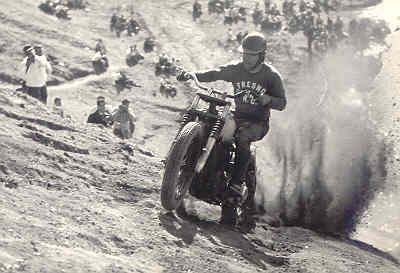
It was in the mid-60’s and I was no older than eight years old when I accompanied my uncles and father to a hill climb on a steep hillside near Corning.  The whole idea of a hillclimb is to see who could conquer the sharp rise of the hill while staying aboard their motorcycles without flying off and sliding (or rather, tumbling) back to the bottom of the hill.

It was a sunny summer day and the field at the base of the hill was littered with all sorts of bikes, mostly pared down iron monsters from the 50’s.  There were Lincolns, Indians and BSA’s, all having that  the throaty sound like chainsaw noise filtered through a big cardboard tube, making it echo and somewhat rounder in sound.  I don’t know if that description makes sense but the sound was so different that the high squeals of modern bikes racing down the highway.

early-hill-climbOne after another guys in leather pants and armless  denim jackets, most without helmets,  would get a running start at the bottom of the steep decline and fire upward, trying to fine the line that would take them to the top.  Dirt flying, undulating back and forth as their bikes belched fire they climbed higher and higher above the crowd only to come to a even steeper point in the hill.  Gunning it, they dove into the rise.  Many would suddenly flip to one side or another, their bikes stalling out as they dug their legs into the ground trying to not start rolling down the hill.  An unfortunate few didn’t get to do this instead flipping over backwards and tumbling a good portion of the way down the hill.

it was pretty cool for a kid.

But the part that remains with me most were the motorcycle gangs that were in the crowd watching.  I was awestruck watching these people.  They were unlike anything I had seen at this point in my life.  The group next to us was gang out of Detroit, the name of which had evaded my memory over the many years.  Scorpions? I can’t quite remember the image on their jacket backs.  They were bearded and filthy, most dressed in black leather or grimy denim covered with writing and patches.  Some had bike chains worn like military braids.  The thing that caught my eye were the animal paws that hung like medals from their jackets.  Were those dog paws?  One looked like a lion’s paw, for chrissakes!  

This was in the days before pop-tops of any type on beer cans.  To open a can you had to use a can opener that cut a triangular hole on the can top.  They would open a can with can openers that hung from many of their jackets and would drink the beer by holding the can at arms length and let the beer sail through air to their waiting gobs. 

Perhaps the most vivid memory from that day was of a biker lady.  She had hair that was bleached to a pale yellow-white.  I had never seen hair that color before.  She fascinated me as I stood staring at her from about eight feet away.  She was wearing worn leather pants and a black and white polka dot bra.  Nothing else.  It was, again, a new look for me.  She wore dark glasses and held a can of beer  as she looked up at the hill.

There was no trouble that day and I didn’t leave with bad memories of those people, although I was still a little worried about those paws.  Over the years whenever I’d see a biker wearing his colors I flash back to that summer day in ’66 or ’67 and that biker lady in her polka dot bra.

You can see more of Bill Murcko’s work at the Principle Gallery in Alexandria, VA or at his website.

Read Full Post »

Bob GibsonIt’s that time of the year.

Catchers and pitchers are reporting to spring training.  Baseball is in the air.

Baseball has always held a special place for me.  Oh, I was no more than an average player– decent bat, lousy arm and a so-so glove– but there was pure magic in seeing the heroes of my youth and hearing the stories of the early legends of the game.

I remember my grandmother telling me of going to NY in 1921 on their honeymoon to see Babe Ruth play.  Ruth hit a double and a triple as she recalled.

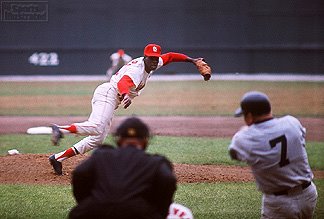
I remember sitting with my grandfather, the mythological Shank ,who used to call me  “The Rat,” and watching the  World Series in the afternoons after I had my tonsils out in 1968.  The St. Louis Cardinals were playing the Detroit Tigers and I was introduced to one of the heroes of my youth, Bob Gibson.

Gibby was it for me.  The toughest guy out there, one whose competitive fire is still legendary.   So dominating as a pitcher that baseball changed the mound height because they felt the hitters needed help since he was practically unhittable.  I read his early autobiography, From Ghetto to Glory, numerous times and that made him an even bigger hero to me.  He was eloquent and college-educated, a rarity for ballplayers of that era, and his story was compelling.  He remains a hero.

Baseball was always played at our house.  My dad was a pretty fair pitcher.  He would play catch with me and my friends and would break out his knuckleball.  It was uncatchable, having a spectacular drop that would appear to be entering your glove only to end up hitting you in the stomach.  I was never able to master the pitch but still appreciate a well thrown knuckler.

Other times, I would pitch to him and he would hit flies to my brother in the outfield.  Periodically, he would hit hard liners back at me.  They would bang off me or make me dive out of the way and he would cackle.  I would then try to drill him with the next pitch, which would make him laugh even more because he had gotten my goat.  I would calm myself and wait until he would pitch to me, waiting for the perfect pitch when I could send one back at him, making him duck or dive.

Over the years baseball has become my calendar for the passing of the year and is a comforting friend on the days when the world seems ready to implode.  I am still captive to the numbers and legends of baseball, one of those romantics who see poetry in a game based in tradition.

To that end, here is a wonderful version of Take Me Out to the Ballpark from Harpo Marx, played on I Love Lucy. It is delicate and graceful.  It’s the essence of the memory of baseball for me…

Read Full Post »

« Newer Posts - Older Posts »