Feeds:
Posts
Comments

Archive for the ‘Photography’ Category

Teun Hocks PrairieI came across these photos by Dutch artist Teun Hocks  (b. 1947) which reminded me very much of the work of Robert and Shana ParkeHarrison, which I have featured here twice before.  Actually, it was on this same day last year that I last featured them– perhaps I am looking for an alternate reality on this date as opposed to trying to relive in some way that morning twelve years ago.  The ParkeHarrisons create elaborate but real backdrops against which they photograph their Everyman in allegorical scenes– there is no digital manipulation.  It is more like the worlds created in the earliest days of cinema when what was seen had to made real in some way, even the most fantastic scenes.

Teun Hooks Untitled- Man on IceTeun Hocks works in very much the same vein except that he creates a painted backdrop against which he photographs himself as the sometimes comical but deadpan Everyman.   Think Buster Keaton here.  He then creates oversize  gelatin silver prints on which he paints in oils, treating his original photo as an underpainting.  The result is a beautiful image with a painterly feel that is  imbued with both humor and pathos.  You can’t but help feel some sort of connection with Hooks’ character as he faces a sometimes puzzling reality.  Don’t we all?

I’m showing just a handful of the work of this prolific artist here as well as a YouTube video showing a larger group.  Hope you’ll enjoy this on this day.

Teun Hocks

Teun Hocks Baggage

Teun Hocks Untitled-Man Sleeping with Weight

Teun Hocks Crossroads

Teun Hocks Music

Read Full Post »

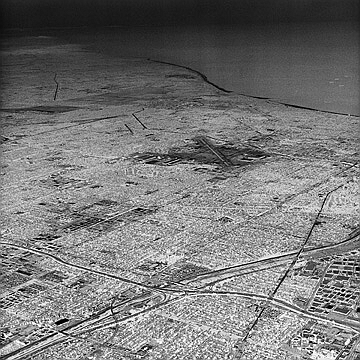
David Maisel Oblivion 1382-52nI really don’t have the time to really get into the work of photographer David Maisel but wanted to at least pass on a few of his images as well as a link to his website.  Initially, I came across some of his black and white views of Los Angeles taken from great altitudes, transforming the landscape into an abstract form that feels darkly uneasy and machine-like, the urban sprawl constantly self-replicating.  I am drawn to aerial imagery and these pulled me in at once.

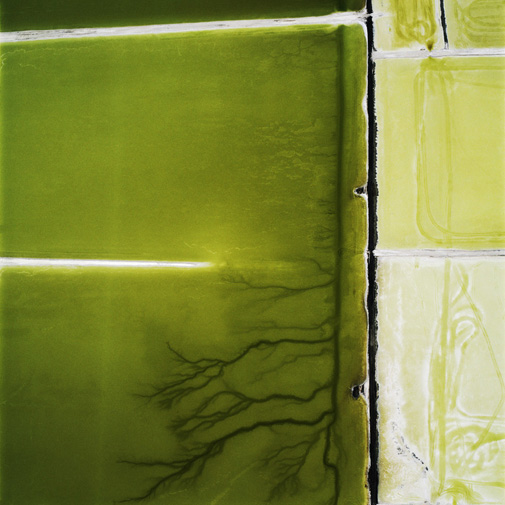
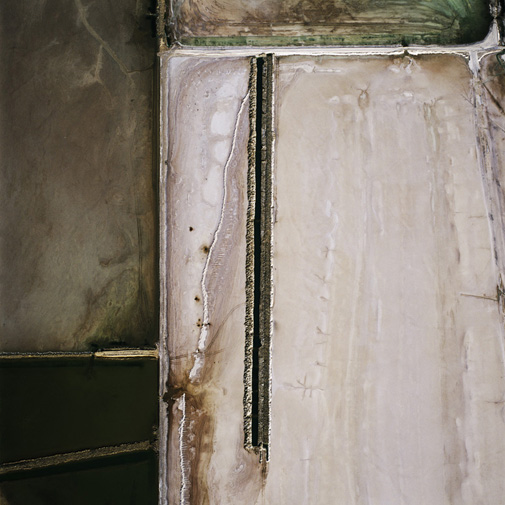
David Maisel  Terminal Mirage 22But going to his site, I was hit with a wide spectrum of images that knocked me out.  Color filled views of geometric beauty shot over the Great Salt Lake. Creepy shots of clear-cut forest zones in Maine with massive piles of logs splayed out like toothpicks.  Images that capture what he calls the apocalyptic sublime in the aftermath of Mount Saint Helens.  Images in black and white and in colors that come off as shocking of mining sites.  It was stunning work that captured the environmental impact of the continual push of humans into all spaces– beautiful and terrifying at once.

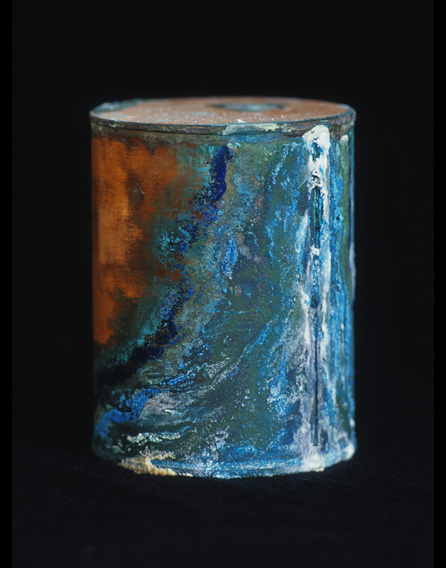
David Maisel Library of Dust 1165Even the parts of his body of work that seem to stray from his aerial assault on our perceptions were fascinating.  X-rays of antiquities.  A series called Library of Dust that shows the degradation of copper canisters containing the cremated remains of patients of an Oregon Insane Asylum who died there between the 1883 and the 1970’s, all unclaimed by family and forever resting anonymously in a decaying building.  Thousands of these sealed copper cans lining simple shelves while time works its magic.

It’s all remarkable and thought provoking work.  As I said, beautiful and terrifying.  I could see myself getting lost in any of his projects.  I encourage you to check out his site and see for yourself.

David Maisel  Terminal Mirage 19 David Maisel  Terminal Mirage 18 David Maisel  Terminal Mirage 8 David Maisel Oblivion 1381-41n David Maisel Oblivion 1380-45n David Maisel  Terminal Mirage 20 David Maisel Untitled [Library of Dust]

Read Full Post »

BOATS UNDER SAIL---Image of japanese Junks ca 1898 T. EnamiThis is an image of two junks that was taken in the late 1890’s by the great Japanese photographer T. Enami .  It was produced in the period as hand tinted  slide to be viewed in the popular stereopticons of the time.  The image was forwarded as a black and white photo to the National Geographic  magazine in the the 1920’s along with other photos of Japan from Enami.  They didn’t use the photo at the time, instead opting for the more traditional images of Japanese farmers and Geishas in a story on the island nation.  However, in the 1980’s the magazine took another look at the image and it really struck a chord with them.  The artistic beauty of the image was evident to them and they ultimately named this image as one of the best photos from their holdings of over 100 years.  It was used on the covers of one of their books and a catalog for a show of their best photography.

T. Enami - Japanese Boys in a Lively Quarrel stereopticon slide 1905I was immediately taken with this photo when I saw it.  It’s just such a beautiful composition and the harmony of the color and atmosphere make it sing.  I decide I should look at some other images from this T. Enami who was born Enami Nobukuni in Tokyo ( actually Edo at the time) in 1859 and died in 1929.  There were many images of Japan from the time, all beautifully captured with a sublime eye.  Some were surprising such as this 1905  image of 3 boys scuffling, an image that was sold in a series of slides by Sears.

But for me his images of  Mt. Fuji were the highlights.  They captured the dramatic presence that the mountain holds and are just incredible compositions, powerful and serene.  There are several of my favorites below.  T. Enami is probably not as well known here as his work deserves.  There is a site,  T-Enami.org, devoted to his work that is worth a look if only to take in more of his wonderful work.

T. Enami Mt Fuji and the Boatmen of Kashibara ca 1900 T. Enami- Mt. Fuji's Summit T. Enami- FOUR_MEN_ON_A_BRIDGE_AT_TAGONOURA_in_OLD_JAPAN.224130134_std T. Enami MOUNT_FUJI_SEEN_FROM_THE_MARSHES_OF_KASHIWABARA.  ca 1892

Read Full Post »

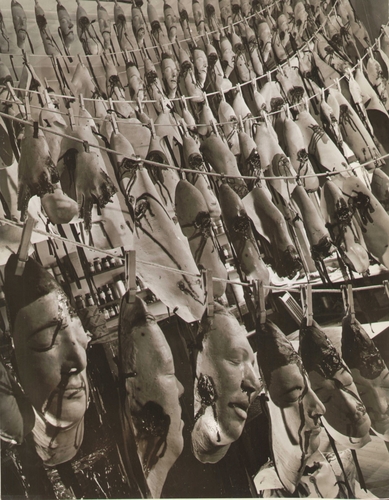
Carol Eyerman-  A Surreal Study of Latex Masks 1950There is something about a mask that captures the imagination.  Hiding our true selves behind a shield often allows us to act in ways that are often in direct opposition to who we really are or to, at least for a short time, take on a persona we would never dare exhibit as our own.  I think we all often wear masks of a sort in our dealings with people, showing only the face we choose to show at any given moment.  We seldom fully take off our masks and show our full and true self.  I think that is a reason I often feature masks in the artifacts of my Archaeology series.

So when I came across this photo it  immediately caught my attention.  It is a wonderful abstraction of latex masks hanging from lines as they dry.  I can find no story behind this 1950 photo or even much about the photographer,  Carol Eyerman , who died in 1996 at the age of 85 and was a Life and Sunset magazine photographer best known for landscape photos.  To me, it is either a shop that makes masks for Halloween or theatrical or movie productions.  I’m thinking Halloween just by the sheer number.

But beyond the facts behind the photo, it’s a terrific image with the looping lines that hold the gruesome faces and  bloodied hands rising up and away.  Like a factory of pain and torture, an image torn from a nightmare. Just a great shot.

Cherry and Richard Kearton - Wildlife Photography Pioneers 1900As an aside, while I was jumping around online trying to find more about Carol Eyerman, I came across this photo of a man standing on another man’s shoulders while taking a photo on a camera atop an extraordinarily tall tripod.  It was such a neat image that I had to stop to discover that the two men were Cherry and Richard Kearton who were brothers and pioneers in wildlife photography.  This photo was taken in 1900.  I always seem to find the most interesting things while searching for other things, as thought the initial search is actually only a starting point.  In this case, it may not be as interesting as the masks but it’s a great image in itself.

Read Full Post »


paul strand ny 1916No matter what lens you use, no matter what speed the film, no matter how you develop it, no matter how you print it, you cannot say more than you can see.

–Paul Strand

************************

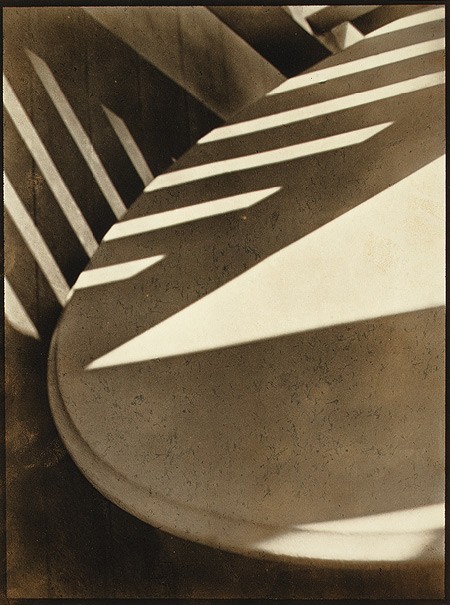
I have featured the photography of Paul Strand here before, writing about his groundbreaking work in the early decades of the 20th century.  There is something about his work and his eye that is unmistakable, something that jumps from the surface.  When I saw this photo of a park in NY, here on the right, I knew immediately that it was Strand’s work.

I love this image, with the abstraction of the forms with the sidewalk forming a flowing diagonal through the picture plane.  The single figure in the lower third of the photo, cutting across the park in full stride,  becomes the focus for me, the soul of the picture.  He becomes the singular voice in a busy anonymous world.

Paul-Strand-The-Court-New-York-1924I think  the way in which he applies abstraction to the common forms in his work is wonderful and inspiring as an artist, something too many of us forget in our own work.  We become too concerned with simply capturing subject and not the emotion created in how that subject fits into its environment.  His best work speaks purely of emotion to me and he was able to find it everywhere.  As he said:  The artist’s world is limitless. It can be found anywhere, far from where he lives or a few feet away. It is always on his doorstep.

I think those are words to live by for any artist.

Paul Strand Abstraction Connecticut 1916


Read Full Post »

Artist Charles Felu Photo by J. MaesThis is sort a continuation of yesterday’s post where I was going back through images of my older work  in the aftermath of a show, something I often find necessary in order to find some balance and assurance that I am still connected to my true self .  I think the idea of connection is probably the important part here as sometimes I often feel a bit disconnected after a show, which I know sounds counter-intuitive. You would think the feeling of connection would be at its highest degree.

Besides scanning my old work, another thing I do to find connection is to go through other images as well, either of other artist’s work  or the artists themselves and their environments.  In their work I am  looking for a voice or expression in their work that is similar to my own, as though finding this common ground will somehow bind me to the greater continuum of  artists.  The same holds true for seeing artists in their studios or at work.  The common experience of creating provides a connection that makes me feel less out of the loop.

In doing so, I often come across interesting images that provoke thought and,occasionally, new directions.  For example, one image that caught my eye is the one above of Belgian painter Charles Felu, who was born without arms and painted with his feet, working in the last half of the 19th century.  Seeing this connects me to that need to express oneself, that driving  force  that has kept me pushing ahead for most of my life.  So many people have overcome  great obstacles to have their voices heard that it makes me grateful that my own obstacles are relatively small and easily overcome.
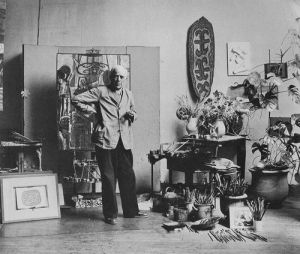
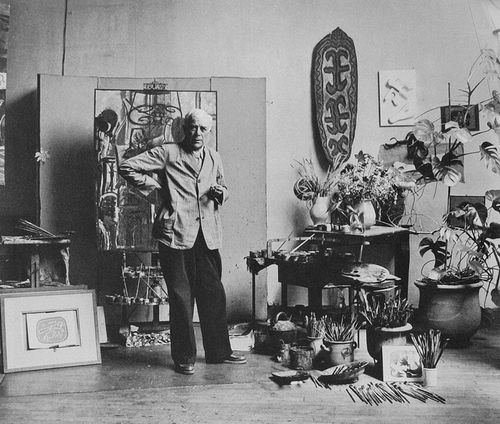
Artist Georges Braques in Paris studio 1948Sometimes, there is inspiration for new work in these photos.  For instance, when I saw this photo of Georges Braques, the Cubist innovator whose quote– There is only one valuable thing in art: the thing you cannot explain— was a rallying cry in my first efforts as a painter, I was taken not so much by the man or his studio but by the smaller framed piece to the left of his feet and the shield-like piece on the wall to his right.  Just a glimpse at both had my wheels instantly turning, the shapes and flow of these pieces translating into my own vocabulary. Instant inspiration.

Artist in Japan by T. Enami ca 1915-1928Another was this colorized image of a Japanese artist at work in the early part of the last century.  There is a great serenity in the space,  in his pose and even in the elegant manner in which his work tools and materials are arranged.  The beautiful cooper pot of water feels like a meditative pool here instead of merely a place to clean your brush.   It has an immediate calming effect on me, something that is often needed in the days after a show as I struggle to regain my footing.

Even as I am writing this, I am feeling the effects of these images, beginning to feel a connection once again.  I feel a bit of inspiration and calm, both greatly needed for me to create.  This is already turning into a good morning.

Got to go…

Read Full Post »

Taxis to hell- and back- into the Jaws of Death  Robt. F Sargent, USCG Photo 1944I think if you need an image to answer the question of why we take this day to honor  those who have served in the military, this might fit the bill.  It is titled “Taxis to hell- and back- into the Jaws of Death” and was captured during the D-Day invasion of 1944 by Robert F. Sargent, a Coast Guard photographer.  I can’t even begin to imagine putting myself into the boots or minds of those soldiers as they came off those landing barges, can’t fathom to any degree the basal fear  that must have been surging through each of them.  My stomach is in a knot just looking at this.

This is a trial of terror that most of us will never have to face, thankfully.  We should be more than grateful for those who been willing to put themselves in the path of great danger , for those that sacrifice their own opportunity for a long and comfortable life so that their comrades and those at home might have one.  They deserve a day, our gratitude and much more.

I am always conflicted on this day.  It’s too easy to be caught up in the romance  of war and combat from a distance, as though it were a mere video game that you can simply walk away from.  It’s much to easy to beat the drums of war from afar. We must honor the sacrifices of these soldiers by understanding the harsh reality of war and its aftermath,  resolving to try to avoid putting future generations of young men and women in harm’s way.  Who among us would want our children or any other child to have to face the scene in this photo?

Take a moment today and put aside the trappings of the holiday that have evolved from this day and remember why it is a holiday.  Be thankful for those who have sacrificed and pray that we can avoid future wars.


Read Full Post »

Babe Ruth Syracuse NY Aug  1922I came across this photo yesterday.  It’s one of my all time favorites.  It’s a shot taken in Syracuse in August of 1922 that features Babe Ruth surrounded by a throng of kids.  He stands in the middle of the crowd,  glowing like a sun that is creating a gravity from which no kid can escape.    I think this photo perfectly captures the incredible charisma that Ruth displayed for the American public.

I believe this was taken at Burnet Park where the Babe appeared at a game between two teams in the newly formed Babe Ruth League.  One of the teams was from the  House of Providence orphanage in Syracuse and many of the kids in this photo are no doubt orphans.  They surely felt a keen kinship with Ruth who had been sent to St. Mary’s orphanage in Baltimore  by his parents when he was an out of control child.  He was one of their own.

It was easy to love the Babe when I was a kid.  I read everything I could on him, knew his stories and stats inside out and remember my Grandmother telling me about seeing the Babe play when she and my Grandfather were on their honeymoon in 1921.   I also remember standing in front of his locker at Cooperstown the first time I was there as a child, looking on at his bat and uniform as though I were a true believer  gazing at some ancient religious artifact.  His big hands had actually gripped the thick handle of the bat.  That amazed me because he was more a mythic character than real man at that point– Paul Bunyan dressed in pinstripes.

He really was a character out of myth.  Everything about him was big–  his physical stature, his appetites and excesses, his generosities and his successes and failings.  He won and lost on a grand scale.  In many ways, he was a pure symbol of our country at that time.  Big, brash, loud and naive.  Famous and wealthy but still of the people.  He was a Horatio Alger rags-to-riches hero come to life.  He was America at the time.

I could just go on and on about the Bambino but I think this photo just about sums its up.  His big round head dominates the scene and the kids reflect back to him the unabashed affection that he emitted towards them.  I always think of this photo as a the head of a sunflower with Babe being the very center and the kids being the golden florets that surround it.  The faces of those kids are wonderful as well, like a compilation of Americana pulled from  Norman Rockwell paintings.   I would imagine almost all are long dead since this photo was taken 91 years back but I wonder what became of many of these kids, what sort of lives they led.  How they made it through the coming Depression and World War and where they ended up.  But I can probably imagine that most of them remembered the day that they stood with Babe Ruth until the day they died.

Just a great photo…

Read Full Post »

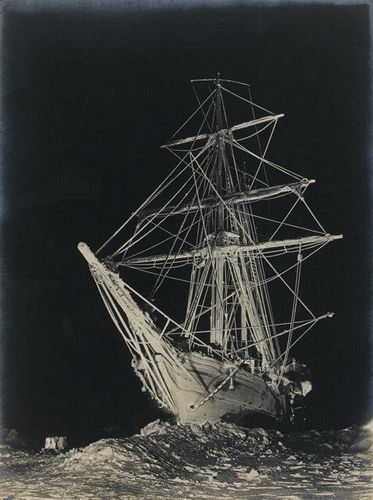
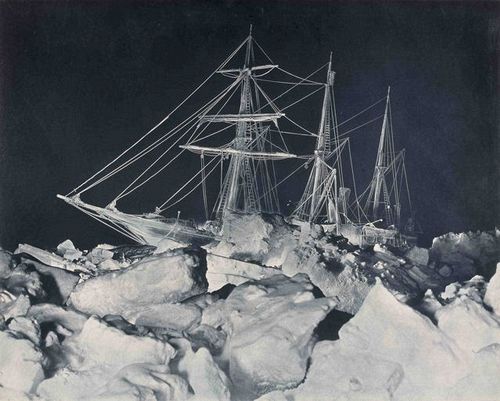
Frank Hurley- Endurance in the Antarctic- Ghost Ship 1915I came across these photos from the great Frank Hurley when he was part of the fabled Shackleton Expedition (Imperial Trans-Antarctic Expedition 1914-1917) that tried to cross Antarctica but was trapped  en route in a huge moving ice floe that ultimately crushed and sank their ship, the Endurance.  They  drifted for months and months on ice floes and were in lifeboats in the frigid sea for several days until finally making landfall, nearly 500 days since their voyage began.  This photo shows the Endurance as it is held in the clutches of the Antarctic ice at night.  It’s ghostly image really caught my eye and made me wonder how the members of the expedition might have felt, trapped in a most inhospitable place so far from anyone without any form of communication as you watch your only means of escape slowly be crushed.  

What makes man push to those extremes?

Frank Hurley- Endurance in the Antarctic Night 1915Part of me admires them mightily and makes me wonder if I have ever possessed anything near that drive.  It certainly doesn’t feel like it as I live my relatively safe and comfortable life.  In fact, most of us spend our lives striving to avoid ever being put in harm’s way.  But what drives these others?

I certainly don’t know.  As I said, their exploits fascinate me.  Their actions, which on the surface seem foolhardy for even being considered, take on heroic perspective over time and I suppose that explains my admiration.  I think we all like an epic, almost mythic,  journey.  But I still find myself wishing that I could really get a sense of what they truly felt as they stood in cold silence of the Antarctic night and looked at the frozen bones of their ship.

Perhaps that is just part of the soul of a man.  Here’s a great version of the old Blind Willie Johnson song, Soul of a Man, from David Lindley and Harry Manx.  Great playing on this cut.

Frank Hurley Endurance in the ice 1915 


Read Full Post »

Nadar_autoportrait_tournantWhile following the events of last week , both in Boston and in Texas, it seemed as though the media was constantly mentioning how many terrible things had happened during this week in the past.  The Oklahoma City bombing and the end of the siege at  the Waco compound of the Branch Davidians, to name a couple.  It sent me to  the computer to search for something more positive to mark this week of the year.  I came up with the first exhibition of the Impressionists in  1874.  It took place at the Paris studio of a photographer called  Nadar.  The story of this  photographer looked even more interesting  than the original story  of the Impressionists and set me off on a tangent.

Nadar Self Portrait 1909The Frenchman Nadar, who lived from 1820 -1910 and whose real name is Gaspard-Félix Tournachon, was a larger than life character who acted as a caricaturist, photographer, journalist and a pioneering balloonist.  That’s him above in a revolving self portrait that he did in 1865.  Of course, the automated spinning was a bit after his time but I’m not sure he didn’t see it coming.  He was always pushing for the advancement of  heavier-than-air flight, in the form of balloons at the time, and was a friend and associate of Jules Verne, who based his book Five Weeks in a Balloon as well as a character in his book  From the Earth to the Moon on Nadar.

Nadar Le Geant Gondola after flight and wreckHe was well known for his aerial photos of Paris taken from a tethered balloon.  In fact, he was the first person to take an aerial photo in 1858 although none of these survived until today.  The aerial shot below of Paris  is from 1867.  In 1863, he built a huge gas balloon, Le Geant (the giant),  the largest to date.  It had a huge two story gondola and had room for thirteen passengers as well as a lavatory and other amenities such as a darkroom and a lithograph press on which short reports would be printed and flung from the balloon.  After a failed first attempt, a flight that lasted more than 17 hours and covered 400 miles was made but unfortunately there was a mishap on landing.  The winds were high and the gondola was dragged along the ground for several miles, injuring  all aboard, some seriously.  But it never deterred the forward looking Nadar, who sent the balloon to England to be displayed at the Crystal Palace in hopes of raising funds for an future attempts.

Nadar Aerial View of Paris 1867

The ballooning aside, his portraits of the leading names of the time are really wonderful.  Artists such as Monet, Corot and Delacroix were all subjects as were many others from all other fields– the actress Sarah Bernhardt; the composers Rossini, Chopin and Liszt; writers Baudelaire and George Sand.  Perhaps most striking of his portraits is a shot of Victor Hugo as he lay dead in his bed,shown here at the bottom of this post.

It all amounts to a pretty big life, one that we know little of today except as a footnote to other events.  I’m glad I followed that tangent…

Nadar Death Portrait of Victor Hugo

Read Full Post »

« Newer Posts - Older Posts »