Feeds:
Posts
Comments

Archive for the ‘Recent Paintings’ Category

GC Myers- Into the PatternMy latest works have been focusing on the use of pattern within my landscapes.  Well, I guess you could call it pattern.  There is often a motif of shape and sometimes a direction of movement but for the most part it is fairly chaotic and seemingly without order.  Maybe that is what art is –trying to see pattern within chaos, trying to impose some sense of order so that we might better understand what we are seeing.

And maybe it is our reaction to seeing an emerging pattern that defines what we consider as beautiful.  I am sure many of you have once seen an image that struck you immediately and remained in your mind even if it was only seen in a glimpse.  I know I have.  I am often mystified as to why this occurs.  My only explanation is that its form and pattern somehow jibe with some innate sense of form and pattern, something inborn and with us since the beginning of our time as a species.

Perhaps even the patterns of those things of which we are made.  Maybe the pattern is us.

And that could be expressed through religion.  Or spirituality.  Or physics. Or art…

That being said, this new painting is an 18″ by 36″ canvas that I am calling Into the Pattern.  For me, it represents what I have written above– that we are  part of the pattern  and the pattern is part of who we are.  The Red Tree here is understanding of this and begins to meld into the strong pattern of motion seen in the sky, as expressed by the leaves coming from its limbs.

This is a pretty simple image but it has a nice tension between chaotic motion and calm stillness of understanding.  At one point, I had painted in a figure near the tree.  For me, it absolutely destroyed the impact of the whole piece, distracting focus from what the painting was trying to send out.  The figure just plain bothered me and it didn’t take much thought for me to decide to paint it over.

It was amazing how this changed the painting and my perception of it.  Now, it is one of those pieces that I look at quite often throughout the day here in the studio, pondering what it is saying to me and trying to decide if we are part of the pattern or if it is part of us.  Or both…


Read Full Post »

GC Myers- Icon- Tacy CooperThe more I read about this ancestor,the latest entry in my Icon series,  the more interesting I find her.  Her maiden name was Tacy Cooper and she is my 10th great-grandmother, born around 1609 in England.  Little is known of her parentage or when exactly  she came to America but she is known to have lived in Dorchester, near Boston in the Massachusetts Bay Colony in the early 1630’s.

At the time, the Colony was strictly ruled by the Congregational Church and its precepts.  Very puritanical, of course.  Many of the settlers who were coming into the colony sought more religious freedom than was being offered and under the influence of Roger Williams, set out  in 1634 to leave the Colony and establish a new community outside its boundaries.  They sent out a party of scouts who chose a site on the Connecticut River below present day Hartford.  Soon after, a group of about 100 people set out by foot for this location.  Among them was Tacy Cooper and her future husband, Samuel Hubbard.  They met during this journey and Samuel later wrote that Tacy was the lone bright spot in the whole undertaking.

Although the heavy goods for the community had been shipped by boats from Boston up the river, it was a harsh trek.  Many of their provisions had also been shipped and their trip was ill-timed.  By the time of their arrival, a bitter winter had set in on them and the boats had not arrived nor would they arrive in the future. Without those provisions,  a number of this group died that winter and those who remained survived on acorns, malt and grain that had brought along as seed for future crops.  To make things worse, the Pequot Indians were attacking as they tried to stem the spread of the settlers into their territory.

But they persevered  and in 1636, Tacy and Samuel were married.  However, the religious freedom they sought did not come to bear in this new community.  Samuel spoke up in protest to the role of the Church Elders in the local government and was driven from the community along with several other families who were in agreement with him.  They fled south, settling in the area now known as Springfield, Massachusetts.  They thought they were outside  the boundaries of the Massachusetts Colony but in subsequent years,  the provisions of the settlement of the Pequot Wars brought that location back into its realm.  In protest, Samuel and Tacy became Baptists.

In the following years, Baptists were banished from the Colony and, after many threats, they fled once more, this time to Rhode Island where they were reunited with Roger Williams.  They lived peacefully there for many years as members of the Baptist Church but it didn’t end there.

In the mid 1600’s, a movement had began in England– the  Seventh Day Baptists.  While they were almost exactly the same in their beliefs as traditonal Baptists, they observed their sabbath on the seventh day, Saturday.  In 1665, Stephen Mumford moved from England to Rhode Island, bringing this new sect with him.  He spoke of this beliefs to Tacy and Samuel  and a few other members of the First Baptist Church of Newport.

It was Tacy alone who first chose to join with Mumford in observing a seventh day sabbath.  Soon after Samuel and four other joined them and they formed the first Seventh Day Baptist church in America.  Tacy is considered the first American founder of the church.  The Seventh Day Baptists exist to this day and were a big part of my mother’s line for almost two hundred years and six generation, although I am pretty sure she would have not been aware of this fact.

While I am not a religious person in any organized sense of the word, I still find it fascinating in the way religion has shaped much of my( and just about everybody else’s) past.  I am pleased that Tacy was such a strong woman.  She was the one who stood and answered the Church Elders when she and the others were made to account for their desire to break from the Baptist Church.  She went before the congregation and  with “great clearness and force” outlined their reasons for departing.  I can’t help but think that this must have been a rare moment in early America– a woman speaking to power.

This may not be the best painting of the Icons but it moves me in the same way.  I always hope to find something in these stories that I can take for my own life and I can only hope to one day have Tacy’s strength and conviction.


Read Full Post »

GC Myers- Jumping Off PointBetween two worlds life hovers like a star,
‘Twixt night and morn, upon the horizon’s verge.
How little do we know that which we are!
How less what we may be! The eternal surge
Of time and tide rolls on, and bears afar
Our bubbles; as the old burst, new emerge,
Lash’d from the foam of ages; while the graves
Of Empires heave but like some passing waves.

Lord Byron, Don Juan

***************

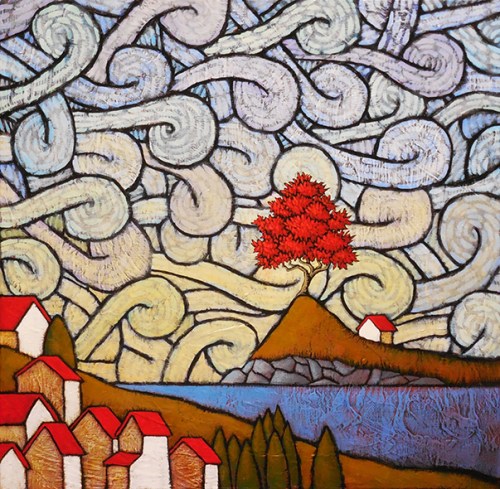
I chose the stanza above from Lord Byron’s Don Juan to kind of describe this new painting because it seemed to fit so well what I was seeing in this piece.

When I look at it the Red Tree seems to be an intermediary between differing worlds–  between the solid ground of earth and the airiness of the heavens, between the closer living of the settlement of houses and the wide open spaces of the fields and hills beyond, between the now and eternity, between the visible and the invisible.

Standing with one foot in either world, it becomes a moment of contemplation on the temporary nature of our existence.  Standing there before the suddenly visible and unrelenting power of nature and the universe– the eternal surge of tide and time— the Red Tree recognizes its own smallness and insignificance–How less what we may be!

This idea of  insignificant beings living but for a short time may seem like a dismal prospect to some.  But I don’t see it that way.  If anything, I see this as a celebration of just having the opportunity to bear witness to the grand spectacle of life set before us each day, to have a chance to play a part, albeit small, in the machinations of the universe.

Maybe this is too much for a simple painting such as this to bear.  Maybe you will not see it in the same way, only seeing a tree on a mound overlooking a group of houses with a patterned sky.  That’s fine because in its simplest terms that is what it is.

But even the simplest moments and images can have greater depth and meaning if we only choose to look more closely, to choose to perceive our place in the world in a different manner.

Well. that’s what I think anyway…

—Oh, this painting is 18″ by 18″ on canvas and I am calling it Jumping Off Point.

Read Full Post »

Sustenance

GC Myers- SustenancePainting is the pattern of one’s own nervous system being projected on canvas.

Francis Bacon

********************

I am still in the midst of processing this new painting for myself, trying to determine what it is saying to me.  For now, I am calling this 16″ by 20″ canvas Sustenance.  There is something about the pattern of the sky filled with rays containing smaller strokes that remind me of surging atoms.  Maybe it’s my own nervous system being projected as Bacon says above or maybe it is an energy that feeds everything.  The ubiquitous energy  that transforms into vibrant, richly colored life.

I am still not sure.

You might notice that this is not a Red Tree.  Yes, this is the rare Green Tree.  Coming to the end  of this painting, I decided on green as a contrast to the reds and oranges I had used for the land around the tree.  It just felt right from a design standpoint and I think it works here.

It has emerged better than I had originally thought it might when I was working on it.  But, as I said, I am still taking this in. There are a lot of things in this simple painting that speak to me but I still can’t exactly put them into words.

And I kind of like that it doesn’t have an obvious read for me, that it leaves me without words.  So, I will stop now and just try to figure out what those words are…

Read Full Post »

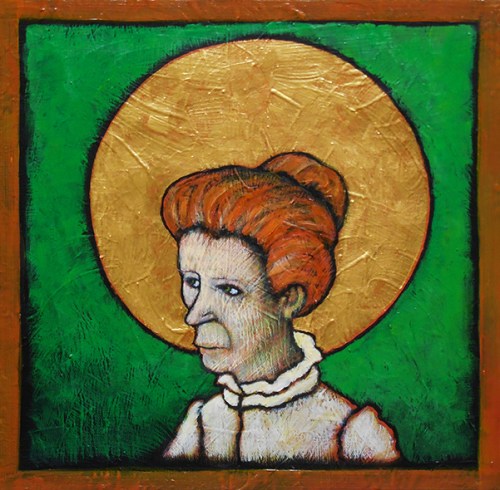
GC Myers- Icon: Joe H.Here’s my latest entry into the Icon series, a 12″ by 12″ canvas piece that is titled Icon: Joe H.  He is my 3rd great-grandfather and his name was Joseph Harris and he was born in the Lindley (the town named after our common ancestor, Eleazer Lindsley,who was among the first Icons) area south of Corning in 1833.
He led a fairly typical life for the time and place, serving in the Civil War and raising a family.  He worked primarily as a blacksmith and a sawyer ( I have a lot of lumbermen in my family– maybe that’s where my affinity for trees comes from) in his early years, working for a number of years in the then booming timber business that was taking place in northern Pennsylvania and western NY.   It was there that his wife, Emeline Whitney, died just a year or so after the end of the Civil War.  Later in his life, he returned to the area of his birth, settling in as a farmer  just over the border in Pennsylvania where he died in 1922.

That was about the extent of his life for me, at least what I could find of it in records.  I did discover that he married his step-sister, Jennie, who was twenty years younger, as his second wife.  But it was my research into local newspapers that gave me a better sense of him.

Looking at records gave no indication of anything but the basics but in his 1922 death notice printed in the Wellsboro Agitator ( I love the name of that paper!) the headline lists him as a “Skilled and Noted Musician.”  It goes on to say that he had been the one-time Banjo Champion of the United States.  He very well may have picked up the banjo from his Civil War experience as it’s popularity in the time after the war is often attributed to many people being exposed to it for the first time during their service.  I could never find anything to document a championship which was no big surprise as it most likely occurred somewhere in the 1870’s or 1880’s and whatever group sanctioned the competition is more than likely no longer in existence.

But I was pleased to know that music played a big part in his life and I later found an item that confirmed this.  It stated that his son, William Harris, was working as a musician in one of the  oilfield boom towns in northern PA in the 1890’s when he tragically took his own life by shooting himself at the hotel where he was living.  As is often the case, you find a lot of tragedy when you look backwards so it’s some consolation to know that there was a bit of music and joy mixed in there somewhere.

I did visit Joe’s gravesite a while back.  It is a bare-boned and flat plot of land that sits next to a harsh little trailer park visible from the new interstate.  Standing at his grave you looked into the backyard of several trailers, the kind of yards scattered with kids toys, spare tires and oil drums.

It made me a little sad but then, I guess a guy who lived through the Civil War, endured the death of his first wife and several of his children before him and lived to see the first World War, this wasn’t all that bad.

Read Full Post »

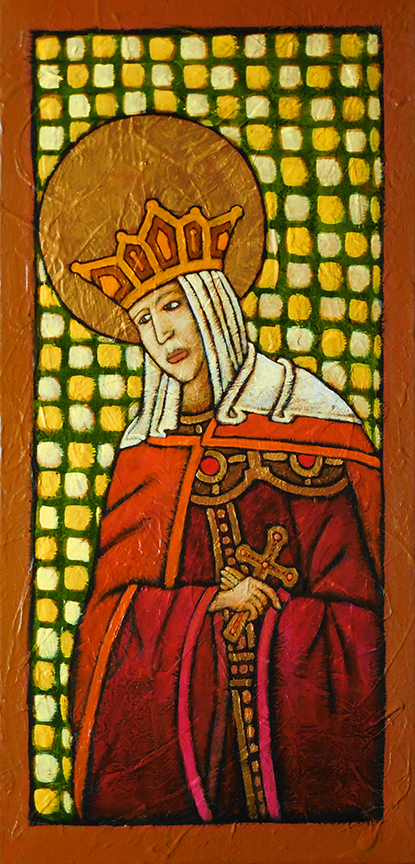
GC Myers= In DelightThere is delight in singing, though none hear beside the singer.
Walter Savage Landor

*********************

The British poet, Walter Savage Landor, who wrote those words above knew what he was talking about: Sometimes you do something that is filled with pleasure for yourself yet it might not stir the soul of a single other person.  The delight comes in simply doing it.

Not that Landor, who lived from 1775 to 1864,  was without accolades.  He had an incredibly long career–almost 70 years— and was held in the highest esteem by his peers. But he never gained widespread public popularity or love for his work in his life or after.

His poetry was his singing and sometimes only he and perhaps a few others could appreciate that voice.

I chose these words from Landor for this painting not only because I felt that he was writing about his own work in a way.  I used it because of the great pleasure I took in painting the painting above, an 18″ by 18″ canvas that I am fittingly calling In Delight.  It was one of those paintings that gave me a lot of joy at every step of its growth, each stroke making it come more and more to life for me.

It’s that fulfillment of joy that makes me not worry about how it is received.  If not a single person sees a thing in it, I do not care.  It pleased me to simply make it and even now it makes me smile when I look at it from my chair in the studio.

For me, I felt like I was singing with a rich and full voice.  But again, that’s just my ear.  You might hear fingernails on a chalkboard when you look at it.  And that’s okay– the delight was in the singing.

Read Full Post »

GC Myers- Icon: St. Anna of NovgorodI don’t know how to start with this newest painting from the Icon series.  When I started the series I wanted it to focus on the lives and stories of the everyday ancestors that make up my and many others’ family lines.  But there ares some folks in these lines that are definitely not everyday people.  Such is the case with this icon– she was already the subject of multiple icons before I even thought of painting her.

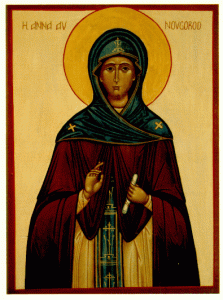
Her birth name was Ingegerd Olafsdotter and she was born to the Swedish king Olof Skötkonung  right around the year 1001.  She is my 32nd great-grandmother.

She received an exceptional education as a young girl of the time, studying the scriptures, literature and history as well as being instructed in the use of military arms.  In order to extend his own influence and consolidate power, Olof sent her to Kiev in 1017 to wed the Russian Great Prince Yaroslav the Wise.  There she took on the name Greek martyred saint,  Irene.

During her time as the Great Princess of Kiev, Irene acted as an ambassador of sorts in maintaining Russia’ influence in the Europe of that age.   She offered sanctuary to several outcast princes to protect them from overthrowing forces and arranged marriages for her children that placed them squarely in the middle of continental affairs.  Her three daughters became Queens of Hungary, Norway and France ( my 31st gr-grandmother, Anne of Kiev)  while her sons all took positions of power within Russia.

St. Sophia Cathedral in Novgorod

St. Sophia Cathedral in Novgorod

She and Yaroslav also continued the growth of Christianity in that time, building the Saint Sophia Cathedral in Kiev as well as one of the same name in Novgorod.  Near the end of her life, Irene established a monastery in Novgorod and, as was the custom of the time, as founder was required to operate it.  In doing she was tonsured (which involves the cutting of the hair) and took on the name Anna.  She continued in this capacity for several years until her death around the year 1050.  She is buried in St, Sophia Cathedral in Novgorod.

Holy Anna of Novgorod from Holy Annas Chapel in SwedenFor her works in spreading the beliefs of the church as well, in actually building churches, Anna was made a saint in the Eastern Orthodox church.  In fact, one of the feast days of St. Anna is next week on February 10th.

You would think it would be easier to paint this type of ancestor, especially one who is already portrayed in many real icons.  But there is such a disconnnect in time and place that with some of these distant illustrious ancestors, while I am pleased to know that I somehow have a blood  link to them, I feel less of a bond with them than  with a hardworking lumberman in the Adirondacks or a forgotten housemaid who stole from  her employer.  Or even a Scottish scoundrel and liar who remains a mystery to me.

Maybe I see more of myself in them.

Genealogy often reveals great discoveries.  In some cases, you are left wondering how a family rose so far from humble beginnings while in others you wonder what choices and factors along the way brought a descendant so far below the stature of their ancestors.

I guess it’s a great case study in the laws of probability.  Over the course of a thousand years and thirty some generations winding their way into a new country, some bad choices and bad luck will inevitably fall on some along the way.  I am sure there are literally many, many millions of descendants springing from St. Anna and some families have probably maintained power and prestige through the ages.

And others– well, you know the story.  It’s most of our stories.


Read Full Post »

GC Myers- Where the Winds GatherSometimes I will get an image in my mind that seems all fleshed out and full.  It’s just a matter of moving that image from the inner workings of my consciousness into the outer world of reality.  Sometimes, it goes smoothly and the final painting matches that first thought of it.

But more often, that trip from thought to reality produces something completely unlike the original vision. And sometimes that is not so good.  The work shows the struggle in trying to force the vision into reality and the whole thing looks forced and without rhythm.  But occasionally, one slips out that is not at all like the original vision but somehow finds its own rhythm and comes to life on its own.

I think that is what happened with the painting shown above, a small 9″ by 12″ canvas that I call Where the Winds Gather.  I’ve had an image of this painting in my mind for a few weeks and as I would be doing other things it would often bounce through my mind.  But it looked much different than this painting.  The color was not the same nor was the manner in which the whirls of wind in the sky were painted.  Some of that is the result of working in a smaller size which restricted the type of marks I could make with my brush.

There was a point when I was well into this piece that I could see that it had strayed far afield from my original concept and I began losing my enthusiasm.  For a while I wanted to just set it aside or simply call it a day and paint it over.  But I decided to push through and see if it could evolve into something more.  And slowly it did, at  least in my own eyes.  There’s an interesting balance of rough and soft in this and the pattern in the sky came together much better than it appeared in its earlier form.

There’s just something I like in this piece.  Maybe it’s just the fact that it came to life despite my own original misgivings.  I know that I admire that kind of determination from someone in overcoming the low expectations placed on them.  Grit.

Maybe that should be the title– Gritty Determination.


Read Full Post »

GC Myers- Small Remembrance Group 2016 smWithout memory, there is no culture. Without memory, there would be no civilization, no society, no future.these
Elie Wiesel

*************

I recently finished this group of small pieces for the upcoming Little Gems show at the West End Gallery in Corning.  Called Small Remembrances, they are all tiny paintings, coming in at only 1 1/2″ by 2 1/2″ in size.  Like many of the tiny pieces I have done over the years tend to remind me of small snippets of memory.  I tend to think of memory as tiny bits and pieces, individual images and bits of film that tell small stories of themselves before fitting into any sort of larger continuum.

When I assembled these Small Remembrance pieces together as a group I was struck by their cohesion and relationship to one another.  The quote above from Elie Wiesel, the Holocaust survivor and Nobel Prize winning authorcame to mind.  This past Wednesday had been International Holocaust Remembrance Day and his always eloquent words were already on my mind.

There’s a darkness, a somberness, in these small pieces that fits here.  While we might prefer that it be so, memory is not confined to the bright and happy nor should it be.  Each memory, regardless of its size, by its very nature has an importance, an effect.  Memory of our past shapes our future.

So while these may be tiny and may be insignificant in many ways, they have a purpose and a meaning that goes beyond size.

Read Full Post »

GC Myers- Icon: Mary TOne of the things I am trying to emphasize with this current Icon series is the fact that we are all flawed in some way, that we all have deficiencies and stumbles along the way.  Yet, uncovering these faults in my research, I find myself holding affection for many of these ancestors that dot my family tree.  Perhaps it is the simple fact that without them I would not be here or perhaps I see some of my own flaws in them.

I’m still working on that bit of psychology.

The 12″ by 12″ canvas shown here is titled Icon: Mary T.  She is my great-great grandmother.  Born Mary Anne Ryan  of Irish immigrant parents in the Utica area she married Michael Tobin, an Irishman ( I believe he was from County Kerry but the research is still up in the air on this) who came to the States around 1850, right in the midst of the Great Irish Immigration.

Michael worked on the railroads being built throughout central New York in the late 1800’s.  Following the progress of the railroads, the couple and their growing family worked their way down through the state towards Binghamton, NY where they eventually settled.  Mary Anne eventually ended up as a housekeeper in a prominent home in the area.  Michael died around 1890 although records are sketchy on this and Mary died at my great-grandmother’s home in Elmira in 1914.

All told, they had seven daughters and three sons.  Most worked in the then booming tobacco industry of that time and place.  Most of her daughters worked as tobacco strippers  and some worked as cigar rollers, as did her sons.

That’s the simple telling of the story.  Looking into the back stories provide a little more depth which can sometimes change all perceptions.

None of her sons ever married and all were had desperate problems with alcohol.  One son was listed in a newspaper report from some years later as having been arrested for public drunkenness around 40 times over the years, seven times in one year.  He was also arrested for running a still more than once during the prohibition years.  Two of her sons died in institutions where they had been placed for their alcoholism.

A Silk Spencer

A Silk Spencer

I came across a story in the local Binghamton newspapers about Mary and two of her daughters, who were also working as domestics with here in the prominent Binghamton home owned by a local attorney and nephew of the founder of Binghamton .  In 1874, the story reports that a number  of items came up missing, including a “forty dollar silk spencer,” which is a sort of short garment like the one shown here at the right.  Neighbors informed the owner of the spencer that Mary had a number of the stolen items in her possession and a search warrant was sworn out.

Detectives came to the Tobin home and made a thorough search but turned up nothing.  They then tore up the carpets which revealed a trap door that led to a small basement.  There they found many of the stolen items but no spencer.  But they did find a silk collar that had been attached to it.  Mary and her two daughters were arrested.

Mary did finally claim to be the sole thief and her daughters were released.  I have yet to find how this particular story ends and how Mary was punished but based on the futures of some of her children I can’t see it being a happy ending.

Doing this painting, I was tempted to make my Mary a bit harsher, a lit more worn.  But as I said, there’s some sort of strange ancestral affection at play even though I know she was obviously a flawed human.  She’s smaller and more delicate looking in the painting than I imagine she was in reality. But maybe that’s little payback for the information her story reveals about the future of my family.

This is a simple painting because, as I pointed out, this is a simple story at its surface.  It’s the story of many, many families.


Read Full Post »

« Newer Posts - Older Posts »