Archive for the ‘Technique/History’ Category
Show Night
Posted in Recent Paintings, Technique/History, tagged Corning, West End Gallery on July 22, 2010| 1 Comment »
All Is Given
Posted in Painting, Recent Paintings, Technique/History, tagged Corning NY, West End Gallery on July 13, 2010| 2 Comments »
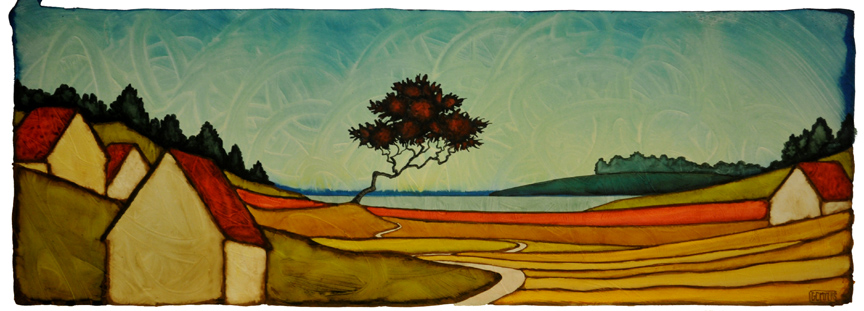
Another new painting for my show, New Days, that opens next Thursday, Jully 22, at the West End Gallery in Corning. this piece is titled All Is Given and is 12″ by 12″ on paper. This piece, for me, is like comfort food. The color and the way it comes together as a composition has a very soothing effect and there is a real harmony in the deep greens and blues that shines through here.
Even the fact that there is motion in the central figure of the tree doesn’t detract from this peaceful feeling. The giving of leaves to the wind by the tree seems natural and there is no remorse over the loss. It is all just part of existing in nature. Just being and not reacting. Accepting what is and what cannot be.
It’s one of those pieces where, when done, I feel a great sense of satisfaction. As though I’ve hit my mark, reaching some undefined, hazy goal that is known only by reaching it. That’s hard to explain. I don’t have specific endpoints when I’m painting. There is seldom, if ever, a fully realized image in my mind when I start painting. It’s more of a shifting amorphous mass of color and with no specific shape or imagery. I just hope that when I’m painting I can somehow capture the essence of this idea or whatever it is. Sometimes it is revealed and other times, something different emerges which is a discovery in itself that is quite unlike what I felt in my mind at the beginning of the painting.
See? Hard to explain.
Bent But Not Bowed
Posted in Painting, Recent Paintings, Technique/History, tagged Corning NY, West End Gallery on July 10, 2010| 4 Comments »
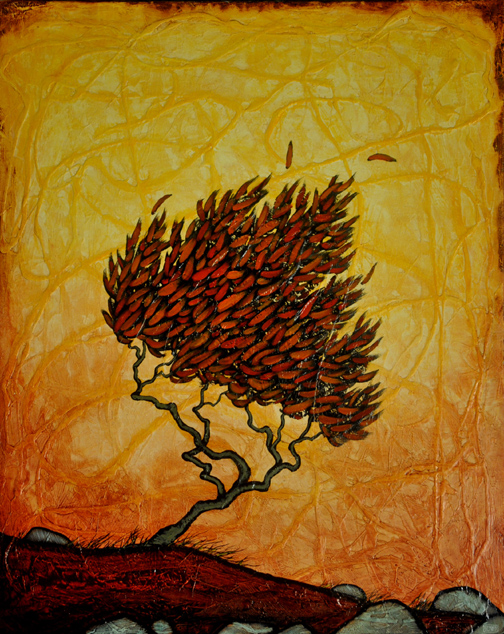
This is the last painting I finished for my show, New Days, that opens in two weeks at the West End Gallery. The name of this 24″ by 30″ canvas is Bent But Not Bowed and was started several months ago, sitting in various stages just on the periphery of my vision.
It started with many layers of gesso that were at first troweled on then finsihed with thick veins that run through the surface in a haphazard, chaotic fashion. When it was finally prepped it had a definite character before I ever put the first drop of paint to it and as a result, begged for me to put it aside and ponder it. It had something in it that was there to be revealed with the paint above it, if I could only find it.
So I set it aside and would consider it as I worked on other paintings, always a bit intimidated by the strength and motion within the surface. It had to be right or it would fall apart under its own force.
The surface was so rich in texture that over the months I determined that the imagery should be simple and close to the surface, not deep into the picture plane, which is counter to what I normally seek in my work. The imagery should truly react to such a strong and emotive surface.
It also needed strong color to accentuate the surface, to bring it even more forward. More prominent, not understated. The trick was bringing these elements together in a way that didn’t look too considered, too thought out. Make each element- the texture, the color and the imagery- play off of one another, bringing the strengths to the forefront in an organic fashion that gives the painting a feeling of it bursting off the canvas on its own.
This piece certainly has a dynamism is the studio. It demands the eye.
I feel as though I haven’t squandered the potential that the canvas first held when I first looked on it after the gesso was applied. It is a piece that has real life, real feel. A voice that has words of its own, well beyond mine.
In short, it is what I hoped it could be…
Change and Breakthrough
Posted in Influences, Opinion, Painting, Quote, Technique/History, tagged Helen Frankenthaler on July 9, 2010| 2 Comments »
There are no rules. That is how art is born, how breakthroughs happen. Go against the rules or ignore the rules. That is what invention is about.
–Helen Frankenthaler
************************
I’m using this quote from Helen Frankenthaler, the famed Abstract Expressionist, as a sort of follow-up or addenda to yesterday’s post about change. I remember reading about Frankenthaler when I was first beginning to really paint with purpose. In an article that I read but can’t locate now, she spoke of how she came to her trademark stain paintings where very thinned oil paint is applied to unprimed canvas. She said it was almost by accident that she first experienced the absorbing of the paint by the raw cotton canvas and how that it caused a reaction, a breakthrough, in her thinking about how she wanted to express herself within her work.
She felt that all artistic breakthroughs were the result of a change in the way one saw and used their materials. It could entail changing the type of material used or using them in a more unconventional manner, as her above quote stating there are no rules infers.
This immediately clicked with me at the time I read it. I had been trying to shape my way of thinking to fit the materials I was using at the time. Unsuccessfully. What I needed to do was change the materials to fit the way I was thinking. Allow my thought process more free rein and not cater to the restraints of materials.
That may sound kind of abstract but it allowed me to start working with my paints and grounds in a much different way, forming my own process that worked well for my way of thinking and has become entrenched in my thought process. Even though it may be outside more traditional forms of using these same materials,this process has over time become as rigid in my use as the techniques used by the most steadfast adherent of the most traditional school of painting. This is sort of what I was referring to when I mentioned the end of the cycle, as far as art is concerned. You reach a certain point, a mastery of your materials, where there are few accidents, few surprises in the materials’ reactions and, as a result, fewer surprises in your own reactions.
For most, this is the goal. But I want that surprise, that not knowing exactly how the materials will react and that need to solve the problem presented by the need to express with the limitations of the materials used. So I try to continually tweak, create a little tension in how the materials react to my use of them, to create a sense of surprise. Breakthrough.
And that’s where I feel I am at the end of the cycle mentioned in yesterday’s post.
days pass in gray
Posted in Recent Paintings, Technique/History, tagged Alexandria VA, Principle Gallery on June 22, 2010| 2 Comments »
I’ve been working on a series of pieces that are monochromatic but for small bursts of color. It started as an exercise, just something to reboot my brain after finishing the show that’s currently hanging at the Principle Gallery in Alexandria. I wanted to think less about color and more about form, letting color emerge as the exercise went on. I wasn’t sure what would show up but as these gray paintings took shape I was pleased by the overall feel.
They felt stripped down, detail peeled away leaving only the essence. Haiku-like. But still saying essentially what I wanted from them.
So after the show, which had a great response for this work, I decided to explore a bit more with this series. It’s been interesting to revisit familiar compositions with this spartan palette, finding new definition in in the already known. There is a different sort of challenge in trying to coax emotion from the limits of grays and blacks, keeping myself from going to my strength, color. For me, maybe that’s the appeal of these pieces- that tension of restraint.
This painting is Days Pass In Gray and is definitely familiar in form. With full color, this piece is an iconic image of strength and perseverance- a celebration of triumph almost. But stripped of color except for a touch of red in the tree’s canopy it becomes a different view of perseverance. There is a victory of sorts but it seems more hard-fought and the price paid is worn for all to see. The red in the tree is a garland of victory but the tree realizes that the days don’t stop to celebrate any triumph but continue their steadfast march ahead.
Time has the pitiless stare of the sphinx.
Maybe that’s too grim an assessment because I do see a joy in this painting as well, in the distant light on the far mountains. It gives a certain hope to this piece that lifts it above the darkness that I wrote of above. Perhaps that is what I enjoy about this work, the polarity of the emotions it pulls all at once from me.
Maybe. I don’t know. I guess I’ll have to look a little more…
Baucis and Philemon
Posted in Favorite Things, Influences, Technique/History, tagged Baucis and Philemon, Hermes, Zeus on June 9, 2010| 3 Comments »
As the days wind down before I head to Alexandria for Friday’s opening, I’m still pretty busy in the studio. I’m in the midst of completing several pieces for another show later in the year as well as working on several projects unrelated to shows, including minor repairs on an older painting of mine that was damaged in a fall at its owner’s home. Another is a request for a painting from a couple marking their 10th anniversary.
I often get requests for commissioned work but usually am not excited by the prospect of being dictated to in the creation of my work, actually turning down many that get too specific in their requirements. I want my paintings to reflect my thought process and emotion as well as my craft. As a result, I have an informal set of rules that let me have free rein in the creation of the work so that the painting is allowed to form in an organic way. Not forced, which often takes away the vitality of many pieces, in my opinion.
But this particular request is unlike many others that I receive. They want this piece to relate the story of the classic myth of Baucis and Philemon, which is the tale of a poor but happy couple who are unknowingly visited by Zeus and Hermes disguised as dusty travelers. Beggars, really. The two gods had went door to door among their neighbors seeking hospitality and were rebuffed in every attempt, often with harsh words. Zeus became angry as door after door was slammed in his face. Finally, they came to the door of the shack of Baucis and Philemon, the poorest looking home they had yet approached.
Upon knocking, they were greeted warmly by an elderly couple who welcomed them in to their simple but cleanhome and treated them with what little they had in the way of food and drink. They were gracious and hospitable, seeking to give comfort to the strangers. As the night wore on, the couple, who had been serving their simple wine to the travelers from a pitcher, noticed that the pitcher stayed full even after many pours. They began to suspect that these were not mere beggars but were, in fact, gods.
They apologized to the gods for not having much to put before them then offered to catch their prized goose, which was really a pet, and cook it for them. The old couple chased the goose around the shack until finally the frightened creature found sanctuary on the laps of the gods. Stroking the now safe goose, Zeus then informed them of their identities and, after complimenting on their hospitality and of the mean-spiritedness of their neighbors, told them to follow them. They climbed upon a rise and Zeus told them to look back. Where once their town had stood was nothing but water, from a deluge that had washed away everything, including all who had insulted Zeus. From where their poor home had been, a majestic golden-roofed temple with sparkling marble pillars rose from the receding waters.
Zeus told the couple that this was their new home and asked what wish he could grant them. They asked that they be made priests, guardians of this temple and that they should always remain together until the ends of their lives. Seeing their obvious love for each other, Zeus readily agreed. The couple lived for many more years together, reaching a prodigious age. One day they stood together and all the past moments from their life and love together flooded over them. Baucis saw leaves and limbs sprouting from Philemon and realized that the same thing was happening to her. On the plain outside the temple, they transformed into two trees, an oak and a linden, that grew from the same trunk, their limbs intertwined, eternally together.
That’s a simple re-telling of the tale but I think you can see why this couple might want a symbol of this story to mark their time together…
Gossamer Days
Posted in Painting, Recent Paintings, Technique/History, tagged Painting, Principle Gallery on June 6, 2010| Leave a Comment »
The studio is relatively empty now as I’m now in the week between delivering the Facets show to the Principle Gallery and the actual opening night this coming Friday. While there is always anxiety over the show itself, there is usually a sense of relieved relaxation in the studio at this point, an almost giddy feeling over the possibility of what may come next there. Usually at the end of painting for a show, all the creative energies have come to a sharp, focused point and in the weeks of prepping the work for a show and the point when painting is resumed, this point is constantly poking me, impatiently waiting to be untethered.
At the moment, it wants to explore new ideas in sometime older styles. For instance, the painting shown here, Gossamer Days, is painted in the more transparent manner of my early work and provides me with a new spark each time I see it. After years of having the work grow and evolve beyond this style, it’s always interesting to revisit it with the benefit of knowledge and insight gained through the years. Something new and exciting emerges as new ideas are incorporated and older ideas that may have faded from my vocabulary are reintroduced. For me, this an exciting time in the studio.
This discovery of things new and old keeps me always fully engaged, always feeling that the work is growing and not stagnant. The idea of the work not moving forward is death in the energy of the studio and something for which I always on the lookout. For the work to be vibrant and have its own sense of life, I must have a sense of engagement with and excitement for the work myself. So, at points like this, when that excitement is almost palpable I am thrilled because I know the importance of it. But I am always also a bit nervous of not capturing the full strength of this creative wind in my sails and being left adrift to paddle my way out by creating new energy somehow.
That is tough work…
In the Golden Light
Posted in Painting, Recent Paintings, Technique/History, tagged Alexandria VA, Painting, Principle Gallery on June 3, 2010| 2 Comments »
I’m in the last days of preparation for my show, Facets, that opens June 11 in Alexandria, VA at the Principle Gallery. Today I put on the final few hanging wires on the backs of the paintings, finish the necessary paperwork and documentation then wrap and load the paintings for tomorrow’s delivery.
This is often a hectic, anxious day but this year I find it strangely calm thus far. Maybe it comes from the relief of seeing the endpoint in preparations for this show or perhaps it comes from finally seeing this group of work together, now fully framed and moved from raw images into their now presentable form.
Often a piece, especially one on paper, undergoes a startling transformation once it is put in a setting for presentation. I think of the painting as a gem of sorts and the matting and framing as the setting that holds this gem and allows it to be seen in its best light. Sometimes a piece takes on a sparkle, a different life even, when seen in the setting of its frame rather than as a raw image on paper. I see this often with Cheri when she will see a painting in the studio before framing and give little response then will react so much more stronglyand positively after it is fully presented.
Seeing this group together and fully presented gives it a wholeness and allows me to see the continuity in it that I knew was there, which is reassuring. It looks like it will hang together well and the pieces will play well off one another, each exhibiting its own individual strength and acting as a complement to those around it, reinforcing them. There is a great blend in this group of boldness and softness, strong colors and muted tones. Like the name of the show implies, this group shows many of the facets of the body of my work to date.
The piece above, In the Golden Light, is part of this show. It is a work on ragboard and measures a little over 11″ by 25” and is matted and presented in a 20″ by 34″ frame. I think it’s a prototypical example of my work, one that strikes close to the core of everything I want to show and say in my work. It’s a painting that flowed out easily and gracefully near the end of the final days of painting for this show, almost as though it were the final performance after months of dress rehearsals. There was no struggle with this piece and there was a sense of a type of destiny in it even as the first section of paint began to dry. I can’t fully explain this. I used the word gracefully earlier in the paragraph and there was a type of grace in the painting of this, an ease of motion and a confidence that I seek yet seldom find, in my work or in my life.
I think I can say the same for much of this group of work. I think there’s an ease and a confidence in this work that arises from coming to terms with where I am as a painter, reveling in what I am and setting aside concerns about what I am not. I think it comes through quite evidently in this show.
At least it does for me. I can’t predict what others might see…
Archaeology: Legacy
Posted in Painting, Recent Paintings, Technique/History, tagged Archaeology, Painting, Principle Gallery on May 24, 2010| 2 Comments »
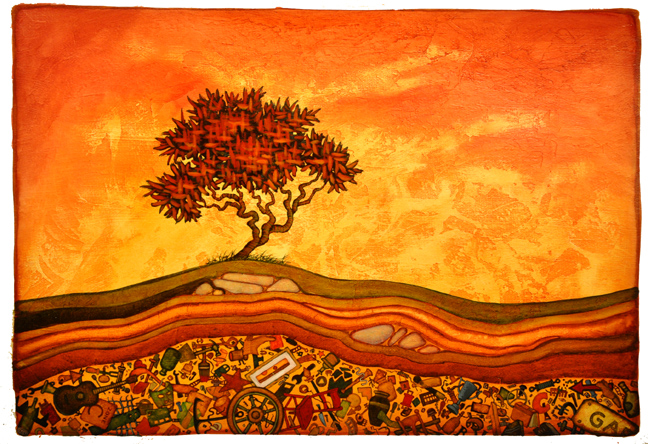
I am finished painting now and have started the process of finishing my work for the upcoming show, Facets, at the Principle Gallery in June. As with every show, there is a final painting completed and for this show this is the last painting finished, a piece from the Archaeology series that is 18″ by 25″ on paper. I call this painting Archaeology: Legacy.
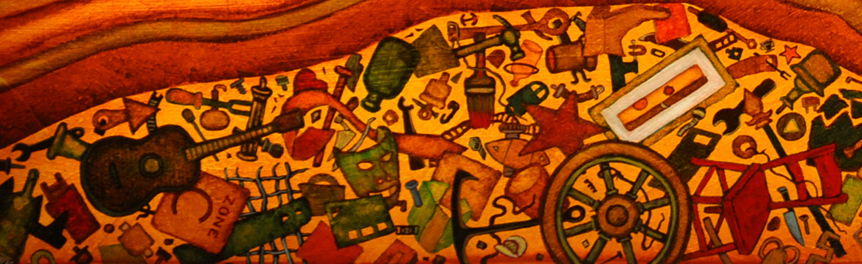
This is a piece that I started at the end of last year. It was one of those times when I got to a certain point and liked what I had in front of me but had decisions to make witht he piece and didn’t feel ready to make them at the time. So the piece would be set aside. Occasionally, I would pull it out and add a bit to the underground artifacts but it just kind of simmered, growing slowly.
As I neared my self-imposed deadline for this show, I began to hover back more and more to this piece. I think part of it has to do with the feeling I’ve been experiencing in my mind at this point in the process. Sometimes, as I near readiness for a show, there is a sense of great mental focus and clarity and other times, a feeling of chaos and disassociation. There is no rhyme nor reason for this. It just happens. Maybe it has to do with my view of the outer world at the time or how often I yell at the moon.
I don’t know.
But as the prep for the show winds down this year, I find my concentration and attention dwindling. Thoughts are short and fleeting. Bursts of thought and image come and go in a flash. It might be disturbing if I didn’t recognize this as being a sometime by-product of my process. So, it seemed fitting that the last piece before me was an Archaeology piece where the details underground consist of a free flow of items and associations.
As it neared completion, it seemed to calm me, as though a great piece of unfinished business that had been hanging like the sword of Damocles above was finally out of the way. When the last iota of detritus had found it’s way to the surface, I breathed a sigh of relief. A sigh of finality.
And maybe that’s what this painting is about. The sigh of relief of a future world growing beyond the legacy passed on to them from a chaotic world.
Or not.
Hierarchy
Posted in Painting, Recent Paintings, Technique/History, tagged Archaeology, Principle Gallery, Red Chair, Red Roof Series on May 20, 2010| 2 Comments »
The name I’ve chosen for my exhibition that opens June 11 at the Principle Gallery is Facets. When looking at this year’s show, I realized that there was a very wide variety of my work in this group. Not focusing on one specific aspect as in previous years. There are a few Red Roof paintings, a few fragmented sky paintings , a few with converging field rows, a few with Red Chairs and a couple of my small, lone figures. It’s overall a pretty interesting group that I think shows a fuller spectrum from the prism of my work. Thus, the name, Facets.
There are also a handful of my Archaeology pieces in this show. I only do a handful of these per year now. The piece above, Hierarchy, is derived from that series although it focuses more on the layers below the surface rather than artifacts, although there is one yellow shoe there. This painting is a 30″ by 40″ canvas so it has some size which gives it some visual wallop.
I’ve been working on this piece for about six months, doing a bit then setting it aside. I would keep glimpsing at it when I wasn’t working on it, trying to figure where I would go with it. But I never wanted to rush it, never wanted to push it too hard. Wanted it to grow naturally, organically. It wasn’t until yesterday, when I dragged the last few strokes on the canvas, that I felt I finally saw where the painting had settled and it felt whole.
That’s always an interesting feeling, this sense of the work being suddenly complete. Full. Alive. As though the last few embellishments stir something that make it more than mere paint smeared on canvas, make it an entity with a history and a future all its own. It’s exhilarating but sad at the same time, as though the life it’s taken on will soon be gone from my life. I can’t fully explain it but that’s the feeling I felt yesterday with Hierarchy.
So, I share my studio for the next few weeks with this breathing, living creature as it impatiently waits to shows its true self to the outside world…