Feeds:
Posts
Comments

Archive for the ‘Technique/History’ Category

de chirico_mysteryA turning point for me when I was first stumbling around with my own painting was when I encountered the work of Giorgio de Chirico, an Italian painter of darkly toned metaphorical works.  He lived from 1888 until 1978 but was primarily known for his early work from 1909-1919 which is called his Metaphysical Period.  Metaphysics is  devoted to the exploration of what is behind visible reality without relying on measurable data.  Very mystical.  De Chirico’s work after 1919 became more realistic and less appreciated.  It is the work from this earlier period that defines him.

I was immediately drawn to the work.  It was full of high contrast, with sharp light and dark.  The colors were bold, bright and vibrant, yet there was darknessde-chirico-the-great-tower implied in them.  The compositions were full of interesting juxtapositions of forms and perspectives.  It was a visual feast for me.

At that time in my own painting, I was still painting in a fairly traditional manner, especially with watercolors.  That is to say that I was achieving light through the transparency  of my paint, letting the underlying paper show through.  It was pretty clean which was fine.  But it wasn’t what I was looking for in my work.

Seeing de Chirico’s paintings made me realize what I wanted.  It was that underlying darkness that his work possessed.  Almost a grittiness.  I immediately began to experiment with different methods that would introduce a base of darkness that the light and color could play off.  My work began to change in short order and strides forward came much quicker as a result of simply sensing  something in de Chirico’s work that wasn’t there in my own.

Perhaps that is what is meant by metaphysical…

de-chirico


Read Full Post »

Depth

GC Myers 2009I am still finishing up a group of paintings that I will deliver to a few of the galleries that represent my work in the next week.  I am doing bits of touch-up, varnishing paintings and final framing.  One that I am framing today is this painting, one that I’ve really been focusing on as it sits in the studio.

This is a 12″ by 36″ canvas which gives it a little size.  By that I mean the painting is big enough to have its size give additional impact.  For instance, if this piece were a much smaller size, say 6″ by 18″, it would still have the visual oomph of the painting itself but would not visually dominate a wall because of its size whereas this larger sized painting has the same visual impact and because of its size, could be the focus of a much larger area.

This painting has tremendous visual pull.  I find myself peeking at it at many points during the day, drawn in by the warm feeling of the layered fields.  It also has great depth into the piece which is something I often mention as a desirable trait in any of my paintings.  I don’t know if I can explain what I really mean by that.  When I look at one of my pieces, I visualize the horizon or focal point of the painting as being the point where the two planes of the sky and ground come together.  Like looking into the bottom of a triangle set on its side.  The further away that this line of convergence appears to me, the better.  I don’t know if this is just my particular preference or if this is something that is one of those common traits of response.

I struggled a bit with a title for this piece because I saw a lot of different things in  it.  There is a sense of moment, the sense of the new day coming ( or the present day fleeting, however you prefer to see it) in the light of the sky as well as a sense of place in the houses and fields.  The red tree has a feeling of pondering and the two nearest trees at the left give a sense of entering upon a scene or moment.  The whole thing has a nice unity with all elements coming together and playing off one another that I could use as well when considering a title.

I am considering calling it the In The Depth of the Sky.

I don’t know.  There’s still a little time to reconsider…

Read Full Post »

And the New Day Approaches...This is another new piece that I’m calling  And There is a New Day…  It’s a 24″ by 30″ canvas and is in the obsessionist style that I have been primarily focusing on lately, which is closer to traditional painting than the usual style I have used for the past 13 or 14 years.

I really like the feel of this painting.  The underlying texture is such that it really allows the darkness to show through while still bearing lighter paints above.  This texture also gives a slightly ragged edge on the lines, which really alters the overall look.  It gives it a less controlled feel.  It reminds me , in a way, of some examples of German Expressionism and American Modernism of the  early 1920’s.  This piece still is more controlled than many of the pieces that it brings to mind but still has the give and take of light and dark that I so admire.

The theme of this piece is a familiar one for me.  There is sense of being caught in a pause, waiting for the onset of something.  A new day.  A new wind.  A new path.  In this case, it is light of the new day breaking over the horizon.  I like the way the light breaks into confetti-like dabs of color.  It creates a real vibrancy, a sense of movement forthcoming that is spreading over the sleeping village.  The houses have no windows or doors, as is usual for such pieces of mine.  I sometimes think the absence of the doors and windows symbolizes sleep in my paintings but I’m not really sure if that’s all I really see.  There are other times when I think they symbolize a general inward turning, an introversion where there is no awareness of the outside world.  Sometimes, I just think I like the look without the windows or door.

I like that there’s a little mystery in that interpretation, even for myself.  The excitement in painting for me is in not knowing what will emerge.  The day that I know how everything in one of my paintings will turn out or be translated will be the last day I need to paint.

This painting makes me glad that I do still need to paint…

Read Full Post »

Blue Canal Pieces- GC MyersThese are two new pieces I recently completed, both 12 ” square canvasses.  They are in the same vein as several other paintings I have completed recently and featured here on the blog.

As I’ve stated before, these pieces are for me all about shapes and forms and color, more so than about an actual depiction of place.  I want to clarify that the feeling and sense of place that is created in these pieces is important to me.  But it is something that comes about as a result of the way forms and color fall together, rather than a premeditated plan for the composition.

The canal in these pieces is very important with that bright blue counterpoint to the red of the roofs and the way it bisects the village.  I have tried using a more subtle color in the canal but that blue pop! makes each painting stand out.

I have considered keeping these pieces together as a set, which is something I have done in years past, but I probably will not this time.

I had an interesting experience with a set of 3 very small paintings that were sold 11 or 12 years ago.  They were tiny landscapes, only about an inch and a half square in size.  They were, like the paintings above, not of any specific location but like many of my landscapes, influenced by the area around my home.  There is a spot on the way to Ithaca called Connecticut Hill that has an interesting look and feel that I often think of when I’m painting.

I met the buyer of this particular set one day at the Principle Gallery in Alexandria, VA  as I was delivering some work and we spoke about the paintings.  He told me that he loved the way they reminded him of an area near he went to college.  I asked him where he had went.  He said Cornell, in Ithaca.  I asked him where this place was he had described.

He said Connecticut Hill.

He didn’t know that I was from near there when we spoke and there was little in those tiny pieces that would make me say they were of that place.  Just the feeling…

Read Full Post »

 Peers -GC Myers 2003I was looking through some older images on my computer, searching for a painting that I had completed several years back.  As I scanned through the paintings, I noticed several pieces through the years that were different from most of the work I’ve been doing recently.  They were multiples, such as Peers, shown here.  They were  paintings with several windows with a new scene in each, although most of the scene were very similar to the others.

It was a format in which I really enjoyed working and one that I have not revisited in a couple of years.  I really don’t know why. Four Moments  GC Myers 2006 They have a very graphic appearance and really stand out on a wall, making them pretty well received as a rule.  I guess in the past few years I’ve been focusing more on working on texture and heightening the color, as well as working in the Archaeology series, so that I haven’t even thought of revisiting this format.

I remember some  of the early ones very well.  One had 48 cells and had a great look, the result of overlaying the paint with layers of chalk and pastel.  Another was the same number of cells with 48 individual small paintings,  each window having a separate opening in the mat.  It was a pretty difficult piece to mat and frame but it also popped off the wall.   I will have to go through my slides from that time (pre-digital) and see if I can wrangle up a few shots.  I would like to see them again to see how they really hold up against my memory.

Fourfront  - GC Myers 2003Maybe I will revisit the multiples sometime soon.  I often run across things that have slipped from the front of my painting mind when I go back looking for something else.  It may be a format such as these multiples or may be a small compositional element.  It’s always interesting for me to try to re-insert this older element into the new work, to see how the inevitable evolution of the work will change this older concept.  We’ll have to see what this brings…

Read Full Post »

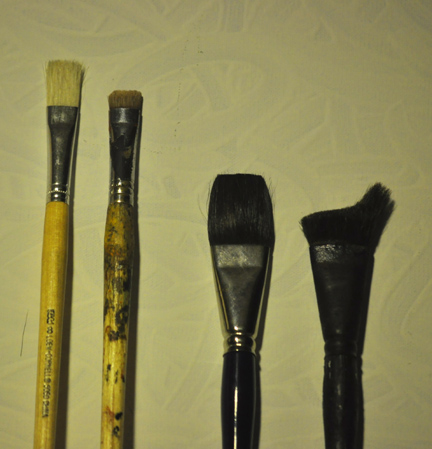
BrushesI was looking at the brush in my hand the other day and I realized how rough I am sometimes on my brushes.  It was a natural bristle brush that was new just a few weeks ago, when it looked like the brush to the far left in the photo.

Over those few weeks, I caressed paint on to canvas.  I also pushed paint into the canvas.  I ground the paint against the canvas, using a lot of force, to almost burnish the surface.  I stroked.  I poked.  And when I looked down the brush had turned into that poor guy shown second from the left.

I can be rough on my brushes.

For my normal wet technique I use a natural hair squirrel mop like the two shown on the right.  It’s a big, soft brush that holds a lot of paint and is a staple in my studio.  The brush on the left is new and the one on the right is obviously not.  This erosion of the bristles shown here represents about 6 or 7 months of use.

Hard use.

I like the way the bristles whittled themselves down to the angle my hand takes when I normally strike the painting surface.  Unfortunately, it has eroded to a point where its capacity to hold paint makes it a hindrance to my technique.  So he is put aside and maybe I will find a use for him at some point, so I keep him with my other spent brushes.  I could never throw such  loyal workers to the trash heap.

I have amassed quite a number of brushes, both well used and brand new, over the years.  I have tiny detail brushes that I go through quickly.  I have  some cheapy brushes that work perfectly well for certain techniques.  I have some of my favorite medium priced brushes that I have stockpiled because they’re no longer made.  I also have some pretty expensive brushes.  I have a set of beautiful Winsor & Newton Series 7  brushes that are handmade with soft, luxurious Kolinsky sable.  I’ve had them for about 13 years and have only used one or two of them for a few minutes.  They’re lovely in the hand but I never felt comfortable with them and just wouldn’t feel right grinding them roughly into the surface.

So they sit and wait for a day when I’m ready to put them in the game.

Maybe today?  Maybe… but probably not.

Read Full Post »

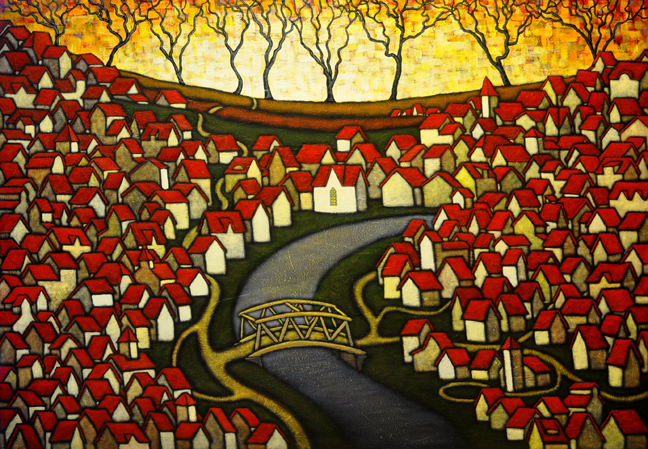
Final Version (?) GC Myers 2009Well, here’s what I’ve come up with for the painting that I’ve been working on over the past two weeks.  I added one window, on the central structure (thanks, Brian, for the suggestion) and went with twisting bare trees on the ridge to mirror the road.  I also added a little more light in the central section.

And there it is.  So far.

There is always the possibility that over the next week or so I may change it in some small way, a highlight here or there.  Just little tweaks to fine tune the weight of the piece.  When I say weight I refer to the way I look at the painting as though it were suspended from a center point in the painting and each visual element to either side of that point added weight, causing the painting to lean to the side with more visual weight.  I try to keep the painting centered and balanced on this center point, changing the weight on each side by adding elements or enhancing those that are there to create more visual interest, by which I mean weight.

Thus far, I like this piece a lot.  It has a lot of wallop in the studio with its size, 42″ high by 60″ wide, and its masses of bright red roofs.  The feeling of the piece has evolved over the process.  I originally felt that the focus and feeling of the piece stemmed from the area where the sky met the far ridge.  But the simple addition of one tall window  brought the focus down lower to that structure and changed the complete impact of the piece, giving it a feeling of warmth beyond the warmth of the colors.  Human warmth.

So that is basically how I paint in my additive  or obsessionist style, which is quite different  that my typical pieces which are reductive, which means I add lots of paint in a liquid fashion then pull paint off the surface to reach my desired end.  I may or may not show that in the future.

So this piece will stay with me for a few more weeks in which time, when I am fully satisfied of its completion, it will  be varnished then framed.  I use an archival quality varnish with UV protection to prevent fading from normal light over the coming years.  I usually use a gloss because I like the added brilliance and depth it adds.  The frame comes from my good friend Stephen who has built my frames for about the last twelve years.  He generally uses native poplar which gives a fine grain which beautifully accepts the stain that I apply after receiving the raw frames from him.   I will talk more about framing in a later post.

The final step is applying a title to the painting.  I have a few ideas but am open to suggestions.  No contest this time although there may be another in the near future.

But for now, if you have any ideas, let me know…

Read Full Post »

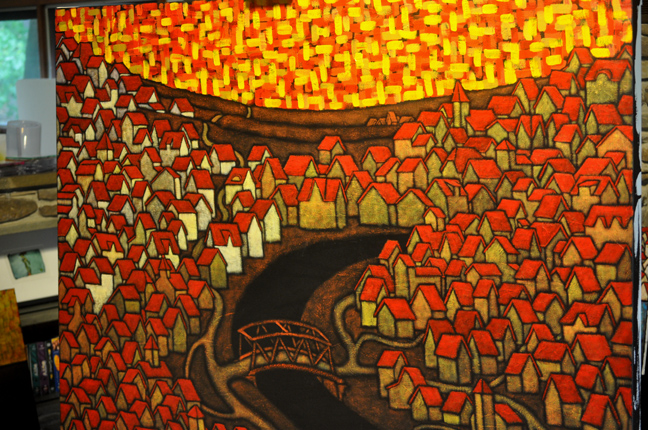
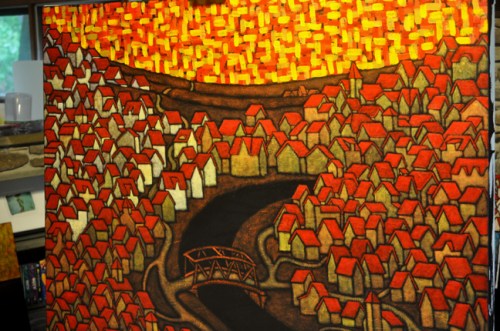
GC Myers 2009 adding BlueWell, this painting, a 42″ by 60″ canvas, is closing in on what may be its final appearance, at least in my head.  I have the sky close to where I see it finishing, the village only needs some highlights here and there  and the landscape is basically set in place.

My next move is to move into the last large area that needs paint- the waterway and the land on either side of it.  I first go in with a manganese blue, a rich color that I can play off as I move along.  I often use blue for water even though it seldom appears that way in nature.  There seems to be a childish element that allows us to imagine or see blue as water.  For me, it goes back to how the color plays off the other colors.  The harmony produced is more important to me.  I also start adding color to the bridge at this point, although I see it changing in color over the rest of the process.

GC Myers 2009 Nearing the Finish LineFrom there it’s on to putting some color into the lower segment of landscape around the waterway and the structures.  I start with a dark Hunter green which actually darkens this space with a real earthy almost black green tone.  I like the way this sets everything off but am feeling it’s a little too deep and dark, almost flat in dimension.  I think that I probably lighten this soon but I first transition back into the water where I start laying in a lighter blue over the darker manganese underneath.  There is a bit of violet mixed with the blue I’m using which warms the blue just a bit.  I feel like I’m close to where I want this to be at this point but there is still a little work ahead, especially on the water and the bridge.

I start by lightening the bridge so that it has more contrast against the blue of the water.  I want contrast but not so much that the eye settles there.  I next begin adding a little depth in the green of the landscape with a mix of cadmium orange and yellow, once more put on with a light, dryish brush.  The  technique with the brush is as though I’m dusting something off the canvas with short, quick strokes, leaving only a residual of pigment.  This little bit of color atop the green makes a huge difference and I take this same color and technique into the water, really lightening the color so that it has a violet-slatey color, much less blue than it started.  Here’s where I am:

DSC_0106 smallSo I’m near the end and I really like the feel so far with this painting- but…  There’s always a but.

But I really feel it needs one more element beyond the village to bring it all together.  A real object of focus.  Like the tree or trees I mentioned in yesterday’s update.  Or I could take one of the larger, centrally located structures and put even more highlight, more brightness on it.

I’m leaning toward the tree but this is the part of the process where the painting sits for a while in the studio and I look at it over the next several days.  I’m consciously weighing all the elements in the painting to see if there is balance in the structure.  Does it hold together as a composition and do all the elements and lines make sense, not make me stop and wonder why this is here or that is over there?  As it stands, does it convey a wholly realized emotional feeling?  Lots of questions.

So, I’m at a terminus and just have to put in some mind time.  Soon it will be done…

Read Full Post »

GC Myers 2009 Taking ShapeI am now into the part of my process where things happen much quicker and all the pieces fall into place.  I first proceed by moving in with a combination of white paint, unbleached titanium, along with some deep cadmium yellow, painting the walls of the structures.  This really brings light to the surface and opens up the whole surface.  In painting these walls I generally highlight one side of each structure which gives the appearance of that side receiving light and the other being in shade.  I don’t necessarily have this representation of light completely accurate.  I’ve said before that I am more concerned with how the whole thing translate more than being completely true to nature.

GC Myers 2009 White in PlaceTo further illustrate my point, if you look at this second photo with all of the white in place, you’ll notice that the highlighted side of each structure is facing the center of the painting.  Much like my roofs, I am trying to bring the eye to the center of the painting.  I hope I am not jading how people will look at my work but in my mind, this manipulation of natural light translates in my brain as being natural, having a sense of rightness.

GC Myers 2009 Brightening the SkyNow I’m moving  along faster and decisions are made quickly.  I immediately jump from the village to the sky and start layering in different shades of yellows and whites, trying to locate where my light focus will lay.  Usually in a piece like this, one with a central cradle or saddle, I will have the light intensity grow from the low point.  Such is the case with  this piece.  It’s at this point that I begin to also start to re-darken the far edges of the sky, inserting more red and also a few selected strokes of a light violet.

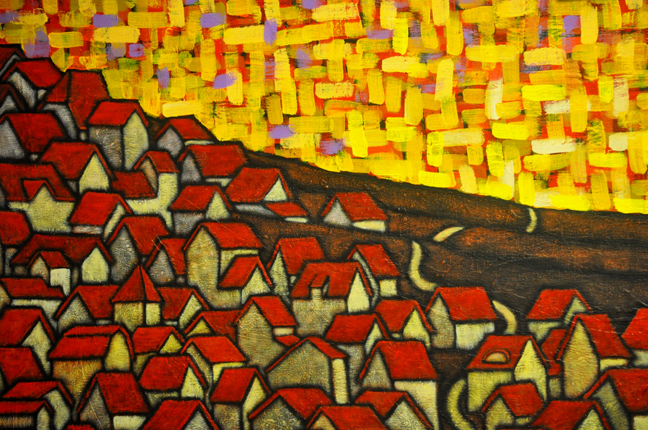
GC Myers 2009 DetailIn this detail you can see these violet strokes.  In the final version of the painting these strokes may barely show but even the smallest bit that does show through brings me a real sense of delight when I look at the sky of the painting.  This tiny detail, I feel, brings a fullness or richness to the whole piece.  I can’t fully explain this but I know I feel better when it’s there when I’m painting in this obsessionist manner.
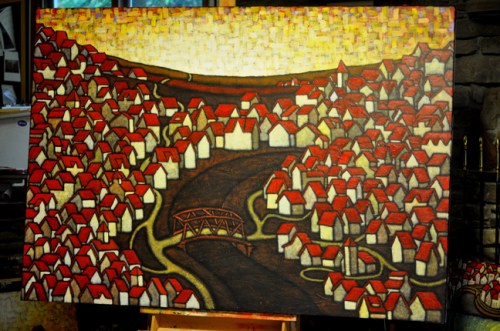
GC Myers 2009 Building Up LandscapeSo I continue in the sky adding more and more layers of lighter and lighter color.  As you can see, the center is starting to glow a bit.  When I am close to where I want the final sky to be, I move to the edge and put on a thin transparent layer of  a nickel azo gold color, burnishing it so that it blends into the rest of the sky but darkens the edges.  When I’m somewhat satisfied ( I don’t have to be completely satisfied at this point- there is room to re-enter at a later point in the process), I begin to ponder how to bring the landscape alive with color.  I want it to maintain some darkness, to give a contrast to the sky and make it pop with light, but I still want a certain vividness.  I’m also trying to create more distance into the picture.  I have found that this creation of distance often dictates how effective my paintings will be.  In this painting I have chosen an orangish blend of color for the farthest layer and a deeper red for the one before it.  Both are deep and dark in color and show well under the brightest part of the sky above.

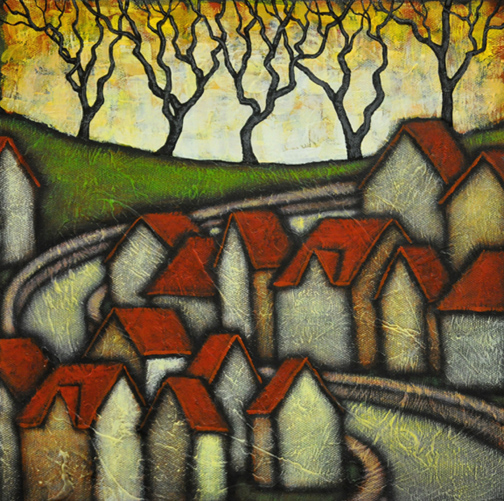
So, I stand back and look at this thing.  I think I’m ready to work on the waterway and the bridge next, starting to feel what I may need to do incorporate these elements smoothly into the rest of the composition.  I first add a light layer of the red oxide to the water surface.  It probably won’t show through much but what does will have a unifying effect with the rest of the painting.  I’m starting to look at the road on both sides of the waterway and how it rises to the horizon in a very viney, limb-like way. GC Myers 2009Wanting to mirror this effect, I’m beginning to think that I may use some bare, bony trees on the top ridge, dark silhouettes against the skylight.  This would be an expansion of an idea I used in this piece that I finished a few weeks back, a much smaller 12″ square piece.  It’s a piece that I like a lot and feel that the trees could be really dynamic in the sky of this larger piece.
But that’s something I will have to debate in my head before I jump in too deeply.  Decisions at this point in a painting can have a major influence on the final feel of a piece and shouldn’t be rushed.  But, you never know.

To be continued…

Read Full Post »

GC Myers 2009 Buildiing UpI’m at a point with this work in progress, a 42″ by 60″ canvas, where I have basically finished the underpainting which is the process of blocking in the composition.  The next step for me is to start building up color throughout the piece, developing more depth from all the elements.  In this case, I start by using a light application, again almost drybrush, of a yellowish paint.  for this piece I’m using a yellow oxide.

The thinly applied yellow allows me to see dimension yet still lets the darkness of the base’s black and the red of the underpainting show through.  This is something that I feel is crucial to the feeling I’m trying to achieve.  Again, I could easily go through and simply paint each structure with one pure color and save a ton of time but it would lose the effect I desire.  Besides, it gives me more time to consider each subsequent move.

Now comes some red.  I start with a few cross-strokes of a crimson in the sky then start applying some yellow strokes as well, just to start to give light the sky.  I also start to lighten the path in all parts of the painting just to give some more depth.  At this point, I’m also pondering if I should start working a bit on the waterway as it is such a large and crucial element in the lower half of the painting and it’s darkness at this point might alter how I proceed with other elements.  After some thought, I decide against working on the waterway and move on to the roofs of the structures.

GC Myers 2009 Adding the Red RoofsAgain, I use a crimson red that is a bit darker which gives me a bit of leeway so that I can lighten roofs later as I see the need.  I’m beginning to see more and more light in the piece at this point and can see areas where I want to concentrate in some of the next steps in the process.  For instance, sides of the houses that will be a sort of focal points through the piece.  I’m reminded also at this juncture of how the roofs of the village act as little pointers or arrows that move the eye upward in the picture.  I do this with other elements as well, in may of  my paintings, everything pushing the eye toward the center of the painting.  It didn’t start as a conscious effort but I became aware that I was doing this years ago and have been doing this subconsciously, albeit with an awareness,  for years.

I was a little apprehensive in showing how I paint in this style, afraid that it might take away some of the mystique of the final paintings, make it seem that  the work was a pure product of process.  But taking the time to write down how I proceed makes me realize that while there is a process it is the decisions that are made during the process that make it either work or not work.  Intuition and a constant visual weighing of elements play huge roles in this decision making, which makes each piece unique beyond the process.  These are things that I take for granted in my day to day existence in the studio, parts of the process that are below the surface and operating on a subconscious level but are perhaps the most important aspects of the process.

So, I’m on to the next step.  Stay tuned…

Read Full Post »

« Newer Posts - Older Posts »