Feeds:
Posts
Comments

Archive for the ‘Uncategorized’ Category

A Van Gogh Cookie

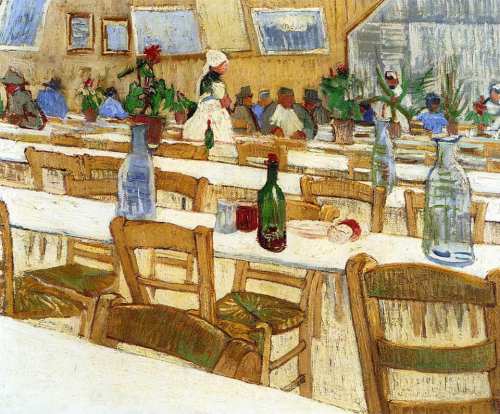
Van Gogh- Interior of the Restaurant Venissac in Arles, August 1888.

Van Gogh- Interior of the Restaurant Venissac in Arles, August 1888.


There is something intimate about painting I cannot explain to you – but it is so delightful just for expressing one’s feelings.

–Vincent van Gogh


I came across the above Van Gogh painting online yesterday. It was one of those pieces that I couldn’t recall ever seeing, even in the books with his collected works. It probably was in there somewhere but just didn’t register with me like it did yesterday.

I immediately liked this piece and just seeing it made me feel better in some small way. It was like stumbling across one more cookie when you thought the cookie jar was empty. You savor this newfound delight a bit more.

Or maybe it has to do with the intimacy that Van Gogh mentions above. He’s right, there is something intimate about painting. Every piece offers some small secret or aspect that comes from the mind and soul of the artist.

So, this morning I am greatly enjoying a morsel from Van Gogh. Not a bad way to spend a few minutes on a dark morning with torrential rain pounding the roof for the time being here in upstate NY.

Now, what’s old Van Gogh trying to tell me here?

Read Full Post »

GC Myers- Fire and Ice sm

Fire and Ice“- At the West End Gallery


Slow getting around this morning. In August, I dream of the gray coolness of fall and winter. Feels like a good moment for a short Robert Frost poem– Fire and Ice.


Read Full Post »

Once in a Very Blue Moon

GC Myers- Sequester's Moon

Sequester’s Moon“- At the West End Gallery


The things that I loved were very frail. Very fragile. I didn’t know that. I thought they were indestructible. They weren’t.

― Cormac McCarthy, The Sunset Limited


Tired and achy this morning, the result of a recent lower back injury/issue, whatever you want to call it, that kept me from sleeping much the last couple of nights. Though I think ( and hope) this will pass within a week or so, it brings to mind a thought that has been rolling around lately.

Life turns on a dime.

I have seen it recently with friends and loved ones whose lives change dramatically from the sudden onset of illness or world rattling events such as wildfires. One day your world seems to be cruising into the future as well as could be expected and the next it is turned upside down. The future that was right in front of you yesterday seems much further away today, with a lot more complications and hurdles between you and it.

It might not even be the same future.

It makes one realize the fragility of our existence in this world. We can plan and visualize our futures but sometimes as the old Roberts Burns line goes:

The best-laid schemes o’mice an’ men Gang aft agley.

Or as you may better know it, without the Scottish intonations: The best laid plans of mice and men often go awry.

So we adapt. We attempt to heal or strengthen our defenses. We learn to do things in a new way. We try to fight back to that original future we foresaw.

It’s what we do. It’s all we can do.

And it’s worth the struggle because as dark and ugly as the world is on many days, it can be far more beautiful and bright on others.

So, if you’re feeling great and your future seems certain, enjoy it now because the world changes quickly. Don’t be surprised if your tomorrow is much different that your today.

For this Sunday Morning music, I am playing a song from singer/songwriter Nanci Griffith who died this past Friday at the age of 68. I don’t know what took her life, if it was an extended illness or if her life just turned on that dime. She was a wonderful songwriter best known for From a Distance, which was a giant hit for Bette Midler, as well as this song, Once in a Very Blue Moon, which was a hit for Dolly Parton. She was also an effective performer with her distinctive trilling voice. She did a marvelous cover of Townes Van Zandt‘s tragic Tecumseh Valley.

She will be missed. I thought Once in a Very Blue Moon was appropriate for today.

Please enjoy the day you have at hand.


Read Full Post »

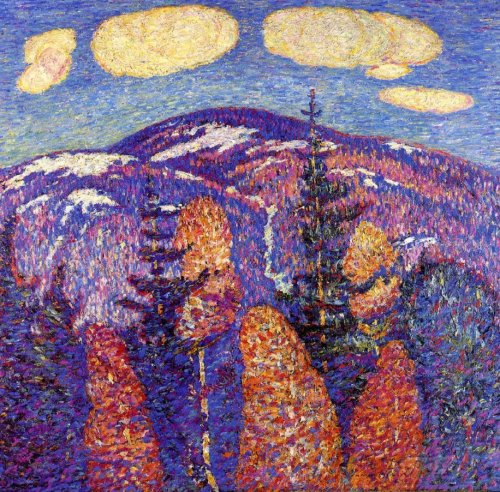
Hartley/ Symbology

Cosmos-The-Mountains-Marsden-Hartley-oil-painting-1

Marsden Hartley (1877-1943)- “Cosmos: The Mountains


All things that are living are expression and therefore part of the inherent symbology of life. Art, therefore, that is encumbered with excessive symbolism is extraneous, and from my point of view, useless art. Anyone who understands life needs no handbook of poetry or philosophy to tell him what it is.

–Marsden Hartley


I think this is an important point from a favorite artist of mine, Marsden Hartley. Trying to paint work that is pointedly symbolic, that tries to force meaning that doesn’t naturally flow from the subject, often feels flat and lifeless to me. Or extraneous and useless as Hartley put it.

Generally, the subject evokes its own meaning and feeling and the best the artist can do is enhance it with their own skills and style — the artist’s tools for storytelling– to make it apparent to the viewer.

Sounds easy. It’s not.

We often add symbology or clutter that either clouds, alters, or detracts from the inherent meaning of the subject.

We complicate when we should simplify.

It’s the story of communication throughout time. Simplicity always triumphs.

I hope that makes sense. I am tired this morning and it sounded okay halfway through my first cup of coffee. A couple of hours from now I might have questions about this.

Here are a few more of Hartley’s landscapes, most from his home state of Maine.


marsden-hartley--an-evening-mountainscape

Marsden Hartley- ” An Evening Landscape”

marsden-hartley--hall-of-the-mountain-king

Marsden Hartley- “Hall of the Mountain King”

marsden-hartley--storm-clouds-maine

Marsden hartley- “Strom Clouds, Maine”

marsden-hartley--the-ice-hole

Marsden Hartley-“The Ice Hole”

Read Full Post »

Distraction


GC Myers- Waiting For the Fire  2002


The mind gets distracted in all sorts of ways. The heart is its own exclusive concern and diversion.

–Malcolm de Chazal


I had a whole thing I meant to write here this morning but August, my annual nemesis with its heat and anxiety, has stripped me of my willpower to do so. I am distracted and sapped of energy this morning.

So, I guess the quote I was going to use fits anyway.

By the way, Malcolm de Chazal was a writer and painter from the African island nation of Mauritius, which is east of Madagascar in the Indian Ocean. It is a former colonial outpost that now has a highly diverse ethnic mix, a high income economy, and is a welfare state with universal health care, free education and free public transportation. It is considered one of the best economies and the most peaceful of the African nations. Just so you know.

Anyway, I am shucking my earlier plans for this post and just playing a song. It’s Who By Fire from the late Leonard Cohen. Goes with the painting.


Read Full Post »

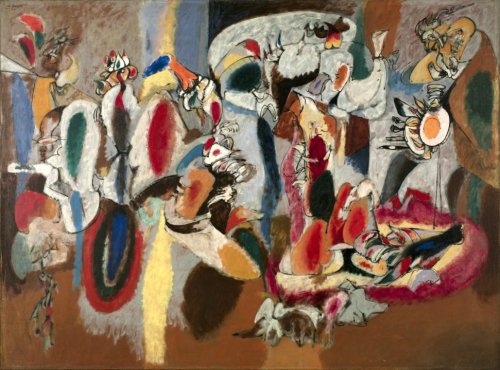
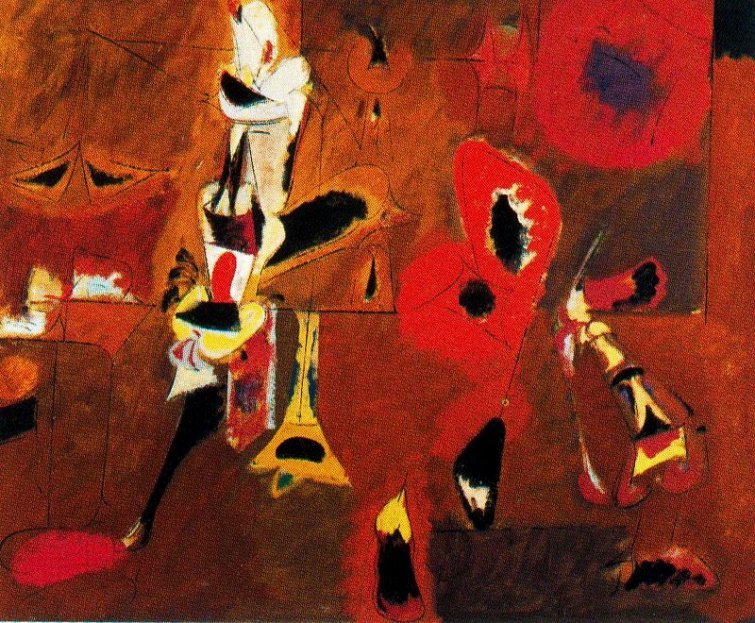
Gorky’s Rightness


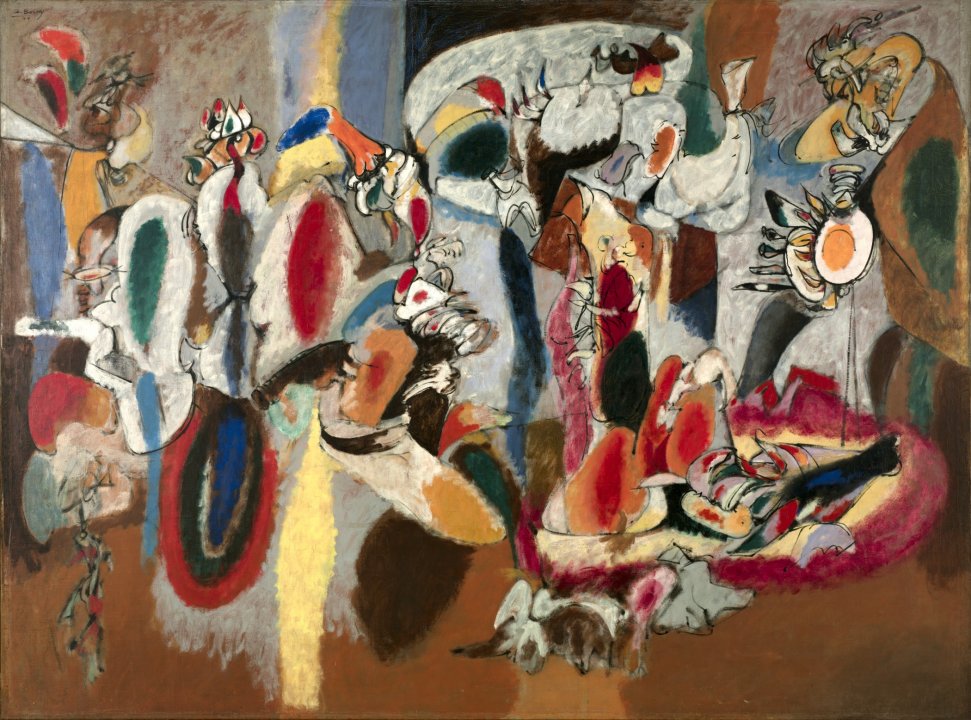
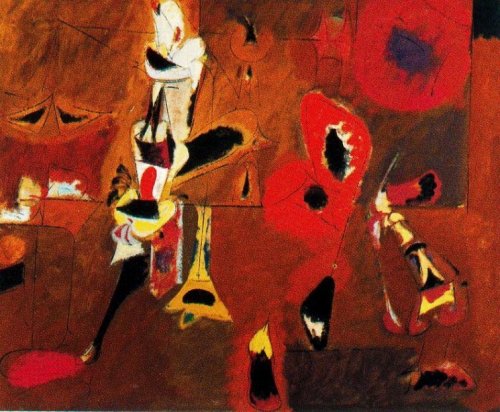
If a painting of mine suits me, it is right. If it does not please me, I care not if all the great masters should approve it or the dealers buy it. They would be wrong.

Arshile Gorky


My computer was a little wonky this morning whcih took some time to straighten out. I think I have it now but time is short so I am replaying a post from a few years back. I agree with Gorky’s words above, that only the artist can really judge the rightness of a piece of their work. I try to remember, here in the studio, that I must paint to satisfy myself only, to work to my own sense of rightness, and let the chips falls where they may in respect to how others see it. It’s not easy because you always hope to have others respond positively to your work. It takes a trust in your ability, built up over many years, to develop this sense of rightness.

Here’s a bit more about Gorky:


Arshile Gorky is one of those names that instantly stands out for me. But the reality is that I never knew much about his work. Just a unique name.

But of course there is more than the name. Gorky was born sometime around 1904 in Armenia and came to America in 1920 in the aftermath of the Armenian Genocide perpetrated by the Ottoman Empire on its own citizens of Armenian heritage. About 1.5 million Armenians died in this dark era including Gorky’s mother in 1919.

Fortunately for him, America was still a welcoming land to refugees fleeing hatred and danger.

He quickly integrated into the America of the 1920’s and spent the rest of his life here, gaining a sizable reputation as an important painter. He is considered one of the major influences on the Abstract Expressionist movement of the 1950’s, which he unfortunately didn’t live to see.

His candle burnt brightly but was short lived. He suffered several personal setbacks after 1946 including a car crash that broke his neck and temporarily paralyzed his painting arm. He hung himself in 1948, dying at around a young 44 years of age.

He hadn’t even come into his prime as a painter.

I like much of his work that I have seen. I am not a fan of abstraction for abstraction’s sake. For me, a work still has to have something to say and a sense of movement, rhythm and harmony of some sort. It has to talk, to communicate a meaning of some sort to me. It has to have have that sense of rightness that I have referred to a number of times here.

Without that, the most beautifully crafted piece of work can be sterile and cold.

Dead.

So, I agree with Gorky’s words above about rightness in his own work. That is the quality I seek most in my own. His work is often described as Lyrical Abstraction which is where the work has many of the qualities that I described above, forming in itself a visual language of sorts that transcends the image.

These are ideas that spark my imagination, that make my time spent in the studio worthwhile.


Read Full Post »

The Unseen

GC Myers- Angels Reach sm

Angel’s Reach“- At the West End Gallery

How fathomless the mystery of the Unseen is! We cannot plumb its depths with our feeble senses – with eyes which cannot see the infinitely small or the infinitely great, nor anything too close or too distant, such as the beings who live on a star or the creatures which live in a drop of water… with ears that deceive us by converting vibrations of the air into tones that we can hear, for they are sprites which miraculously change movement into sound, a metamorphosis which gives birth to harmonies which turn the silent agitation of nature into song… with our sense of smell, which is poorer than any dog’s… with our sense of taste, which is barely capable of detecting the age of a wine!

Ah! If we had other senses which would work other miracles for us, how many more things would we not discover around us!

― Guy de Maupassant, The Horla 


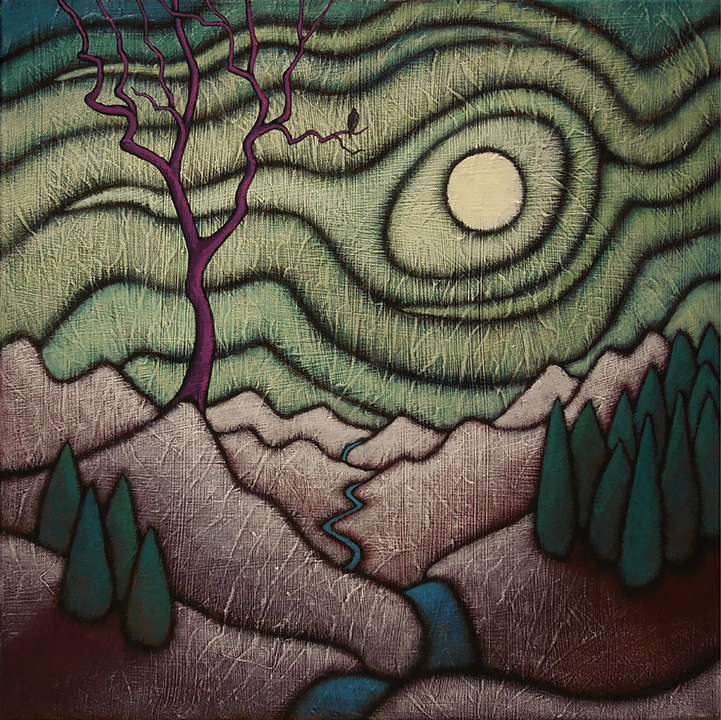
I had someone recently ask me at the West End Gallery about this sky comprised of slashes of paint colors. Why was it painted that way and what did it represent?

I explained as best I could about the fact that there is there are forces always swirling around us, unseen and undetected by our feeble senses. The sky here just gives them a bit of form.

This always reminds me of the final story written by Guy de Maupassant, the great innovator of the short story. Titled The Horla, it is a tale of horror about an alien being — an invisible organism, actually– called the Horla that comes to earth with the intention of subjugating the human race. This unseen invader has the power to enter and sway the minds of its victims.

The narrator of the story describes his emotions, the vast emptiness that overtakes him, as he realizes what is happening and his powerlessness in the face of the threat.

It’s a story that certainly echoes these times. We are beset by a virus we cannot see and are hampered in our efforts to combat it by those who manipulate the minds and opinions with innumerable conspiracy theories for the purpose of obtaining money and power. Perhaps Rupert Murdoch is the Horla?

There’s another passage for the story that adds to the drama of these unseen forces:

I told myself: ‘I am surrounded by unknown things.’ I imagined man without ears, suspecting the existence of sound as we suspect so many hidden mysteries, man noting acoustic phenomena whose nature and provenance he cannot determine. And I grew afraid of everything around me – afraid of the air, afraid of the night. From the moment we can know almost nothing, and from the moment that everything is limitless, what remains? Does emptiness actually not exist? What does exist in this apparent emptiness?

This idea that emptiness does not exist is fascinating to me and echoes what I see in this sky. My idea of what might be contained in that emptiness is much more benign than the terror of the Horla, of unseen forces wanting to gain control of our world or destroy us. I would like to think that there are new dimensions and valuable energy swirling around us at all times if we could somehow detect them.

That might be more of a hope than any glimmer of the reality of what is really contained within the emptiness.

Maybe empty is just empty, a void that we fill with our highest hopes or darkest fears.

I don’t know.

My mantra.

I need to send some time looking at this painting so I can fill my emptiness with those higher hopes before darkness and fear rushes in to fill the void.

Hope it does the trick…

Read Full Post »

She’s a Rainbow

Shes a rainbow Image


Change is not merely necessary to life – it is life.

–Alvin Toffler


Some stuff going on this morning and not enough time, energy, or willpower to write much. I will say that life changes fast and one must be ready to adapt, to move quickly on to those new paths that are suddenly set before us. That goes for us on the personal as well as the societal level, as famed futurist AlvinToffler pointed out in his book, Future Shock.

Sometimes stuff happens and we simply have to take care of it.

That being said, here’s a longtime favorite from the Rolling Stones for this week’s Sunday morning music.

All good wishes for your Sunday.


Read Full Post »

9921089 Cool and Composed sm

Cool and Composed“-Now at the West End Gallery, Corning NY


To persons standing alone on a hill during a clear midnight such as this, the roll of the world is almost a palpable movement. To enjoy the epic form of that gratification it is necessary to stand on a hill at a small hour of the night, and, having first expanded with a sense of difference from the mass of civilized mankind, who are disregardful of all such proceedings at this time, long and quietly watch your stately progress through the stars.

― Thomas Hardy, Far From the Madding Crowd


I have expressed my extreme distaste for the month of August here in the past. I am not going to go through the list of experiences that formed my hatred for this time of the year. Let’s just say that it’s a month whose name alone never fails to put a giant, squirming knot in my gut.

And this first week of this year’s August has lived up to its reputation. It’s been a tremendously stressful week for a number of my favorite people in the world, for a variety of reasons all beyond anything I can do in the way of real assistance, outside of offering words of comfort and support.

I wish them all the coolness and composure of the painting at the top. It has that sense of detachment that Hardy describes so beautifully in the passage above. It’s a separateness where our problems in this world seem insignificant and one is able to obtain a stillness that allows us to sense the turnings of this planet as it makes its way through the cosmos. I can see that in this painting. Maybe that is its purpose, to alleviate the stress of times such as this.

Oh, to have that now.

But it’s August. Damnable August.

Here’s a taste of the coolness. I played a song titled River from Leon Bridges last week. This is another song with that title, this one a a favorite from Joni Mitchell that I have played more than once here in the past. It is the antithesis of August for me.

Ah, wish I had a river to share…


Read Full Post »

Self Portrait/ Drudgery

GC Myers- 1995- Exiles-Let Us Now Praise Famous Men


Drudgery is one of the finest touchstones of character there is. Drudgery is work that is very far removed from anything to do with the ideal – the utterly mean grubby things; and when we come in contact with them we know instantly whether or not we are spiritually real.

― Oswald Chambers


I was recently approached by a collector interested in possibly obtaining some of my Exiles paintings that were from around 1995. They were pieces that were in direct response to my mom’s illness and subsequent death at that time. The offer made me think about what these pieces mean to me and what I see in them. I realized that they had become more and more precious to me over the years. 

I ran the post below about the painting above several years back, speaking about how I saw this piece. I changed the opening quote which had been one from Thomas Edison. I went instead with the one above from Oswald Chambers. an influential Baptist preacher from around the turn of the 20th century who died in 1917 from appendicitis in Egypt while ministering to the troops there. I felt that there was an element of both drudgery and the spiritual in this piece.


I was going through old blog posts recently and I noticed that I had used the painting above a number of times in my earliest posts. It’s part of my Exiles series from back in 1995 and is titled Let Us Now Praise Famous Men, borrowed from the title of a group of Depression-era photos of sharecroppers in the American dust bowl shot by photographer Walker Evans.

I never really wrote about this painting except in what I saw as it’s similarity to what I saw in those photos of Depression era workers. I always felt a connection to this piece but thought it was an outer connection, one that simply had to do with my reaction to form and color and not with anything I might see of it in myself.

Maybe that was my hope.

But it is a painting that I find has more meaning for me than I might want to let on. It’s a piece to which I always return, again and again, to study closely. While I sometimes see it as apart from me, more and more as I live with it, part of me feels like I am that man, standing alone in his landscape.

A sometimes self portrait.

It’s not a flattering self portrait. I used to see this figure as sad or regretful, world weary. But that has changed over time. There is some sadness, some regret but more than anything, I now see him as resigned, neither happy or sad. He is in his place with work behind him and much more work to do. It still has a weariness in it, but not from a physical standpoint. It is more a sense of tiredness from working to stay ahead of the world’s constant encroachment, the world’s constant erosion.

But while it appears tired there is also a sense of implied strength and determination to stay on task.

The hand here is important to me, a symbol of the bond of a working mind and working hands. Ideas set in motion and realized.

It’s a painting that means more and more to me as times passes and the world works its erosive qualities on my self and my world, my landscape. Maybe I am that dirt farmer, looking back with pride in his work along with an apprehension that it will someday be carried away like dry soil in the wind.

Here’s a little music for the morning, a song that fits pretty well in tone and substance to the painting above. It’s the immortal Otis Redding with I’ve Got Dreams to Remember.


Read Full Post »

« Newer Posts - Older Posts »