Feeds:
Posts
Comments

Archive for the ‘Uncategorized’ Category

GC Myers-  Symphony of Silence  2021

“Symphony of Silence”- at the Principle Gallery


Don’t feel like saying much this morning so I will just send out many thanks to those folks who were able to attend the opening of my new show at the Principle Gallery last night. Lots of thanks also to Michele and the rest of the gang  there who do so much good work on my behalf and for their patrons. It is very much appreciated. Sorry I couldn’t be there to help.

Saturday is my unwind day after an opening so here’s a song that sets the right mood for easing into whatever comes next. It’s a bit of bossa nova written by Antonio Carlos Jobim in 1960. This version is from Stan Getz along with bossa nova legends Jobim and Joao and Astrud Gilberto. The song is Corcovado, also known as Quiet Night of Quiet Stars.

Enjoy. And thank you again to those who were able to make it to the show. And thank you for reading.


Read Full Post »

Memorial Day 2021


Civil War Soldier DageurrotypeAnother Memorial Day weekend. The day we remember our fallen soldiers, those who gave their lives to serve and protect this country, this democracy. I’m no historical anthropologist so I can’t be completely certain when I say that I don’t believe there is any one group of people on this planet who have not been touched by war in some significant way.

The history of this world has been written in the bloody ink of war.

A few years back, when I began doing genealogy for the families of my wife and myself, I was surprised at the many, many generations in each of our lines who had taken part in the wars of their times, putting their lives aside to give so much of themselves– in some cases, their very lives– for causes that often might have been mere abstractions to them. I was surprised at the number of our relatives who had died in combat on the soil of this land. In some cases, some were buried far from their homes near the battlefields of the American south.

Part of me is proud that these people have answered the call to be a small part in something bigger. But another part of me is simply sad to think that they were called on to give so much in order to satisfy or deny the baser motives of those in power. War has usually been about greed and acquisition, nationalistic pride or ethnic and religious hatred– in each instance proposed with the greatest conviction and certainty by the leaders of each side of the cause.

And on Memorial Day, we remember the people who actually fulfilled the pleas of these leaders, be they right or wrong. These citizens did what they were asked and what they felt was necessary in their time and place.  And I have nothing but respect for that.

For today’s image, I chose the daguerreotype of the Civil War soldier at the top because there was something in him that seemed to show the sacrifice of war. Maybe it’s the steely stare of his eyes. Or maybe it was his belt that is cinched in to what looks to be a ridiculously tiny diameter, showing how emaciated he appears to be. I’m not exactly sure but there is something in him that seems contemporary, less dated. He looks like he could be the guy behind you in line at the local convenience store.

And for today’s Sunday musical selection, I have chosen the song Ben McCulloch from Steve Earle. It tells the story of two brothers — the guy above was no doubt like them– who enlist in the Confederate Army in the Civil War and discover the hard realities of war as they serve under General McCulloch, who was a real person who died in battle in 1862. The chorus probably echoes the sentiments that many soldiers through time held for their commanding officers as they face overwhelming odds.

I hesitated when choosing this song because I didn’t want it to be seen as glorifying the Confederate dead. I read a couple of Frederick Douglass‘ speeches given in the 1870’s and in that time, there was a growing movement to create an equivalency between the two sides of the Civil War, an effort that continues, unfortunately, to this day.

Douglass pointed out that it was acceptable to honor the courage of the fallen Confederates but it should be forever remembered that they were trying to destroy everything this nation had stood for since its formation and that it should be clearly noted that there was no equivalence between the two sides. Morally, there was a right side and a wrong side.

As Douglass put it:

It was a war of ideas, a battle of principles and ideas which united one section and divided the other; a war between the old and new, slavery and freedom, barbarism and civilization; between a government based upon the broadest and grandest declaration of human rights the world ever heard or read, and another pretended government, based upon an open, bold and shocking denial of all rights, except the right of the strongest.

We should never become a country where the rights of the strongest outweigh those of the weakest among us. Hopefully, fewer folks will have to sacrifice their lives to ensure this. So have a good Memorial Day, hopefully one filled with some appreciation of what the day really encompasses.


This post was adapted and added to from one that ran several years ago.

Read Full Post »

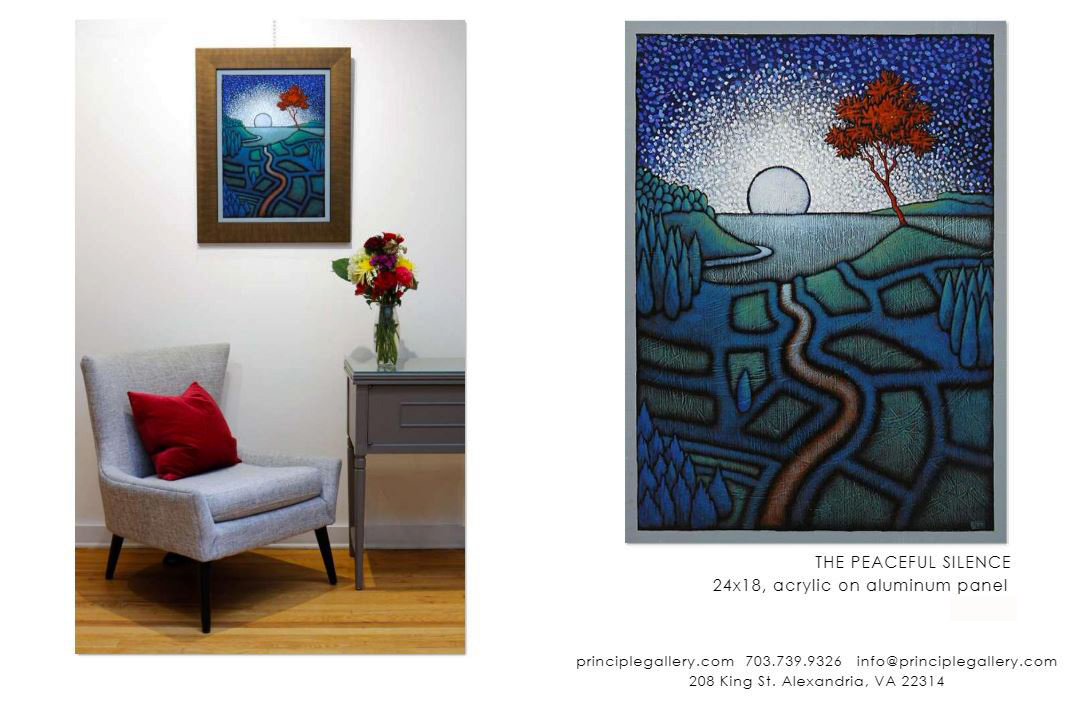
GC Myers The Peaceful Silence 2021 PG Catalog page


Didn’t get around to writing my regular blog this morning but I did want to let folks know that the full catalog preview for my annual solo show is now available by contacting the Principle Gallery. Just send them an email at info@principlegallery.com and they will set you up. This year’s show, titled Between Here and There, opens next Friday, June 4 at the Principle Gallery located on historic King Street in lovely Alexandria, VA.

Read Full Post »

In the next couple of weeks I will be focusing here on work from my annual solo show at the Principle Gallery. This year’s show is titled Between Here and There and opens next Friday, June 4 at the Alexandria gallery. But this morning, I have several tasks to see to and am rerunning the post below about the late artist Preston Dickinson. Great work. See you tomorrow!


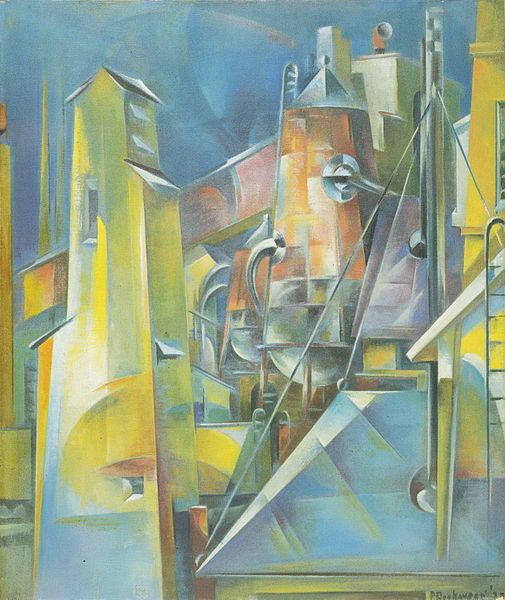
Preston_Dickinson_-_Factory_(c__1920) Columbus Museum of ArtI’m a fan of the Precisionist movement in art which was formed in the early 20th century and often depicted the industrial structures that were fueling the growth spurt taking place in America. There are some big names in this movement, mainly Charles Sheeler and Charles Demuth, both of which I have featured here in the past.

But, like many of the movements in art, there are many lesser but equally brilliant stars in their universe. I recently came across one that really hit with me, mainly because of the energy and breadth of his work. I thought it was all really good, really strong and evocative. But it moved in many directions, pulling from many inspirations. There was some Futurist work, some elements of Cubism and others. It was as though this was an artist that was so talented that he was having trouble finding that single voice that fit his needs.

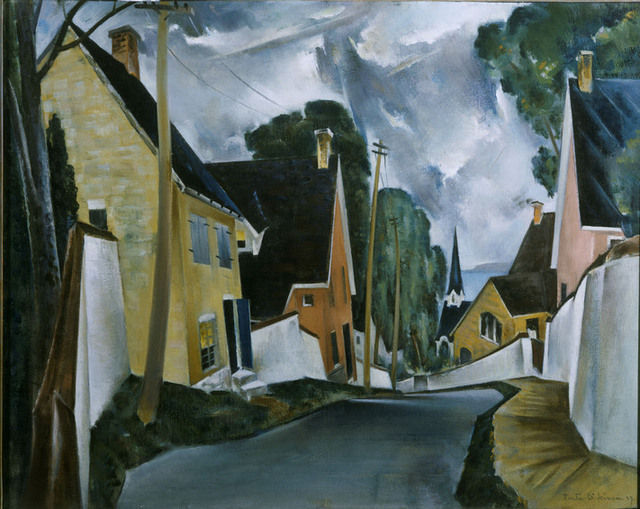
Preston_Dickinson Old Quarter Quebec 1927 - The Phillips CollectionHis name was Preston Dickinson who was born in NY in 1891.  He studied as a youth at the Art Students League under William Merritt Chase and soon after, with backing from a NY art dealer, headed off to Europe to study and exhibit there. Coming back to America, he moved around a bit but by the late 1920’s was considered among the stars of American Modernist painting.

In 1930, he moved to Spain to live and paint and several months after being there contracted pneumonia and died there. He was only 39. He produced only a few hundred pieces of work in the twenty years or so in which he was producing work.

So maybe there is something to this feeling that he was still in the midst of finding his true voice. It makes me sad to ponder what might have been and what sort of work was lost to the world when he passed away. He was obviously a huge talent with an active and inquiring mind.

I am glad to have just stumbled across him now and hope that the joy his work brings me somehow moves into my own.


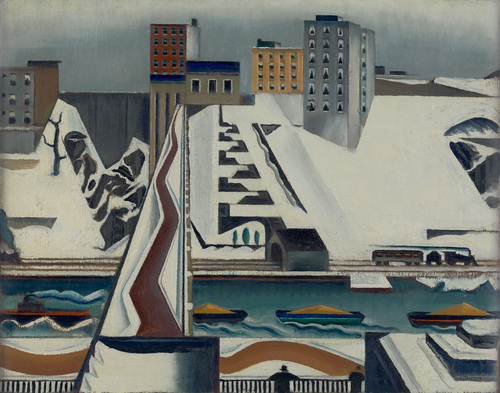
Preston Dickinson Harlem River MOMApreston-dickinson-tower-of-goldPreston_Dickinson Old Quarter Quebec 1927 - The Phillips CollectionPreston_Dickinson_-_My_House_-_Google_Art_ProjectPreston_Dickinson - Industry 1923- The Whitney Collection

Read Full Post »

Frames

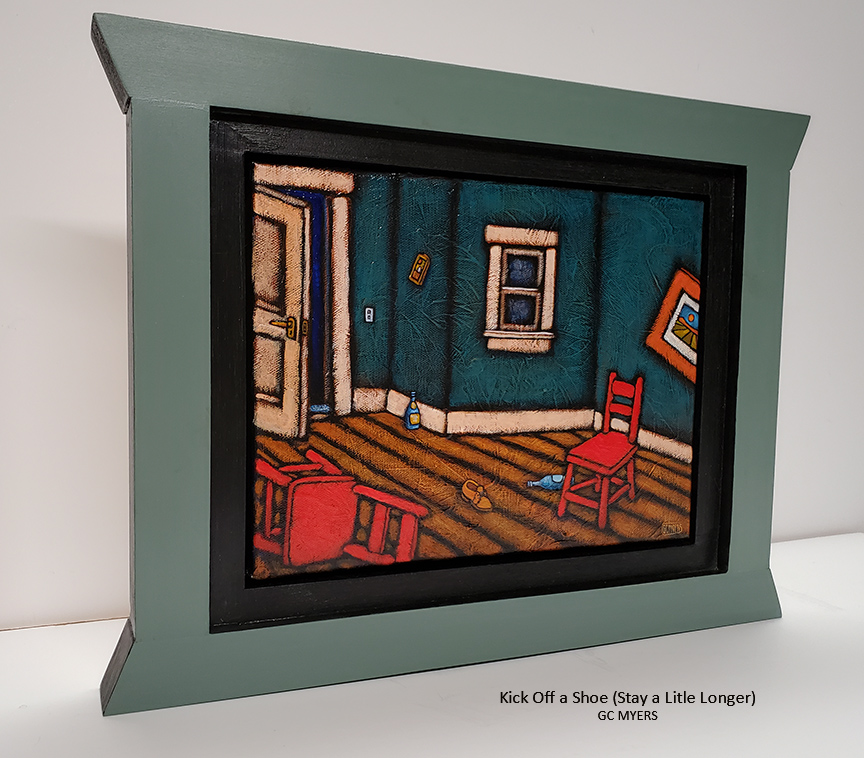
GC Myers- Kick Off a Shoe in Frame


Still a lot to do today before I am ready to deliver the work for my June 4 show to the Principle Gallery tomorrow so I am going to be brief.

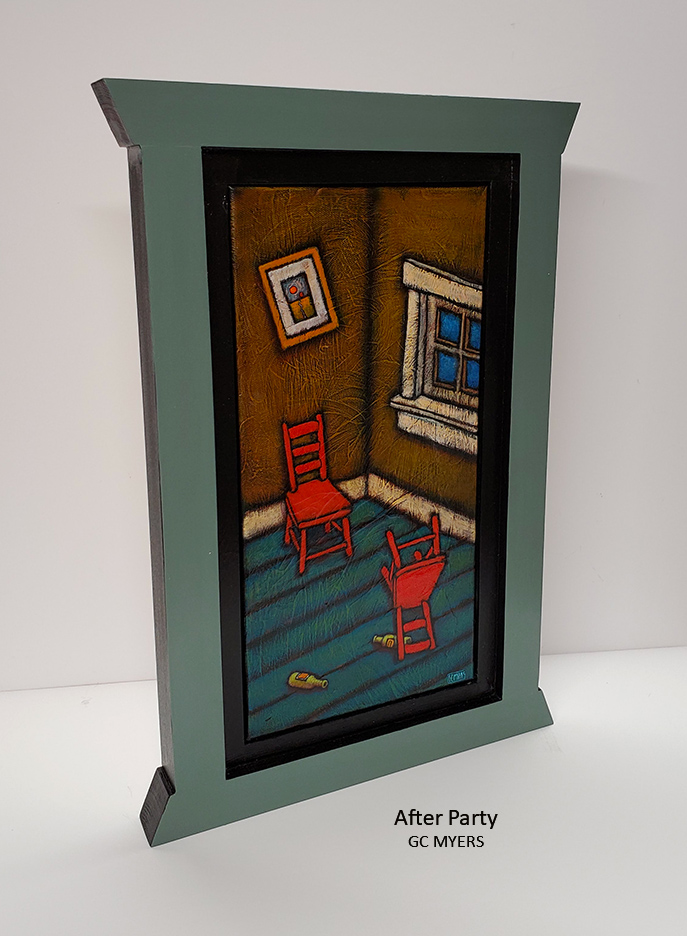
GC Myers - After Party in frameDue to circumstances that kept my friend who has made most of my frames for the past 23 years from supplying me, I had to scramble for some frames for this show. I think, all in all, it was a successful effort that included using frames I had in stock, some new frames from well known frame manufacturers, some raw wood frames I scoured and found on the internet, and a handful of handmade frames, which I am showing here.

While it’s more work than I would like to take on on a regular basis, I generally like the results with the handmade frames. I like the idea of an artist-built frames to go with a painting, especially if it echoes the feel of the work. It adds something personal, something unique, to the work.

I think that is the case with these two. Like my work and myself, they are not perfect. You won’t see them in Fine Woodworking magazine anytime soon. But they feel quirky and definitely attuned to these pieces.

Plus, they are solid. They have a heft that makes me think that you could fend off a marauding team of grizzlies with one of these in hand. For all I know, they might even be bulletproof.

Hope I– or you— never have to find out if these claims are true.


Read Full Post »

Van Gogh in the Rain

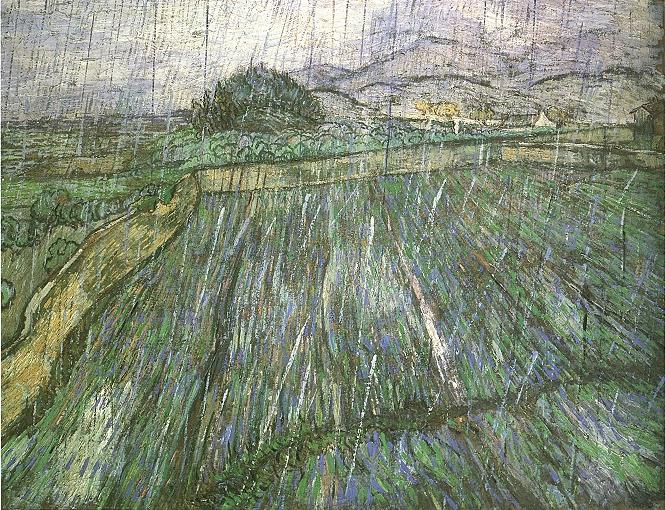
Vincent Van Gogh Wheat Field in Rain 1889

Vincent Van Gogh- Wheat Field in the Rain 1889


If you work diligently… without saying to yourself beforehand, ‘I want to make this or that,’ if you work as though you were making a pair of shoes, without artistic preoccupation, you will not always find you do well. But the days you least expect it, you will find a subject which holds its own with the work of those who have gone before.

-Vincent Van Gogh


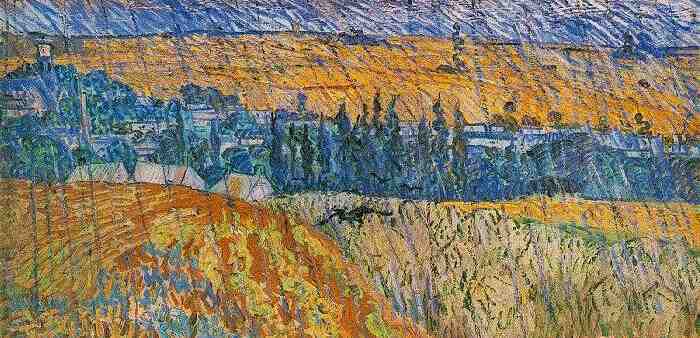
I really just wanted to show these two Van Gogh paintings that feature the falling rain as part of the overall composition. I recently have been particularly interested in seeking out lesser known Van Gogh paintings. We all know the major one, Starry Night and the like. There’s a reason they are so special to us. But there is something quite exciting about these more obscure pieces, something that fills in the blanks between the better known work.

But beyond that, the sentiment above from Van Gogh really resonates with me. Sometimes it seems as though those paintings which you aim at with all your greatest effort fall flat while on those days when you have little idea of where the work will go, something special emerges quite unexpectedly.

It is those days and those painting that you crave as an artist. Oh, it is gratifying to create work that you feel is well within your body of work. That is to say, work which follows a path you have trod upon many times before. But to have those days and those pieces that surprise you– well, that is beyond gratification. It has an almost religious aspect, like an affirmation of one’s belief in something greater.

But those days are often rare and come without a hint of what may emerge. Even sitting here now, I don’t know if today will be one of those days. But just knowing that it is possible makes me anxious to get at it.

Enjoy the Van Goghs and I am going to move into my day.


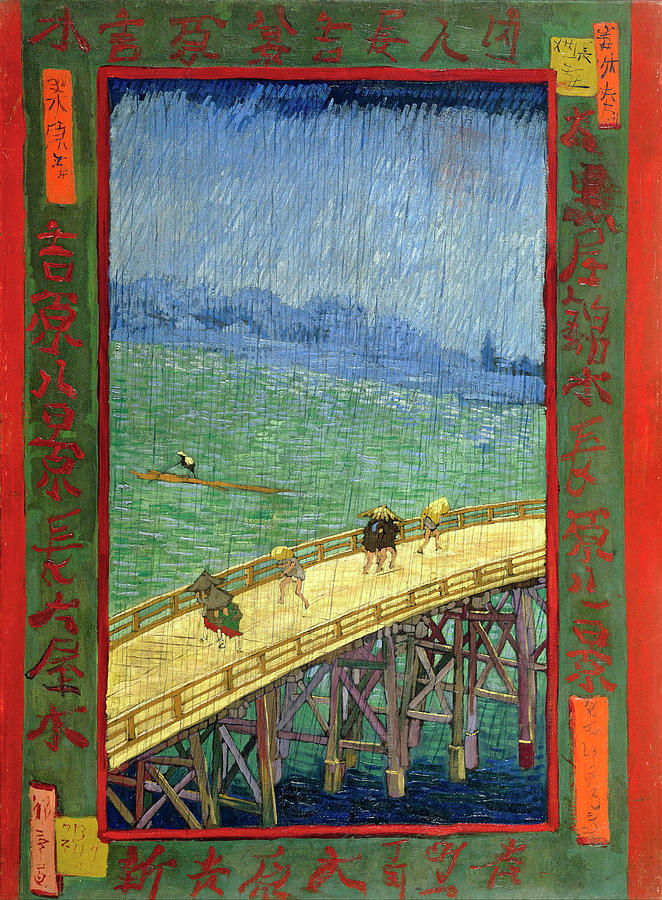
There’s too much to do this morning so I am running this post from 2016, adding a piece where Van Gogh copied a well known Hiroshige painting. But just as then, I am anxious to get my brush back in my hand soon.


Vincent Van Gogh-Landscape at Auvers in the Rain 1890

Van Gogh- Landscape at Auvers in the Rain

1-van-gogh-bridge-in-rain-after-hiroshige-vincent-van-gogh

Van Gogh- Bridge in the Rain (After Hiroshige)

Read Full Post »

Work

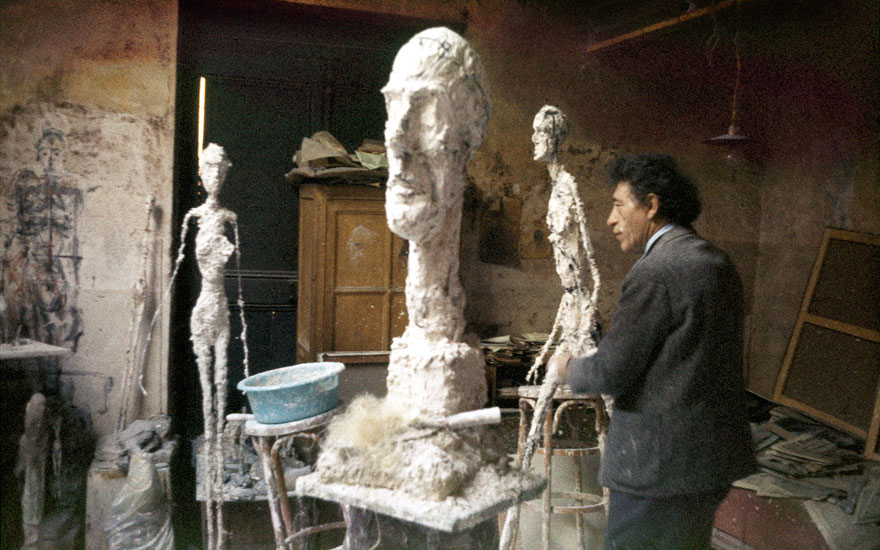
giacomettiinhisstudiocirca1960

Alberto Giacometti in his studio ca. 1960


Basically, I no longer work for anything but the sensation I have while working.

-Alberto Giacometti


That sounds about right.

I am in the midst of prepping work for my upcoming June 4 show at the Principle Gallery. Prepping consists of framing and matting and staining and sanding and varnishing and this and that and so on. All important in presenting the work but none of it is actually the painting that I call my work.

And I am severely missing that work in these last couple of weeks as I have had to put down the brush to finish off the show. The months leading up to this point were the most intense period of work that I have had in several years. My productivity has waned a bit in recent years and this show, after a year that was memorably awful for us all, demanded a new commitment to the work.

And I believe that I found it.

I locked myself in basically over the past several months and just worked. It was in recent weeks, as I approached this point where I would have to stop painting for a while to prep the show, that a realization came to me. I saw clearly that how important that sensation I had while working, as Giacometti puts it, was to me, how it drove everything in me and unlocks so many things there.

I need that sensation. It is a self-generating source of energy and the path to that place where I am at my best, where I have an opportunity to be more and expand my understanding of this existence.

This realization required a deepening of my commitment to my work. I want and need to delve deeper and the work is the only way to get there.

Just felt that needed to be said aloud, even if only for myself to hear. Now, I have to get back to prepping so that I can truly get back to that work.

Read Full Post »

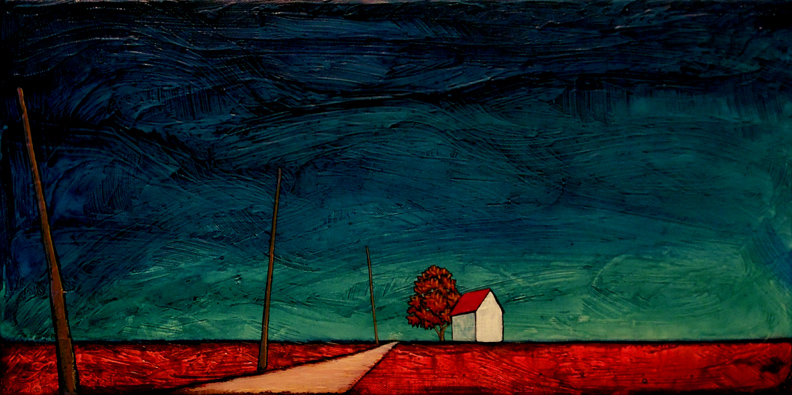
gc-myers-memory-of-night-sm


The opposite of love is not hate, it’s indifference. The opposite of art is not ugliness, it’s indifference. The opposite of faith is not heresy, it’s indifference. And the opposite of life is not death, it’s indifference.

-Elie Wiesel


I am super busy working on my upcoming Principle Gallery show this morning but thought that I’d share a post that I like to replay every few years. It meshes well with yesterday’s post about how each of us deserve to have our voice heard and our existence acknowledged.


I’ve been sitting here for quite some time now, staring at the quote above from Elie Wiesel, the late Nobel Laureate and peace activist. I had planned on writing about how my work evolved as a response to the indifference of others but now, looking at those words and putting them into the context of Wiesel’s experience, I feel a bit foolish. Wiesel, who had survived the Holocaust and crusaded so that it might never happen again, was eyewitness to indifference on a grand scale, from those who were complicit or those who did not raise their voices in protest even though they knew what was happening to the personal indifference shown by his Nazi guards, as they turned a blind eye to the suffering and inhumanity directly before them on a daily basis, treating their innocent captives as though they were subhuman, nothing at all in their eyes.

The indifference of which he speaks is that which looks past you without any regard for your humanity. Or your mere existence, for that matter. It is this failure to engage, this failure to allow our empathy to take hold and guide us, that grants permission for the great suffering that takes place throughout our world.

So you can see where writing about showing a picture as a symbolic battle against indifference might seem a bit trivial. It certainly does to me. But I do see in it a microcosm of the wider implications. We all want our humanity, our existence, recognized and for me this was a small way of raising my voice to be heard.

When I first started showing my work I was coming off of a period where I was at my lowest point for quite some time. I felt absolutely voiceless and barely visible in the world, dispossessed in many ways. In art I found a way to finally express an inner voice, my real humanity, that others could see and feel a reaction. So when my first opportunity to display my work came, at the West End Gallery in 1995, I went to the show with great trepidation.

For some, it was just a show of some nice paintings by some nice folks. For me, it was a test of my existence.

It was interesting as I stood off to the side, watching as people walked about the space. It was elating when someone stopped and looked at my small pieces. But that feeling of momentary glee was overwhelmed by the indifference shown by those who walked by with barely a glance, if that. It was as though my work wasn’t even there.

Those moments crushed me. I would have rather they had stopped and spit at my work on the wall than merely walk by dismissively. That, at least, would have made me feel heard.

Don’t get me wrong here. Some people walking by a painting that doesn’t move them with barely a glance are not Nazis nor are they bad folks in any way. I held no ill will toward them, even at that moment. I knew that I was the one who had placed so much importance on this moment, not them. They had no idea that they were playing part to an existential crisis. Now, I am even a bit grateful for their indifference that night because it made me vow that I would paint bolder, that I would make my voice be heard. Without that indifference I might have settled and not continued forward on my path.

But in this case, I knew that it was up to me to overcome their indifference.

Again, please excuse my use of Mr. Wiesel’s quote here. My little anecdote has little to do with the experience of those who suffered at the hands of evil people who were enabled by the indifference of those who might have stopped them. The point is that we all want to be heard, to be recognized on the most basic level for our own existence, our own individual selves. But too often, we all show indifference that takes that away from others, including those that we love. We all need to listen and hear, to look and see, to express our empathy with those we encounter.

We need to care.

Maybe in that small ways the greater effects of indifference of which Elie Wiesel spoke can be somehow avoided.

We can hope.


The painting at the top is a new piece [at the time this was first written] that I call Memory of Night, inspired by Wiesel’s memorable book documenting his Holocaust experience, Night.

Read Full Post »

9912238 Up and Up small


There are only patterns, patterns on top of patterns, patterns that affect other patterns. Patterns hidden by patterns. Patterns within patterns. If you watch close, history does nothing but repeat itself. What we call chaos is just patterns we haven’t recognized. What we call random is just patterns we can’t decipher. What we can’t understand we call nonsense. What we can’t read we call gibberish.

–Chuck Palahniuk, Survivor


I tend to agree with the snippet above from author Chuck Palahniuk’s novel.

Everything is built upon pattern. Who we are and how we behave. History. Science. Music and art. It is all dictated by patterns.

Most of us don’t dwell too long on identifying patterns in the world around us and some of us will even refuse to acknowledge the predominance of pattern in the world, believing everything is random and chaotic. I suppose that in itself is part of a pattern, a larger one that is so encompassing that we can’t see it from our vantage point within it.

Just speculating there, of course.

I know that I am always looking for pattern, even when I’m not really looking. I call it pattern, rhythm, flow, sense of rightness and other terms, without knowing why I am drawn to this concept. It just attracts me in that it is so much part of everything that there must surely be significance.

This search for pattern often shows up in my work, especially in those with unusual dimensions like the painting shown on the left, titled Up and Up. The width of its picture plane is very restrictive, forcing all the elements within it to be condensed so that it maintains a semblance of coherence for the viewer. For these paintings, it results in patterns all their own. Patterns that often hold the visual appeal of the whole painting.

For example, Up and Up has a pattern that reminds me of ladder rungs, with each new layer in the landscape lifting you higher. I see it both as a landscape and as a pattern, a sort of DNA-like structure or armature on which this world is built.

Whatever it is, it holds my eye and makes me keep searching for something in it.


This post ran several years ago but has been adapted for the piece shown here, Up and Up, which will be part of my upcoming solo show, Between Here and There, opening June 4, at the Principle Gallery in Alexandria, VA.

Read Full Post »

The Arc

Arc


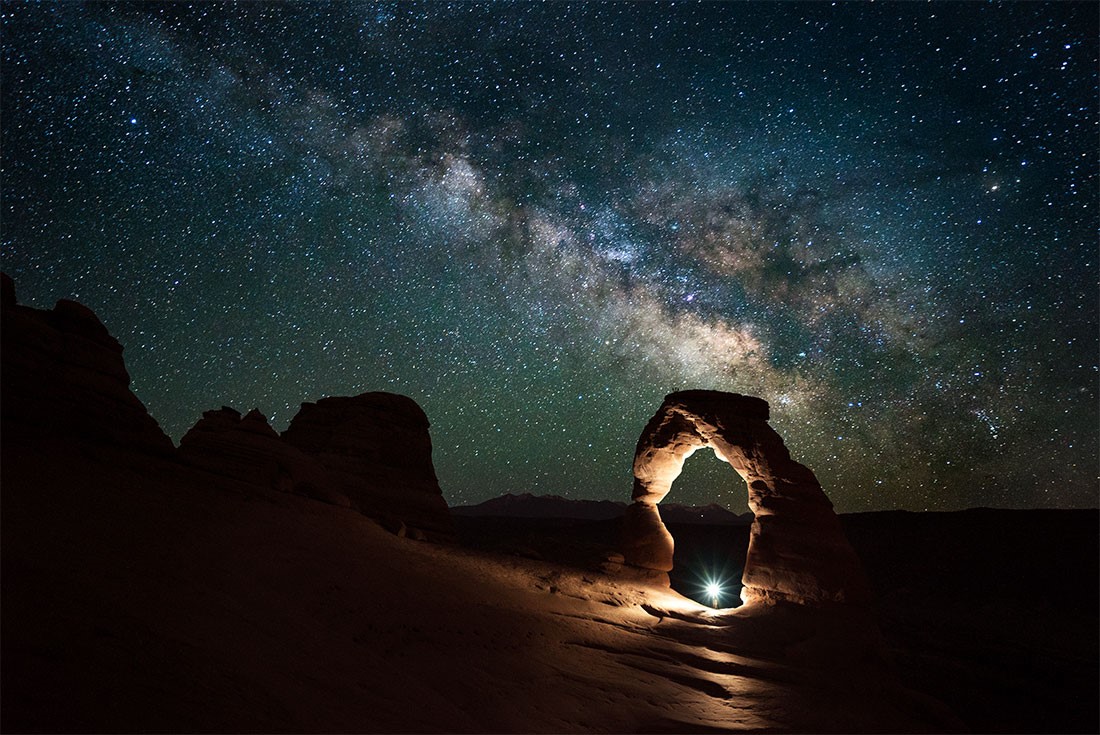
I do not pretend to understand the moral universe. The arc is a long one. My eye reaches but little ways. I cannot calculate the curve and complete the figure by experience of sight. I can divine it by conscience. And from what I see I am sure it bends toward justice.

-Theodore Parker, 1853 Sermon


The excerpt above from Unitarian minister Theodore Parker in the Abolitionist years before the American Civil War was the source for a popular quote from another famed minister. Dr. Martin Luther King, Jr. later condensed Parker’s words into a quote that has become almost an anthem in recent times–  The arc of the moral universe is long, but it bends toward justice.

Yesterday provided some small proof of this moral arc bending toward justice. I was holding my breath as the judge in the George Floyd murder case rendered the jury’s verdict. When he announced that the officer was guilty of all three counts, I felt a great sense of relief overtake my body. It was not a moment of jubilation or joy. This may ha been a pivotal moment in the way in which this country moves forward and had the verdict went the other way, we might be looking at a much different scenario today.

Feeling that justice was finally served in some way, I immediately thought of King’s words. However, it kind of nagged at me because I knew that this was not some sort of preordained result, not some sort of karmic return that was meant to occur.

No, it was the result of an outcry and vigilance. Had it not been for the courage of a seventeen year old young lady with an IPhone camera who was willing to document the atrocity she was witnessing, if not for throngs willing to take to the streets during the height of a deadly pandemic, if not for police officers who could no longer turn a blind eye to the criminal behavior of some of their brothers in blue, the moral arc might not yet be bending. 

Nothing, especially justice, is preordained. Change, including the bending of the moral arc of the universe, is the result of actions taken. Without the will and the courage to continue to attempt to bend that arc, it will never head completely toward justice.

While I love the belief of Dr. King’s words, I think I prefer Parker’s longer message where he adds that he can divine by conscience, meaning, I believe, that he knew that the will and effort to bend that arc was a critical necessity but that it was at hand.

There is much work to be done. It is not a time for celebration. Even my sense of relief should be avoided because for every action there is a reaction.

Those hate-filled folks who have a different view of where justice rests on the moral arc of the universe are not going away any time soon. They will continue to try to warp the arc toward their own vision, seeming to believe that denying rights and dignity to others somehow elevates their own. 

In fact, diminishing the rights of any one of us diminishes the rights of us all.

So, let’s stay watchful, responsive and brave, folks, okay? It’s up to us alone–you and me and all our friends– to bend that arc towards a form of justice that blindly and equally serves each and every one of us.


Read Full Post »

« Newer Posts - Older Posts »