Feeds:
Posts
Comments

Archive for the ‘Uncategorized’ Category

Georgia O'Keeffe Autumn Leaves

Georgia O’Keeffe- Autumn Leaves, 1924


October is the month for painted leaves. Their rich glow now flashes round the world. As fruits and leaves and the day itself acquire a bright tint just before they fall, so the year near its setting. October is its sunset sky; November the later twilight.

–Henry David Thoreau


An October morning. I have nothing to say this morning. Well, that’s not true. I have things to say but don’t want to say them or, at least, don’t want to make the effort. Too interested in watching the light begin to show through the bones of the trees that have become more visible as the leaves have fallen. In the semi-dark. I am listening to Cannonball Adderley and his version of Autumn Leaves, with his all-star band featuring Miles Davis on trumpet. There are a wide range of takes on this song from many artists and most are wonderful. It’s that good a composition. But this remains a favorite for me.

Good stuff for an autumn morning…


Read Full Post »

gc-myers-early-figure


What are we when we are alone? Some, when they are alone, cease to exist.

Eric Hoffer


I’ve spent a tremendous amount of time alone in my studio over the years. Literally, tens and tens of thousands of hours in solitude. It has been time that has allowed me to close myself off in a certain way from the outer world and create the inner world that I show in my work. But occasionally the outer world breaks through and my simple solitude is shaken. I find myself caught between the outer world and my inner creation, my inner being.  

It’s a frustrating time and it becomes hard to focus in order to find that inner world. It’s been that way recently but I keep pushing for it and know that it will return soon. I am reminded of the post below from a few years ago that deals with being alone.


I was recently contacted by author for use of one of my images for inclusion in his upcoming book. It was an old image, one that I still possessed and had used on this blog, so I began to go through my files to find it. Shuffling through the old work, many from before I began exhibiting publicly, brought a number of surprises. There were pieces, like this one here on the right, that had slipped my mind and seeing them rekindled instant recognition and memory, like stumbling upon an old acquaintance who you had not thought of in ages. But there were others that had been lost in my memory and seeing them still only vaguely brought traces of their origin, as though you were again coming across someone who knew you, but you couldn’t quite remember them even though there was something familiar in them, something that told you that you once knew them.

Looking at these old pieces made me think of all the time spent alone with these images. The quote above from Eric Hoffer came to mind. What are we when we are alone? Is that the real you? Or is the real you that person that interacts with all the outside world?  Looking at these pieces, I began to think that the person I was when I was alone had evolved slowly over the years, becoming closer to one entity. What I mean is that the person I was when I was alone, my inner voice, did not always jibe with my outer voice and over time, especially as I have found a true voice in my work, has come closer and closer to becoming one and the same.

I don’t know if I can explain that with any clarity. It’s a feel thing, one that instantly comes from holding one of these paintings and still seeing the division that once was in them and in myself.  It is not anything to do with quality or subject or process. It’s just a perceived feeling in the piece, an intangible that maybe only I can sense.  But it’s there and it makes me appreciate the journey and the work that brought these two voices closer together.

My alone time immersed in these pieces has seldom felt lonely and, going back to Hoffer’s quote, never did I feel that I ceased to exist in my oneness. I know people who are like that, that need constant connection and interaction in order to feel alive and vital, but for me it has often felt almost the opposite. That probably is a result of that division of my inner and outer voices that I have been trying to describe. When I was alone, I was always comfortable with my inner voice and the work that resulted from it served in the forms of companions.

I definitely exist in my solitude and my work, my constant companion, is my proof.

I am going to stop now. Enough confession for one morning.  I have new companions on the easel to which I must attend.


This was a replay of a replay from back in 2017. Its message hasn’t changed a bit in the intervening years. Maybe I am just using it as pretense to play a song, The Inside Man. that I played here a few years back. I have no idea about its title’s meaning but for today it refers to the inner being. It’s a piece I came across awhile back, a piece of dance music from a Croatian DJ/ musician, Funky Destination. There’s something in it that always both focuses me and stirs me up– at least that inner part of me. The inside man…


Read Full Post »


He [Cézanne] reproduced himself with so much humble objectivity, with the unquestioning, matter of fact interest of a dog who sees himself in a mirror and thinks: there’s another dog.

–Rainer Maria Rilke, Letter to his wife, from Rilke’s Letters on Cézanne


After Paul Cezanne died in 1906, during the next year there was a retrospective exhibit of his work at a Paris gallery. Throughout the autumn of 1907, the poet Rainer Maria Rilke went to that gallery nearly every day to take in the Cezanne paintings. He would then write long letters to his wife describing the work and what he saw in it. These letters were later assembled in a book that expresses the joy and wonder that Rilke found in Cezanne’s paintings.

I came across the passage above about Cezanne’s habit of revisiting subjects again and again. He painted over 30 self-portraits (a handful are above) in his lifetime as well as over 80 versions of Mont Sainte-Victoire. His still life paintings were often new examinations of the same subject matter.

Rilke’s description of Cezanne as being like a dog gazing into a mirror and thinking that it was another dog made me laugh. But it also made me think about how many other artists often revisit the same themes and subjects repeatedly.

For me, it is in my landscapes and the ubiquitous Red Tree. When I think about it, every time I am in the midst of a new painting and it shows itself as Red Tree landscape, I seldom, if ever, think of it as a revisitation of a past painting. No, it always feels like it is something new, something fresh. It may be familiar to me, may spark a feeling of recognition but it seems new to me in that moment.

Another dog in the mirror.

One might wonder why that is so. I can’t say for sure, can only throw out theories based solely on my own glaring lack of knowledge in things such as art or psychology or most anything else. Just guesses really.

Maybe it is mere mental laziness? I might go with that but that is kind of insulting on a lot of levels. If that were the case, why even make the effort to talk or write about it?

Maybe one senses there is something more to be found in whatever that subject is but can’t quite determine what it might be. You need to come back to it again and again.

Kind of like a recurring dream, one that keeps showing up over time as the seemingly same dream but one that is slightly altered in some way that makes it feel somehow new to the dreamer. Certain aspects of the previous dreams remain but some are gone. Some elements that might have been mere background in former dreams suddenly take on greater significance. As a result, though it might have the same overall imagery and scenario the tone and feel of the dream is entirely different.

I could see this being the case with my painting. There is often a repetitive quality, but similar paintings never feel quite the same. There are often subtle (and not so subtle) changes in color, texture, emotion, depth, perspective, and on and on. There are refinements and progressions to the previous incarnations as well as regressions.

Like the recurring dream, some parts move forward to the new dream and some do not.

That dog in the mirror looks familiar but I don’t know it. Yet.

Here’s a tune that has nothing to do with this post other than the fact that it has dog in its title. Maybe that’s more than enough. Anyway, this is Sundog Serenade from the new album, The Southwind, from Grammy-winning guitarist Bill Mize. As mentioned here before, the album cover features one of my Archaeology paintings. That doesn’t matter– this is just a lovely tune for this morning.


Read Full Post »

Jamie Wyeth The-Sea-Watched_2009

Jamie Wyeth- The Sea, Watched


Painting to me is addictive. These are moments when it is inspiring, but they are few and far between. I keep my tools sharpened for the moment when things do start clicking, but that doesn’t happen a lot. I really have to push myself sometimes. Painting is a profession in which it is very easy to be lazy, particularly if you have any degree of success.

–Jamie Wyeth


I am in the same time period as the post below from 2018, in the weeks after my last major obligation of the current year and next year’s shows in the distance.  It’s a time to catch up on things unrelated to painting, things like maintenance projects on my home and studio, before the winter weather begins. I have found that while it feels like lazy time that takes me away from painting, it is actually a time of germination. Seeds of new images and colors grow during this period until they get to the point that break through the surface when I finally get back to painting in earnest.

I thought this was a good piece to share today. Its sentiment remains constant and serves as a reminder to not become too lazy, to get back to it as soon as possible. One difference might be that I could possibly have to adjust the amount of productive time as an artist I have left in my life. This morning, 30 years seems like a major stretch. But who knows, right? It remains something to shoot for, at least.


The painting above is The Sea, Watched from artist Jamie Wyeth. son of Andrew Wyeth and grandson of NC Wyeth. I came across the quote from Wyeth that is below the image, and it really struck a nerve with me, especially in the moment.

Being back in the studio after the Gallery Talk at the Principle Gallery [2018], I am conflicted by two desires. One is to just be bone lazy and do nothing, to simply enjoy the good feelings generated by the talk and my own sense of my work at the moment. The other is to dig back in with even greater fervor, to move the goalposts ahead and begin the next step towards reaching those goals. What exactly those goals are is yet to be determined but I do know they are there.

I do feel that I do have to move forward, to not be lazy and rest on the work that is out there at this point. Part of that comes from doing these talks and getting real feedback on what I have done. I don’t want to come before these folks next year and have nothing new, no advancement in the body of the work, to point to.

That is the one of the addictive parts of this painting thing– a fear of falling short.

But sometimes the lazy part is appealing. I look at the work so far and I feel good about it. I tell myself to take it easy. Relax. Coast for a while. That would certainly be easy to do.

But part of me knows that’s the wrong way to go. If for some reason my career ended today, I can’t say I would be satisfied with what I have done. I don’t feel that my story is completely told yet, that the work hasn’t yet revealed all that it has to yield.

So, I dig back in.

I was asked after the talk the other day if I planned to retire and I laughed. First, I said I couldn’t because all of the paintings I have given away at these talks represented my retirement funds. But I then said I couldn’t imagine not doing this to the day I either die or become incapacitated in a way that would prevent me from picking up a brush and making a mark.

Realistically, I figure I have a good twenty-five years in which to be productive. And if I am fortunate and take care of myself, maybe thirty. I notice more and more older artists working into their 90’s and beyond, producing new work that are exclamation points on long careers.

That would be good. But it won’t happen if one lets laziness creep too much into the equation. Fortunately for me, the credo, “Live to work, work to live,” is not a scary or depressing idea.

So, that being said, I’ve got a lot of work to do. Have a great day.

Read Full Post »


The post below is from four years ago, in the runup to the 2020 presidential elections. It was a time at the end of an administration that had buffeted the American people for nearly four years of continuous lies and divisive hate-filled rhetoric. It culminated in the events of January 6, 2021. It’s four years later and the person responsible for that division and violence is frantically operating at an even greater magnitude of darkness in his appeal to his followers. Tomorrow, we will be a mere four weeks from Election Day. The same person who stoked the storm that was January 6 is desperate and is once again attempting to set a whirlwind upon us that he hopes will tear us apart so that he might once more take power.

I thought this post was appropriate to this time, as it was four years before and as it was in 1936. Be mindful, my friends, for there are perilous weeks ahead of us.


Lately, I have been reading bits and pieces from a book of Carl Sandburg poems called The People, Yes. Published in 1936, It is a broad work that attempts to span the multitudes, much like Whitman and his Leaves of Grass. It is a deep reflection on the American people at that time, in the midst of the upheaval of the Great Depression and the rise of Fascism and Naziism in Europe.

As I say, I have been reading it piecemeal, picking it up at loose moments. Each time I am struck how relative it is to this time even though it is nearly 90 years old. For all the technological and societal changes that have occurred, for all the progress and sophistication we assume took place, we are still pretty much the same and pretty much in the same place. Still maintaining many of the same conceptions and misconceptions, still as biased and still as vulnerable to being manipulated.

One verse from this book that I keep coming back to is shown above, at least its beginning, #102.

It begins with bits from President Lincoln’s July 4, 1861 speech to Congress, one in which he justified his actions in the aftermath of the Confederate’s attack on Fort Sumter. In it, he outlined how the leaders of the Southern rebellion stoked the enthusiasm for conflict among the people living there through the dispersal of misinformation and fallacies. Some things never change, eh?

Reading Sandburg’s take on this is a bit scary. It seems to reflect what has happened here so well. The public has been barraged with lies and hateful, divisive rhetoric for the last four [now eight] years to the point that we are without moorings. Many of us have lost the ability to discern truth from the lie and right from wrong. And now, in this unsteady state, we are experiencing the convergence of events that have been precipitated by these actions.

We are reaping the whirlwind.

And, unfortunately, the man and his accomplices who have done this, who have unleashed this awful power, can no longer control its direction or the scope and range of its destructive power.

As Sandburg put it:

Is there a time to repeat,
“The living passions of millions can rise
into a whirlwind: the storm once loose
who can ride it? You? Or you? Or you?
only history, only tomorrow, knows
for every revolution breaks
as a child of its own convulsive hour
shooting patterns never told of beforehand”?

As I say, some things never change. There will always be those who try to benefit from inciting chaos and division upon the people. But, as it has always been, these devious people have never been able to reliably predict or control the whirlwind they let loose.

The public mind generally has the final word in such matters.

And it is speaking now.


Let us hope the people answer the call in the coming four weeks…

Read Full Post »

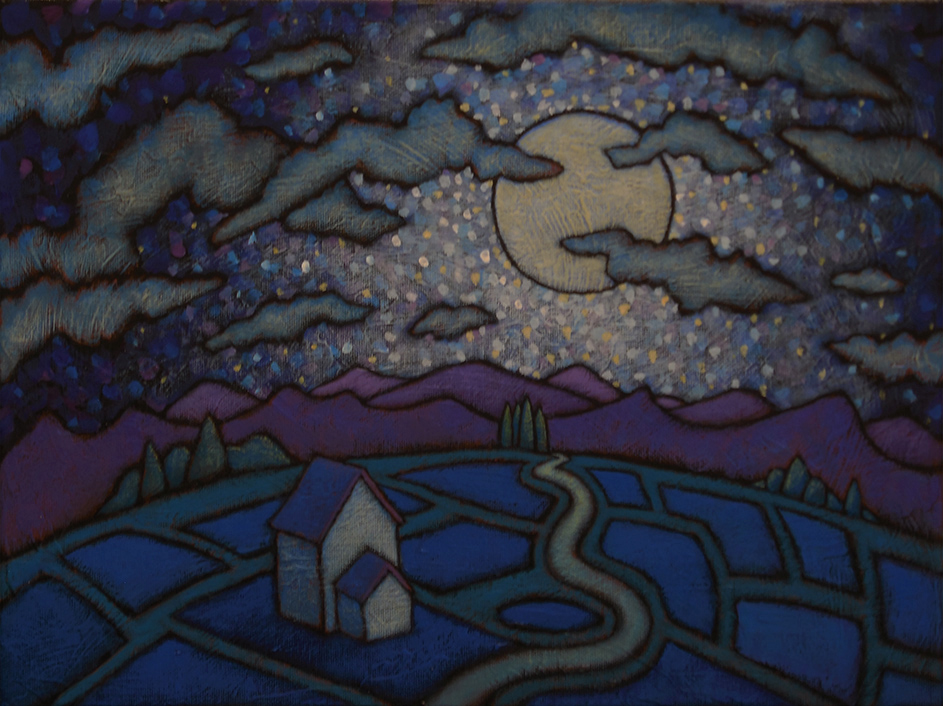
GC Myers- Night's Dream

Night’s Dream–At Principle Gallery


If a little day-dreaming is dangerous, the cure for it is not to dream less but to dream more, to dream all the time.

–Marcel Proust, Within a Budding Grove (1919)


Time for some Sunday Morning Music. And that’s all. I have too much dreaming ahead of me this morning to spend much time here. Feel like I might be in a dream deficit. I would explain but I have said too much already.

Let’s just leave it with a line from Proust, a painting of mine from the Principle Gallery, and a song from a longtime favorite album by Richard Thompson. This is You Dream Too Much from his 1991 Rumor and Sigh album.

Do what you will with this triad then hit the road, folks– you’re standing on my dreams…


Read Full Post »


GC Myers- In Eminence 2024

In Eminence– At Principle Gallery, Alexandria

“This is why alchemy exists,” the boy said. “So that everyone will search for his treasure, find it, and then want to be better than he was in his former life. Lead will play its role until the world has no further need for lead; and then lead will have to turn itself into gold.

That’s what alchemists do. They show that, when we strive to become better than we are, everything around us becomes better, too.”

— Paulo Coelho, The Alchemist


This is a rehash of a post from 2013. It was originally about a solo show from that year titled Alchemy I chose that title because it often feels as though art is akin to alchemy, the ancient and mysterious practice that is defined by its stated goals of turning base metals into gold or silver and creating an elixir that would give man’s life great longevity, possibly immortality.

Most of us likely think of it in terms of some wild-eyed, wild-haired scientist futilely seeking a way to transform lead into gold.

But at the heart of alchemy is the simple concept of the transformation of something ordinary into something more than it initially appears to be. That really strikes home for me. I have often written of sometimes feeling surprised when I finish a piece, as though the end result, the sum of my painting, is often far more than what I have to personally offer in terms of talent or knowledge. Like there is a force beyond me that is arranging these simple elements of this work into something that transcends the ordinariness of the subject or materials or the creator.

This feeling has remained a mystery to me for almost twenty years, driving me to write here in hopes of stumbling across words that would adequately describe this transformation of simple paint and paper or canvas into something that I sometimes barely recognize as being my own creation, so marked is the difference between the truth of the resulting work and my own truth.

Even as I write this, I can see that my words are inadequate to describe this vaporous process. So, I will stop here. But, of course, I will probably continue to try to describe it again and again in the future.

And will inevitably come up short.

I chose the painting here for this rehash because I thought it was a good example. It is simply composed with basic elements. While I was working on it, it felt as though it was a bit dull. Flat. Then at a certain point, it suddenly transformed in almost every way. It felt like it had come to life, from a leaden, flat surface to animated being within the blink of an eye.

It must be alchemy…

Read Full Post »

GC Myers- Time Patterns 2024

Time Patterns– At West End Gallery


The point is, art never stopped a war and never got anybody a job. That was never its function. Art cannot change events. But it can change people. It can affect people so that they are changed… because people are changed by art – enriched, ennobled, encouraged – they then act in a way that may affect the course of events… by the way they vote, they behave, the way they think.

― Leonard Bernstein


This is not meant to be a political post and I will try to not veer into rhetoric. But, as I have pointed out in the past, everything ultimately is political in some way.

I have been thinking lately about the difference between the two presidential candidates. Not the obvious things. Those are too glaringly obvious in almost every way to go unnoticed. I don’t have to go into detail here. You see and know. Even those people who say they don’t know Kamala Harris can see the differences.

And I am not talking about gender or skin color.

The difference that sticks out for me is a little less obvious. It is something that the felonious former president*** lacks, at least in my observations. And it makes me wonder if this particular deficit is a bond between him and his most ardent followers.

What I see him lacking is a sense of art. He is a person who has obviously never felt nor been changed by art. He has seemingly never felt the communion that occurs between someone and any particular piece of art that stirs something deep within them.

For him, art is like everything else in his world–a transactional tool or commodity, something to be used to gain something tangible for himself alone. When he encounters art, it is to be used, not experienced or felt with awe or joy.

There is not art for art’s sake in his worldview.

You could see it in the years he was in office. There was no music in the White House. No celebrations of music and culture at the Kennedy Center. It was a time when the titular leader of our nation refused to honor the arts because its purpose and meaning both evaded him and failed to serve him.

It was a time devoid of art and joy for us a nation.

And that begs the question: Is that same deficit of feeling for art one of the unifying bonds between him and his most slavish followers? Have they never been changed by art, never responded to deeper feelings that art offers? Have they not seen themselves in, and been transformed by, the words, images or music of others?

And if they do lack this relationship with art, does it make them resent those who openly experience and feel art, seeing them as being somehow elite?

I don’t know that there is an adequate answer or if this is even a legitimate question. I just find myself wondering. It seems like it could be so.

But again, I don’t know.  I just feel that art, while it may not end the suffering felt by so many, expands the experience one feels of this world, creating new avenues of reality. And denying art limits our possibilities as humans. Much like the sage words at the top from Leonard Bernstein.

One guy’s opinion…

Read Full Post »

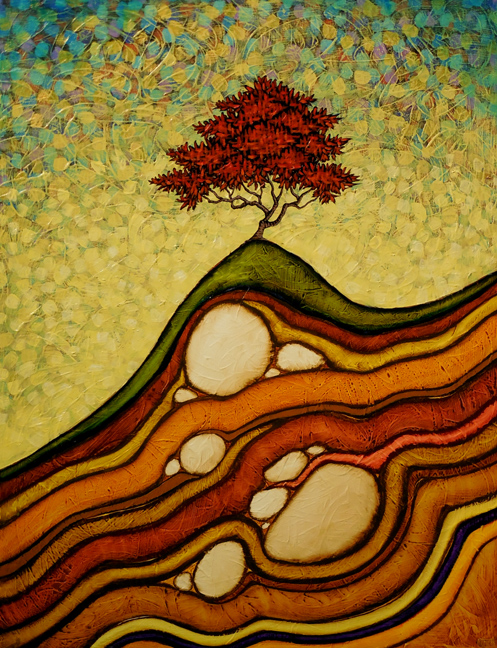
GC Myers-  In the Pocket of Time sm

In the Pocket of Time, 2014


The crystal sphere of thought is as concentrical as the geological structure of the globe. As our soils and rocks lie in strata, concentric strata, so do all men’s thinkings run laterally, never vertically.

Ralph Waldo Emerson, The Method of Nature (1841)


I came across the passage above from an Emerson essay and decided to look it up to find the context from which it came. It originated in an essay/oration that was written in the 1839-1841 period and was titled The Method of Nature.

I am still trying to glean the exact meaning of the essay but the section that contained the line above speaks about how those who, in any time, claim to have the answers to existential questions or insights into the deepest concerns of mankind eventually reveal themselves to be superficial. Their thoughts seldom, if ever, dig deeply enough to reveal eternal truths that might unify all people and times.

As he put it, their thinking runs laterally, not vertically.

I immediately felt that this might be applied to the painting the top, In the Pocket of Time. It’s a painting (30″ by 24″ on canvas) from 2014 that I brought to the Principle Gallery this past weekend as part of a group of work featured at my Gallery Talk there. It is from a subset of my Archaeology series that I call my Strata work. It is much like the Archaeology pieces without evidence of humans, focusing instead on the layers below the surface.

This particular painting from that Strata series has been with me for a while now. It hung for the last few years in a back bedroom/storage space of my studio. It reminds me of fine wine as it seems to get better with time. I am more and more struck by its surface finish and the rhythm of the strata, as well as how well it transmits its feeling and message from the wall. It’s a piece that speaks directly to me.

Putting Emerson’s thought to it deepened my appreciation of it. I could see in it how we deal always with what is presented on the surface and how seldom we recognize how much more there is to discover if we would only dig a little deeper.

That might be a gross simplification. Or not. Who knows? The words and the mage just seemed to click for me and maybe that’s enough to say.

Let’s tie this up with some music. Here’s a 1992 song from Peter Gabriel titled Digging in the Dirt.  The video is from the same time frame as his Sledgehammer song/video and, like it, this video has some interesting visuals.


Read Full Post »

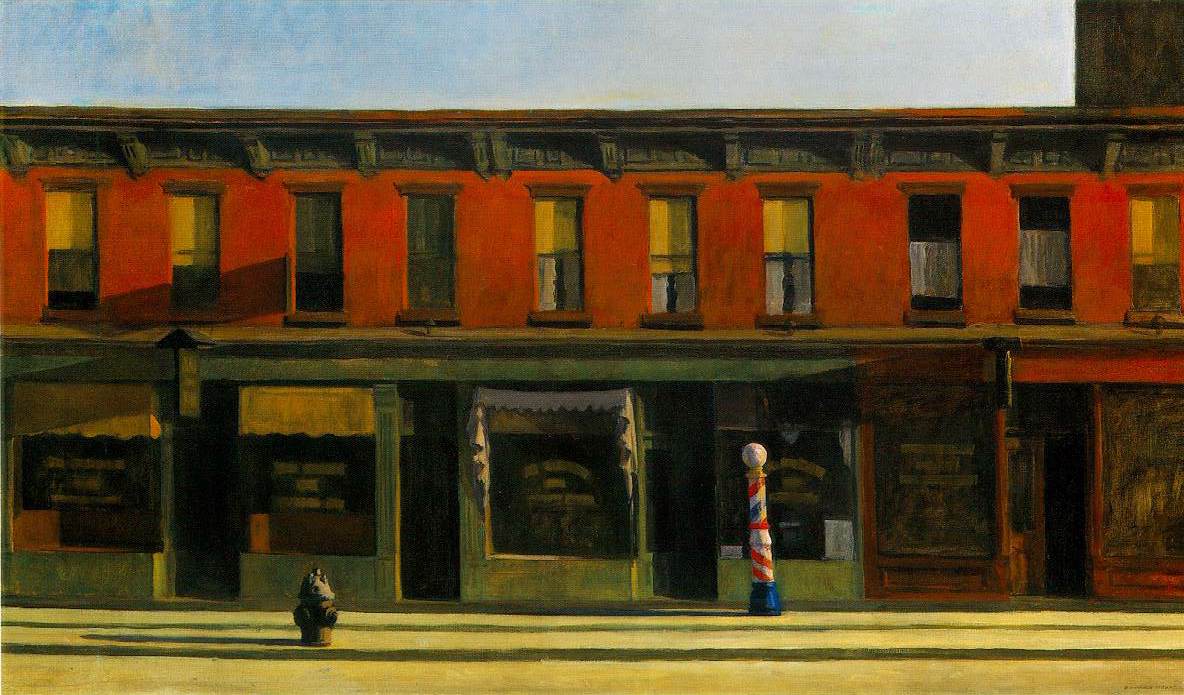
Edward Hopper -Early Sunday Morning 1926

Edward Hopper -Early Sunday Morning 1926


Freedom’s just another word for nothing left to lose
Nothing don’t mean nothing honey if it ain’t free


Things have been a bit hectic and I failed to mention the death of Kris Kristofferson this week at the age of 88. The line above from his song Me and Bobby McGee, has echoed in my mind since I was a kid. So much so that when a high school English teacher asked our class how we would define freedom, I quoted that line as my answer. He took off his shoe and threw it at me.

The following paragraphs are taken from a post from a few years back, on his 85th birthday.

Kris Kristofferson was many things in his life, as the bio on his website points out:

He was an Oxford scholar, a defensive back, a bartender, a Golden Gloves boxer, a gandy dancer, a forest-fighter, a road crew member, and an Army Ranger who flew helicopters. He was a peacenik, a revolutionary, an actor, a superstar, a Casanova, and a family man. He was almost a teacher at West Point, though he gave that up to become a Nashville songwriting bum.

Definitely one of the more interesting people of our time. And a helluva songwriter.

As I mentioned, Me and Bobby McGee is burned into my brain, especially the version from Janis Joplin. He also dated Janis for a while, which adds to his interest factor. There are plenty of other songs to mention– Help Me Make It Through the Night, Why Me, For the Good Times, etc.–but for me, my mind always goes to either Bobby McGee or to Sunday Morning Coming Down, whose big hit for Johnny Cash remains a favorite of mine.

The feel of Sunday Morning Coming Down is unmistakable and for someone who grew up when the Blue Laws were still in effect and Sundays were, for the most part, shut down affairs, it rings true. The Edward Hopper painting at the top, a favorite among many other Hopper favorites, captures that same feeling for me.

The angle of the sunlight creates an unflinching glare on the storefronts that feels like it is burning off the sins of the night before.  It has that stillness that comes after long Saturday nights spent knowing that the following day was there for recuperating.

And it brings up the memory of the weekly Sunday dinner from that time. Ours was often a roast chicken meal, if we weren’t going to another relative’s home for the meal.

The song opens up floodgates of memory and feeling. Though the world is now 24/7 all systems go-go, this song takes me back to those slow-moving Sundays of my childhood. There were many Sunday mornings and throughout my life that had that same quality of sunlight and stillness. That surge of personal memory makes this song so memorable for me.

Anyway, here’s the late Kris Kristofferson and Johnny Cash performing his Sunday Morning Coming Down. Thanks for the music and good travels to you, Kris.


Read Full Post »

« Newer Posts - Older Posts »