Saturday morning and there’s a cloudiness of thought and as I sit here, wanting to say something of value, I find myself an empty vessel. There’s not always something there when you reach down inside so I put this aside for a while and listen to some music, putt around the studio and look at things. Read a post on another blog that sets me thinking. It was about the act of forgetting, losing all the details of an experience. Remembering only your view and not taking in the whole. The richness of the entirety.
Maybe that’s not even what this blogger was trying to say but we tend to transform what we hear or read or see into something that pertains to our own base of experience and knowledge, if only to try to understand what is being said.
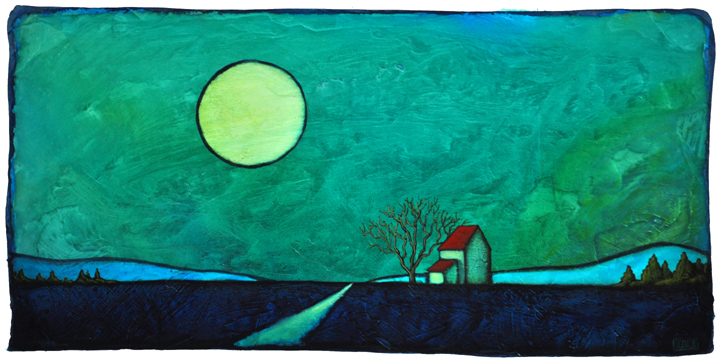
As I’m wrestling with this in my foggy mind, a song comes on. I Wish I Was the Moon from Neko Case. And it fits as I find myself wishing I, too, were the moon, fleeing the rising sun that is beginning to flood through my studio windows. Wish I were the moon casting light on wherever my eye might fall and cloaking the rest in the shelter of darkness. And I think of this piece, Under a Pale Eye. And in it, I am the moon, if only for a moment.
But the sun is shining bright and the fog begins to lift from my mind and I am no longer the moon. For now…
Well, my show at the Principle Gallery, Facets, opened last night. Wow! Was it ever great!?
Actually, I’m writing this Thursday afternoon so I have no way of knowing how everything turned out at the show. I’m probably heading back up the highway as you read this but I will give you some details within the next few days.
The painting shown here is actually the title piece for the shows, Facets. It has a very stained glass feel and the sky is broken apart in a way that seems to section off the light from the moon/sun, giving me the title. It’s a simple, pensive piece and one that I think works well with the concept contained in the title.
Here’s a little traveling or just hanging out music from Billy Bragg and Wilco‘s interpretation of Woody Guthrie’s lyrics for a song called Walt Whitman’s Niece. Enjoy your Saturday!
I’m on the road today, delivering the work for my show next week at the Principle Gallery. My day will be filled with music from my iPod and I thought I’d share an old nugget from the past, a song that is incredibly infectious. It was a staple on my boombox when I used to build swimming pools, mainly because it’s driving beat kicked up the pace a little when I would start wilting in the summer heat. Besides, everyone needs a shot of sax and an extra dose of the organ Hammond organ every now and then.
Here’s Shotgun from the great Junior Walker and the All-Stars from Hullabaloo in the mid 60’s. And yes, that is Dean Jones introducing the song. Enjoy!
It’s Memorial Day weekend and every year at this time, TCM shows films with military themes as a way of honoring the holiday. I see that tonight they’re showing The Best Years of Our Lives from 1946. It’s a movie I have watched a number of times and am always reminded of one of its stars, Harold Russell.
Harold Russell was not an actor. He had been an Army instructor during World War II when he lost both hands in an accident while handling explosives. Near the war’s end, he was the focus of a film about the rehabilitation of disabled vets which is where director William Wyler first saw him and decided to cast him as Homer Parrish, a sailor who loses both hands in the war.
Though not a trained actor, Russell gives a spectacular performance as Homer. There are many memorable scenes with Homer that linger with you long after the film ends. One that stands out for me is one in which Homer is in the garage and his young sister and a friend are watching from outside and Homer, tired and frustrated at the stares and pointed fingers from the curious, smashes his hooks through the window at the girls. The visual impact of the scene is brilliant.
There are many other scenes that shine as well and they came together to bring Russell the Best Supporting Actor Oscar for the film. He holds a unique distinction as the only actor to have two Oscars for the same performance. You see, the Oscar board thought Russell had no chance at winning and wanted to honor his performance for bringing attention to the plight of disabled vets so they chose to honor him with a special Oscar.
The Best Years of Our Lives is a compelling film. Sure, there are moments of sentimentality. How could there not be? But this is no rosy view of the world in any way. It has a dark grim tone and shows the damage the war has inflicted on the returning vets, both physically and emotionally. It has an honesty about the subject of the effects of war that you didn’t often see in contemporary films of the time. The vets returned to a world that was changed from that which they remembered and they were often forced to deal with indifference and sometimes scorn from a public that soon forgot their sacrifice. It seems to me to be the jumping off point for the dark realism of many films from the next decade.
So, if you get a chance tonight take a look. It’s a great film and you’ll be reminded why we honor the sacrifice of those who served. Here’s a great scene with Harold Russell as Homer and his girlfriend, who he has felt alienated from because of his disability. He’s trying to show her what she will face in the reality of a life with him.
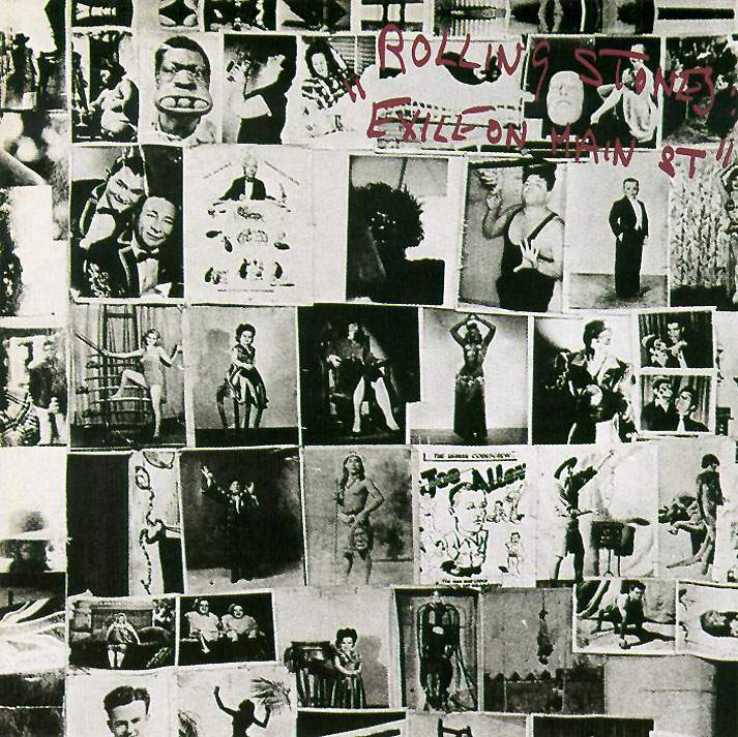
There’s a lot to do this morning so I’m a little distracted by my work. So I’ll quickly make quick work of something I meant to mention earlier, last week’s reissue of the Rolling Stones’ 1972 classic LP, Exile on Main Street. I grew up with the Rolling Stones’ early albums and over the years my appreciation for this album has grown time I hear it. Love or hate the Stones, this is great stuff. And it has a great album cover, to boot.
So, even though this is not off this LP, I’m playing their earlier Get Off My Cloud, mainly hoping that that infectious guitar line and defiant chorus will keep me away from simply railing against all the crap that is going on in this world.
I’m in the last days of painting before I start final preparations such as framing and such for my upcoming show. I’m currently putting the final touches on a piece that is a multiple similar in form to the one shown here, Peers from back in 2003. The piece I’m working on consists of 3 rows of 3 red trees on a 30″ by 30″ canvas. I’ve used multiple images a number of times over the years, although I often go years between. There is something almost musical, almost choral, in the repetition of form.
I only mention this today because when I came into the studio I put on an album (CD actually but I still call them albums) of work from Arvo Part. One of the first pieces to play was Cantus in Memoriam of Benjamin Britten. It was a mesmerizing tonal piece and as it played, I looked at the title and realized I didn’t know what was meant by the cantus in the title.
Looking it up brought me to the term cantus firmus which is described as a sort of polyphonic composition, meaning it is comprised of multiple interwoven and, often, the same melodies. A Gregorian chant is an example of one type of polyphony. The voices, or melodies, are repeated, one over the other, some at different tones and varying lengths. I don’t know much about music but as I read I began to equate this meshing of voices and melodies in a cantus firmus with what I was trying to achieve with the multiple images in the painting I was working on. Each image is basically the same but because of the way they are positioned and come together as a whole, they become more than the product of their parts.
At least, that’s my take on it.
Anyway, I found a name for the piece I am finishing. Cantus Firmus.
I’ve been showing a lot of new work lately that I will be showing at my upcoming show in june at the Principle Gallery in Alexandria, VA. This is a 24″‘ by 30″ painting that I finished back in February which has been above my studio’s fireplace for most of that time. I look at it several times a day and have yet to want to alter it in any way. I find the sparseness of detail adds to the coolness and focus that I think make this piece work.
I didn’t have a title for this piece, even after months of looking at it. I sometimes struggle with titling certain pieces that I’ve lived with for a while and seem to strike an inner chord with me. This was one such painting. But the time has come to start putting names to paintings. I have a certain way of doing that that I’ve outlined before where I will set up a piece, pretending that I have never seen it before. I will turn away from it then turn back quickly, taking it in and grasping whatever first strikes me about the piece. Color, shape, mood—–whatever jumps at me. Then, taking that first impression, it becomes easier to find the right name.
But sometimes it doesn’t work and there are pieces that don’t adhere to this method. Like this piece. So I wait and hope something jumps out at some point or that I stumble across the right words for it. I was looking for something else earlier and came across an old song from the late 60’s from a group, Marmalade, a Scottish band that had long since left my memory. While their band’s name was forgettable, their best known hit, Relections On My Life, was not. Great song that rekindled old memory and I immediately knew I had a title for this painting: Reflections on a Life.
Sometimes you find things in unlikely places. For those of you who don’t remember Marmalade, here they are:
Monday morning. For me, it’s not like the start of the week. Just another day in a continuum that is more a straight line than circular. At least, that’s how I usually view it. Today, it feels like the start of a week. Maybe it’s the fact that I’m in full work mode or just that I’m a little tired this cool morning. Whatever the case, I find myself at a loss for meaningful words. So instead of agonizing for any appreciable time searching within, I’ll simply depend on someone else for meaningful words.
Here’s a song from Jimi Hendrix, May This Be Love which most people know as Waterfalls. Don’t want to even talk about it this morning, just give a listen. Nice stuff…
I was working in the studio yesterday with the television on, set to one of the news channels. After a while, the constant drone of bad news from every corner of the world- unstable economies, Wall Street panic, oil spills. floods, terrorist bombings, wars and on and on-became more than I could bear. I flipped over to a movie channel and there it was. Meet John Doe, the Frank Capra classic from 1941 starring Gary Cooper and the great Barbara Stanwyck.
Meet John Doe is one of Capra’s visions of American idealism wherein the main character hesitatingly fights the malevolence and greed of those in power for the rights of those with little power. Think Jimmy Stewart in Mr Smith Goes to Washington or It’s a Wonderful Life. In these movies, the hero often has the very people he champions turn on him, usually as the result of those in power twisting the truth to suit their own dark agendas. But in Capra’s world, the hero perseveres and is vindicated by the truth. Sure, it’s naive but it’s a wonderful place to let your imagination rest for a spell.
The hero here is Cooper who plays a drifter who is enlisted by a newspaper to play the part of John Doe, a character in a publicity stunt who threatens to kill himself on Christamas Eve because of the state of the world. This was 1941, folks. Europe was at war with the Nazis marching and we were on the verge of entering the fray. We were still reeling after a decade of the Great Depression. It was not a pretty time.
The John Doe character was supposed to disappear after Christmas but it hit a note with the common note and a populist movement grew from it, funded by the newspaper mogul (played to perfection by Edward Arnold who I will someday highlight in this blog) who seeks to usurp and mold it to suit the political agenda of his powerful cronies and himself. Sound familiar? The mogul tries to destroy the movement and Doe, who has come to believe in the ideals that he is supposed to represent as John Doe, by turning the movement against, portraying him as a fraud and an opportunist.
Eventually, right prevails, of course, and Doe overcomes the powerful and the people’s movement continues. I know it’s a fantasy but after day after day of watching newcasts filled with nothing but darkness and dire pessimism, I’ll choose this fantasyof hope and possibility anytime. I never fail to be moved by these movies from Frank Capra, and the day that I’m not, I will truly be worried because that means I will have lost all optimism. And that is a dark day for anyone.
Here’s one of my favorite scenes with the great Walter Brennan, who plays John Doe’s traveling companion. Here, he gives his theory about heelots…
Relief of cool air on a Sunday morning. I’m about a month or so out from my next show and there’s so much to do. I’m itching to get at some new work that I started yesterday so I think I’ll just play a tune today. It’s Two Angels from Peter Case.
I’ve been looking for a decent version of this song to put on the blog and finally came across one that does it justice. It’s been one of my favorites for a long, long time but doesn’t seem too well known. I’m always surprised at its relative anonymity. The good part of not being too well known is that it doesn’t get played to death, so that when I hear it it sounds fresh. Retains all its beauty.
By the way, the engraving shown here is Durer’s Sudarium Displayed By Two Angels. FYI, the sudarium here is supposedly the piece of cloth that covered the face of Jesus as he was being transported from the crucifix to his tomb. Sort of a pre-Shroud of Turin relic.