Feeds:
Posts
Comments

I Am Waiting


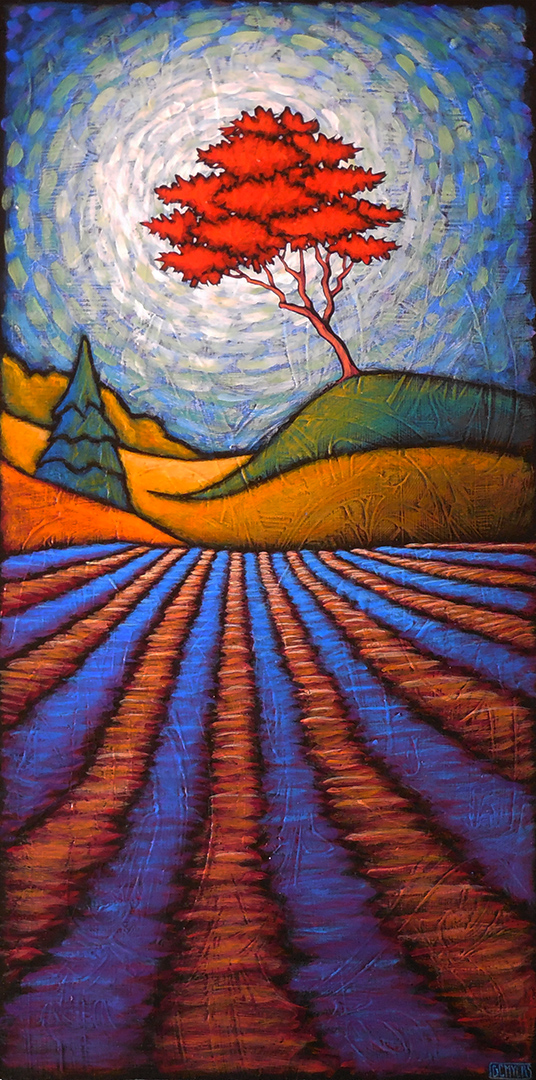
GC Myers- In a Corner  2021

In a Corner– At the Principle Gallery

We never live; we are always in the expectation of living.

― Voltaire


After you find out all the things that can go wrong, your life becomes less about living and more about waiting.

― Chuck Palahniuk, Choke


I used two quotes to kick off today’s post. They are from two very different sources, one the intellectual leading light of the Enlightenment of the 17th century and the other the hard-edged contemporary author of Fight Club.

But both say pretty much the same thing, albeit in different terms: Life is often mainly a matter of waiting.

Waiting for things to begin. Or end.

Waiting for signs or a proper time. Or conditions to change.

Waiting for the Muse to visit.

Waiting for the sun to shine or the dark clouds to recede.

Waiting for justice.

Or the next shoe to drop.

Waiting for things to get better. Or worse.

Waiting for hopes or horrors.

That’s certainly how the last couple of years have felt, like I have been treading water in a deep pool. Not going forward in any way but paddling like hell to just stay afloat, waiting for something to which I can’t even name.

Not even sure I will recognize whatever it is if when and if it appears.

The scary thing about this time is that feels like the normal state of being now even though deep down, something tells me this should not be so.

So, I wait in my corner trying to appear as patient as possible to see if this will soon change. All the while, my brain is furiously treading water, nervous and impatient.

Here’s this Sunday Morning music, going way back with the Rolling Stones. Here’s one of my favorite Stones songs, I Am Waiting, from 1966.

Now, time for me to get back to my chair in the corner. Gonna get some good waiting in today. Close the door on your way out, okay?


Peace Vigil

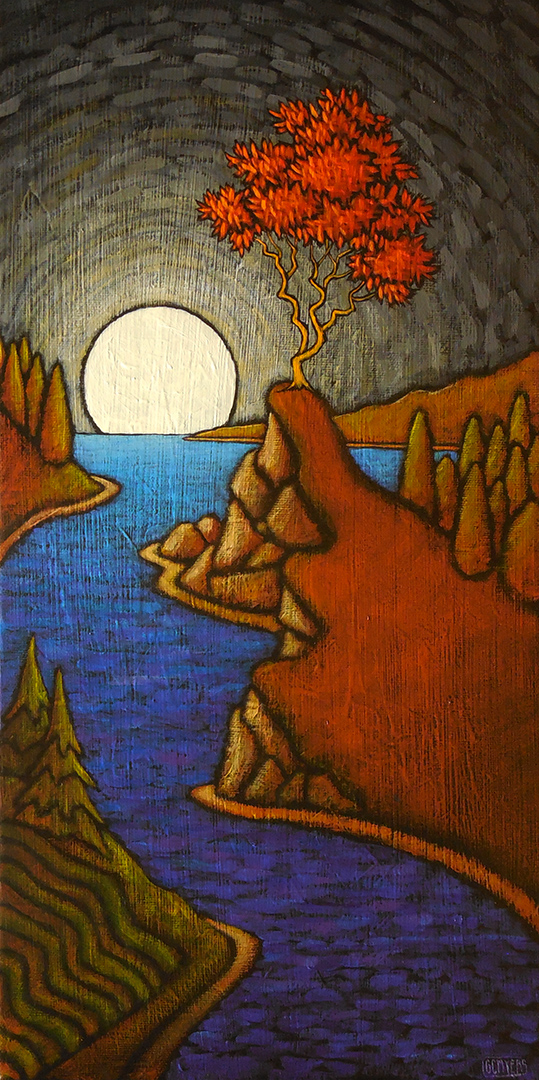
GC Myers- Peace Vigil  2021

Peace Vigil– At the Principle Gallery


When despair for the world grows in me
and I wake in the night at the least sound
in fear of what my life and my children’s lives may be,
I go and lie down where the wood drake
rests in his beauty on the water, and the great heron feeds.
I come into the peace of wild things
who do not tax their lives with forethought
of grief. I come into the presence of still water.
And I feel above me the day-blind stars
waiting with their light. For a time
I rest in the grace of the world, and am free.

— Wendell Berry, The Peace of Wild Things


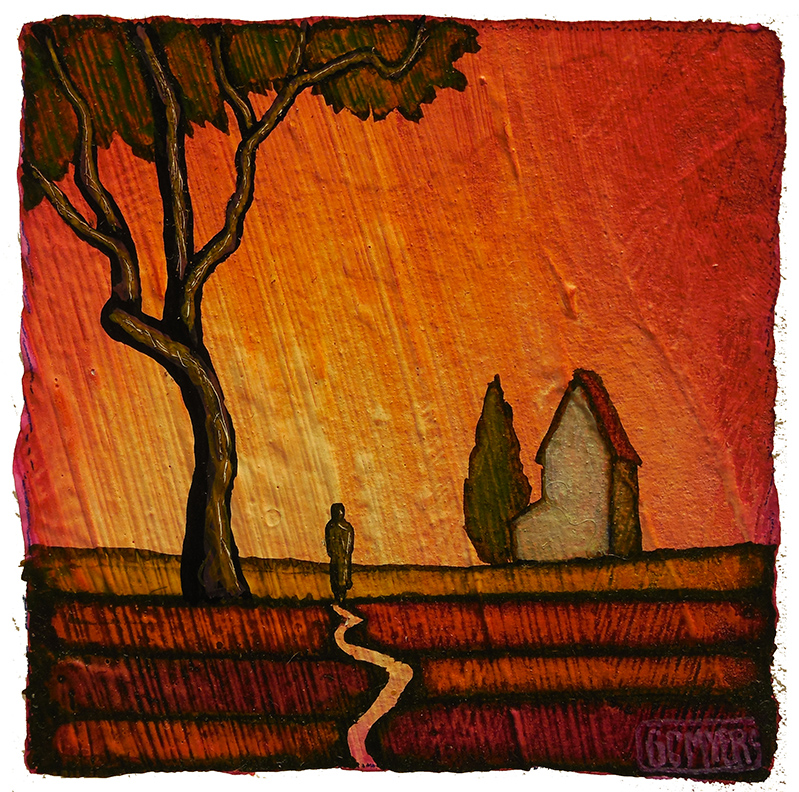
I haven’t shared the above poem, a favorite of mine from Wendell Berry, for a few years but felt that it paired up well with the new painting at the top. It’s a small piece called Peace Vigil which is part of the Small Works show that opens today at the Principle Gallery in Alexandria.

Besides that, I needed words like those to settle a mind troubled by the angers and indignities of the outer world, words that remind me that there is peace out there, a freedom found resting, as Berry puts it, in the grace of the world.

I try my very best to keep to myself, to not bother others or ask much of them.  I try to keep my infringement on the lives of others to a minimum.

I know that sounds funny coming from someone who writes a blog and depends on people buying his paintings for a living. That seems like a big ask of people. But I am not forcing it on anyone and am surprised when anyone does either of those things.

Plus, everyone is totally free to ignore my words and paintings. And they often do just that. Sometimes to my dismay. But sometimes to my delight. Being ignored or overlooked sometimes comes with a great sense of freedom. Nobody expects anything nor holds me responsible for their care or their woes and wobbles.

Nobody bothers me. And that is all I ask in exchange for keeping to myself and not bothering others.

Like the Red Tree in the painting above, I perch myself on my small island, looking forever for peace and quiet.

Can it be found? I don’t really know. Maybe it could if people could constantly keep in mind the simple idea of not bothering others, of respecting the space and existence of others. That like themselves, nobody wants to be bothered or abused.

I guess that falls into the Do unto others as you would have them do unto you category. 

It’s pretty good advice. It was then, back in the times of Moses, and it is now. It’s probably the best, and maybe only, path to true peace and freedom. But it might be too simple and elegant a solution for a culture steeped as it is in greedy selfishness, fear-based hatred and the worship of wealth and power.

But I can do my small part and try to keep that in mind here on my little island, forever on the watch for peace and quiet.


Called Home


GC Myers- Calling Me Home

Calling Me Home– At the Principle Gallery

Everyone must leave something behind when he dies, my grandfather said. A child or a book or a painting or a house or a wall built or a pair of shoes made. Or a garden planted. Something your hand touched some way so your soul has somewhere to go when you die, and when people look at that tree or that flower you planted, you’re there.

It doesn’t matter what you do, he said, so long as you change something from the way it was before you touched it into something that’s like you after you take your hands away. The difference between the man who just cuts lawns and a real gardener is in the touching, he said. The lawn-cutter might just as well not have been there at all; the gardener will be there a lifetime.

― Ray Bradbury, Fahrenheit 451


The painting above is titled Calling Me Home, a little 2″ by 4″ painting on paper that is part of the Small Works show that opens Saturday, December 4, at the Principle Gallery.

Sometimes small pieces can be easily overlooked because of their size. But a diminutive size doesn’t prevent them from speaking with a much larger voice and meaning. I think this piece falls into that category.

In an earlier post about this small painting, I mentioned that I named this piece after a song from one of my big favorites, Rhiannon Giddens. The idea of being attached to a place called home is a powerful one, indeed. I saw that in this piece. But there’s a line in the song that stood out for me:

Remember my stories, remember my songs/ I leave them on earth, sweet traces of gold

It made me think of that existential question: What is it we leave behind?

That immediately brought to mind a favorite excerpt, shown at the top, from Ray Bradbury in his sci-fi/ dystopian classic Fahrenheit 451. It’s those things to which we devote our full effort, our mind and time, that have lasting effect. Often, things that are done with no real expectation of anyone recognizing your thought or effort in doing them.

It doesn’t matter what you do, he said, so long as you change something from the way it was before you touched it into something that’s like you after you take your hands away.

This line says a lot. Maybe it’s the reason that home holds such meaning for many of us. It is that place where we were shaped, where we touched and formed by the influence of our parents and other family members.

In many cases there may be no remnants of home left, no door to pass through nor rooms to wander. Nothing left to touch. It may no longer exist and parents and family members might be forever gone.

But the memory remains. It is an artifact, evidence that that place and those people touched and changed your life. We carry many of those changes throughout our lives.

It is a real and powerful thing.

Now, here’s the song from Rhiannon Giddens. 


This post was adapted from an earlier post.

The Beholder


GC Myers- The Beholder  2021

The Beholder– At the Principle Gallery

The eye you see is not an eye because you see it;
it is an eye because it sees you.

― Antonio Machado, Times Alone: Selected Poems


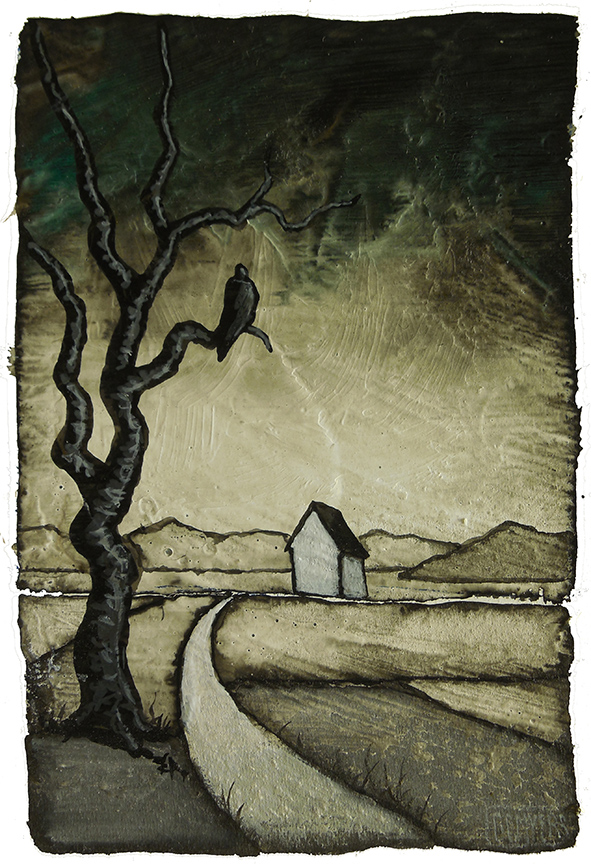
Another new small piece from the Small Works show at Principle Gallery that opens Saturday. This is called The Beholder.

I’ve always been aware of crows and ravens, and fascinated with their proximity to us. I have long admired their great intelligence and problem-solving skills, their strong family and societal bonds, their ability to survive in a world all too often unfriendly to their existence, and their willingness to occasionally interact with us humans, even if it’s in a distant and wary way.

But it is their watchful presence that piques my interest most. I have been watched carefully forever by the crows around here and in the cemetery we haunt for walks. They sit patiently and usually quietly; their gaze fixed on me as I move around. They are used to me now and their normal wariness is relaxed a bit.

Just a bit. I am still a human in their eyes, after all. And we all know what that crowd is like.

Occasionally they let out a few of their trademark caws.

It all makes me think that they have gained a great deal of wisdom from their eons of being on the fringes of our existence, observing our behaviors and following our movements.

This belief that they possess some greater knowledge is heightened by the fact that they persist even though we have often killed them in great numbers, shooting them when we labeled them as a threat to crops or for sheer sport(?), or poisoned them with our use of pesticides and herbicides on those crops.

What do they know? What have they seen? Could it be something we cannot see in ourselves, something that requires an impartial outside observer?

Maybe they are just fascinated by us, watching us as though we were chimps in a monkey-cage at the zoo, waiting for us to do something goofy or stupid.

They usually don’t have to wait too long.

I see this small painting, The Beholder, as being about that sense of watchfulness, about how we might benefit from simply sitting quietly and observing ourselves.

It certainly couldn’t do any harm…


FYI– The short verse at the top is from renowned Spanish poet Antonio Machado, who died in 1939 at the age of 63. At the time, he had fled to France as he was opposed to the fascist threat posed by the Nationalists in the Spanish Civil War.

Sojourner’s Return

GC Myers- Sojourner's Return sm

Sojourner’s Return– Now at the Principle Gallery


He came down over the hillside and into the pinewood. Through the trees he could see the red and gold sunset settling down among the white farm-buildings and the green apple-branches. It was his home now. But it could not be his home till he had gone out from it and returned to it. Now he was the Prodigal Son.

— G. K. Chesterton, Homesick at Home


Home.

Even after yesterday’s trip to the Principle Gallery, which was only a daytrip of several hundreds miles, it was still good to get home last night.

Always is.

Something about the safety and comfort of home. The person waiting for you. The other creatures and things that depend on your presence. It creates a sense of being needed.

And I guess that’s something we all desire. To be needed.

It was good trip and visit at the Principle Gallery, though short in length. Just good to spend a little time and catch up a bit as Michele and the rest of the gang there hustled around trying to find some space in which to get things ready for the this week’s show opening as a crew of workers installed new lighting in the front rooms of the gallery.

A little chaotic but in a good way.

The work I was delivering, including the very small piece at the top, Sojourner’s Return, is part of their upcoming Small Works show which opens this Saturday, December 4th.

In my isolation, I apparently have lost all idea of how schedules and calendars work. I have been writing for the last week or two that the show opened on Friday, December 4th. Of course, I now know that Friday is December 3rd this year and that the show actually opens on Saturday, December 4th.

Another 50 or 60 years and maybe I’ll get the hang of this time thing. Probably not.

And that’s okay. Sometimes it’s kind of nice to not know whether it’s Tuesday or Friday — especially when you’re comfortably at home.

Memoir


Memoir” – At the Principle Gallery

Everybody needs his memories. They keep the wolf of insignificance from the door.

–Saul Bellow


On the road today, delivering a group of mainly small pieces to the Principle Gallery for their annual Small Works show. It opens Friday, December 4.

Feels a bit weird to be on the road again. This was a trip I made several times a year for many years so the route and trip routine is almost ingrained. But with the pandemic  and the cancellations of the last two Gallery Talks and limited show openings, these trips have been much less frequent.

But it feels good to hit the road once again and be able to see some of my favorite folks at the Principle Gallery. Maybe catch up a bit. That would be a return of some small degree of normalcy.

And that would be good.

One little piece going down is Memoir, shown above. Since I am short on time today– actually, this is from last night– I thought that a pairing of this little piece with some sage words from Saul Bellow and a song from Nick Lowe would be appropriate. Here’s When I Write the Book. from many moons ago.

It plays pretty early on in my memoir.

See you somewhere down the road…


Across the Continuum

GC Myers- Across the Continuum 2021

Across the Continuum– Soon at the Principle Gallery


There are no telegraphs on Tralfamadore. But you’re right: each clump of symbols is a brief, urgent message– describing a situation, a scene. We Tralfamadorians read them all at once, not one after the other. There isn’t any particular relationship between all the messages, except that the author has chosen them carefully, so that, when seen all at once, they produce an image of life that is beautiful and surprising and deep. There is no beginning, no middle, no end, no suspense, no moral, no causes, no effects. What we love in our books are the depths of many marvelous moments seen all at one time.

― Kurt Vonnegut, Slaughterhouse-Five


I love this description of how the inhabitants of Tralfamadore, those strange looking characters that appear in several of Vonnegut’s books, read. The idea that in a single glance they can see the entirety of whatever they are looking at, all its depth and breadth, every moment, is a fascinating one to ponder.

Even more so as an artist. We (I’ve decided that for the purpose of this blogpost will identify myself as an artist) often describe our works in terms of capturing a moment, a specific instance, in life. I think it’s just an easy answer, one that we can pull out quickly when asked.

And sometimes, it is certainly the case.

But many times we want to capture an image that a Tralfamadorian would feel right at home with, something that has no beginning, no middle, no end. One, that with a glance, the viewer knows everything they will ever know about that image.

An image of life that is beautiful and surprising and deep, as Vonnegut wrote.

I sometimes  refer to this as us trying to capture the continuum of time and space, of which we all are part.  It is that plane of existence that we inhabit in some form or another, perhaps sometimes only on the molecular level, for eternity.

Wouldn’t be nice if an artist could capture that in an image, one where the viewer felt this entirety of the continuum, all its depths and beauty, and how they belonged as part of it?

It’s an impossible goal, of course. Especially so when it becomes the stated goal. Then it becomes too thought out, too enmeshed with a particular thought and moment and idea. I am not saying that it can’t still be beautiful and emotionally powerful and filled with depths.

It just doesn’t meet the high bar set by the Tralfamadorians.

But what does?

The new piece shown at the top, headed down to the Principle Gallery in the next day or so, is called Across the Continuum. The fact that I used the term continuum in its title tells you that it struck a chord with me personally, that it captured my own sense of this ethereal and timeless plane of being.

Again, my own sense.

I am seeing with the knowledge and understanding of my other works through the years, all that has come before it. With a glance it captures the entirety of that connection to the whole, all its depths and surprises and beauty of that totality for me.

So for the purpose of this painting and blogpost, I am, in effect, a Tralfamadorian.

Of course, you most likely are not. You are probably human so you will probably not see this in the same way.

And that’s just fine with me. I’m just glad you came through this post this far.

I appreciate that. No matter what, if anything, you see in this painting, you are okay by me.

At least, as far as humans go.

I’m Still Here

GC Myers- Light Exaltation sm

Light Exaltation— Coming to the Principle Gallery


I’ve run the gamut, A to Z
Three cheers and dammit, C’est la vie
I got through all of last year, and I’m here
Lord knows, at least I was there, and I’m here
Look who’s here, I’m still here

— Stephen Sondheim, I’m Still Here, Follies


Another new piece headed to the Principle Gallery for their annual Small Works show, opening this coming Friday, December 4. This painting is titled Light Exaltation but it could well be called I’m Still Here, which is this week’s pick for Sunday Morning music.

As you may know, Stephen Sondheim, the legendary composer and lyricist, died this week at the age of 91. This song, I’m Still Here, might be my favorite of his many great songs.

The song is from his 1971 show Follies, which is about a reunion of a group of former showgirls in the old theater, scheduled for demolition, where they once performed in the 1920’s and 30’s as part of the Weismann’s Follies.

Many great songs in this show but I’m Still Here really stands out for me. There’s something in its themes of endurance and almost defiant persistence through a life filled with highs and lows that really strikes a chord with me. It’s like: you hit me with everything you’ve got and I am still standing.

Though Sondheim based much of this song on the long and enduring career of Joan Crawford, I think  the 60+ year career of Elaine Stritch makes her a perfect match for this song. There are lots of more polished versions out there but this performance just kills me every time I hear it. The humor is spot on and her gruff, defiant attitude jumps off the stage.

In our lives, we all have many high and low points and it takes a toll. We all get beaten up a bit. I think we need that bit of defiance and ability to laugh at it all, both the highs and the lows. The song’s last verse, shown at the top, could have been wrote for this very moment.

Glad you’re all still here…


The Understanding

GC Myers- The Understanding 2021

The Understanding– At the Principle Gallery


Nothing in life is to be feared, it is only to be understood. Now is the time to understand more, so that we may fear less.

–Marie Curie


This is a new painting that is headed to the Principle Gallery in Alexandria this coming week for their annual Small Works exhibit which opens Friday, December 4. It’s on the upper end of small, coming in at 10″ by 20″ on canvas mounted on aluminum panel.

I call this piece The Understanding. The thought behind this title is very much in line with the words at the top from Marie Curie, the legendary scientist and first woman to win a Nobel Prize.

And her words certainly apply any periods of great unrest and trouble throughout history.

Fear is our greatest enemy.

It lacks knowledge and, most importantly, it lacks the understanding of how things operate and occur. This in turn prevents one from addressing the problems at hand, from diagnosing what has happened, how to repair the damage done and how to move forward without the problem arising once more.

Sounds like the work of a mechanic, doesn’t it? And maybe in simple terms it is a good analogy.

A mechanic, after all, has understanding of how things are put together, how things operate. The mechanic can look at a problem and know immediately what may have caused the problem and affirm that with a few tests or by examining the potential problematic element. He can then figure out what went wrong and what needs to be done to fix the situation.

Everything is done with clarity and calmness because the mechanic has an understanding of his field.

None of the fear and worries and hand-wringing that someone without this understanding goes through when faced with the problem at hand.

When we experience fear, it is generally because we lack the understanding of what has brought about the situation, how it must be dealt with, and how to prevent it from re-occurring at some later time.

In may cases, we have become so used to others– other mechanics, if you will– taking care of our problems without us needing to understand anything, without us lifting a hand to help things along. But sometimes, the problems are large and require time and patience. These are things that we often fail to grant without at least a basic understanding of how things work.

Without it, we become anxious and fearful. Reactionary and impulsive. We begin to question the knowledge and honesty of the mechanic, demanding fixes that don’t fit the situation.

Okay, it’s still before 7 AM so maybe I am torturing this analogy a bit. It feels like it’s one that could be played out into infinity. Let’s put this one to rest, okay?

But it seems to me that so many of our problems result from so many folks are stirred to fear because they have little or no understanding of how things operate. Nor do they have the willingness to try to obtain true understanding. They want things to go as they desire without their input or assistance.

The idea, or at least the feeling, behind this painting is that when one has patience and a bit of understanding, the way the world operates and is put together becomes more apparent. As a result, one becomes less fearful and more open to gaining even more understanding.

Understanding shows us the answers, gives us ways to move forward.

Fear is a hammer that breaks everything apart. Understanding is the glue that holds this whole crazy contraption together.

Understanding is fearless…


Thank you for your patience and understanding this morning!

A Perfect Love

GC Myers- A Perfect Love sm

A Perfect Love — Soon at the Principle Gallery


How very lovable her face was to him. Yet there was nothing ethereal about it; all was real vitality, real warmth, real incarnation. And it was in her mouth that this culminated. Eyes almost as deep and speaking he had seen before, and cheeks perhaps as fair; brows as arched, a chin and throat almost as shapely; her mouth he had seen nothing to equal on the face of the earth. To a young man with the least fire in him that little upward lift in the middle of her red top lip was distracting, infatuating, maddening. He had never before seen a woman’s lips and teeth which forced upon his mind with such persistent iteration the old Elizabethan simile of roses filled with snow. Perfect, he, as a lover, might have called them off-hand. But no — they were not perfect. And it was the touch of the imperfect upon the would-be perfect that gave the sweetness, because it was that which gave the humanity.

― Thomas Hardy, Tess of the D’Urbervilles


I love this paragraph from Hardy and, in particular, that last sentence:

And it was the touch of the imperfect upon the would-be perfect that gave the sweetness, because it was that which gave the humanity.

It might well be the mission statement I might give for my own work, if asked.

Viewing it as a sign of our humanity and vulnerability, I almost strive for imperfection, though I never do so consciously. I just know that if I try to do my very best, to try to reach my own pinnacle of accomplishment, that somehow my own imperfections will find their way into that work and show through.

And in doing so, I find that when I notice these imperfections that they seldom seem to detract from the work. No, like the words from Hardy, they enhance the work for me.

They add the sweetness of humanity.

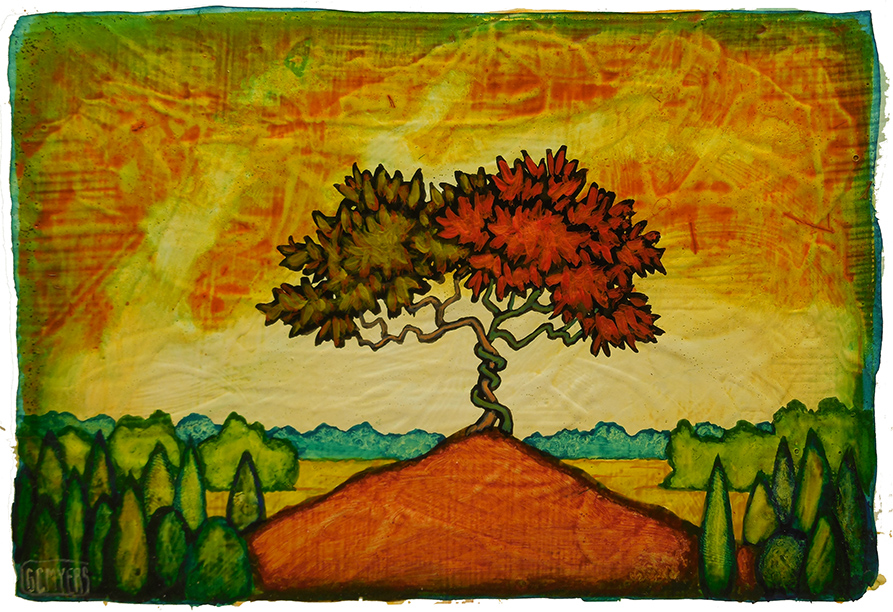
That brings us to the painting at the top, a new piece headed to the Principle Gallery for its annual Small Works show which opens next Friday, December 4. The painting is from my Baucis & Philemon series, based on the Greek myth that had an poor, older couple who had pleased Zeus with their open-heartedness and generosity, granted an eternity together by him as trees bound as one.

I call this piece A Perfect Love.

The title refers to the wish of Baucis & Philemon, of course. But it is actually a bit tongue in cheek because of the imperfections that clearly show in this piece.

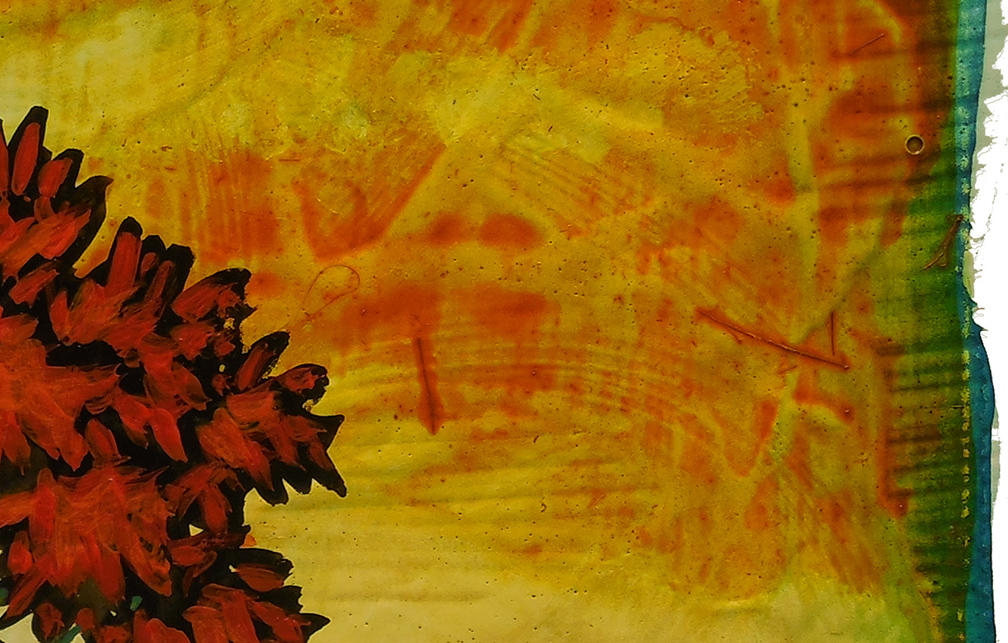
A Perfect Love- detail

A Perfect Love detail

There are bits of broken bristle from a worn brush embedded in the dried liquid of the inks I use. A tiny hair here and there, probably from an eyebrow as I hover over the piece. The rough edges of the paint layers. A constellation of pinholes in the underlying gesso.

All these things I seldom see while I am at work. My attention is on the whole of it and capturing some from of energy that will bring it to life. It’s only after it is done– unless it’s such a large flaw that it detracts from the whole– that I notice these things.

And, as in this piece, they bring me joy. They are striking evidence of my humanness, my flawed existence on this planet. I would like to think that sometime in the future someone might look on these imperfections and think about how they arrived there, imagining an artist standing over this surface with brush in hand at the moment that the energy of the painting emerged.

They’ll be able to see the hand ( and maybe the hair and sometimes a bit of spit or blood) of the artist in the work. And I like that, disgusting as it may sound to some.

It’s human. Imperfect.

And that is, in its own way, perfect.