Feeds:
Posts
Comments

What Was


“I have an idea that some men are born out of their due place. Accident has cast them amid certain surroundings, but they have always a nostalgia for a home they know not. They are strangers in their birthplace, and the leafy lanes they have known from childhood or the populous streets in which they have played, remain but a place of passage. They may spend their whole lives aliens among their kindred and remain aloof among the only scenes they have ever known. Perhaps it is this sense of strangeness that sends men far and wide in the search for something permanent, to which they may attach themselves. Perhaps some deep-rooted atavism urges the wanderer back to lands which his ancestors left in the dim beginnings of history.”

W. Somerset Maugham, The Moon and Sixpence


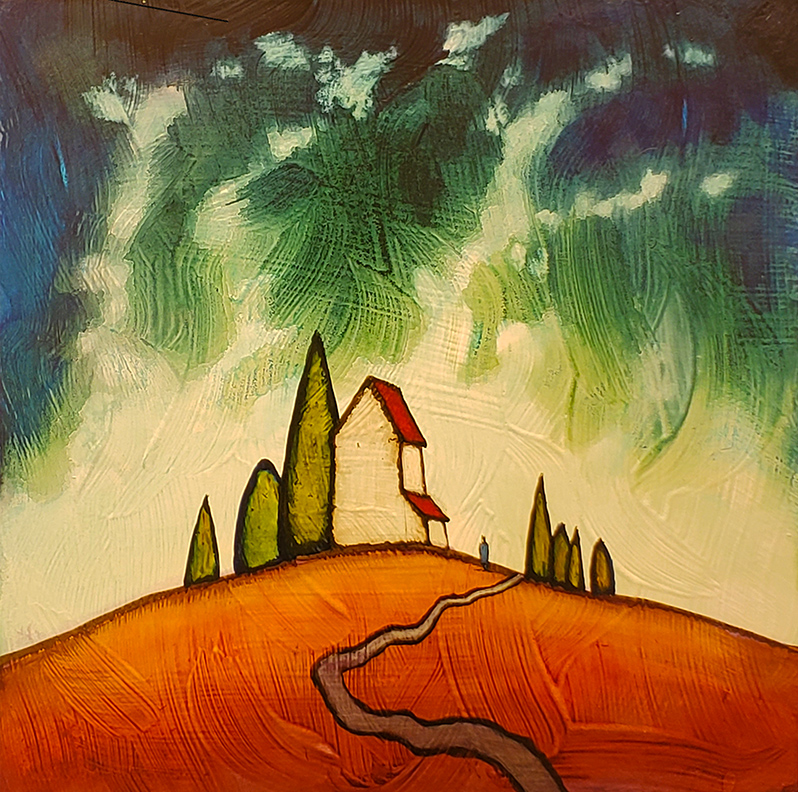
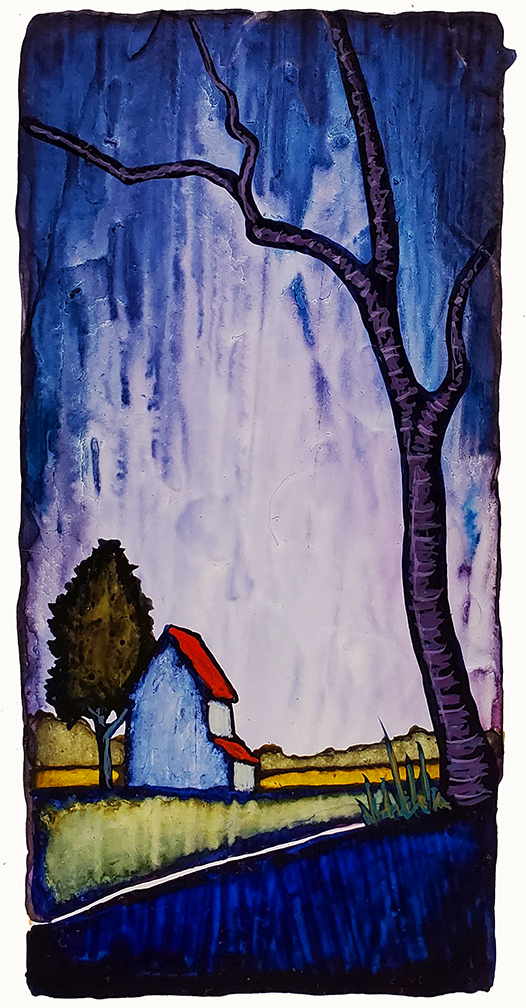
Short one today for this Sunday morning. The painting above is a little guy, a new 2″ by 4″ piece called What Was, headed to the West End Gallery for the Little Gems show. It’s one of those pieces that speak to me of the search for home, a theme that has been pretty prevalent in my work over the years.

I very much identify with the excerpt above from Somerset Maugham’s The Moon and Sixpence whose story incorporates the search for home by Paul Gauguin, which eventually took him to Tahiti. I have always felt a bit out of place, even in this place where I have lived all my life.

Yet, I don’t know what place or situation might ever make me feel truly at home. Maybe that’s the purpose of my work, at least for me personally. To formulate an idea of what home might be.

I don’t really know. But I know that it has a strong pull.

Let’s leave it at that. For this Sunday, on the theme of home, I am returning to an old Staple Singers song from the late 1950’s. I played Uncloudy Day on this blog recently and this song, I’m Coming Home, is very much in that same vein. It’s from the same timeframe and has that same sort of sharp underlying guitar line from Pops and powerful vocals from a very young Mavis Staples. Great song to kick off a cold Sunday morning.

Have a good day.


Come Days of Color

“Come Days of Color”- Now at the West End Gallery


Not knowing how near the truth is, we seek it far away.

― Hakuin Ekaku


Wise words from Hakuin Ekaku, the 18th century Japanese Zen Buddhist master. You have probably heard of his famed kōan (a short story, statement, or question meant to test a Zen student’s progress) that basically asks: What is the sound of one hand clapping?

Heady stuff. But today we’re focusing on two of his thoughts, the one at the top and this gem:

At this moment, is there anything lacking? Nirvana is right here now before our eyes. This place is the lotus land. This body now is the Buddha.

We are creatures of desire and envy. We want constantly what others have, somehow thinking it offers us some intangible that will somehow provide us with lasting happiness. We envy other places, seeing in them qualities that we believe are lacking in those places we now occupy and believing that those places will provide a higher level of happiness or contentment.

But is happiness better found in more things or in far flung places? As Hakuin points out, in this moment, is there anything lacking? What prevents you from knowing what your happiness or what your truth might be?

Those two things–truth and happiness– are interior qualities. No place or thing can provide lasting truth or happiness. The secret is in not straining for these things but in recognizing that they are at hand, available if only you open yourself to them.

You may still want to to improve things in your life, acquire things or even physically move. But remember that they are not the way to contentment because it is already here, wherever that might be.

I write these words as a reminder to myself. I am as susceptible as anyone to falling to the lure of thinking that I can find happiness in external things and places. But a simple reminder helps me remember the happiness found in simple things, in recognizing the good things present in the humblest moments.

I thought about just that the other day. I was trudging through the mud outside my studio, a common thing at this wet time of the year. At first, it made me cringe and grump about it for a bit. Then I wondered why it bothered me so. It was part of the place that is a very important piece of my life and simply a product of the ever changing seasons. Soon it would be dry and grass would again be growing. I changed my point of view and felt a pang of happiness in that wet moment.

Contentment.

Simple things are not necessarily small things.

And vice versa.


This post ran on the blog several years ago but I thought it matched up well with the new small painting at the top, Come Days of Color. which is part of the upcoming Little Gems show at the West End Gallery. The exhibit opens Friday, February 12.

I see much of the message of this post in this painting, about fully appreciating the fullness and beauty of all things within your reach. We often see the days of our lives as drab and dreary but there is great color to be found if only we attempt to see the beauty contained in all things.

Hope you see some color in your days. Have a good one.

kandinsky


Lend your ears to music, open your eyes to painting, and… stop thinking! Just ask yourself whether the work has enabled you to ‘walk about’ into a hitherto unknown world. If the answer is yes, what more do you want?

Wassily Kandinsky


Still working on getting my creative engines revved up and ready to go. Normal for me at this point n the year. One thing that usually helps me in these times is turning to the words and works of Wassily Kandinsky.

Several years ago in a short post here, I shared the quote above and a great little film from Alfred Imageworks that features an animation of the elements from some of Kandinsky’s great paintings as well a film from 1926 of Kandinsky creating a drawing with these same elements.

These always seem to help me in some way that I can’t quantify. Maybe I should take Kandinsky’s advice and stop thinking on this.

Anyway, thought they’d be worth revisiting today before I get down to real work.

Take a look if you are so inclined and then have yourself a good day, again, if you are so inclined.

STEREOSCOPIC FOR EXHIBITION – KANDINSKY from Alfred Imageworks on Vimeo.


Memory and Return

“Memory and Return”- At the West End Gallery


It was odd getting up this morning and not staggering out the door to climb on my tractor to plow. It was almost becoming habit. Not having to do so felt liberating and it was nice to relax as I walked over to the studio under a still hanging half-moon that made the icy surface of the deep snow sparkle.

It was nice image. It made me wonder if these sort of images linger in our subconscious, becoming enmeshed and part of who we are.

They say that your life flashes in an instant in your mind’s eye just before you die. Would these be one of those images that would flash before my eyes when my time comes? Would they be random moments that didn’t even register in our conscious mind, hidden clues to who we are that lay deep in our brains waiting for the final moment to reveal themselves?

Or would they be those moments and faces and places that we do remember consciously, that we have already placed in our memory as being important?

I find myself often wondering about what sort of imagery, if any, would be there. Sometimes I will stop in the woods on those seemingly perfect days when the temperatures are pleasant and the sky peeking through the trees is that rich color of placid blue. Looking up, I will think to myself that if this were the last image in the final flash of my life, I would be okay with that.

And if not, it’s a perfect moment of calm in the present moment. Win-win as they say.

I guess I won’t know the answer to my questions until that last moment so I most likely won’t be able to write about them here. I just hope I am satisfied with what I am shown.

It would be awful if I were to end up like the Albert Brooks character in his film Defending Your Life who has to make the case after his death, using flashbacks to vital points in his life, that his time on Earth was well spent and that he was worthy to move on to the next world. His flashbacks focused, to great comedic effect, on his many fears and his weaknesses. 

I was hoping for something a little more zen, perhaps even answers to what the meaning might be for this particular life on this strange spinning planet.

But you get what you get, I suppose. We most likely have to do our own editing now, while we have the opportunity, if we want to be pleased when that flash comes before our eyes. 

That brings me to the painting at the top, an 8″ by 8″ piece called Memory and Return that is part of the West End Gallery’s annual Little Gems show of new small work, that opens next Friday, February 12. This piece has that feel of an image that might flash in my mind during that final slideshow of my life.

I don’t exactly know why.

While I am hoping the rest of the film will reveal the answer, I am mainly hoping I don’t see this film for some time to come. 

Here’s a lovely rendition of a favorite song that continues this theme. The song is In My Life from the Beatles and this version is from Diana Krall.

Give a listen, then go work on your own film and have a good day.


Franz Marc- The Yellow Cow 1911


Traditions are lovely things- to create traditions, that is, not to live off of them… the great shapers do not search for their form in the fogs of the past.

–Franz Marc


I chose today’s quote from German painter Franz Marc (1880-1916) because he was an influence for me early in my career. Not so much in the style or subject matter that he employed but more in attitude. I admired the fact that he created work that stood out and was identifiable as his from across a gallery space.

His work, vision, and voice were his alone, never aspiring to follow the style or schools of others. This is basically what he is pointing towards in the aphorism above– to not toil in the fields planted by earlier artists but to carve out your own space and work it in the way that suits and  best expresses you.

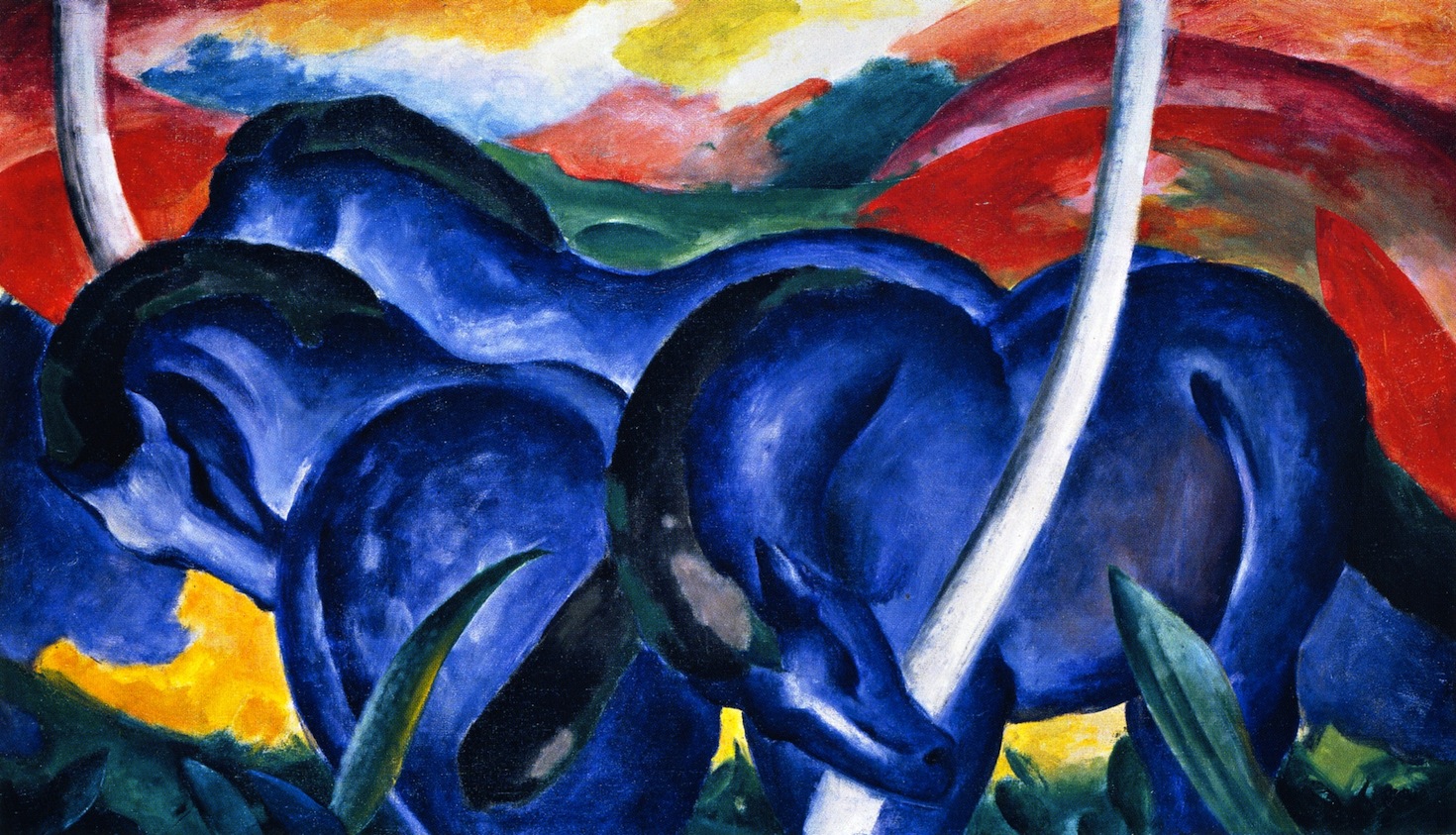
Franz Marc- Large Blue Horses

Franz Marc- Large Blue Horses

He is not downplaying the influences of the past. Early in his career Marc copied the works of other artists from before and contemporary to him. Doing so allowed him to pick and choose the elements in the works of others that meshed with his vision, allowing him to use these found elements to create his own avenue of expression.

He did not want to remain a replicator but wanted instead to be a creator. He wanted to work in a field that he had planted and nurtured. One that was his own.

And that was the attraction for me.

Of course, there was safety and security in remaining in the larger symbolic field with others but it would often be as an anonymous member of a larger group, your furrow always directly compared to the furrow of those alongside you, your harvest always compared to those of others.

Breaking away and heading out was risky. You had to believe that in taking this leap of faith that you would be able to work your little spot in your own way away from others and produce a harvest that is uniquely appetizing to others in some manner. But you might end up toiling in barren soil, creating crops that appealed to no one but yourself. It was scary to think that your field might never expand but you were at least nourishing yourself.

This was the type of thinking that drove my work early on, fueled by looking at the work of Marc and others who veered from the traditions of the past in their times.

Unfortunately, Franz Marc only worked his fields for a relatively short time, dying in WW I at the Battle of Verdun. He was a mere 36 years old. But his crop still lives on, surviving being labeled as degenerate art in the 1930’s by Hitler and the Nazi regime.

It is unique and in his own tradition.

I believe that the lives and careers of artists  like Franz Marc provide valuable lessons for any aspiring artist, even in this world and creative environment that is vastly different than the one that Marc inhabited.

I know it helped me. 


Back trying to take a hiatus. This post ran six years ago but it’s one that I felt deserved another run. Unlike the traditions that sustain and give meaning to our everyday lives, art often occurs when the traditions of art are set aside. I think that is what Marc was talking about here and I believe it is an important thought to keep in mind for those who have their own voice heard.

Back to plowing. Again. Have a good day.


Franz Marc- The Waterfall 1912

Franz Marc- The Waterfall 1912


Franz Marc- Horse and Eagle 1912

The Cowardice


“Call him tyrant, murderer, pirate, bully; and he will adore you, and swagger about with the consciousness of having the blood of the old sea kings in his veins. Call him liar and thief; and he will only take an action against you for libel. But call him coward; and he will go mad with rage: he will face death to outface that stinging truth. Man gives every reason for his conduct save one, every excuse for his crimes save one, every plea for his safety save one; and that one is his cowardice. Yet all his civilization is founded on his cowardice, on his abject tameness, which he calls his respectability.”

― George Bernard Shaw, Man and Superman


I’ve been plowing for an hour already this morning and it’s not even yet 7 AM. It looks like there is a lot of work today outside the studio. Even so, I wanted to stop to make one comment on what I have been seeing lately. Well, actually it’s been evident for years but it has really coalesced in recent times.

Cowardice.

Complete and abject cowardice.

I used the Shaw quote at the top to illustrate my point but in this case I believe that Shaw, that great observer of the human condition, might be wrong. Most of these people know they are cowards and don’t even have the spine to react with faux righteous indignation when the word is yelled in their face.

I am, of course, speaking of the modern Republican party. Not the party of Lincoln. There is a moral bankruptcy there that is staggering and it is all driven by the fact that there is not a soul in that party willing to match action with words in doing what is right.

What they know is right. They know that they are plowing ahead on lies and lunacy at this moment.

And that is the difference between courage and cowardice. Courage is knowing what is right and what must be done then doing that thing while accepting the consequences of doing so, even if it puts that person in personal peril.

The type of cowardice we are witnessing is beyond the opposite of courage. A coward who admits his cowardice has the potential for redemption. That’s not what we’re seeing here.

Nearly all the members of this party party understand what is right and wrong. They know what they should do in service the oath they have sworn to their country. But they refuse to do so and create all sorts of excuses and obfuscations, trying in vain to either validate or cloak the reprehensible motives that seem to be behind this party today.

And they barely utter a peep in response to those who point out their gutlessness, that call them cowards to their faces.

I don’t see anybody in this party willing to change that anytime soon and that is a sad state of affairs for their constituents and for this nation. I often have thought that this time is a perfect opportunity for someone of that party to step boldly and bravely step forward, to state the beliefs and goals that they hold that are righteous and to outline a new direction for that party. Someone to call out the bonds that now exist between this party and white supremacists. Someone willing to extend a hand to others and make their tent more inclusive instead of relying on chicanery to suppress votes.

Why not just make their party in a way that they can simply get more votes from everyone, from all creed and colors? Is that asking too much?

Maybe so. That would take courage and a total rejection of the cowardice that now encompasses this party. It would be almost Lincolnesque.

Then maybe they could again proudly call themselves the Party of Lincoln.

I don’t see that happening anytime soon. I also want to point out that the Democrats are not immune to cowardice, that they too often suffer from a lack of courage. In fact, it has been their unwillingness to boldly do what they know is right when they solely possess the moral high ground that has allowed the darker aspects of this political world to rise. They sometimes seem timid and fearful of exercising the power they have campaigned for so long to possess.

If they truly have the moral high ground and do things that benefit the greater portion of the population, things that makes the lives of everyday folks better in some way, they have nothing to fear. 

I don’t have any answers, of course. I am a simpleton sitting in the woods, getting ready to go out and plow. But I do have one bit of wisdom to share:

Both courage and cowardice are contagious and you are a carrier.

Choose your malady well.


I know I said I was taking some time off from doing this and I am and will. I just needed to vent a bit this morning. Hope you understand and thank you for reading.


“Snow was falling,
so much like stars
filling the dark trees
that one could easily imagine
its reason for being was nothing more
than prettiness.”

― Mary Oliver


As I get ready to go out and plow the snow that has already fallen while fretting about the snow that is coming behind, I thought I would repost an entry from several years ago about an artist whose snow paintings always please me. They focus on the prettiness of the snow and not the work nor the possibility for peril that it brings. And there’s nothing wrong with that. Even though I am no fan of plowing or shoveling or trudging in wet and cold boots, the beauty and quieted atmosphere of snow is among my favorite things. And Nichols captured that in his work. Enjoy this rerun and have a good day, snow or not.


Most likely prompted by the recent weather here as well as a desire to try a slight change of palette, I have been doing a small group of snow paintings recently. I thought I would look at several other artists, especially those with a distinct personal style, to see how they handle snow in their work. One of the artists whose snow works really stuck out was Dale Nichols, who was born in Nebraska in 1904 and died in Sedona, AZ in 1995. He is considered one of the American Regionalists, that loosely defined group of painters whose work  for which I have long expressed my admiration.  

Dale Nichols- After the Blizzard 1967His biography is a bit sparse with but Nichols lived a long and productive life, serving as an illustrator, a college professor and the Art Editor of the Encyclopedia Brittanica. He also spent a lot of time in Guatemala which resulted in a group of work with Meso-American forms that is quite different from his Regionalist work and more than likely influenced the color palette of his normal work as well.  

But Nichols is primarily known for his rural snow scenes and it’s easy to see why. The colors are pure and vivid. The snow, put on in multiple glazed layers with watercolor brushes has a luminous beauty. The stylized treatment of the crowns of the bare trees adds a new geometry to the paintings. There is a pleasant warmth, a nostalgic and slightly sentimental glow, to this work even though they are scenes that depict frigid winters on the plains of Nebraska. Free of all angst, they’re just plain and simple gems.

You can see a bit more of Dale Nichols other work on a site  devoted to him by clicking here.

Dale Nichols- The SentinelDale Nichols- Silent Morning  1972Dale Nichols- Mail Delivery  1950Dale Nichols-  Bringing Home the Tree

Uncloudy Day

“Private Space”- Available at the Principle Gallery, VA


Oh, they tell me of a home where my friends have gone
Oh, they tell me of that land far away
Where the tree of life in eternal bloom
Sheds its fragrance through the unclouded day

Uncloudy Day, Josiah K. Alwood 


Still on a semi-hiatus here on the blog but wanted to continue playing my Sunday Morning musical selection. This week I am going way back with a gospel tune called Uncloudy Day, written by Josiah K. Alwood in 1879. We’re not going back quite that far for this week’s pick but it’s still pretty old, taking us back to 1956 when The Staple Singers first recorded what is probably the definitive version of this song. 

This is a powerfully performed song, with the droning bite of the undertone from the electric guitar of Pops Staples and an emotional vocal lead from Mavis Staples. It’s hard to believe but Mavis was only 16 years old when she recorded this.

It’s reported that this song was a huge influence on a young Bob Dylan. His appreciation didn’t stop at the song as he pursued and proposed to Mavis Staples in the early 1960’s. She turned him down but they have maintained a close friendship and working relationship to this day, recording and touring together periodically over the many decades that followed.

Anyway, it’s a song that always stops me in my tracks and I think anything that makes you stop to listen is a good song to kick off a Sunday. 

Be careful out there and have a good day.


Compromise/ 2021

I thought since I was running some old posts I would go back a little further, this one from early 2010. The painting in this post still excites my senses and makes me eager to be at work. It’s just what I need right now. Take a look .


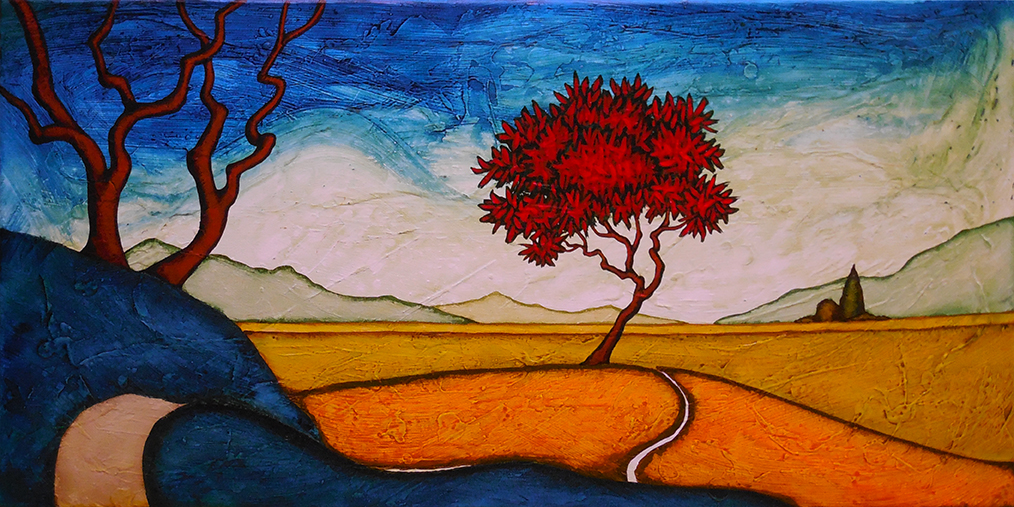
I came across this painting from seven or eight years back, an 18″ by 26″ piece from 2003 titled Call of Freedom. It was quite a different look for my work at the time with its simple design of two two blocks of colors playing off one another. It may not visible in this photo of the piece, but there was a hint of purple through the bottom block of color that really enhanced the piece for me.

The tree was put in at the last moment. After I had completed the two blocks, I sat this aside for quite awhile, looking at it in the studio, trying to determine if it held together just as it was. Was there enough there — color, texture, contrast– to hold my interest, to make me want to continue looking?

This was a tough one for me. It met all my criteria. It held my eye. It had meaning for me. But I still wasn’t sure it would hold the attention and meaning of others. So, I hesitatingly put the blowing Red Tree in place, almost as a compromise.

The tree changed the dynamic, bringing the picture plane closer to the viewer, from vastness to intimacy. But it still allowed the blocks to dominate, to tell their part of story, so to speak. Adding the Red Tree worked without altering my first impression of what I saw in the piece and created an introduction into the painting for others.

This might be considered a compromise.

I don’t know.  

For me, it’s about coming across that space between the painting and the viewer and connecting in some way, communicating something I might not be able to define. So long as it doesn’t alter the feeling or the message I get from the painting, it’s not a compromise but an opportunity for more engagement.  

As a result, I often think of this piece as where I want my work to be in the long run.

Is it compromise? I don’t know. And so long as the work is transmitting my message, I don’t care.

Fragments Once More

9913217-fragments-sm


“All there is, is fragments, because a man, even the loneliest of the species, is divided among several persons, animals, worlds. To know a man more than slightly it would be necessary to gather him together from all those quarters, each last scrap of him, and this done after he is safely dead.”

Coleman Dowell, Island People


[Been running some older posts this week — and maybe next week, as well– as I attempt to recalibrate. Or better yet, as the post below says, gather the fragments and try to reassemble them in some workable form. This post features a favorite painting here in the studio as well as a favorite song.]


It’s been hard finding footing lately in the studio. It’s been hard to just get started on most days. There are plenty of factors that play in to this, some external and some internal, some that I can control and some I cannot. But the end result is the same: left feeling fragmented, broken into shards that don’t want to reassemble easily in the form of my work.

I am not worried however. This is not the first time I’ve felt so fragmented nor will it be the last. I know that I come apart at times and have to bide my time, just continuing to try to put myself back together so that I may uncover what I know is waiting there for me.

It’s there. It may seem an awfully long way away but I can see it and I know that while it may take time and much effort, I shall be together with it again.

The painting above is a piece that has been with me for a while now. One of the orphans that come home to reside for a bit.  I wrote about it last year when I thought I might change its name to Dimming of the Day but it still remains under its original title, Fragments, in my mind. And I suspect it will stay that way.

This painting is based very much on this feeling that I am experiencing at this moment and when this feeling emerges, I often think of this painting.  There is darkness and distance here. The space between the Red Chair and the house has a certain weight that makes me feel as though there is something more than physical distance at play here. The sky, a confetti-like blend of thousands of little fragments of brushstrokes that gave the painting its title originally, represents, for me at least in this piece, the world falling out of harmony.

Dark, distant and coming apart.

Yet despite that I find this painting very comforting. I think that goes back to what I said above, that I know this place well from past experience. I know how to navigate it and know that the distance is not so great nor the darkness too deep. And I know that the parts are still in place to come together again in the future if I simply exercise patience and don’t give in.

It’s funny how that works. I walk by this painting several times a day in the studio and it’s often without a thought as my mind is preoccupied with something else. But every so often I stop before it and suddenly all of these feelings flood back on me when I look closer. I’m glad it works that way, actually.

Here’s the song, Dimming of the Day, which made me think about renaming this painting. It’s from one of my favorites, Richard Thompson. This is a great acoustic version. Have a good day…