Feeds:
Posts
Comments
Jean Arp- Torso of a Giant 1964

Jean Arp- Torso of a Giant 1964


*****************

Soon silence will have passed into legend. Man has turned his back on silence. Day after day he invents machines and devices that increase noise and distract humanity from the essence of life, contemplation, meditation… tooting, howling, screeching, booming, crashing, whistling, grinding, and trilling bolster his ego. His anxiety subsides. His inhuman void spreads monstrously like a gray vegetation.

–Jean Arp

**************
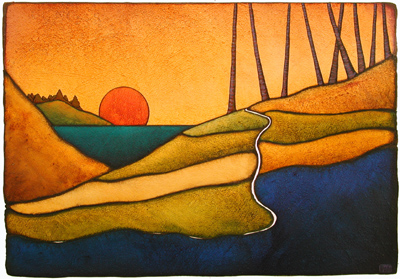
GC Myers- Quiescence

****************

I had a quote on the last post with a quote from artist Jean Arp about man turning his back on silence. Rather than savoring the quiet, he runs from it, instead distracting himself with all manner of noise. Anything to keep him from facing the fears that the quiet represents to him.

It’s a theme that has been large in the background of my work. Early on, when I felt that I wanted to be a writer, I would find myself writing about large open spaces and the caverns of silence that rested in these places. I called it the Big Quiet. Of course, it’s a pretty limited subject and there is a certain redundancy in writing about silence and stillness. I mean, how can you use the noise of words to aptly describe the absence of noise?

So I gave up writing about it and went on with my life, always with an eye out for this Big Quiet. I don’t know that I was craving it or fearing it at most points. My life was pretty much filled with the noise of the world, all the snaps and pops of sound and distraction that creep into every living space. I was like so many others who needed the security blanket of sound to protect them from what they might discover if they were forced to face the silence.

But the sounds that I hoped would lessen my anxiety only seemed to feed it.

However, painting gave me a path to finding this Big Quiet. It was wordless and calm, creating an inner space absent of the sounds of the world that I was and am still occupying. It became a destination, an oasis to turn to when the din of world became too loud, too overbearing. It eased my fears of looking inward and allowed me to savor the quiescence of the brief moments I actually myself there in those scenes of stillness and calm. It became real and necessary to me.

I don’t know where this going, this wordy noise I’m creating about the stillness I find now. I just felt that I should add a bit of context to my work, to give a an understanding of what I hope to take from it for myself. This moment came about from running across the image above, a piece from several years ago that is called, fittingly, Quiescence. It’s a piece that brings me quiet immediately and seeing it at any time makes me again think of the main reason that I paint.

So, I am going to be quiet now…

********************

The post above is comprised of two posts that ran here on consecutive days back in 2013. They served a great purpose for me this morning when I read them again for the first time in many years which made me think they were worth sharing.
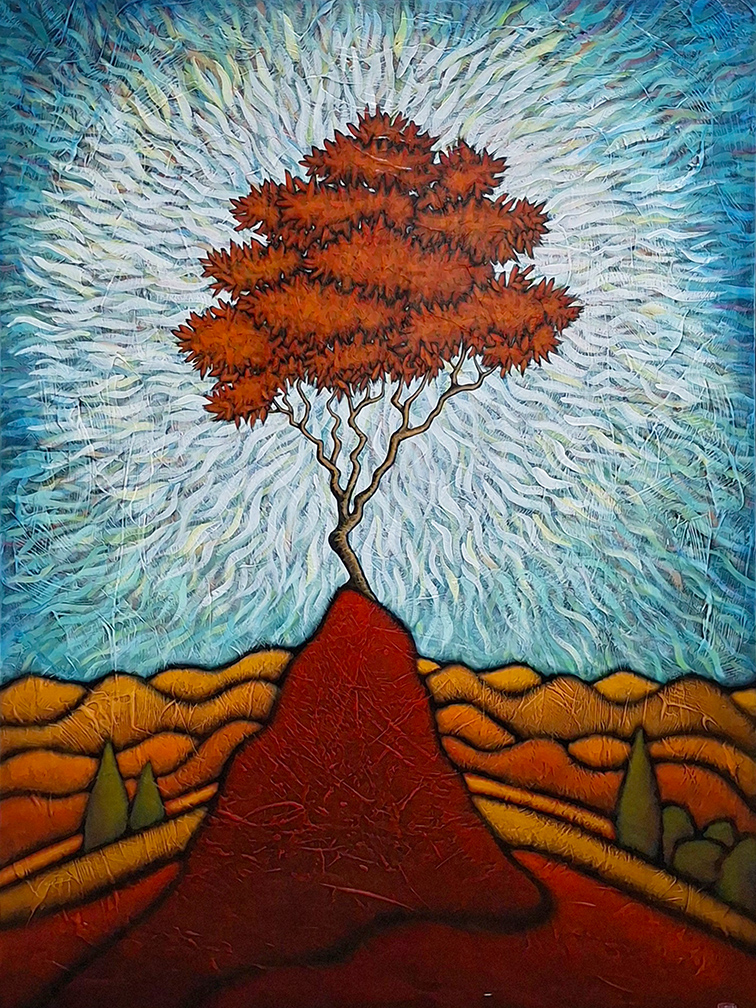
Corona


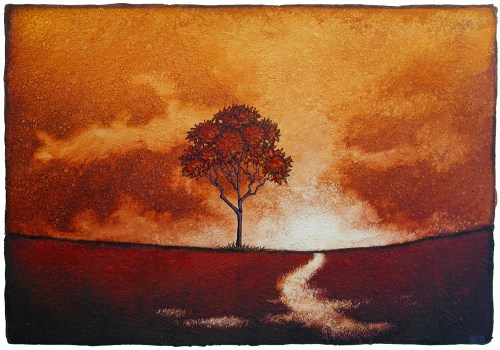
I have a large painting, 36″ wide by 48″ high, here in the studio, one that was done a couple of years back and which has had limited exposure in being displayed. I was surprised to find that I haven’t written about it or even shared its image here in the past. I say surprised because it’s one of those pieces that feels immediately at home with me.

I would consider it prototypical of my work, a single Red Tree pushed forward in the picture, almost a portrait rather than a landscape. There is a burst of light that appears in the sky behind it, creating an aura-like appearance around the Red Tree’s crown. This led to its title– Corona.

Unfortunately, this word, corona, has taken on a new meaning as most of you know. That poor Mexican beer of the same name is being blamed by some folks — those with small and defective brains, I would suspect– as the cause of the outbreak. They probably believe there are junkyards filled with old Toyota Coronas that are radiating the virus outward 24/7.

Even though this is just gross ignorance, it makes me think I might have to rename this piece. Maybe something close in sound?

How about Corrina? You know, like the old song Corrina, Corrina?

Hmm. Have to give that some thought.

As for the song, it’s an old chestnut that was written in 1928 and has been recorded by scores of artists in a wide variety of styles. It seems to work in every genre mainyl because it’s just a very good tune. Here’s a version of the song with kind of a Latin swing from Lloyd Price, who is best known for his big hit from the 1950’s, Stagger Lee. This is not the best known version but I’ve liked it since I heard it many years ago on a Lloyd Price tape that I found in a bargain bin at a discount department store.

When I think of this song, this version always comes to mind. Have a good day and stay away from that beer.

***********************

If necessary, I would even paint with my bottom.

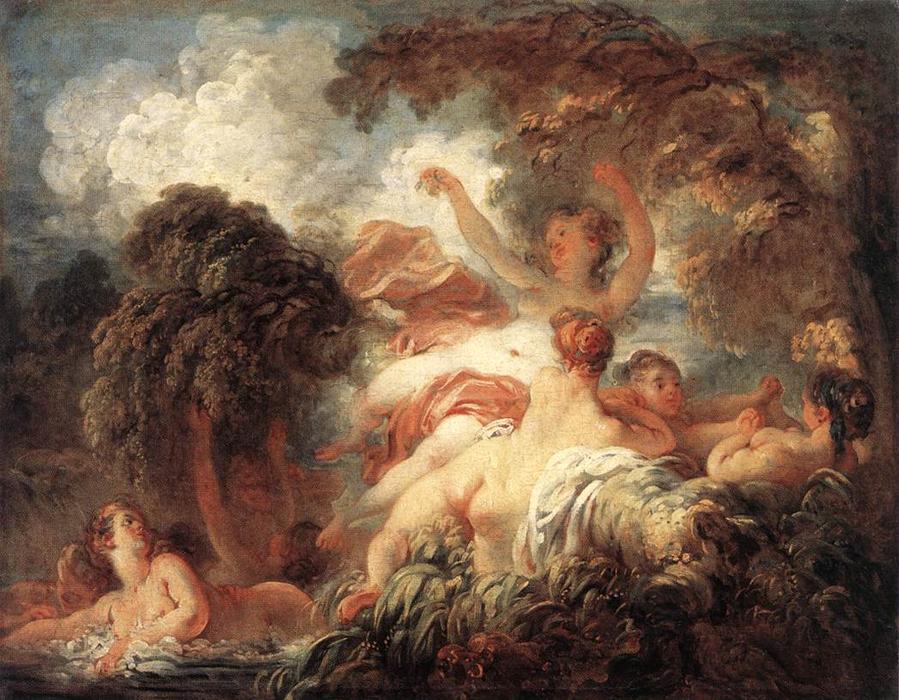
Jean-Honore Fragonard

***********************

I can’t say I am a fan at all of the work of Jean-Honore Fragonard but the quote above made me laugh this morning. I think some folks believe I’ve been painting that way for years now. Sometimes, I believe it myself.

But his point, while humorous, makes a vital point.

I know I have been asked what I would do if I suddenly couldn’t paint anymore and I always answer the same way:

I’d find a way.

Whatever obstacles arise, there is usually a way to be found around or over or under them. Hopefully, it doesn’t come down to painting with my bottom but if that’s the way it must be, so be it.

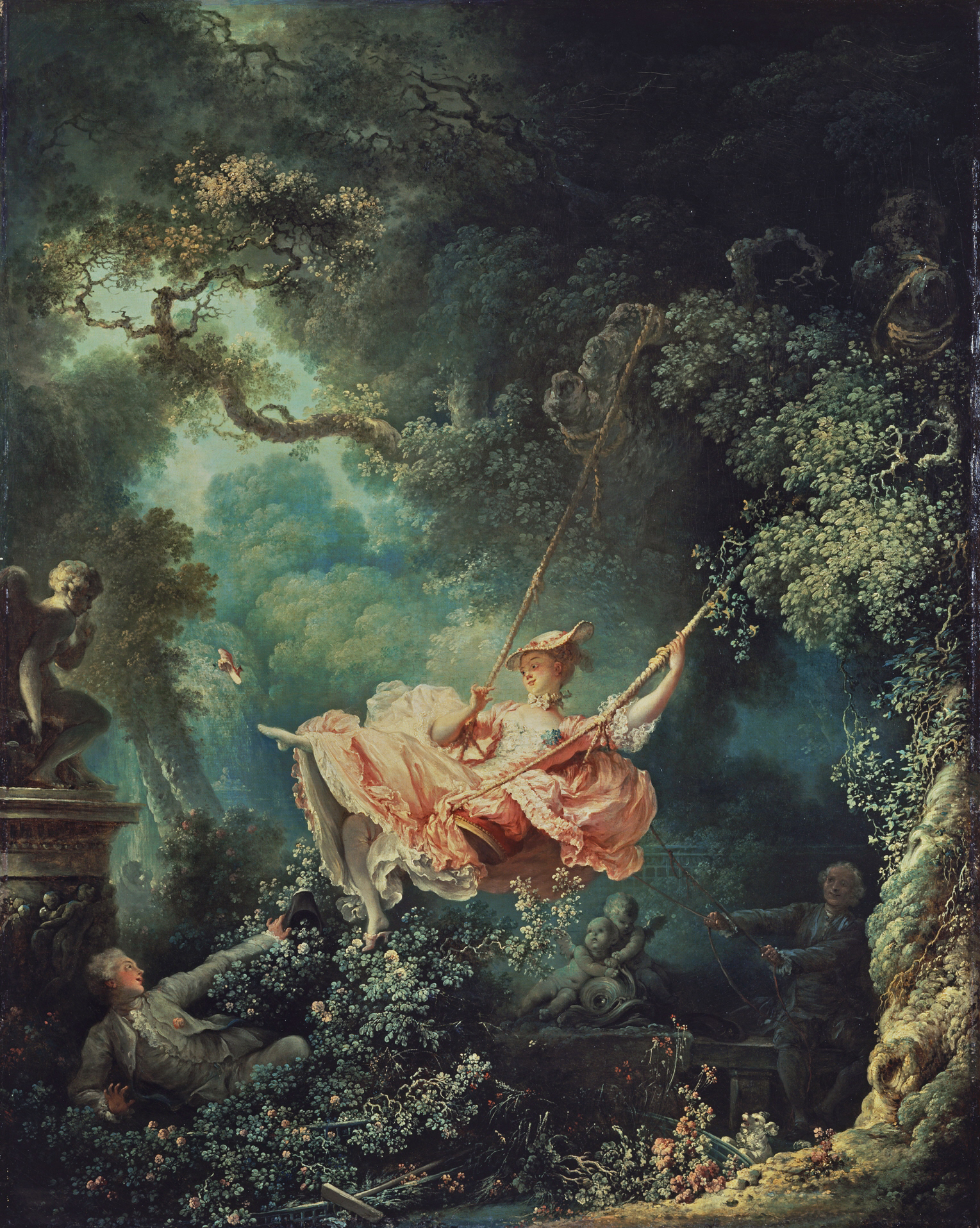
Now, let me share just bit about Fragonard, the French painter who lived from 1732 to 1806. He painted in the Rococo style, one which never really appealed to me. It’s very

the French painter who lived from 1732 to 1806 and worked in the Rococo style, which has never really appealed to me. I have a hard time even describing it except to say it’s busy and soft and often has the feel of a bad romance novel book cover. Rococo paintings might look fine and in their proper place in a highly decorated chateau in the Loire Valley but they just don’t translate well for me personally.

But that’s just my take.

Fragonard dies in 1806 as an almost unknown painter. He had achieved fame and notoriety as a painter earlier in his career, painting his elaborate pieces with a hedonistic feel for the upper classes of French society. Unfortunately for Fragonard, the French Revolution effectively wiped out most of his patrons, most either guillotined or sent into exile.

His style of painting was not appreciated and he went into hiding of sorts. For the last fifteen years or so of his life, he was off the radar completely. This extended for another sixty or seventy until his work underwent a reevaluation and rebirth. He has since been hailed as one of the masters of French painting.

So, his work lives on and he never had to paint with his bottom, to the best of my knowledge.

*************

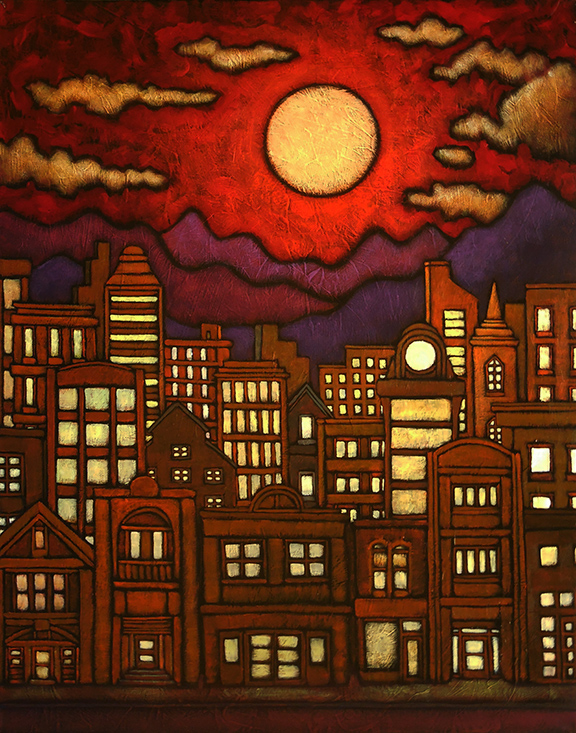
I showed a work in progress here a couple of weeks ago that featured a cityscape that I compared to a skeleton that spoke to me as I painted, telling me how to flesh it out. Above is a side by side comparison that shows where that skeleton led me.

It was one of those paintings where I find myself constantly trying to restrain myself from going too bright. As noted in recent posts, I am looking for more depth and darkness in the colors I employ right now. But I often still want to go the next higher and brighter tone. Holding back on that impulse is difficult but rewarding in the long run. Even though this is a painting with a lot of color, it is greatly restrained which allows the deeper colors hold court and show through clearly.

I was originally going to call this piece Light on Main Street. It works well but in the end I opted to adopt the title from the classic Rolling Stones album, Exile on Main Street. The reason for this change was that I saw this piece as being the view of the Exile, an important character in my work, standing on the other side of the street.

The Exile sees the blank  and anonymous eyes of the lit buildings. It’s a feeling of alienation that I described in a post last week, Inner City Blue, about another cityscape, where each building seems like its own alien world filled with lives and occurrences about which you know little, if anything.

I think this feeling of being the Exile, a stranger in a strange land, is enhanced by the reddish tones of the sky and the deep gem tones of the distant mountains.

They seem familiar but different somehow.

And it’s that familiar but different feeling that appeals to me. I think it is may be something I actively seek in my work. It might be described as a desire to have you feel the comfort of the familiar while at the same time thinking that there is something different at play.

I really don’t know for sure.

I’ve looked at this piece for a couple of weeks now and I am still taking it in. The fact that it makes me want to continue to do so is a good indicator for my personal judgement of a work. I look forward to continue doing so with this piece.

Hey, since I snagged their title, how about a track from the Stones from Exile on Main Street? Hard to decide which to use with so many great tracks from which to choose. However, I am going with a personal fave, Sweet Virginia, in honor of Virginia’s presidential primary taking place today. Plus, there’s something in it that matches up well with this painting. Can’t put a finger on it but…

Hey, have yourself a good day.


Inner World/ Hesse

This quote came from Hermann Hesse‘s most famous book, Steppenwolf. A great book but my favorite Hesse book is Demian, which I have referenced here a couple of times in the past. It was a book that I read at a time when I was at a crossroads in my life and it was very influential in my heading in the direction which led to this point. I think this quote very much jibes with my perception of the world portrayed in my work, that being that it is a real entity, a real place.

It has as much substance as the outer world to me. It has depth and layers. It has breath and light. It has emotion and its truth comes the fact that it is a precise portrayal of itself– not a replication of the outer world.

It just is.

That may sound nutty or perhaps egotistical to some. I get that. But without this belief in the reality of this inner world, the validity of the work to myself comes undone. It fades to nothingness and certainly doesn’t move across the void to the viewer. It loses all meaning for everyone, myself included, without this certainty in its being real.

I’m going to stop at this point. I may have said too much already, maybe too much for the outer world. In here, in my little inner world of colors and shapes, it sounds right…

*************

This post was from about five years back. I reread it for the first time again this morning and thought it deserved another run.

Wild Is the Wind

I don’t have much to say today. Oh, I have plenty to say but I am going to spare you having to hear it. I just want to get to work this morning seeing as it’s March 1 which translates to me as march forward as I prep for my annual shows. It’s total immersion time.

So, let’s keep it short today. I want to show a coupling of a song and a painting which I think works well together. The painting is above and is titled Blaze. It’s one of those pieces that have somehow found their way back to me and this one always confounds me. It felt so right and easy– graceful–off the hand. Even now, I always stop and look at this piece for the longest times, wondering why it is here. I guess it just hasn’t met its rightful partner yet.

The song that I matched up with Blaze is Wild Is the Wind from Nina Simone. It was originally recorded by Johnny Mathis for a movie of same title in the 1950’s. It’s a little overproduced for my taste but the song is undeniably strong. Nina Simone took it and made it into a spare and special song. It was used as the title track for her 1966 album which is considered one of the greatest albums of the 1960’s, remarkable in a decade filled with legendary albums. David Bowie also is noted for performing this song, which was done as a tribute to Simone.

Give a listen and have a good day.
*************

Ah, it’s Leap Day, that one extra day we all receive every four years. I know it’s really just an accounting adjustment and it’s a Saturday like every other Saturday. What’s to get excited about?

Well, this year seems like the perfect year to use it as a timeout, to step back from the precipice on which we find ourselves. A day to take a breath, clear our minds, and really consider how we want to go forward.

It seems that we’re in a time of craziness and just plain old fashioned bad mojo, a time that either rips us down or propels us forward in a new way.

As bad as it appears on many days lately, I see this as a opportune time for transformation. It often takes a crisis to stir people enough that they will act in ways to affect true change, to leap forward from their comfortable perches. We seem on the verge of crisis and catastrophe on a weekly, daily and even an hourly basis so maybe this is the time to take the great leap forward as a society.

Take today and think about it. Do you want to continue down the path in which we’re being led? That’s the easy way, of course. Takes no thinking. Just as a sheep doesn’t think, just follows the sheep ahead of it to either greener pastures or to slaughter.

Or are you ready to leap forward into the unknown? There are no guarantees, of course, except that it will be different from the status quo of a system in which the average person has found it harder and harder to stay afloat over the past forty years. Maybe if enough of us take that leap, we can transform it into a system that solely serves the interests of the people rather than those of corporations, lobbyists and oligarchs.

I don’t know about you but like that cat at the top, I am ready to get off this ledge and move to the next higher one.

Here’s a song from Billy Bragg, a modern day singer/songwriter/activist in the Woody Guthrie mode, advocating for social change, justice, workers’ rights and so on. I’ve been a fan of his work since his days with The Blokes back in the late 70’s. He seldom minces words and this song, Waiting For the Great Leap Forward, exhorts people to get up and become the change they desire.

That’s how change works, after all.

Give a listen. It’s one of those songs that builds and builds so hang with it for a while.

Inner City Blue

*******************

Rockets, moon shots
Spend it on the have-nots
Money, we make it
Fore we see it, you’ll take it

Oh, make you wanna holler
The way they do my life
Make me wanna holler
The way they do my life

-Gil Scott Heron, Inner City Blues ( Make Me Wanna Holler)

********************

I showed a painting last week in progress last week and mentioned that I was working on a series of cityscapes. This is a different painting from that series that I am calling Inner City Blue. It is 22″ wide by 28″ high on canvas.

These pieces are painted in the same way as the Multitudes series that consisted of masses of faces. I normally start at one spot and just work outward from it with little or no plan as to where it will go or how it will emerge. There’s an excitement in working this way because there is always the tension that comes from not knowing whats going to come out.

I often find myself eager with anticipation as the painting progresses. It’s still a mystery at that point and I need that. That not knowing is a big part of how I work, a driving force. I don’t think I would last long if I knew with any certainty how any painting would come out in the end.

And these cityscapes, with all their moving parts and angles and shapes and shades, are totally unpredictable. And that just engrosses me in the process, allows me to find little bits of meaning and beauty in the cracks and crevices that are being created.

Hopefully, a little bit of what I am getting from these pieces comes across to the viewer. That reaction is as unpredictable as the painting itself.

I compared these cityscapes to the Multitudes series earlier. There are similarities beyond the process. Much as I left the faces without eyes in the Multitudes pieces, I leave elements out of these cityscapes. There are no traces of people on the streets or in the windows. There is no signage, no lettering. No street lights or anything on the street. It creates a skeletal effect, showing the bones of what gives the city its appearance while leaving a void.

That void could be described as the anonymity that very large cities often provide.

You know what I mean. That sense of being lost in a throng of faceless people moving on the street. Little, if any, eye contact and as you jostle along with the crowd, your own eyes are locked on some far distant point, fending off the intrusive eyes of the street vendors, hustlers and beggars.

You try to look stoic and determined, like you’re on a mission that should not be interrupted. You’re like a silent rocket hurtling through the space between the buildings that tower above the street and each building is a new alien world to you, filled with life and lives about which you know little.

A stranger in a strange land. That feeling might be the best way to describe what drives much of my work. I often feel out of place in this world– a stranger in a strange land– and am trying to put it, in my work, into some sort of order that allows me to fit in.

Don’t know if that makes any sense. But I do like these city pieces and feel there is something in them that I need to see. So, I will keep looking for a while.

Here’s the song Inner City Blues (Make me Wanna Holler), written by Gil Scott Heron and performed by the great Marvin Gaye. I didn’t mean to borrow the title but after I had titled it I remembered that there was the song. So, here it is. Enjoy.


Grief and High Delight

*********************

“And I can’t be running back and fourth forever between grief and high delight.”

J.D. SalingerFranny and Zooey

**********************

When I send a painting to a gallery it is with the expectation that it might very well sell.  As a result, I don’t usually announce or comment when a piece does actually go to a new home. I am usually very pleased when a sale of my work takes place. I mean, it’s my job and my livelihood plus the sale is a validation, in a way, that the work reached out beyond my own imagination and struck a chord with someone to the point that they chose to spend their hard earned money to obtain it.

What’s not to be happy about that?

But hearing that some paintings have been sold raises conflicting emotions. On one hand, I am thrilled to see the painting find a new home and to know that I can pay my bills for another month. That is a always a good thing.

But on the other hand, there are paintings that I see as being special, as being more significant to myself. Selling one of these paintings means that it is forever out of my hands, that it is no longer mine alone. Like a part of myself has been sheared off and sent away.

As a result, much like Salinger wrote above, I find myself running back and fourth between grief and high delight.

Such is the case with the painting at the top, Saints and Sinners. It’s a piece that I felt was personally among my best, one that was well beyond myself. I learned yesterday that it had sold and was very happy at first. Someone had seen that same special quality in it and was making it part of their life.

But after only a few moments, I had a sinking feeling in my stomach and a sense of loss came over me.

Even this morning, I am a little sad about it being gone forever.

Almost grief.

I say almost because, as grief goes, this is way down on the list of things that might cause one to grieve. For most people, especially non-artists, this sound ridiculous, I know.

So, let’s just call this artistic grief.

Don’t worry. I’m okay. I am not wearing black or tearing up this morning. I sold a painting, for chrissakes.

I am very happy about that but will still miss it, that’s all.

Okay, back to work. Maybe this next piece will be a worthy replacement.

Or better…


I ran the post below several years back and thought it deserved another look. As I say, it is advice from poet e e cummings to aspiring poets on becoming nobody-but-yourself, advice anyone can use for whatever creative path they might want to follow. I know it always makes me want to feel and work and fight a little bit harder. Take a look:

***************

****************

Whenever I am asked to speak with students I usually tell them to try to find their own voice, to try to find that thing that expresses who they really are. I add that this is not something that comes easily, that it takes real effort and sacrifice. The great poet e e cummings (you most likely know him for his unusual punctuation) offered up a beautiful piece of similar advice for aspiring poets that I think can be applied to most any creative discipline.

Or to anyone who simply desires to feel deeply in this world.

I particularly like the line: To be nobody-but-yourself -in a world which is doing its best, night and day, to make you everybody else-means to fight the hardest battle which any human being can fight; and never stop fighting.

That line alone speaks volumes.

Take a moment to read this short bit of advice and see what you think– or feel.

*******

A Poet’s Advice To Students

(e e cummings)

A poet is somebody who feels, and who expresses his feeling through words.

This may sound easy. It isn’t.

A lot of people think or believe or know they feel-but that’s thinking or believing or knowing; not feeling. And poetry is feeling-not knowing or believing or thinking.

Almost anybody can learn to think or believe or know, but not a single human being can be taught to feel. Why? Because whenever you think or you believe or you know, you’re a lot of other people: but the moment you feel, you’re nobody-but-yourself.

To be nobody-but-yourself -in a world which is doing its best, night and day, to make you everybody else -means to fight the hardest battle which any human being can fight; and never stop fighting.

As for expressing nobody-but-yourself in words, that means working just a little harder than anybody who isn’t a poet can possibly imagine. Why? Because nothing is quite as easy as using words like somebody else. We all of us do exactly this nearly all of the time-and whenever we do it, we’re not poets.

If, at the end of your first ten or fifteen years of fighting and working and feeling, you find you’ve written one line of one poem, you’ll be very lucky indeed.

And so my advice to all young people who wish to become poets is: do something easy, like learning how to blow up the world-unless you’re not only willing, but glad, to feel and work and fight till you die.

Does this sound dismal? It isn’t.

It’s the most wonderful life on earth.

Or so I feel.