Over a century ago, in 1912, the Titanic, claiming to be the biggest and best ship of its time, made its maiden voyage heading from England to New York.
Well, there’s a ship out there right now, big and as full of itself as the Titanic. Its name is written in large gaudy gold letters across its bow and like the Titanic begins with a T.
This week, the iceberg that has been looming on the horizon moved perilously close to this ship. And I have a feeling that this iceberg is bigger and deeper and vastly more dangerous than the pompous Captain and his First Mates ever could imagine. They think they can simply evade the part of the iceberg they can see. And the passengers who trust this captain believe that he will steer them clear.
We all know how this story goes: Big Ship+North Atlantic+Iceberg+Crash+Bottom of the sea+Celine Dion singing. Closing credits and fade to black.
There are a lot of people out there saying that the events of this week are the end of the story, that they are a small iceberg that can be swerved around and the big ship trudges onward. But we all know that icebergs are sometimes massive and that the sighting of one is often just the beginning of the story.
We have sighted the iceberg and even the tip of the iceberg is big. This story has just began.
There are so many things we’ve been brought up to believe that it takes you an awfully long time to realize that they aren’t you.
–Edward Gorey
++++++++++++
.
I love the work of the late great illustrator Edward Gorey which very often took matters to dark and quirky places. His Gashlycrumb Tinies, a primer style book with small children being done in in a variety of curious ways, is a prime example. I’ve shown a few here. At face value, it’s awful yet there is a quality to it that still makes you smile at the macabre absurdity of it.
.
It’s often thought that Gorey, who passed away in 2000 at the age of 75, was English, mainly because much of his work looks very Victorian and Edwardian. Lots of well appointed gentlemen and gowned matrons brandishing cigarette holders. However, he was from Chicago and lived most of his life there, in NYC and on Cape Cod, where he died. He actually only left the USA once in his lifetime.
.
One little factoid that interested me was that one of his stepmothers was the actress who played the cabaret musician who sang and played guitar in the movie Casablanca. She was playing the guitar during one of my alltime favorite scenes which featured Resistance fighter Victor Lazlo leading the band in a rousing version of the French anthem, La Marseillaise, that drowned out the singing of the Nazis in Rick’s bar. I guess that doesn’t mean much as far as Edward Gorey’s work but I thought it was a neat little detail.
.
I also like the quote at the top from Gorey. It’s one of those realizations that come only with the passing of time, after years of trying to fit one’s self into a mode of behavior that is acceptable to others. At a certain point one realizes that they don’t have to satisfy anyone’s expectations or beliefs but their own. It’s the beginning of freedom.
This morning, I was looking at the wall in my studio that is directly in front of the desk where I write this as well as the easels where I paint. It’s a large stone fireplace that is about fourteen feet wide made from local creekstone. There are bookshelves built into the wall, the shelves formed by thick slabs of bluestone. There are also three half round ledges that jut out from the wall that were obviously placed to show off tchotchkes.
I have a number of personal things littering the wall. There are several of the carvings from the years before I began to paint. An old snowshoe. A carved crow from a well known regional sculptor shares one of the half round shelves with a cheap carving of Don Quixote that my sister gave me as a Christmas present when I was still a kid . There’s a Buddhist prayer wheel given to me by a friend along with a thumb piano made from koa wood, picked up on a trip to Hawaii many, many years ago.
But in the center is a painting from a few years back, an abstract comprised of colorful blocks. I knew when I did this piece that it was strictly mine and wasn’t surprised that it didn’t find a home. There are several such pieces here in my main painting space. Maybe it’s the fact that I did them just for my own satisfaction that make them favorites of mine. I know this painting catches my eye several times a day and there is definitely a sense of satisfaction in each glance.
Even with that, I don’t know that I would do such a piece again. If I did, the scale of the painting would be much larger, maybe four or five feet square, so that its colors and forms had the size to make a real statement. A bold yelp whereas this small painting is a whispered wish. But that whisper is mine and I wish on it every day.
Below is a post from back when it was made. The quote totally aligns with how I see the key to creativity– finding that medium and process that corresponds with the way one thinks and feels.
____________________
The artist is a man who finds that the form or shape of things externally corresponds, in some strange way, to the movements of his mental and emotional life.
—Graham Collier
****************
I have been working on dream inspired patterned forms, as I’ve noted here several times recently. I have been incorporating into the layers that make up my skies in simple landscapes where they serve to give added depth and texture. It works really well in that context and it would be easy to just use it in that way.
But there is something about some of them that make me just push them to the forefront alone without masking them with any representational forms over them. Something beyond narrative. Elemental. Like it is somehow tied to my own internal shapes and forms and patterns.
I was thinking this when I came across the quote at the top from the late jazz musician/composer Graham Collier. It made so much sense because I think that is, in general, the attraction of art for me– it’s an external harmony of internal elements.
I didn’t know much about Collier who died in 2011. He was a bassist/bandleader/composer who was the first British grad of the Berklee College of Music. He played around the world and also wrote extensively on jazz but he still wasn’t on my radar. While I like jazz, my knowledge, as it is in many things, is pretty shallow. So I decided that I should listen to some of Collier’s music.
The first song I heard was titled Song One (Seven-Four) and it just clicked for me. It was so familiar and seemed to be right in line with the piece at the top, a 12″ by 12″ painting on masonite panel. It made me think about the connection with music, how sounds often take the form of shapes and colors in the minds of both musicians and listeners.
Again, very elemental.
So I began to think of these newer pieces as music. It creates a context that makes sense for my mind, one that gives me a way of looking at the work without seeking representational forms. It’s an exciting thing for me and I look forward to some newer explorations in this realm in the near future. For Graham Collier’s clarification, I am calling the piece at the top Jazz ( Song One). Here it is :
What does the artist do? He draws connections. He ties the invisible threads between things. He dives into history, be it the history of mankind, the geological history of the Earth or the beginning and end of the manifest cosmos.
—Anselm Kiefer
++++++++++++++
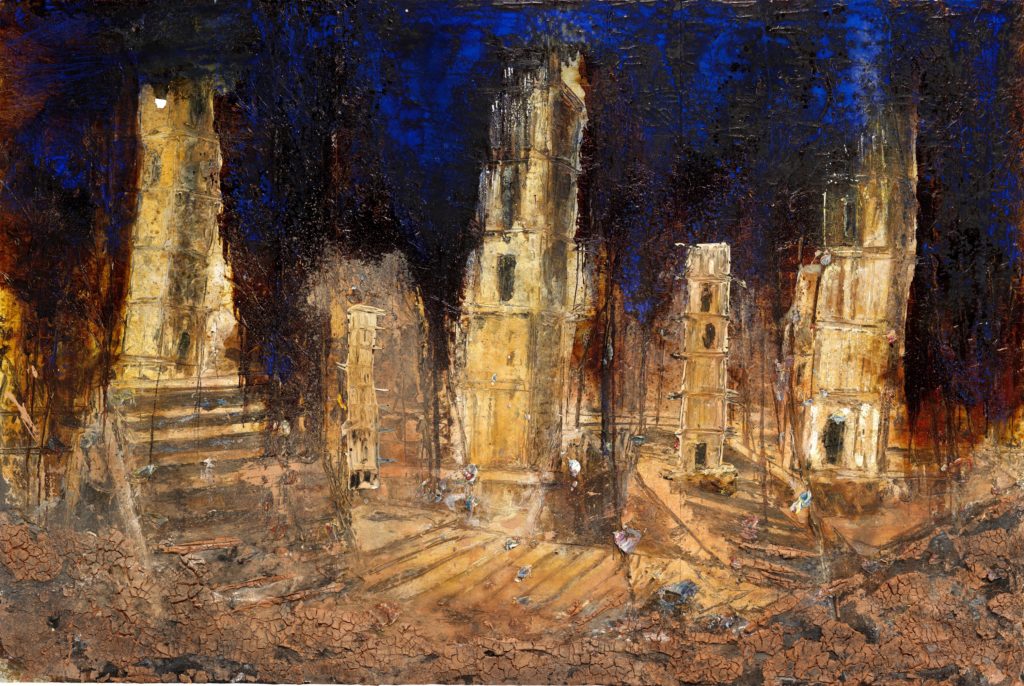
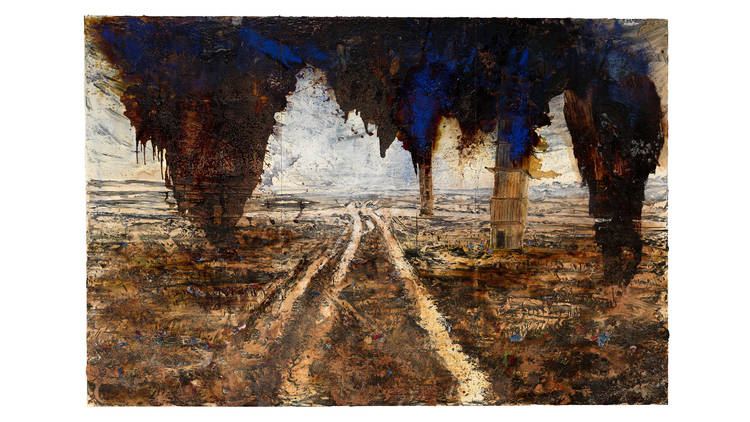
Anselm Kiefer (born 1945) is a contemporary German artist whose work is often epic in size and scale. You can see this in one of the photos below. Many of his more recent paintings use molten lead as a medium which creates these large ominous and heavy (obviously!) areas in the paintings. Over his long career he has been controversial, especially in confronting his German heritage and the events of the first half of the 20th century. But it is always interesting.
.
Several things he has written or said have really resonated with me, including one quote from which I stole a bit to use as the title of a painting, The Palace of My Memory. The quote summed up perfectly how I view the body of my work. I believe I am creating a place, a palace if you will, where my collected memory can be preserved and survive, hopefully, long after I am gone.
.
Here is that quote:
.
But I believe above all that I wanted to build the palace of my memory, because my memory is my only homeland.
The British photographer Alfred G. Buckham (1879-1956) was one of the pioneers of aerial photography. Already a photographer, his career as an aerial photographer began with the outbreak of WW I.
He became the first head of aerial reconnaissance for the Royal Navy and later translated that to a private career of daring and wondrous shots taken from small planes, often with him standing perilously on the plane with one leg tethered to it. He was involved in 9 plane crashes and it was only in the ninth that he was seriously injured, having afterward to breathe for the rest of his life through a tube in his throat after a tracheotomy.
This shot at the top of the page taken by Buckham from above Edinburgh, Scotland around 1920 is one of my favorite photos. I urge you to check out the website devoted to the career and work of Alfred Buckham. Interesting stuff.
I thought I’d accompany this photo with a track from the album Skala from musician Mathias Eick that is titled, of course, Edinburgh. Another track, Oslo, was featured here several weeks ago. Not all the tracks are titled after European cities, in case you were wondering.
I think this composition fits the photo very well, with a gliding beat that I can imagine aligns itself well with swooping over the Scottish landscape in a small plane in 1920. Give a closer look and a listen and have a good Sunday.
I really just wanted to share one of my favorite Edward Hopper paintings but the message attached really speaks to my own thoughts on painting. The painting is his Early Sunday Morningfrom 1930.
I like that it seems so still, so static, yet it is filled–at least for me– with tensions and deep emotional content. That reaction is my own imagination reacting to the elements of the painting. Hopper created an armature, a framework, that gives shape to the emotional response of the viewer without filling out all of the details.
You look at it and there are guides in place that gently direct you to Hopper’s own emotional location. But it never spells it out in great detail, never tells you what you should feel. It relies on your imagination to fill in the voids, to fill it with details to which you can personally relate. You are no longer a mere viewer, you are an emotional participant.
That’s how I think a painting should work, as a sort of active terminus where the work of the artist and the imagination of the viewer meet.
Sometimes, it works that way. Sometimes, it doesn’t. I think this Hopper definitely works in this way.
Well into middle-age now, I can’t remember a time when Aretha Franklin wasn’t around to provide vital part for the soundtrack of our lives. Her best known songs are part of who we are and how we define ourselves in our own time. She won’t be around but her work will continue that job for some time to come.
Here’s one of my favorites, a song from back around 1964 that probably has been overlooked a bit in the deluge of Aretha music that has been played in the last day or so. It’s a great song and a good look back at early Aretha. Here’s Runnin’ Out of Fools.
If only someone else could paint what I see, it would be marvelous, because then I wouldn’t have to paint at all.
—Alberto Giacometti
.
++++++++++++++
.
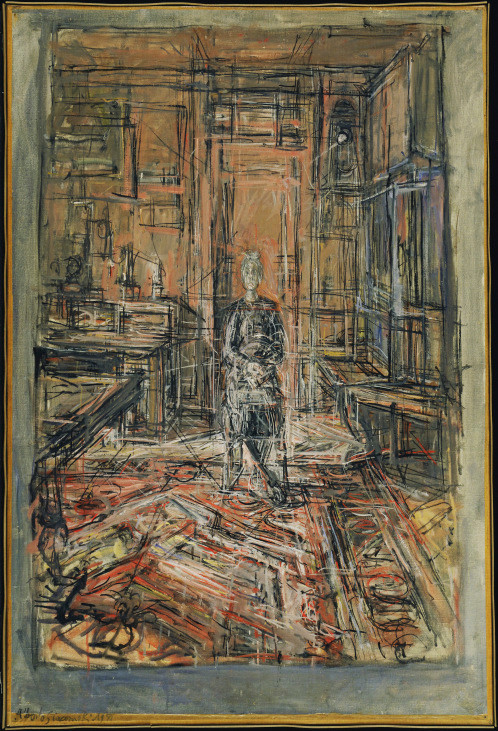
This quote from the great sculptor/painter Alberto Giacometti reminds me of a bit of advice I’ve attempted to pass on for a number of years: Paint the pictures you want or need to see.
.
This idea that I wasn’t finding what I sensed I needed to see drove me early on and still does today.
.
It makes me wonder if I had been aware of someone painting the pictures that I now paint when I was first starting out, would I be painting now? Would there be a need?
.
Even though I want to say that, yes, I would definitely still be painting, I really can’t fully say that mainly because the little spark of doubt it creates makes me think it might well be true. But, of course, it would have to fully satisfy my need and maybe no one artist could do that. Or maybe even seeing that needed work might spark a new need, a further boundary.
.
Hmm. Something to chew on this morning. Now, I best get to work. If no one else will paint the pictures I need to see, I better get going.
Been raining for a couple of days now, often in loud and long downpours. Looking out from my studio, I can see the run-off creek that runs through my property, normally dry at this time of the year. It’s gushing brown now, nearly overtopping the large culvert into my studio, and has a roar that fills the woods.
Down the length of the long driveway into my property, the water runs on it like it’s a newly minted stream while beside the driveway the creek rushes well outside its banks, meeting the driveway water and merging into a mass that covers everything. The end of our drive looks like a large, moving pond.
There are a few younger deer playing in the now hard rain, running through the heavy, muddy overflow coming off my pond. The ground is soft and giving underfoot, like walking on a sponge.
We’re fortunate in our location. High enough to avoid real flooding and far enough away from the water coming out of the creeks and run-offs that run through the property. A lot of other folks won’t be so fortunate and will most likely have to face a long clean up after the flash flooding that is taking place. A day or two more and we might be into heavy river flooding and that’s real trouble.
Hopefully, tomorrow will bring some sun, some relief. But for now, I’ll watch the water run brown with the deer splashing through it. A bit of a watered-in day, as my friends in Texas might call this.
Here’s a great version of the Bob Dylan song Down in the Flood from the bluegrass legends, Flatt and Scruggs. Enjoy and stay dry.
Art has always been the raft onto which we climb to save our sanity. I don’t see a different purpose for it now.
—Dorothea Tanning
+++++++++++++
.
Doing research for this blog, I run into so many artists that work well into their nineties and beyond that I begin to get hopeful for my own longevity. I try to see if there is some sort of common denominator among them, something that might be a key to their long careers and lives.
.
There seems to be among many, at least to my eye, a constant striving for growth and change in their work. There are often new subjects, new styles, new mediums and new processes. But a constant state of wonder.
.
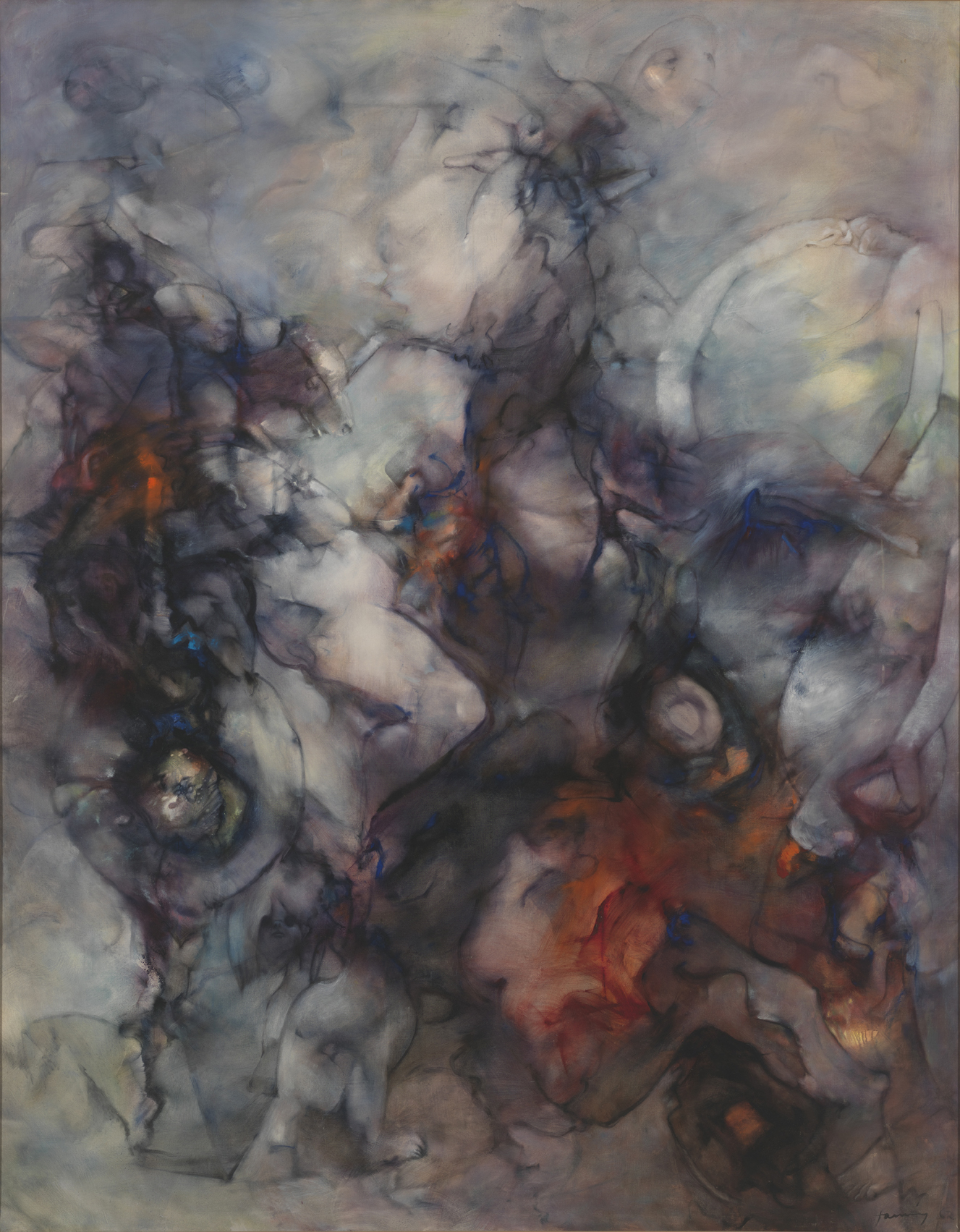
Dorothea Tanning is one such example. Born in 1910, she worked until late in her life and died at the age of 102 in 2012. Her work changed throughout her career, having multiple phases, but always remained her own. I am only showing a few of her pieces here, a few that immediately grabbed me this morning, along with a short video with a bit of an overview. Like many artists I show here, I don’t know a lot about her work but hope to use this as an introduction.
.
Hopefully, in forty years or so, I will still be following Ms. Tanning’s example. But most likely only if I try continue to attempt to grow. Because as Dorothea Tanning also said: It’s hard to be always the same person.
 Over a century ago, in 1912, the Titanic, claiming to be the biggest and best ship of its time, made its maiden voyage heading from England to New York.







 Redtree Times