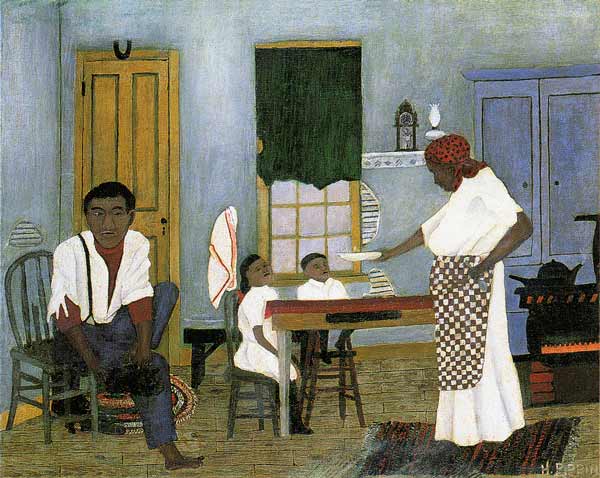
Not surprisingly, I have a real affinity for self-taught and naive painters. Among my favorites is American Horace Pippin who lived from 1888 until 1946. He only produced about 140 paintings in his relatively short life but they are real gems, displaying a wonderfully sophisticated and more mature form of naivete. He achieved a pretty high level of recognition in his short career, being championed by a number of critics as well as artist N.C. Wyeth. The bulk of his work is now held in museums.
Though born in West Chester, PA, Pippin grew up in Goshen, NY, which interests me because I have three grand-nephews living there. Goshen was where he began his artistic journey after winning art supplies in a newspaper contest, using them to make drawings of the jockeys and horses at the famed Goshen racetrack. He was wounded in World War I, serving in the famed Harlem Hell Fighters, and turned to art in a more serious manner to strengthen his damaged right arm.
He married and moved back to West Chester and his work began to draw notice, appearing in numerous exhibits in museums and galleries alongside some of the giants of the art world. In 1946, he suffered a stroke and passed away.
As I said, he produced a fairly small number of paintings, many depicting the African American experience of the time along with a number of biblical and historical paintings, John Brown and Abe Lincoln being favorite subjects. They are a rich American treasure.
Here’s a nice video of much of his work with Ella Fitzgerald’s great Cry Me a Riverbacking it.
“How fathomless the mystery of the Unseen is! We cannot plumb its depths with our feeble senses – with eyes which cannot see the infinitely small or the infinitely great, nor anything too close or too distant, such as the beings who live on a star or the creatures which live in a drop of water… with ears that deceive us by converting vibrations of the air into tones that we can hear, for they are sprites which miraculously change movement into sound, a metamorphosis which gives birth to harmonies which turn the silent agitation of nature into song… with our sense of smell, which is poorer than any dog’s… with our sense of taste, which is barely capable of detecting the age of a wine!
Ah! If we had other senses which would work other miracles for us, how many more things would we not discover around us!”
― Guy de Maupassant, The Horla
**********************
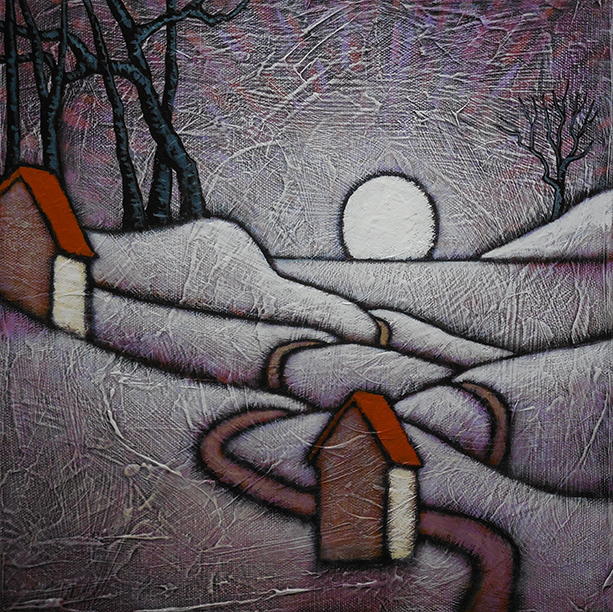
Yesterday I finished the painting above, a 12″ square canvas that is scheduled to head to the Kada Gallery in Erie for my show, Sensing the Unseen, that opens there on December 1. It’s a piece that feels faithful to the theme of the Kada show– that there are energies and forces swirling around us that are imperceptible to our senses. I’ve often felt that one of the purposes of art is to give these forces shape and form.
To make the unseen visible.
And I think this painting is a good example of that thought. Its simple forms, lack of detail and sparse narrative elements might seem an unlikely setting for the unveiling of hidden forces.
Or maybe these things make it the perfect setting for doing such a thing. Distraction is stripped away. The whiteness of the moon at the horizon becomes a central point of focus. The lightness of the landscape (is that snow?) and the path push the eye further inward, past the windowless houses that seem to act as boundary markers between the known and the unknown. There is a created sense of depth and space that belies the tight dimensions of the picture plane. It all makes you feel as though there is something ponderous, something that begs to be known in that space.
Even the color creates a mysterious paradox. It feels cold with the whiteness of the snow and the moon (or is it a sun?) yet the underlying magenta makes it feel warm. It seems perilous and cold yet still feels warm and inviting. It pushes away and pulls in.
Or it’s just a simple little snowy landscape.
I chose its title, Mystery of the Unseen, from the paragraph at the top taken from a short story, The Horla, from the French master of the short story, Guy de Maupassant. It’s a horror story describing how an unseen alien force– an extraterrestrial– inhabits a man, controlling his mind with the intent of conquering humanity. It was the last story he wrote before being committed to a sanitarium, where he died.
Have a lot on my plate this morning, a lot of things needing to be done. But I came across this video by one of my favorite singer/songwriters, the late Townes Van Zandt, and thought I would share it. It’s called Big Country Blues and the video features the photos of primarily working class Americans from the great Richard Avedon.
It’s a compelling video, given this time in this country. I watched it twice this morning just to fully take in the imagery and Townes’ music never lets me down. I wish he were around just to hear his take on these times. He could write some sad songs, after all.
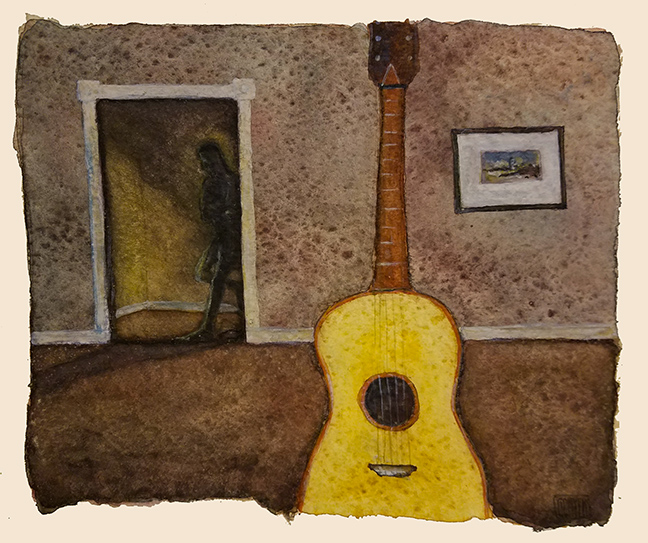
I was looking for an image to pair with the music I want to share today and thought this old piece might work since I’ve been showing a lot of older unseen work lately. It’s a watercolor piece from 1995 or 1996 that I never felt secure enough about to show, one with a guitar dominating the front of the picture plane and a dark character propped in the doorway.
There are a few things wrong with this piece, most notably the way the fretboard just ends at the body of the guitar. And the dark character is just, well… a little strange. He’s either smoking a cigarette or has been recently on fire–which might explain his charred appearance– and is still smoldering.
But even with these obvious flaws, for some reason I still find myself looking fondly at this piece and liking it. Still not sure about showing it to anybody but liking it, nonetheless.
The music I wanted this to accompany is from Australian fingerstyle guitarist Alan Gogoll who is being hailed for his technique that creates bell-like harmonic tones. I came across a couple of his videos and was drawn in by the way the filming focused on his hands. I am fascinated by watching the hands of musicians when they play and his technique has a grace and poetry in the movement of his hands.
He also has a series of short Instagram videos and one very long Youtube video in which the camera is inside the guitar facing out through the sound hole. You see his fingers picking and the vibration patterns of the strings as each string is plucked. Called Stringscapes, they are pretty mesmerizing.
I am showing a short song called Mulberry Mouse first, followed by the Stringscapes video. As I said, this video is long, coming in at 28 minutes. But it is worth at least taking a look for a minute or two. Or longer. Actually, while I was writing this I took a look and about four minutes passed. I said they were mesmerizing.
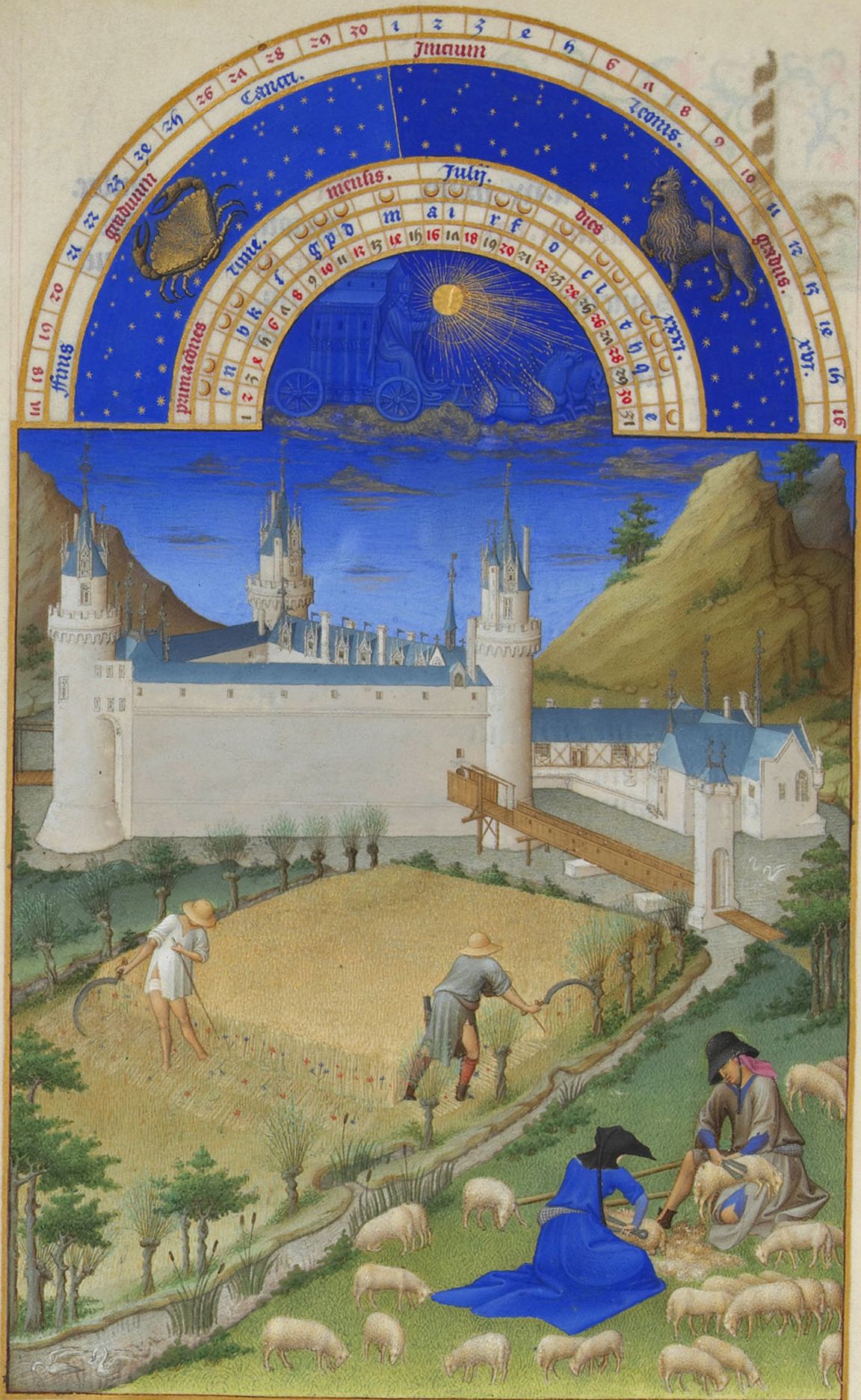
Several years ago I wrote about a spectacular illuminated book called Tres Riches Heures du Duc de Berry. It was a Book of Hours created for a French Duke in the 15th century filled with prayers, calendars, timetables and the like. It also included some of the most extraordinary paintings that illustrated the text, including twelve pages that showed each month in proper seasonal context. I came across the film below that focuses on these beautiful pages, showing them in some detail.
After hitting the start arrow on the video below, you have to click on the link to go to YouTube to watch the video at the request of its creator. But it’s well worth a look to start out your week on such a calm and lovely note.
**********
One of the great pleasures in being fairly ignorant is the thrill that comes from stumbling across something that is absolutely spectacular without any knowledge of its existence beforehand. Of course, the flip side of this experience is the depressing realization that sets in when you realize how little you really know. I know this from experience.
The other day, while searching for images of medieval snow scenes for the previous post, I also came across a beautiful image taken from a 15th century illuminated manuscript called the Tres Riches Heures. It was a gorgeous winter scene, very Dutch looking, with a astronomical chart with beautiful blue lapis bands arching across the top of the page. I was immediately taken in by the image.
Doing some quick research I discovered that this image was but one of over 130 painted images in the Tres Riches Heures, many of whichwere done by a trio of Dutch siblings, the Limbourg Brothers, between 1412 and 1416 for the French Duke du Berry. The Tres Riches Heures is a book of hours which consists of prayers and devotional exercises along with timetables for specific prayers and calendars for feast days and other days of note in the liturgical year, along with some customized additions. This particular book of hours was the most spectacular ever produced.
Of course, something this incredible never comes easily. The Limbourg Brothers, unfortunately, all died within the year of 1416, most likely from the plague, leaving the Tres Riches Heures incomplete. It was worked on for many years by an unknown intermediate painter, most likely a court painter for French king Charles VII, who had attained the unfinished group work in the years after the Limbourgs died. Finally, between 1485 and 1490, the work was completed by artist Jean Colombe.
Today, this considered arguably the most valuable book in the world– a book filled with 130 beautiful Dutch paintings, a book that took nearly eighty years to complete.
As I say, I was thrilled to come across it, having no prior knowledge of it or the magnificent work of the Limbourg Brothers or Jean Colombe. But then I was a bit taken aback by the realization that I had such a gap in my knowledge, especially of a work of such grandeur. But, that’s the way it goes. You trudge forward, a blind squirrel periodically stumbling across a nut.
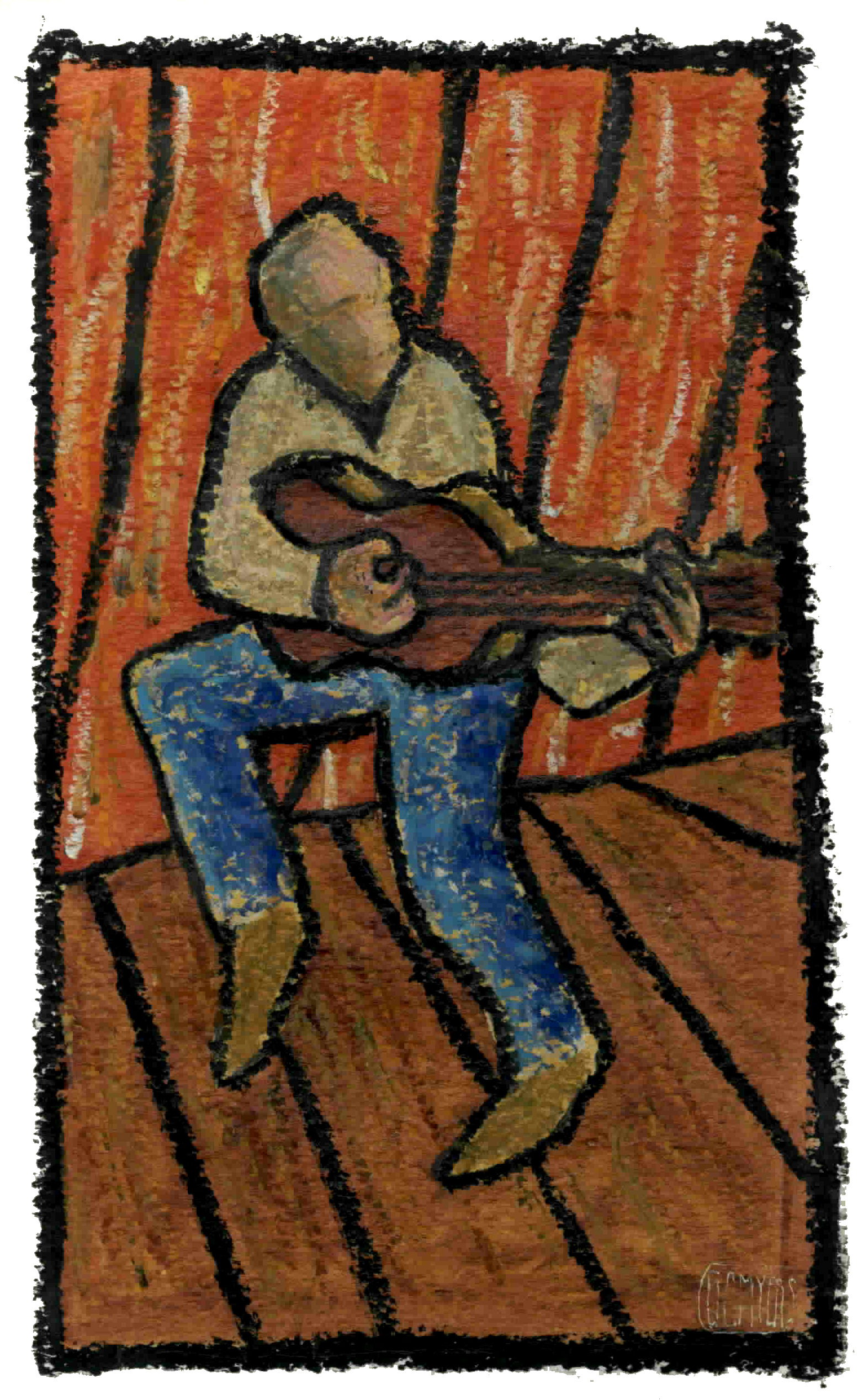
I’ve been revisiting a lot of very old work lately here in the studio, taking little walk down memory lane. Some of the memories are pleasant enough with “oh, yeah, I remember that” coming up periodically in my mind. Some are cringeworthy, making me glad I moved past that time. Some please me greatly and some make me smile. Such is the case with this little piece done in 1994.
Called Rockin’ Billy, it was done quickly in crayons. It’s rough-edged and kind of crude but has movement. I think I was listening to a bunch of old rockabilly at the time. Johnny Burnette, Warren Smith, Jerry Lee Lewis, that kind of stuff– rough-edged and a little crude with some real movement.
But I am pretty sure that this piece was a direct result of Billy Lee Riley and his distinct guitar playing, especially in a couple of my faves from that time, Flying Saucer Rock and Rolland Red Hot. Every time I stumble across this piece I have to break out the rockabilly for at least a few songs and that’s how it is on this Sunday morning. Here are those two songs from Billy Lee Riley.
Oh, what the hell, let me throw in Johnny Burnette’s Rock Billy Boogie. I can see Rockin’ Billy dancing across the stage now. Hope this helps you have your own rockin’ good time today.
My father suffers from Alzheimer’s dementia and is a resident at local nursing facility. One of the highlights of my frequent visits there is when he is flipping through the channels on his TV and comes upon a shot of the president(*) of this country.
It stirs him, producing a most visceral response in him and he almost always snarls out, ” I hate that f!@*&ing guy.”
My dad might not know what day it is, how old he is or where he is, but he knows a creep when he sees one. It always makes me laugh and I generally tell him that I feel the same way.
And my agreement with him might never be stronger than it is this morning as I watch this creep attempt to dismantle the healthcare system in a reckless way that most likely will hurt many people in healthcare facilities like my dad. That will hurt scores of working class families who depend on the subsidies to buy health insurance. That will put more and more Americans at risk.
This spoiled man-baby’s lack of empathy is breathtaking. You see it everyday in his actions and his inaction.
For instance, his response to Puerto Rico is beyond reprehensible and immoral. It is a shameful black mark on this country.
Another example is his silence on the tragic fires in California, not to mention the same for earlier fires that terrorized much of the west.
Or take the fact that he has yet to say or tweet a single word about the four US troops killed in an ambush by an ISIS affiliate in Niger. This blob of ego uses his support for the troops as a political tool of division yet instead of meeting one of the troops when their flag draped casket came home to Dover, he played golf at his club with a Senator on that day.
Not a single solitary word to honor those troops. Yeah, he’s got your backs.
There are so many other examples of his lack of empathy, his narcissism, his greedy self-serving actions, his barely covered scorn for people of color, his need for retribution and revenge, his lack of personal responsibility, his total lack of actual ideas,his ignorance of policy and our constitution and his stupidity in general.
Yes, he is a f@!*#ing moron, as his Secretary of State Rex Tillerson so eloquently stated. And that f@!*#ing moron is the face of our nation now.
People said they wanted change. Well, they got it, in the same way you get change when you drive your car into a tree.
Yeah, I know that 9 billion dollars for health subsidies for the working class is a lot of money. As are the billions of dollars required to help folks rebuild their lives in the wake of the horrific storms and fires the past few months. But a tax cut that overwhelmingly favors the top 1% and explodes our deficit by a trillion and a half dollars is somehow equitable.
I know, I know. Shut up and paint. And I will do that in minute.
I just need to vent periodically. Some vitriol sparks creativity and some destroys it. I find that holding it in is not conducive to my work. Nor is ignoring the things taking place around us. I preach transparency and honesty now so I would be wrong to avoid the subject, to parse my words to not insult those people out there who somehow can accept the actions of administration and can’t see the damage being done to our nation or the future that it portends.
In short, when I see my dad today and he says his piece on this person, I am going to tell him that he’s being too easy on him.
Okay, thanks for making it this far. Here’s the payoff: a 1901 film, Fat and Lean Wrestling Match, from French film pioneer George Melies. I love his early effects and the sense of fun and wonder he creates. A good way to clear the palette.
Busy morning here in the studio but I wanted to replay a post from over eight years ago about a painter whose work always dazzles me, Joseph Stella. I’ve added a few images from the original post as well as a video that shows the wider range of his work over his lifespan. Just plain great work…
When I see the paintings of Joseph Stella, particularly his modernist work, I am immediately engaged. They seem dense and complex, almost manic in their compositional content, yet the color and symmetry have an effect that I find calming. I often wonder how Stella viewed this work, what he felt from it. Not in an artspeak sense. Not academic jargon. Just how it made him feel.
Stella (1877-1946) was an Italian immigrant to this country who has often been linked with several movements- modernism, futurism, and precisionism among them. There is a contradiction in this in that everything I find about him points to someone with an outsider’s mentality, someone who never felt himself a part of any group and with an “antipathy for authority” as it has been described, with which I strongly identify.
Maybe that’s what I see in the work. I don’t know. I do know that I am drawn to the boldness and beauty of it. The strength of the lines. The depth of the colors. The sheer visceral bite of the image that when taken in as a whole seems to engulf you. Gorgeous stuff. Work that makes me feel smaller, even tiny, for a moment yet inspires me to want to move my own work further ahead. To grow and expand.
Maybe that’s how I classify other’s work in my head- by how much they make me want to do better, by the way their work’s impact becomes an endpoint for me, a goal that I hope to achieve.
The work of Joseph Stella is definitely such an endpoint. Now I must work…
_
It’s kind of last minute, but I will be doing one more solo exhibit this year. It will be called Sensing the Unseenand will open Friday, December 1, hosted once more by my friends atthe Kada Gallery. The show will run through the end of the year.
I said that it’s kind of last minute because even though I had been tentatively planning on an event at the Kada Gallery, we weren’t sure it would come about due to health concerns on the part of the owners of the gallery, Kathy and Joe DeAngelo, which limited many gallery activities for much of the past year. As much as I wanted to have another show there, I really didn’t want it if it created an overly stressful workload for either of them.
The Kada Gallery was the first gallery outside my home area to represent my work, back in the first months of 1996. Over the past nearly 22 years, Kathy has been a fervent advocate for my work and has created an inviting landing spot for my work in an area that is probably off the radar of many artists. She takes the work very seriously and her earnest excitement for the work comes through loud and clear when she speaks about it. She has hosted a number of extremely successful shows for me and some of my most avid collectors have started their collections in this gallery.
But more than that, Kathy and Joe treat me like family there which makes me want to do even more for them in my work and my shows for them. So, I view this show as an important thing for my friends there and myself, one that gets my full attention. I am excited for this show and think it will live up, and hopefully exceed, past shows. I have a few things up my sleeve that I think will do just that.
So, pencil it in on your calendar: Sensing the Unseen opening December 1 at the Kada Gallery. Hope you can make it!
I am at work on a large commissioned piece. As a rule, I don’t like doing commissions because I sometimes fear the client’s aims and expectations will somehow cloud my creative process and ultimately make the painting less than it might otherwise be. And for me, trying to please someone else’s eye rather than my own is not usually conducive to good work.
And at the beginning of this particular painting, that definitely seemed the case.
I had several reference photos that were provided by the client to give me context and as general guidelines for the kind of landscape they hoped for in the painting. I don’t normally– actually, I never– work from reference photos. I don’t know why but in this case I tried to remain absolutely faithful to them.
It wasn’t good.
I spent a few frustrating days repeatedly laying out the piece then painting it over to restart again. It just didn’t move, didn’t feel alive. It made me tense and a little angry to where I finally came to a place where I determined that I was being too fixated on accuracy and was setting aside the things that I felt were important to me in my work– rhythm, line and pattern.
This was my painting so it had to excite and please me first. I made the decision to have it do just that and began making big changes that would imbue it with the things I needed to see and feel in it. I began to move things around, cutting away elements in the composition and changing the flow of the landscape.
It began to grow in a more organic and less thought out way. Each step got me more engaged and more excited, each subsequent layer of color bringing it a bit more vibrant and alive. I worked last night on it, leaving as it came to a point where it is has all its momentum steaming forward. All of it’s potential seems now evident to me and it feels like it is a balloon filled to the absolute limit, ready to burst at any instant into a mass of color and movement.
For me, this is the most exciting point of a painting. It’s there and I just have to tear away the shell that is keeping it restrained. I feel a palpable excitement looking at it this morning.
I feel good.
I can’t show you any in progress shots because I believe this is meant to be a surprise gift. So I will instead show a very old watercolor from around 1994 which acts as a segue to a little music from the venerable John Lee Hooker and a song whose title and feeling absolutely hit the mark this morning. It’s his boogie classic I Feel Good. I call the painting Leroi’s Yellow Guitar.








 Redtree Times