Feeds:
Posts
Comments

Posts Tagged ‘Art’

Celebratio

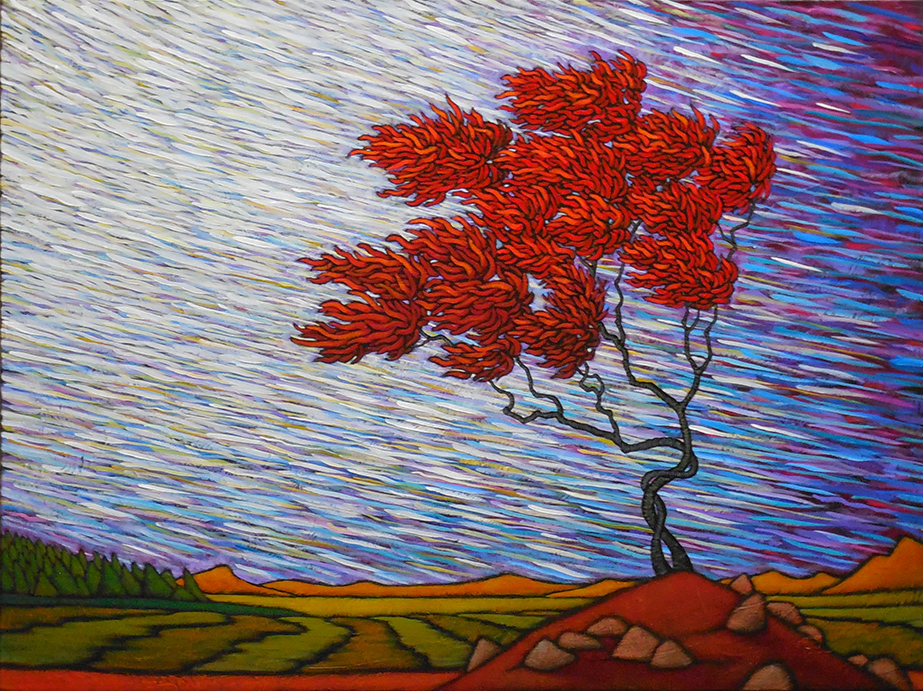
GC Myers- Point of Contact 2016

Point of ContactGrand Prize at Saturday’s Gallery Talk


The very act of understanding is a celebration of joining, merging, even if on a very modest scale, with the magnificence of the Cosmos.

–Carl Sagan, Demon-Haunted World: Science as a Candle in the Dark


I will be giving a Gallery Talk at the Principle Gallery, beginning at 1 PM. I’ve been doing these talks at the Alexandria, VA gallery since 2003, with the only break coming during the pandemic. I enjoy these events, getting to speak with folks, answering some questions, and hopefully sharing some stories or information that is new to those in attendance.

I also have made a habit of giving away some things, including the painting chosen for this year’s event, shown at the top. This piece, Point of Contact, is one that is near and dear to me, which is why it was chosen. I’ve pointed out a number of times here that I only choose work to give away that has meaning to me.

GC Myers- Celebratio sm

Celebratio– Coming to the Principle Gallery

I’ve always believed that real giving has to hurt a bit in order to have real meaning. That’s the case with this piece for me.

I am also readying a group of new work to bring along on Saturday. Mixed in with this group are a few favorite pieces from the past decade. One, Celebratio,  10″ by 20″ on canvas, shown here on the right, is from the same time frame, 2016, as Point of Contact. It slipped under the radar at the time, getting limited exposure in the galleries. Inexplicably, it was never shown at the Principle Gallery or even shared here on this blog. but has become a favorite of mine here in the studio in recent years.

But it has become a favorite of mine here in the studio in recent years. Maybe it is the joy I see in it that inspired its title. It always lifts my spirits and that’s saying a lot, considering what has occurred in the world in the past eight years since it was created.

I like to think that it echoes the words of Carl Sagan at the top of the page, that it represents the coming to an understanding and merging of oneself with the magnificence of the Cosmos.

A reason for celebration, indeed.

Hope you can make it to the Gallery Talk on Saturday.

Here’s a song from Sly & The Family Stone that I think meshes pretty well with Celebratio. Like the painting, I was surprised to find that I have never shared this song on this site.

Better late than never, as they say…


Read Full Post »

Comes a Wind

GC Myers- Comes a Wind  2024

Comes a Wind— Now at Principle Gallery


That man’s best works should be such bungling imitations of Nature’s infinite perfection, matters not much; but that he should make himself an imitation, this is the fact which Nature moans over, and deprecates beseechingly. Be spontaneous, be truthful, be free, and thus be individuals! is the song she sings through warbling birds, and whispering pines, and roaring waves, and screeching winds.

Lydia Maria Child, Letters from New York (1843)


Be spontaneous, be truthful, be free, and thus be individuals!

Is there any better advice than those words from Lydia Maria Child way back in 1843? She is best known for writing the famous Thanksgiving poem, Over the River and Through the Woods. But more than that, she was a forward thinker in her time– an abolitionist, women’s rights and Native American rights activist, journalist, poet and novelist whose work often took on white supremacy and male dominance, issues that plague us to this day.

She would no doubt be a forward thinker in our time. Her words certainly ring true, then and now.

I am using her words today to accompany the new painting above, Comes a Wind. It’s one of the larger pieces, 30″ by 48″ on canvas, from my Principle Gallery show that opens tomorrow night. I chose her words because I felt they somewhat described how I view my landscape work. I never have tried to imitate the reality nature, never wanting exactitude or even a representation of a single real location.

I just wanted to capture the feel and rhythm of the landscape. We live in it and with it. We are part of it, carrying that same feel and rhythm within us. At least, that’s the hope. I believe we sometimes lose that feel and rhythm that connects us to the land. We fail to see the grace and inevitability of nature. When left to its own devices, the landscape achieves an organic perfection.

It is as it should be and only as it can be.

I think this piece is a great example at my attempt to capture that feel and rhythm. It has an organic quality in the curves and lines of the landforms that calms me in much the same way that I feel looking at a panoramic landscape in reality. Like much of my work, there is an area somewhere near the center of the landscape where the landscape’s layers go down then rises up, creating what I call the saddle or easy chair (taken from an old Dylan song) of the painting. I don’t know exactly why I do that, but it feels like it acts as place for the eye to settle in and rest, like one might in a saddle. Or easy chair.

When I first finished this painting, I saw it as being about some forewarning brought on the wind. I still see that somewhat but I now also see the wind as pictured as being about letting ourselves go with the rhythms of nature, about reconnecting to our place within the greater forces.

Or as Ms. Child may have put it: Be spontaneous, be truthful, be free, and thus be individuals!

Here’s that Bob Dylan song with the easy chair reference, You Ain’t Goin’ Nowhere. From1967, it was part of his Basement Tapes and more famously recorded by the Byrds in 1968. This is a newer version that I like very much from Glen Hansard and Marketa Irglova. It’s a great tune. Worth a listen.


Comes a Wind is included in Continuum: The Red Tree at 25 which opens tomorrow, Friday, June 14, at the Principle Gallery in Alexandria. The opening reception runs from 6-8:30 PM on Friday. I will be there so please stop in and check out the show. Maybe have a chat.


Read Full Post »

GC Myers-- Flame Feeding Flame 2024

Flame Feeding Flame— At the Principle Gallery


I know only that I was born and exist, and it seems to me that I have been carried along. I exist on the foundation of something I do not know. In spite of all uncertainties, I feel a solidity underlying all existence and a continuity in my mode of being.

-Carl Jung, Memories, Dreams, Reflections


A couple of days before the Principle Gallery show opens. I am, of course, filled with anxiety. It’s to the point that I find myself leery about writing anything about this show.

I know that in the greater scheme of things, this show and all I do is insignificant. But every show from any artist has great significance and meaning to that artist. The artist defines themself and what they do by how their work is received in the world. You try to act like it doesn’t matter what people think of your work or how they respond to it but that is just a mask.

You want people to like and respond to it, especially when you feel the work is among your best.

But sometimes the artist’s perception of the work and that of the viewing public don’t correspond. The artist might be responding to some personal prompts within the work that don’t mean anything to others. Maybe it is too close, too personal, to the artist. I guess that is why I worry so much when I feel that a group of work is exceptionally strong.

Maybe it is work meant for only me. I don’t think that’s the case with this show. I hope it isn’t but don’t really have a way of knowing.

I find that you don’t have to prepare to be pleased by how a show turns out, but disappointment takes some preparation. So, I spend these days before any show getting ready for that result, creating rationales that will sooth me. That way, I’m ready.

After 25 years, you would think this horrid angst would have gone away by now. But it never does. It’s a funny and maddening thing, this art gig. The best and the worst.

Here’s a slideshow preview of the work from the show. Take a look. I promise you that this is a mere echo of how it looks in person.

The painting at the top is Flame Feeding Flame, a 30″ by 40″ canvas included in the show. The show is called Continuum: The Red Tree at 25 which opens Friday, June 14, at the Principle Gallery in Alexandria. The opening reception runs from 6-8:30 PM on Friday. I invite you to come to the gallery to see if I can cover up my anxiety.

The flop sweat might give me away.


Read Full Post »

Cezanne- The Kitchen Table 1888-1890

Paul CézanneThe Kitchen Table, 1888-1890


An art which isn’t based on feeling isn’t an art at all… feeling is the principle, the beginning and the end; craft, objective, technique – all these are in the middle.

-Paul Cézanne


Since I am a little short on time this morning as I am in the final days of wrapping up my approaching Principle Gallery show before delivery later this weekend, I thought I’d share a thought from Paul Cézanne that pretty much sums up my view on art, that feeling and emotion is the primary driver behind all art.

Here’s a short video of some of of Cezanne’s better known works for you to examine for their levels of feeling.


Read Full Post »

GC Myers-The Fulfillment sm

“The Fulfillment”- Now at the West End Gallery


Take your hand
and place your hand
some place
upon your body.
And listen
to the community of madness
that
you are.

How To Be Alone, Pádraig Ó Tuama


I am up and alone in the studio at 4:30 this morning, eager to get a brush in my hand. It might sound crazy but that doesn’t matter to me right now. I am excited about the work for my Principle Gallery show in June that I am working on and feel a compulsion to keep at it out of the fear that this feeling will soon pass.

But for as excited as I am still about the new work, I am not ready to show a lot of it quite yet. Something makes me want to hold most of it back for a bit, as though showing too much of it will somehow diminish the impact of it as a whole. Actually, the gallery hasn’t even seen a lot of this work, probably for that same reason.

I’ve spent more time already from this early morning than I had wanted before I get to work so I will get to the point of this post. It’s the author’s reading and animation of a piece, How To Belong Be Alone, from Irish poet Pádraig Ó Tuama. It’s a wonderful short poem that speaks to the need to belong which is similar to that driving need to have my voice heard that brought me to painting.

Some days I find myself questioning whether that need to have my voice heard is a necessity or a product of ego. I mean, here I sit writing about my paintings. Isn’t that an act of ego?

Part of me says that it is. But part of me rejects that idea. After all, we all need to know that our voices are heard, that our existence matters, that we belong in this world. Maybe if I believed that my voice or my work deserved to be heard and appreciated above all others or that it mattered more than that of anyone else, maybe then it would be an act of ego.

But I don’t believe that. We all deserve to let the world hear the voice of our unique selves. Each is as valid and valuable as the next.

I think this poem speaks well to this point.

… listen to the community of madness that you are.

Okay, got to get to work. before I burst. Take a look please.


Read Full Post »

Beeple- “Everydays: The First 5000 Days”


“I’ve crossed some kind of invisible line. I feel as if I’ve come to a place I never thought I’d have to come to. And I don’t know how I got here. It’s a strange place. It’s a place where a little harmless dreaming and then some sleepy, early-morning talk has led me into considerations of death and annihilation.”

― Raymond Carver, Where I’m Calling From: New and Selected Stories


I don’t know about the death and annihilation part but somedays I wake up and feel as though I have stumbled into an alternate reality where there are things going on that baffle me completely, that don’t have any basis in the world from which I come.

Like I am a goat farmer from the late 1700’s who has suddenly been thrown through time and ends up in the middle of a Times Square with huge walls of lights flashing, cars whooshing by and jets thundering overhead. 

The place and everything associated with it  just doesn’t line up with anything I know or have ever seen. I am confused, to say the least. Maybe even a little scared because if I don’t know what the hell it is, I have no idea if it can hurt me.

That is exactly the feeling I had when I read that on Thursday a piece of digital art, an NFT— a non-fungible token— had sold in auction at Christie’s for $69 million. The artist’s is Mike Winkelman who goes by the name Beeple and he is a digital artist from Charleston, SC who until October of 2020 had never sold a print for more than $100.

Then came NFTs. Those cuddly non-fungible tokens.

Here’s where I fall through time and space.

I wish I could explain it to you but it feels like the translation of a language I’ve never heard of translated into a language that was just invented and is, yes, unknown to me.

The only thing I understand is the concept of attaching value to an object that is not contained in the value of the raw materials or labor that made it. That is the definition of art and most collectibles. For example, a painting is a token in that it has value attached to it.  But a painting that sells for $100 million dollars is not much different in real world terms from one that sells for $10,000.

The difference is that there is a higher value attached by the market– the potential buyers– that reflects its history, the artist’s reputation, its rarity and provenance and whatever the heck makes a painting worth $100 million. But even then, after the huge piles of cash have been exchanged, the buyer still has a tangible object in their hands.

Probably a closer analogy to NFTs is collectible cards like baseball cards. They are nothing more than a penny’s worth of cheap cardboard with an image printed on one side and some stats on the back. But value is somehow added to them to the point that some are worth hundreds of thousands of dollars while most end up propping up off level tables.

I still don’t know if I am explaining this well. Remember, I just got into this century from the 1788 with goat dung on my boots. Which makes the next part even more difficult to explain.

These NFTs are attached and sold via blockchain technology. Like cryptocurrency. Bitcoin. Ethereum. You know what I’m talking about, right?

I think Yogi Berra would be better equipped to explain this.

I tried at one point a couple of years ago to better understand cryptocurrency but I just couldn’t fully grasp it. It seemed so much like a giant pyramid scheme. But what made it even harder to grasp was that there are actually bitcoin mines.

Yeah, bitcoin mines.

I am standing here with goat stink still on me and I am trying to grasp the idea that bitcoins are mined — created, actually– by people around the world trying to solve the same mathematical puzzle using very large and powerful computers. About every 10 minutes, someone solves a puzzle and is rewarded with some bitcoins. Then, a new puzzle is generated, and the whole process starts over again. As more people become involved around the globe trying to solve this puzzle, it is made more difficult so that it is estimated that it will take ten minutes to come up with the new solution.

Every ten minutes. So, in order to be the first to solve this puzzle and get the bitcoins, one has to have computers that use enormous amounts of electricity. We are talking something on the order of 72 terawatts expended to create a single bitcoin. That is 72 trillion watts of electricity. Every ten minutes.

This first came to my attention when I learned that there was a proposal for a bitcoin mine to be built on nearly Seneca Lake. If I am not mistaken, it would use the water from the lake to run a hydroelectric generator to produce the huge amount of power needed for its computers. 

I still am in the dark on this and can’t even begin to explain blockchain technology. Remember, I am from a time when the Snickers Bar was still a 150 years from being developed and marketed. That’s a technology I can understand and maybe even explain.

So, here I am wondering how a digital file that anyone can download and display is somehow valued by its owner, a person who shelled out $69 million bucks. I really am confused and have all sorts of questions. 

Can this affect my own work? Might my work be stolen– this has happened to other artists– via these NFTs? What does this mean for the future of art? With all due respect to his talent, Beeple is now one of the most valuable artists in the history of art. I think that’s a statement even he would find laughable. Granted, its a lot easier to laugh with $69 mil in the bank. Or is it in cryptocurrency?

Good for Beeple. But the real question is: How do I do this?

The price for goat feed is a lot higher than it was in 1788.

I think I will go outside and bang my head against a tree. Now that I understand.


Read Full Post »

In Radiance

“In Radiance”- Now at the West End Gallery

**********************

Change the focus of the eye. When you have done that, then the end of the world as you formerly knew it will have occurred, and you will experience the radiance of the divine presence everywhere, here and now.

–Joseph Campbell
.
*********************
Change the focus of the eye.
.
Is that the purpose of art? It makes sense. Through the years, many artists have talked about painting beyond what is there, painting the invisible, the intangible.
.
To make the viewer see the ordinary in a new or extraordinary way.
.
Sounds easy enough, right?  Well, it can be done but you don’t always find the divine radiance of all things. That can be frustrating and unfulfilling. But on those times when you do, you understand what Joseph Campbell was describing. And it drives you on.
.
Change the focus of the eye. It most likely applies to life in general, as well. I will have to try that.

Read Full Post »

Between, Again

GC Myers- Between

*************************

A man’s work is nothing but this slow trek to rediscover through the detours of art those two or three great and simple images in whose presence his heart first opened.

-Albert Camus

*******************

These lines above are from an essay, Between Yes and No,  written by the late French Nobel Prize-winning writer Albert Camus. It basically states, in sometimes grim detail, his belief that art “exalts and denies simultaneously.” In short, truth, and life in general, operates somewhere in the middle, never a binary choice, never absolutely in yes or no.

To put it in visual terms– that’s my job, after all– life is never fully black or white. We live in shades of gray.

Yes or no is generally an oversimplified view for existentialists like Camus. The enigma of this world, this life, comes from forever living with both the yes and the no.

Shades of gray.

While I may not fully understand all the subtleties of Camus’ essay, I do fully agree with the premise as I see it in my own simplified way. I think that art communicates best when it contains both the yes and the no— those polar oppositions that create a tension to which we react on an emotional level. For example, I think my best work has come when it contains opposing elements such as optimism tinged with with the darkness of fear or remorse.

Yes and no.

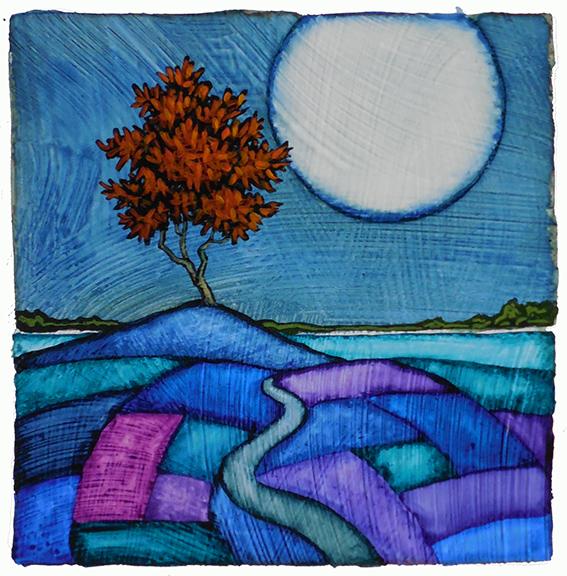
I guess it’s this thought that brought the title for the piece ( 4″ by 4″ on paper) at the top which I call Between. Simply put, I see it as the Red Tree being torn between the nebulous  desire of the Moon’s promise set against the security of its earthly home, represented by the patchwork quilt-like look of the surrounding landscape. Between the unknown and known.

Somewhere in between the yes and the no…

***********************

The post above ran back in 2015. I’ve edited it a bit for a little more clarity, to make it a little less gray.

Read Full Post »

Romare Bearden – Vampin’ ( Piney Brown Blues)

***********************

The artist confronts chaos. The whole thing of art is, how do you organize chaos?

–Romare Bearden

***********************

I think the beginning of this quote from the late artist Romare Bearden (1911-1988) is an important statement and observation.

The artist confronts chaos.

That really speaks to me. It better defines a bit the purpose and necessity of art, both in a general and personal sense.

Maybe the purpose of art is to bring clarity and order to the world that confronts us, to illuminate the hidden or overlooked elements of our existence.

I don’t know for sure but these few words and my own experience make me believe it to be so.

For me, art is a way of distilling the torrent of information and sensations that flow through each of us every day down to a single manageable expression. An expression that helps me better understand and tolerate the chaos before me.

For me, it usually boils down to familiar forms and expressive colors. Found order and harmony above the chaotic rhythm of the texture below.

Like hearing a language you don’t really know but seem to somehow understand and trying to translate it to others.

It is different for every artist, no doubt. The idea of organizing chaos might seem totally foreign to some. I can’t say for sure what drives every artist or what purpose they derive from their art.

I can only speak for myself. That, in itself, might be a valid definition for art.

To that, I answer with my mantra: I don’t know.

And that is undoubtedly the driving force behind art.

Here’s  Big Joe Turner and his Piney Brown Blues, the song that Romare Bearden references in the monotype at the top of he page. Have a good day.


Read Full Post »

Edible Sendak

***********************

Once a little boy sent me a charming card with a little drawing on it. I loved it. I answer all my children’s letters — sometimes very hastily — but this one I lingered over. I sent him a card and I drew a picture of a Wild Thing on it. I wrote, “Dear Jim: I loved your card.” Then I got a letter back from his mother and she said, “Jim loved your card so much he ate it.” That to me was one of the highest compliments I’ve ever received. He didn’t care that it was an original Maurice Sendak drawing or anything. He saw it, he loved it, he ate it.

–Maurice Sendak

**********************

He saw it, he loved it, he ate it.

I love this little episode from Maurice Sendak. Reinforces my own faith in the judgement of children when it comes to art. Their reactions are pure and unadulterated– with the emphasis on the adult portion of that word. Kids look at things without pretensions and preconceived notions of what art is or is not. I am happiest when a kid reacts strongly to my work.

If only I could paint something that some kid would love enough to eat…


Read Full Post »

« Newer Posts - Older Posts »