Feeds:
Posts
Comments

Posts Tagged ‘Art’

Running the Moons— At Principle Gallery


He began to search among the infinite series of impressions which time had laid down, leaf upon leaf, fold upon fold softly, incessantly upon his brain; among scents, sounds; voices, harsh, hollow, sweet; and lights passing, and brooms tapping; and the wash and hush of the sea.

–Virginia Woolf, To the Lighthouse (1927)


I’m a bit tired this morning and have to get right back to work this morning to finish up work for my upcoming West End Gallery show so this is going to be shorter than it should be. It was a long day yesterday, most of it spent on the road, but it was a good day with what I felt was a fun Gallery Talk.

Well, I had fun.

I just want to extend a special Thank You to all that came out to participated. I could not be more appreciative of the warmth and friendliness that I received from you. Your attention, kindness, questions, and comments were the real strong points of the talk yesterday, making me feel as comfortable as possible in my uncomfortable role of standing and speaking before a group.

You folks made it fun for me as well as providing a large boost of energy and a positive affirmation of sorts, something much needed in a year that has been filled with doubts, loss, and uncertainty along with several health concerns.

I received much more than I gave yesterday– and I needed it all. You deserve all the thanks I can muster.

And, of course, a special Thank You to Michele and her wonderful group at the Principle Gallery– Clint, Taylor, Owen, and Brady. I could write a lot of words here (and probably should) about how much your friendship and affection, your caring attitude, and your hard work has meant to me in the 28+ years we have worked together, but my words would never properly capture the depth of feeling I have.

So, I will simply say Thank You with the hopes you know how much I truly mean those two simple words.

Hard to believe I’ve been with the Principle Gallery for over 28 years now. Like the title song chosen for this week’s Sunday Morning Music says, it’s Funny How Time Slips Away. This version is from the great Al Green and Lyle Lovett.

Here’s to many more years…


Read Full Post »

A Place of SanctuaryYou Could Win This Painting!


The whole value of solitude depends upon oneself; it may be a sanctuary or a prison, a haven of repose or a place of punishment, a heaven or a hell, as we ourselves make it.

― John Lubbock, Peace and Happiness


I promised the other day to reveal the painting that I would be the main prize awarded to someone at the Gallery Talk that I will be giving at the Principle Gallery next Saturday, September 27.

Well, here it is.

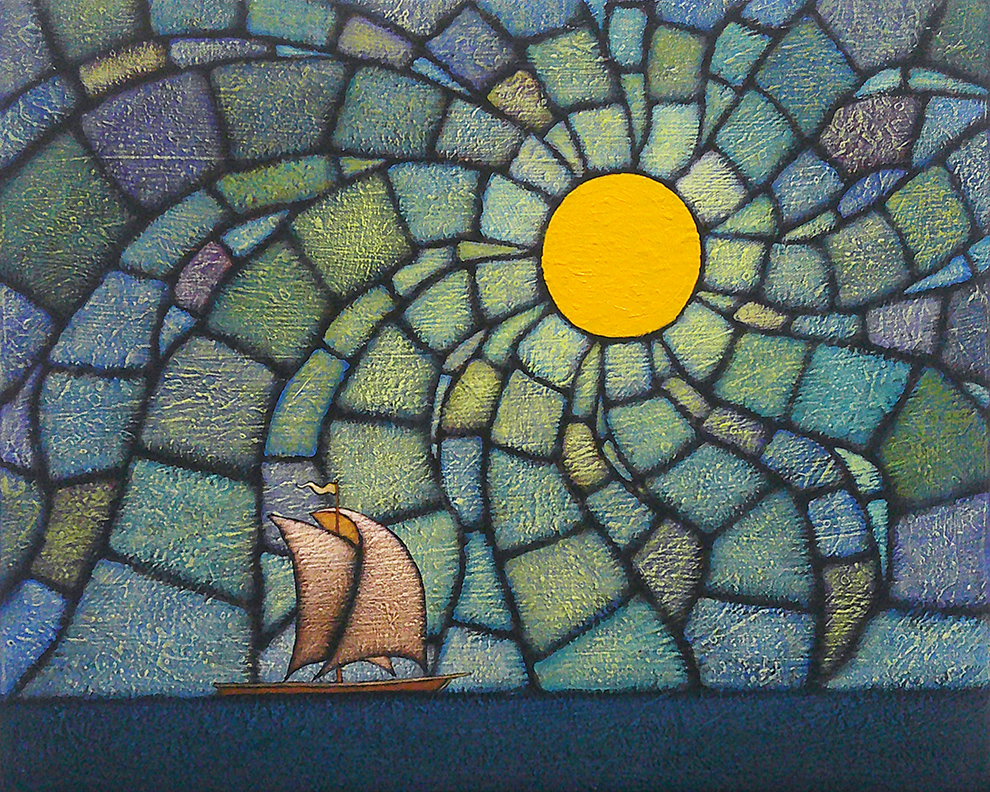
It’s titled A Place of Sanctuary and is a substantial piece at 18″ by 24″ on canvas. I believe this painting is, as I wrote earlier, a pip. I can’t fully describe what it is that makes it so, but it never fails to capture my attention when I am in its presence. Presence might be the right word, with its deep and rich colors and a large sun that feels that it might be a hypnotist’s watch mesmerizing me as I gaze at it.

Whatever it is, it transports me to a place that feels like sanctuary.

I have always maintained that the paintings given away at Gallery Talks over the years have great meaning for me, that giving it away has to involve a sense of sacrifice on my part. It has to hurt a little bit, has to make me question if I am making a mistake. This painting definitely falls into that category.

There will be a drawing for A Place of Sanctuary at the end of the Gallery Talk at the Principle Gallery which takes place next Saturday, Saturday 27, beginning at 1 PM. The Gallery Talk and the drawing for the painting is free and open to everyone. You must be present when the painting is awarded.

Hope you can make it to the Principle Gallery next Saturday. In the meantime, here’s post about this painting from a few years back:


I had never heard of John Lubbock before coming across the short quote above. He was one of those interesting 19th century British characters, a titled member (1st Baron Avebury) of a wealthy banking family who made great contributions to the advancement of the sciences and math as well as to many liberal causes. For example, it was John Lubbock who coined the terms Paleolithic and Neolithic in describing the Old and New Stone Ages, as well as helping to make archaeology a recognized scientific discipline. As a youth he was a neighbor to Charles Darwin and was heavily influenced by the older scientist, who he befriended. He also worked with Darwin as a young man and championed his evolutionary theories in his later adulthood. He was obviously a man who used his position and access to higher knowledge to add to both his own intellect and that of our collective body.

That being said, his words this morning gave me pause. I have generally viewed solitude as a sanctuary, even in the troubled times of my life. It was a place to calm myself, to gather my thoughts and clearly examine what was before me. I crave solitude so the idea that for some this same solitude could feel like a hell or a prison seemed foreign to me.

What differentiates one’s perception of such a basic thing as the solitude in being alone? How could my place of sanctuary be someone else’s chamber of horrors?

If you’re expecting me to answer, you’re going to be disappointed because I can’t really say. I might say it might have to do with our insecurity but I have as much, if not more, uncertainty and insecurity than most people. We all have unique psychological makeups and every situation, including that of solitude, is seen from a unique perspective.

This subjectiveness is also the basis for all art. What else could explain how one person can look at a painting and see an idyllic scene while another can feel uneasy or even offended by the same scene?

Now, the painting at the top, titled A Place of Sanctuary, is a piece that very much reflects this sense of finding haven in solitude. For me, it is calming and centering, a place and time that appeals to my need for sanctuary.

Someone else might see it otherwise. They might see something remote, alien and unsettling in it.

I may not understand it but that’s okay, too. So long as they feel something…

Read Full Post »

Inner Perception (2011)– Coming to Principle Gallery


I have sat here for quite some time this morning trying to write about some of the new work I have been producing for my October West End Gallery show or some that is headed with me to the Principle Gallery for my Gallery Talk there next Saturday.

I know that I am more than little distracted and anxious by what is happening in this country as we descend into outright authoritarianism. It sometimes seems trivial and foolhardy to talk about art and thought when the house is burning down around you.

But I also know that part of what I do is to create work and write about things that deal with coping with life and all its travails. There is a need and a place for what this is in times like this.

I am time strapped now after sitting and ruminating here for so long. So, I am running an older post that deals a bit with an older piece, Inner Perception, shown above, that I am bringing next week to the Gallery Talk at the Principle Gallery. Every so often I like to break out and make available a vintage piece or two. This has been a personal favorite for a long time now and I felt it was time to let it find a place where it could be viewed with fresher eyes than mine.

Here the post from 2014:


This is a painting from a few years back that has toured around a bit and found its way back to me. Called Inner Perception, it has been one of my favorites right from the moment it came off my painting table. Maybe the inclusion of the the paint brush (even though it is a house painter’s brush) with red paint in the bristles makes it feel more biographical, more directly connected to my own self. Or maybe it was the self-referential Red Tree painting on the wall behind the Red Chair.

I don’t know for sure. But whatever the case, it is a piece that immediately makes me reflective, as though it is a shortcut to some sort of inner sanctum of contemplation.

Looking at it this morning, a question I was asked at a Gallery Talk I gave at the Principle Gallery a week or so ago re-emerged.

I was asked what advice I might give my fifth-grade self if I had the opportunity.

I had answered that I would tell myself to believe in my own unique voice, to believe in the validity of what I had to say to the world.

I do believe that, but I think I might add a bit to that answer, saying that I would tell my younger self to be patient and not worry about how the world perceives you. That if you believed that your work was reflecting something genuine from within, others would come to see it eventually.

I would also add to never put your work above the work of anyone else and, conversely, never put your work beneath that of anyone else. I would tell myself to always ask “Why not me?” instead of “Why me?”

This realization came to me a couple of years ago at my exhibit at the Fenimore Art Museum. When it first went up it was in a gallery next to one that held the work of the great American Impressionists along with a painting from Monet. I was greatly intimidated, worrying that my work would not stand the muster of being in such close proximity to those painters who I had so revered over the years. Surely the greatness of their work would show me to be a pretender.

But over the course of the exhibit, that feeling faded and the intimidation I had initially felt turned to a type of defiant determination. I began to ask myself that question: Why not me?

If my work was genuine, if it was true expression of my inner self and inner perceptions, was it any less valid than the work of these other painters? Did they have some greater insight of which I was not aware, something that made their work deeper and more connected to some common human theme? If, as I believe, everyone has something unique to share with the world, why would my expression of self not be able to stand along their own?

The answer to my question was in my own belief in the work and by the exhibit’s end I was no longer doubting my right to be there. So, to my fifth-grade self and to anyone who faces self-doubt about the path they have chosen, I say that if you know you have given it your all, shown your own unique self, then you must ask that question: Why not me?

Read Full Post »

In the Weave of Time– Coming to West End Gallery


Each minute bursts in the burning room,
The great globe reels in the solar fire,
Spinning the trivial and unique away.
(How all things flash! How all things flare!)
What am I now that I was then?
May memory restore again and again
The smallest color of the smallest day:
Time is the school in which we learn,
Time is the fire in which we burn.

–Delmore Schwartz, Calmly We Walk Through This April’s Day (1938)


Sometimes I begin to write about a new painting fully intending to describe what it means to me. But there are times when those intentions go out the window. Then I find myself just staring blankly at the piece.

I should say staring blankly into rather than at the painting because it’s not one of those cases where you stare straight ahead without focusing on or even knowing what is in front of your eyes. The mind is so preoccupied with something else that it commandeers your eyes.

No, this is the opposite, more like having what is front of my eyes push away all thought and empty my mind.

The eye commandeers the mind. I suppose that would be a form of involuntary meditation. Maybe that’s the best kind, one that comes without trying.

That’s kind of what happened first thing this morning. I was intending to write a bit about the new painting at the top. It’s an 18″ by 18″ canvas titled In the Weave of Time and is included in my October solo exhibit, Guiding Light, at the West End Gallery.

I pulled up the image and before I knew it, I was staring into it with an empty mind. I say empty but it was not a pure void. It had a harmony, a tone of great calmness. It had a space as well, one that placeless and timeless.

It’s hard to explain. Placeless and timeless things often are.

But frustrating as it was to find my mind empty at a time when I was desiring words and thought, I was pleased by the effect. It gave me some much-needed stillness at a moment when time and deadlines plague my thoughts.

It felt like a gift in the dark of morning.

This not what I intended to write about this painting but maybe it should have been. It certainly says more about it than the meager words I probably would have spewed.

Unfortunately, I have to return to a world filled with time and place and deadlines right now. But first, I am going to spend a few more minutes in this painting. I need it.

Here’s a favorite song, The Stable Song, from Gregory Alan Isakov. It came on while I was writing what I hadn’t intended writing and it felt right in the moment. I often have music playing while I work and much of it plays without me noticing the song or artist due my focus on the work in front of me. But whenever this song comes on, I stop and listen for a few minutes.

There’s a familiarity in it that rhymes with some memory of in the weave of time. And that’s all I could ask for this morning.


Read Full Post »

Of Fish and Dots


Hokusai Two Fish


At seventy-three I learned a little about the real structure of animals, plants, birds, fishes and insects. Consequently when I am eighty I’ll have made more progress. At ninety I’ll have penetrated the mystery of things. At a hundred I shall have reached something marvelous, but when I am a hundred and ten everything I do, the smallest dot, will be alive.

Katsushika Hokusai (1760-1849)


I really like the bit of wisdom above from the great Hokusai, both for his optimism on aging as well as the idea that as he continues to progress his work will reach a point where everything he paints– even something as simple as a dot– has a life force within it.

Attaining that life force in any one piece, where the painting transcends what you put into it, is a rare and difficult thing for any artist to achieve. This idea that you might one day reach a point where your work has moved from a product of thought and craft to a transcendent expression of the spirit often seems beyond our reach or even our aim.

But perhaps we should keep it as an aim in our mind, along with the idea that we will continue to progress as we age, even if it is stored in rarely visited corner. If we hold on to it perhaps we will subconsciously find our way to that goal. And when we are a hundred and ten, the dots we paint will have that same life force as those created by Hokusai.

It’s something to hope for…

I’ve included a few of Hokusai’s paintings beyond his famed wave and landscapes. I love his fish pieces and the raven is wonderful. Enjoy!


I came across this post from a few years back. It’s one that had slipped my mind but was appreciative for the reminder that art and creation have no endpoints within a person. More than that, this idea from Hokusai of the energy and life force of his work continually concentrating itself until it reaches the size of a dot jumped out at me.

It reminds me of the singularity theory first put forth by Stephen Hawking, which states that when a star dies it collapses into itself until it is finally a single tiny point of zero radius, infinite density, and infinite curvature of spacetime at the heart of the black hole formed from the star’s collapse. A single point of immense mass and energy.

A dot filled with everything.

It also struck me that much of my work in recent times has focused on the sun/moon as a central element and it has taken on more and more prominence as the years pass. I often see it as this same sort of Hokusai-like dot, the energy of the painting concentrating itself in and around this ball.

There are future blog entries coming on this subject. But for this morning I am going to just enjoy some of Hokusai’s wonderful fishes. And that raven!

FYI- I am aware that the second from the bottom image is not a Hokusai painting but rather one from Hiroshige that is styled after Hokusai. I am including it because it was in the original post and I like it. And that’s good enough for me.


koi-carp-and-turtles-katsushika-hokusai

Read Full Post »


You call me a misanthrope because I avoid society. You err; I love society. Yet in order not to hate people, I must avoid their company.


I have cited the quote above from 19th century artist Caspar David Frederich a number of times when speaking before groups as an explanation for my reclusiveness.

It is said in a tongue-in-cheek manner but there is some truth in it. Actually, a lot of truth.

But we’re not going into that today. Instead, I thought I would share a blog entry from ten years ago featuring Frederich’s work. I have added a few more images to the original post. This is only a tiny sampling from his impressive body of work. 


A picture must not be devised but perceived. Close your bodily eye, that you may see your picture first with the eye of the spirit. Then bring to light what you have seen in the darkness, that its effect may work back,  from without to within.

–Caspar David Frederich


I often find myself identifying strongly with the words and work of the 19th century German painter Caspar David Frederich (1774-1840).  His work often takes a symbolic stance with expansive landscapes that overwhelm the human presence in them and much of it moves toward the metaphysical. He, along with his British contemporary JMW Turner, were at the forefront of the movement from Classicism to paintings that reflected the inner emotional reaction of the individual to the world around them.

It was said of Frederich that he was “a man who has discovered the tragedy of Landscape.” I see this in his often moody and contemplative work. It is not painting of only a place or scene– it is more a painting of emotion, of some inner vibration triggered by what is before the painter. His brilliance is in capturing that inner element and revealing it to the viewer. It’s a rare thing, one that I think most painters aspire to obtain in their own work. I know that I do.

Caspar_David_Friedrich_-_Wanderer_above_the_sea_of_fogFrederich’s work fell from favor in the latter stages of his life but the coming of modern art movements, comprised of many painters were greatly influenced by Frederich, brought him back to greater recognition through the first few decades of the 20th century. Unfortunately for Frederich, in the 1930’s his work was associated with the Nazis who mistakenly saw his work as being nationalistic in its symbolism. I know that the piece shown here on the right, Wanderer Above the Sea of Fog, is often associated with Friedrich Nietzsche’s idea of the Übermensch or Superman. Even though Frederich died years before Nietzsche was born and almost a century before the Nazis usurped his art, it took several decades before his work regained the stature it lost due to this association.

But the inner message of his landscapes persevered, and his paintings still resonate with the potency of their timeless qualities today. As they should.

Caspar David Friedrich- Monk by the Sea

Caspar David Friedrich- Monk by the Sea


Read Full Post »

Natural Selection

 The Heights, circa 1994


Evolution advances, not by a priori design, but by the selection of what works best out of whatever choices offer. We are the products of editing, rather than of authorship.

–George Wald,The Origin of Optical Activity  (1957)


I came across the quote above from George Wald (1906-1997) who was a Nobel Prize winning a scientist whose work focused on retinal pigmentation. I don’t know much about that, but his words made me think about how evolution occurs in whatever we do, how we try new things in order to hopefully make our lives better. We keep those that work best for whatever reason and discard those that don’t, mirroring the process of Natural Selection.

This thought made me think of how this has worked in the evolution of my own work. It has been a constant trial of new techniques and materials. There have been small and large changes, some that have stuck with me and are now built into my artistic DNA. Others lingered for but a short time and were soon took their place in my personal annals as examples of a failed past, like looking in a book of natural history describing species like the Dodo that lost out to Natural Selection.

Thought I’d take this opportunity to share a post on some of my earliest work, sort of like pages from my book of extinct species. Some are gone forever as a result of the editing of natural selection, but some live on in certain traits that have been passed down from them. And as I point out in the post below from 2014, the styles and techniques shown below, unlike the Dodo, can always be reborn by me in some manner in the future. 


GC Myers 1994 Early ReductiveWork6I have been spending a lot of time in the studio in the last few weeks painting in a more traditional manner, what I call an additive style, meaning that layers of paint are continually added, normally building from dark to light. I’ve painted this way for many years and most likely that’s the style you know. But much of my work through the years, especially in the early years of my career, has been painted in a much different manner, one where a lot of very wet paint is applied to a surface, usually paper. I then take off much of this paint, revealing the lightness of the underlying surface. That’s a very simplified explanation of the process, one that has evolved and refined over the years. I refer to it as being my reductive style.

When you’re self-taught, you can call things whatever you please. I’m thinking of calling my paint brushes hairsticks from now on. Or maybe twizzlers. Maybe I will call my paints something like colory goop?

This reductive process is what continually prodded me ahead early on when I was just learning to express myself visually. I went back recently and came across a very early group of these pieces, among the very first where I employed this process. I am still attracted to these pieces, partly because of the nostalgia of once again seeing those things that opened other doors for me. Pieces that set me on a continuing journey. 

But there was also a unity and continuity in the work that I found very appealing. Each piece, while not very refined or tremendously strong alone, strengthened the group as a whole. I would have been hesitant to show most of these alone but together they feel so much more unified and complete.

This has made me look at these pieces in a different light, one where I found new respect for them. I think they are really symbolic of some of what I consider strengths in my work, this sense of continuum and relativity from piece to piece. It also brings me back to that early path and makes me consider if I should backtrack and walk that path again, now armed with twenty years of experience. Something to consider.


GC Myers 1994 Early ReductiveWork 1GC Myers 1994 Early ReductiveWork 5GC Myers 1994 Early ReductiveWork 2GC Myers 1994 Early ReductiveWork 4

Read Full Post »

Wherever the Wind Takes Me – At Principle Gallery


The worst sin that can be committed against the artist is to take him at his word, to see in his work a fulfillment instead of a horizon.

–Henry Miller, The Cosmological Eye (1939)


Love these words from Henry Miller. I think most people, artists included, look at a piece of art and see it as an endpoint rather than a jumping off point. I would like to think that my work serves both as an invitation and starting point for the viewer. My hope is that my little world as I present it is welcoming enough that they easily enter and feel comfortable. Once there, my wish is that they begin to explore both the space in which they are and the self they see in it. To start an inner journey of some sort, one that might last only for a few moments or for a lifetime.

That’s asking a lot, I know. And it’s not fully in my mind when I am at work because at that point I am fully engaged in my own inner journey. It’s only after I step back and try to view a piece with a more dispassionate eye that I begin to recognize if a piece has that potential in it.

A horizon to pursue.

A starting point of a journey.

Some do. Some don’t. And maybe some that I think do, don’t. And vice versa.

One never knows for sure. And that is the beauty of art. Some see totality and some see endless potentiality.

That’s all the time I have this morning. I see a horizon forming and need to get moving towards it.

Here’s a song from Michael Nesmith, best known as one of the Monkees. This is his take on Beyond the Blue Horizon, a song that was first performed by Jeanette MacDonald in 1930. It’s quirky but still works for me this morning.


Read Full Post »

Advice: Hard Work

gc-myers-1994

GC Myers- Early Work, 1994


He was justifying his existence, than which life can do no greater; for life achieves its summit when it does to the uttermost that which it was equipped to do.

–Jack London, White Fang


From 2011:

I had a nice email from a gentleman who sent me the image of painting done by his 16-year-old daughter, telling me about a prize it had been recently awarded in a scholastic competition.

I took a look at the piece, and it was indeed a very well-done painting, nicely composed with strong lines and color. It was certainly far ahead of anything I was doing at that age, especially by the virtue that it was complete. It was obvious that this young person had talent, and I could see this young person doing more with it in the future. I wrote him back and told him this but with my standard warning, one that I have written about here before: Potential must be actively pursued with constant efforts and a consistent pushing of one’s abilities.

In other words: Talent is great but doesn’t mean much if it’s not constantly practiced

I wrote him to tell him this, to let him know about some of the young talents I have seen come and go because they felt their talent was something that was innately within them and could be turned on and off with the flip of a switch.

I told him to tell her to look at the work required in the way a musician looks at rehearsals. Perhaps even look at their talents as being like those of a musician, talents that need constant exercise in order to stay sharp and strong. For instance, even if you have great innate talent, you can’t expect to play the violin like Itzhak Perlman if you don’t devote your talents in the same way as he does. As it is with many great musicians, the greater part of his life is spent in nurturing his abilities.

I always feel like a sourpuss when I’m giving this advice. Nobody wants to hear that in order to reach their potential they need to work harder or that they might have to sacrifice time that might be spent elsewhere doing other things. Everyone wants to think that they have this great talent born within them and it will flow like a spigot whenever they so desire.

If only that were true.

I think you will find that those who succeed at the highest levels in any field are those who understand this need to constantly push and work their talents. I’m sure there are exceptions, but none come immediately to mind. I wrote about this in a blog post when I first started this, two years back, in 2009. I wrote about something author John Irving had said about his work habits.

He saw himself competing as a writer in the same way as he did in his time competing as a wrestler. Irving felt that reaching one’s fullest potential as writer required putting in the same levels of intense effort as those needed to compete as a wrestler or any other athlete on the Olympic level. 

Hard work– it’s not glamorous especially in this world of instant gratification but it is a proven entity.

I’m showing the piece above to highlight this. It’s a small painting that I did before I was showing in any galleries, in 1994. At the time, it pleased me very much, though I am not sure I felt it was the best thing I had done to that point. However, it felt complete and self-contained. I could have very easily kept painting in that style and been satisfied in some ways without much effort.

But I also recognized that it was limited in many ways. It began to say what I was feeling but didn’t fully express it. There was more beyond this. I just knew there had to be. A little voice kept urging me to push ahead and work harder, to dig deeper to uncover what I could accomplish with greater effort.

This little painting soon was not an endpoint but a steppingstone on a much longer path.

 I hope this man’s daughter also sees her painting as a steppingstone. She may think now that it is the best thing she has ever done. She might be right– to this point. But if she is willing to push ahead and put in the effort, she will look at it someday as a very fine first step in a journey to reach her true potential.


I think the last time I shared this was ten years ago. Nothing has really changed. Around the time I painted the piece at the top, I read about John Irving comparing his work schedule to that of an Olympic athlete. That really connected with me. By then, I knew that I possessed an ability to work hard. It might even be my only true talent. If for once I was to apply this talent towards doing something that truly excited me, who knew where it might lead? And even if it was short path to nowhere, the time was well spent since I was doing something that had meaning and fulfillment for myself.

I don’t regret taking that path or a single minute spent toiling at whatever hard work there is in doing what I do. Like they say, it’s not hard work if you’re doing that which you enjoy. The hardest work I ever did was working at jobs I hated, jobs where was little pay, fulfillment, or joy. 

My worst day in the studio is better than most of the best days at those other jobs. But making that happen took a lot of time, effort and blood, sweat and tearsthe definition of hard work.

Maybe it is also, as Jack London put it at the top, the justification for our existence.

Maybe…


Read Full Post »

The Omnipresence— At West End Gallery


Shakespeare said that art is a mirror held up to nature. And that’s what it is. The nature is your nature, and all of these wonderful poetic images of mythology are referring to something in you. When your mind is simply trapped by the image out there so that you never make the reference to yourself, you have misread the image.

Joseph Campbell (with Bill Moyers), The Power of Myth (1988)


I love the passage above that Joseph Campbell spoke during his conversation with Bill Moyers for the PBS series The Power of Myth. I feel that it describes beautifully the connection between the individual and mythology and art, at least in my view. I believe that we truly connect with myth and art when we see it as personal to ourselves, as being somehow symbolic of our own experience and being.  

Our emotions and reactions.

Of course, some myths and much in art may not speak to us on this personal level. There is plenty of art out there that doesn’t speak to me. That is not to say that it is not good work. Some is masterfully crafted and has an undeniable surface. It is not a judgement of quality.  just doesn’t speak to me personally and doesn’t reflect my own experience or worldview.

And I certainly don’t expect my work to speak to everyone no matter how much I may wish that it could. 

It simply cannot be a reflection for everyone.

My work, after all, is a reflection of my life’s journey. My experiences, knowledge, understanding, and being are mine, complete with flaws and limitations. Yours is completely different, as it should be. Try as we might, no two people can have an identical existence. I believe (without evidence, of course) that even conjoined twins must have differing views and feelings of their shared experiences.

But occasionally, there is a moment of overlap, when the work reflects a truth– perhaps a personal truth or one that is universal– that speaks to another and that other person recognizes something of themself and their own world in my representation of my inner world.

That is a magical and most gratifying moment for me. The fact that someone might see a reflection of their own life and experience of the world in my representation of my own that makes me feel connected to the mythic and the universal.

For that moment, I feel that there is a meaning beyond the mere surface imagery of my work. And I think that sense of meaning is something we all crave, regardless of the field in which we toil.

Here is a song I’ve shared a couple of times over the years. It may or may not have anything to do with this post. I just felt like hearing it this morning. This is Marmalade with the very 60’s sound of their Reflections of My Life.


Read Full Post »

« Newer Posts - Older Posts »