Feeds:
Posts
Comments

Posts Tagged ‘Friedrich Nietzsche’

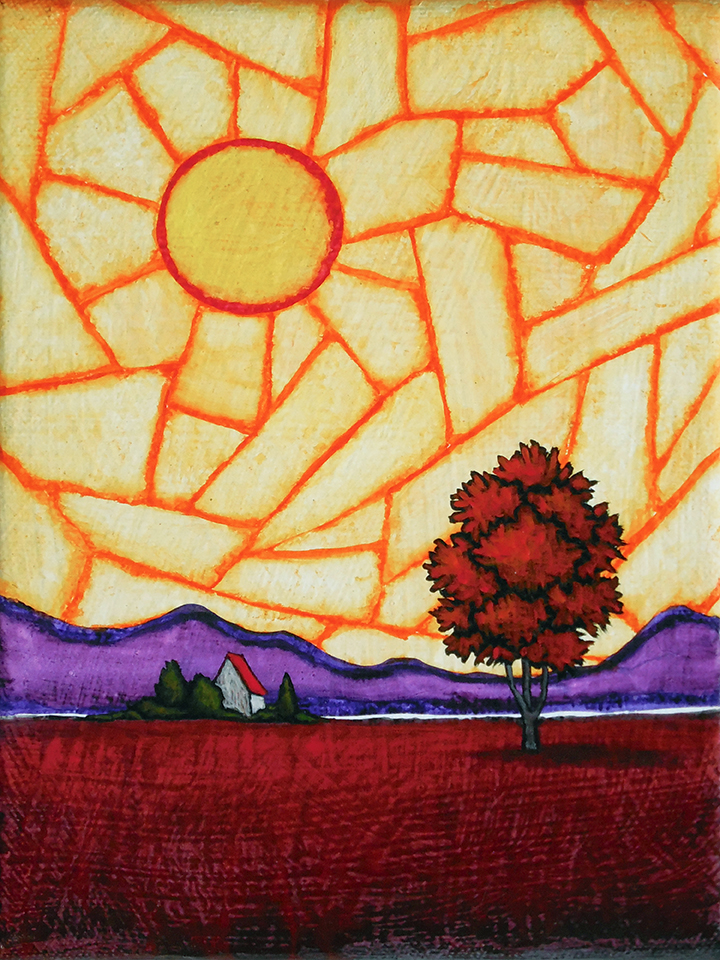
The Welcome Tree–At the West End Gallery


There is one thing one has to have: either a soul that is cheerful by nature, or a soul made cheerful by work, love, art, and knowledge.

—Friedrich Nietzsche, Genealogy of Morals (1887)


Nietzsche wrote a lot more about cheerfulness than one might expect. Not that I suspect that he himself was a cheerful soul. Maybe he was one of those, as the quote above implies, was made cheerful through work, love, art and nature.

I don’t know and I’m not interested enough right now to explore it any further at the moment. This quote seems to be one that is not verbatim from its source but was instead a compilation of thought.

That, too, doesn’t matter to me at the moment. I just like the quote as it stands, without full context.

It makes me wonder about my own nature and that of many others I know. Do I consider myself one who is cheerful by nature? I don’t believe I am though I have certain aspirations of being naturally cheerful, to not feel the weight of periodic depression or be eternally optimistic. I am not to that point yet and seriously doubt I will ever be there.

Actually, I know I won’t ever be that person. Whatever cheerfulness I possess comes from those potential sources that Nietzsche mentions. I think that holds true for most people, but I can’t say for sure. We all wear masks that sometimes cover our true natures.

I am sure we could go into a whole psychological examination of one another here but let’s save that for our diaries this time. 

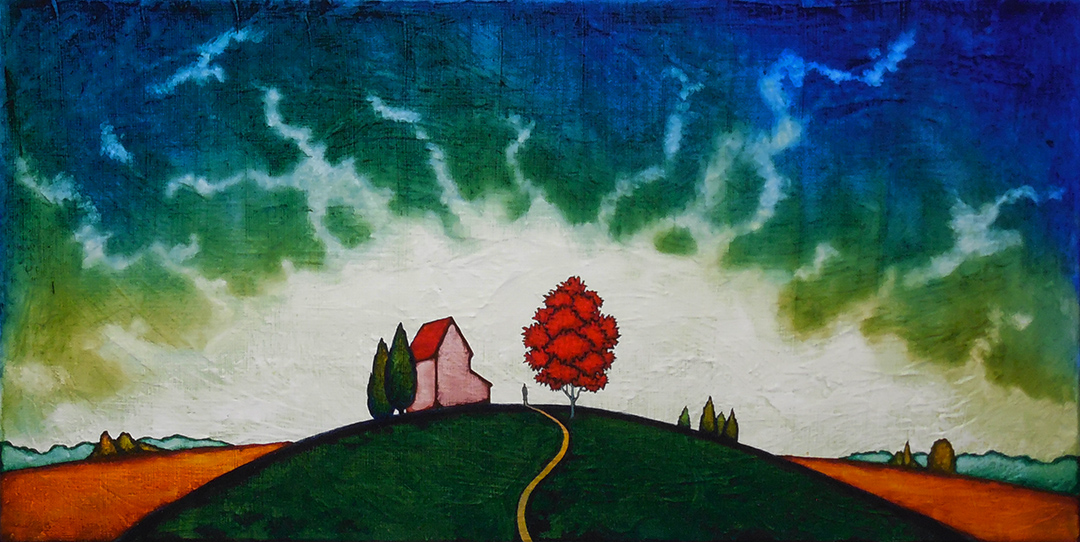
Instead let us enjoy another song from Chicago that plays into the theme today, as does the painting at the top. This is Make Me Smile. I wasn’t a big Chicago fan when I was younger and they were in their heyday. But we change with time– hopefully and thankfully– and I have become quite a fan over the years.

Read Full Post »

Completeness— At West End Gallery


We do not belong to those who only get their thought from books, or at the prompting of books, — it is our custom to think in the open air, walking, leaping, climbing, or dancing on lonesome mountains by preference, or close to the sea, where even the paths become thoughtful.

–Friedrich Nietzsche, The Gay Science (1882)


Below is a poem from the late Nobel Prize-winning Polish poetess Wislawa Szymborska (1923–2012) called Possibilities. I featured it here back in 2015 but it struck my fancy this morning and I thought I’d share it again and maybe add a bit to the original blogpost. It is basically a laundry list of her personal preferences. Some are small and some significant but all contribute mightily to her wholeness as a person. We are all the totality of our own laundry lists of preferences that define our character and personality just as our DNA determines our physical characteristics.

It’s a simple yet thought-provokingly complex poem that leave me wondering about my own preferences, my own possibilities. What are those small things that give you shape, make you who you are? Do we rely solely on these preferences in making the choices that we face in this life? Or do we sometimes make choices that do not align with our own preferences?

There are a lot of Symborska’s preferences that strike a chord with me. For instance:  I prefer myself liking people to myself loving mankind. That certainly has been my preference for most of my conscious life.

Then there’s: I prefer the absurdity of writing poems to the absurdity of not writing poems. Like writing poetry, painting can often seem like an absurd thing to do. I often find myself asking why I am alone in the woods smearing paint on surfaces. Is there a purpose or meaning in it?

But I have known the other side of that coin, living a life where I wasn’t painting, and that existence was far more absurd for me. Absurd to an unsustainable degree.

And that final line says it all: I prefer keeping in mind even the possibility that existence has its own reason for being. We may never know whether there is a reason for our being but that should not take away from the life we have here.

If this is all we get, live by the possibility of your own preferences and not those of any other.

Live as you are. As you want to be.

You might not agree with some of her preferences. That’s okay– they’re not yours to determine. She is simply giving us a loose outline of her individual nature, her humanity. And there’s poetry in that for any of us.

I am also including a song which was a favorite of Symborska, who requested that the version below from Ella Fitzgerald be played at her funeral. The song is Black Coffee and since being written in 1948 by Sonny Burke it has been covered by some of the great vocalists of our times– Sarah Vaughan, Peggy Lee, k.d. lang and so forth. You could pick any as your preference and they are all special. It’s that kind of song. But this version from the great and grand Ella Fitzgerald is extra special.


POSSIBILITIES

I prefer movies.
I prefer cats.
I prefer the oaks along the Warta.
I prefer Dickens to Dostoyevsky.
I prefer myself liking people
to myself loving mankind.
I prefer keeping a needle and thread on hand, just in case.
I prefer the color green.
I prefer not to maintain
that reason is to blame for everything.
I prefer exceptions.
I prefer to leave early.
I prefer talking to doctors about something else.
I prefer the old fine-lined illustrations.
I prefer the absurdity of writing poems
to the absurdity of not writing poems.
I prefer, where love’s concerned, nonspecific anniversaries
that can be celebrated every day.
I prefer moralists
who promise me nothing.
I prefer cunning kindness to the over-trustful kind.
I prefer the earth in civvies.
I prefer conquered to conquering countries.
I prefer having some reservations.
I prefer the hell of chaos to the hell of order.
I prefer Grimms’ fairy tales to the newspapers’ front pages.
I prefer leaves without flowers to flowers without leaves.
I prefer dogs with uncropped tails.
I prefer light eyes, since mine are dark.
I prefer desk drawers.
I prefer many things that I haven’t mentioned here
to many things I’ve also left unsaid.
I prefer zeroes on the loose
to those lined up behind a cipher.
I prefer the time of insects to the time of stars.
I prefer to knock on wood.
I prefer not to ask how much longer and when.
I prefer keeping in mind even the possibility
that existence has its own reason for being.

–Wislawa Szymborska


Read Full Post »


“Madness is something rare in individuals — but in groups, parties, peoples, and ages, it is the rule.”

― Friedrich Nietzsche, Beyond Good and Evil


I am going to just leave that hanging out there for today.

Here’s a song from Puddles Pity Party singing with Haley Reinhart and the Postmodern Jukebox. Sticking with the theme, it’s a nice cover of the old Tears For Fears classic, Mad World.

Have a good day. But be careful– it’s a mad world out there.


Read Full Post »


“To those human beings who are of any concern to me I wish suffering, desolation, sickness, ill-treatment, indignities—I wish that they should not remain unfamiliar with profound self-contempt, the torture of self-mistrust, the wretchedness of the vanquished: I have no pity for them, because I wish them the only thing that can prove today whether one is worth anything or not—that one endures.”

Friedrich Nietzsche, The Will to Power


I paused a little bit before using this quote from Nietzsche this morning. The use of anything from a philosopher whose work, and the book from which this excerpt has been taken, had been appropriated and distorted to justify their own ends , by the Nazis is a little risky, especially in this time of rising authoritarianism here and around the world. For many of us, just the title, The Will to Power, immediately conjures up imagery of invading Nazis goose-stepping through conquered cities in their quest for more and more power.

People naturally assume that that the power to which he is referring is ultimate power, ruling power to be  exercised over others. That is how the Hitler and his ilk interpreted it. But Nietzsche was talking about two separate forms of power which are expressed in German as the words Kraft and Macht. Kraft refers to brute force, both physical and mental, while Macht refers to true power. Kraft is the animal force, that primal element that is possessed in all of us. Macht, on the other hand, is the power to control one’s own kraft and use it in positive ways.

Macht is the overcoming and controlling of the kraft within us.

And that’s where we are now. We have two elements within this nation, one who see the power of this nation as pure animal power, and another who recognizes our power– our kraft— but understands that it cannot solely guide our actions and future. It is unsustainable. History shows that clearly. 

So, the question is how do we emerge from this? Do we have the fortitude to endure this tug of war between these two concepts?

Though I have my doubts on some days, in the long run I think we do have the ability to endure, actually.

And as Nietzsche expresses above, perhaps this struggle is just what we need to really move forward. Maybe we need some real hardship and suffering to understand the responsibility of our power. Maybe we need it to finally recognize that we must at some point sacrifice something of ourselves to a greater good, that our bounty does not come without a price.

Many of us have never had real hardship. I am not talking about normal loss and suffering that comes with being a human being. I am talking about widespread hurt that runs through the nation and touches most every citizen. Most of us have never had to sacrifice much for anyone.

Maybe we need the hurt and the humbling. While nobody wants to willingly take on great suffering, there are lessons to be learned from it. Perhaps that one can overcome and endure great hardship is the greatest of these. That and allowing more of us to develop a greater sense of empathy with those who continue to suffer around us.

Maybe we need to simply learn that we can endure.

Maybe then we can cross the divide between us and work together for some greater good.

Let’s hope, okay? 

Hey, here’s some old Canned Heat from about 50 years back with a fitting message for any time. It’s Let’s Work Together. Now, have a good day.


https://youtu.be/oXo6G5mfmro

Read Full Post »

The individual has always had to struggle to keep from being overwhelmed by the tribe. If you try it, you will be lonely often, and sometimes frightened. But no price is too high to pay for the privilege of owning yourself.

Friedrich Nietzsche

*******************

I am calling this new painting, a 30″ by 24″ canvas, Maverick. I hesitated about using that particular word for a bit, as it seemed a bit tainted for me by a certain past vice-presidential candidate from outside the lower 48 states. But it’s too good a word to let that person’s use of the word spoil it. A maverick is just a consciously active nonconformist, someone who makes the choice to separate themselves from the herd.

I think many of us would like to think of ourselves as nonconformists or mavericks. But I don’t know how many of us ever really deserve that label.

I know that I certainly don’t see myself as one, at least in the true sense of the word. I find myself all too often bending to the will of the crowd and staying in line. Oh, I still try to have my way and to do what I want in the manner that I want but I try to keep it low key without flaunting it or unnecessarily stepping on toes.

Maybe if you were able to use an adjective in front of the word. An anxious nonconformist or a fretting maverick. Maybe then I would put myself in that category.

And even then, probably not. I mean, what kind of maverick cares what they are called? They just want to do their thing without any hassle and the opinions of others be damned.

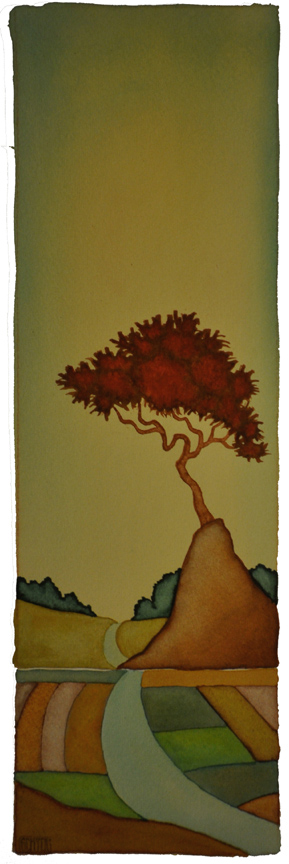
And that’s kind of what I see here with the Red Tree on a rocky outcropping away from the other multi-colored entities that seem to be primarily focused on the issues of themselves and their neighbors. Looking at the lower part of this piece reminds me of a microscope image of the endoplasm of an amoeba as it pulses and churns. It all seems inward and involved only with what is around it. It can’t see much beyond its own cell walls whereas the Red Tree, having freed itself from those struggles, is able to focus on other matters- the sea, the sky, the sun, and its place in that realm. A perspective that encompasses things well beyond itself.

Well, that’s my opinion. If you’re a maverick you most likely won’t give much of a damn what I think. Good for you.

Read Full Post »

Caspar David Frederich- Abbey Among Oak Trees

Caspar David Frederich- Abbey Among Oak Trees

A picture must not be devised but perceived. Close your bodily eye, that you may see your picture first with the eye of the spirit. Then bring to light what you have seen in the darkness, that its effect may work back,  from without to within.

–Caspar David Frederich

***********************

I find myself identifying strongly with the words and work of the 19th century German painter Caspar David Frederich (1774-1840).  His work often takes a symbolic stance with expansive landscapes that overwhelm the human presence in them and much of it moves toward the metaphysical.  He , along with his British contemporary JMW Turner, were at the forefront of the movement from Classicism  to  work that reflected the inner emotional reaction of the individual to the world around them.

It was said of Frederich that he was “a man who has discovered the tragedy of Landscape.”  I see this in his often moody and contemplative work.  It is not painting of only a place or scene– it is more a painting of emotion, of some inner vibration triggered by what is before the painter.  His brilliance is in capturing that inner element and revealing it to the viewer.  It’s a rare thing, one that I think most painters aspire to obtain in their own work.  I know that I do.

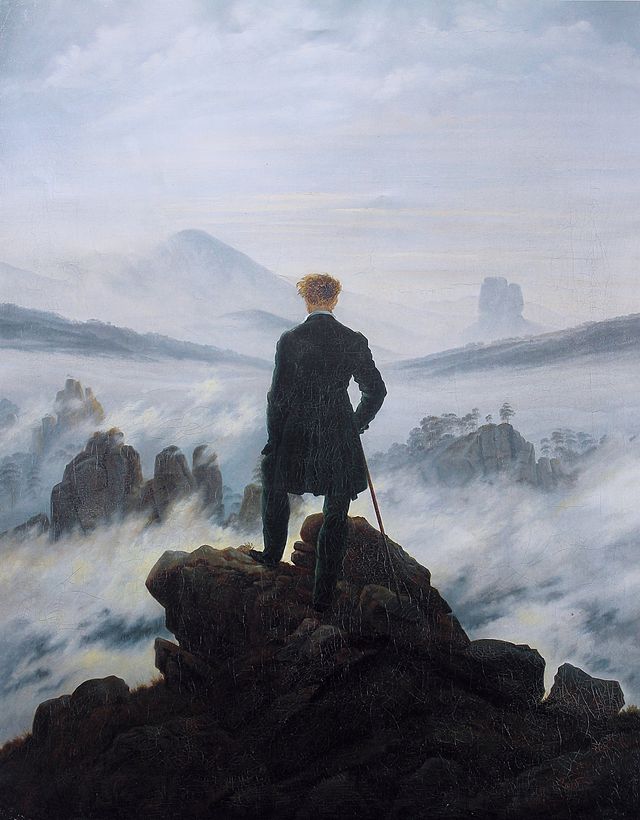
Caspar_David_Friedrich_-_Wanderer_above_the_sea_of_fogFrederich’s work fell from favor in the latter stages of his life but the coming of modern art movement whose many painters were greatly influenced by Frederich,  brought him back to great recognition through the first few decades of the 20th century.   Unfortunately for Frederich, in the 1930’s, his work was associated with the Nazis who mistakenly saw his work as being nationalistic in its symbolism. I know that the piece shown here on the right, Wanderer Above the Sea of Fog,  is often associated with Friedrich Nietzsche‘s idea of the Übermensch or Superman.  Even though Frederich died years before Nietzsche was born and almost a century  before the Nazis usurped his art, it took several decades before his work regained the stature it lost due to this association.

But the inner message of his landscapes persevered and his paintings still resonate with their timeless qualities today.  As they should.

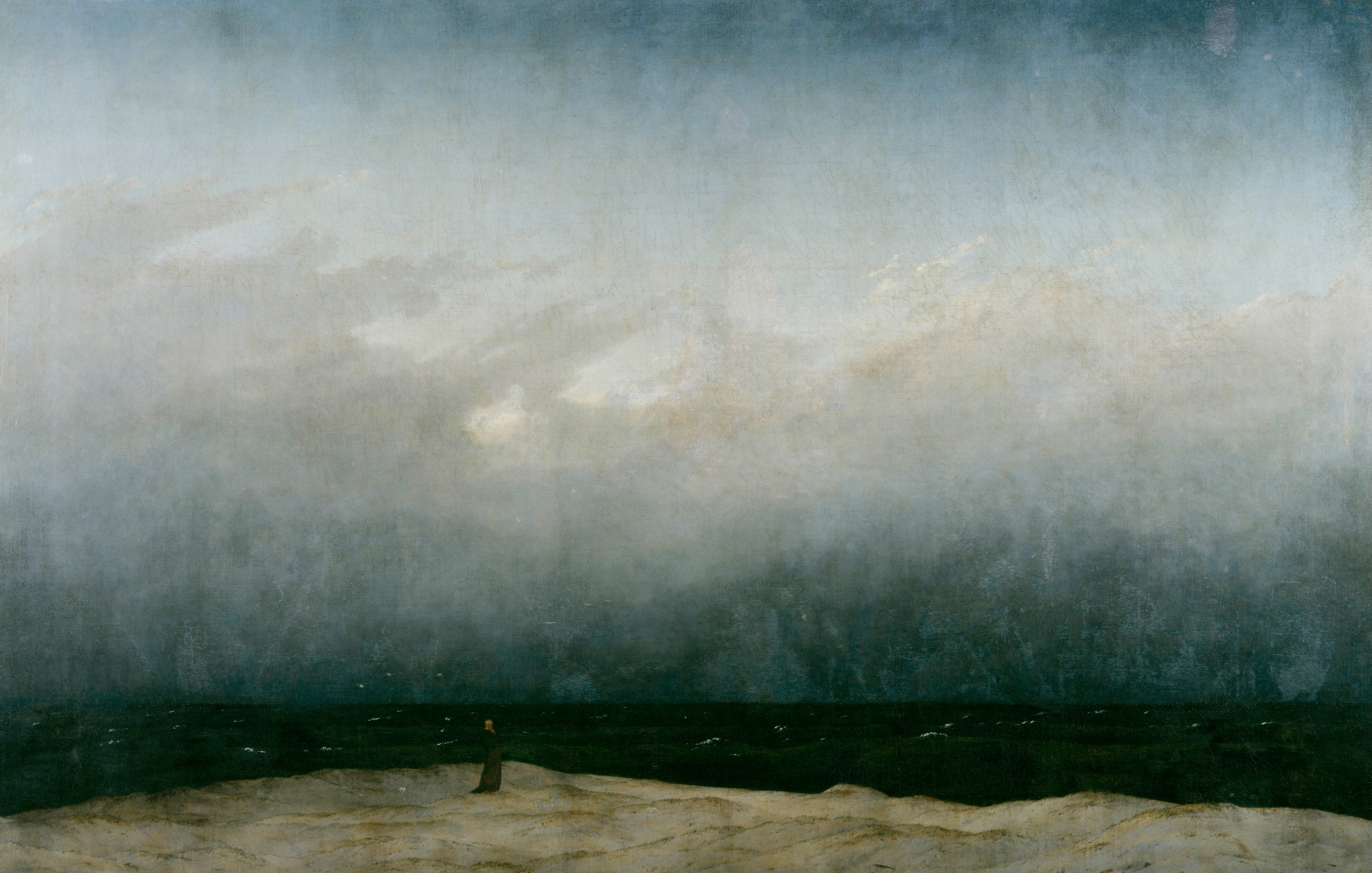
Caspar David Friedrich- Monk by the Sea

Caspar David Friedrich- Monk by the Sea

Read Full Post »

A newer painting, this one an image of about 18″ by 26″ on paper.  The composition is intentionally simple in that  this piece is obviously very much centered on its color and texture.  The stringlike twirls of its texture create a real feel of motion and energy underneath the image, the hint of the hidden forces of nature  that exist just beyond our ability to recognize or comprehend them.  I don’t know if I would call these  purely physical forces or if they somehow become a spiritual force as well.  For this painting, let’s assume that they are both.

I see the Red Tree here as being enmeshed in both the visible world and in the world of these hidden forces.  While trying to find a way of describing this energy, these hidden forces of life, I came across the writings of Sri Aurobindo, anIndian philosopher/yogi who was very influential in the the first part of the last century.  Some of his writings describe the spiritual evolution of man into what he called the Supramental Being.  Here is how it is described in Wikipedia:

Sri Aurobindo’s vision of the future includes the appearance of what may be called a new species, the supramental being, a divine being which would be as different and superior to present humanity as humanity is to the animal. It would have a consciousness different in kind than the mind of the human, a different status and quality and functioning. Even the physical form of this being would be different, more luminous and flexible and adaptable, entirely conscious and harmonious. Between this supramental being and humanity, there would be transitional beings, who would be human in birth and form, but whose consciousness would approach that of the supramental being. These transitional beings would appear prior to that of the full supramental being, and would constitute an intermediate stage in the Earth’s evolution, through which the soul would pass in its growth towards its divine manifestation as the supramental being in the earth nature.

It is an interesting concept and one that I feel fits the imagery of this painting.  However,  I did think about how the concept was similar in nature to Nietzsche’s Superman  or Ubermensch  and the use of that idea by the Nazis,  how it could easily be diverted from its original meaning and twisted to rationalize behaviors far from the true nature of the concept.  It’s unfortunate that many ideas that are concerned  with the betterment of all people are often perversely used to divide and destroy people.  Here, I am thinking of this concept in the purest sense, of the elevation of the individual to a higher state of being, aware of and in harmony with all the forces of this world.

Or it’s just a tree blown by the wind…

Read Full Post »

A Cheerful Nature

There is one thing one has to have: either a soul that is cheerful by nature, or a soul made cheerful by work, love, art, and knowledge.

———Friedrich Nietzsche

***************************

Interesting quote.  I know that my life is made more cheerful from work, love and art. It’s the knowledge part that I find myself questioning.  Sometimes it feels that knowledge takes away cheerfulness, as thought the more we know the more dire the situation seems.  But I realize that I’m confusing knowledge with information.  Knowledge is taking information and having the ability to use and cope with it, to see how information fits into a larger framework.  A distinct difference there and one that most of us confuse. 

We’re bombarded with new information all the time, in an endless barrage of charts and numbers and words.  We are living in the world of information today, after all.  And after taking it all in feel as though we’ve obtained knowledge. 

 Information, yes.  Knowledge, no.

So, maybe Nietzsche is right after all.  Having true knowledge, an ability to cope with all this information in a coherent manner, would cheer me up. I guess I’ll keep trying to gain some.  I would so much more enjoy living in the world of knowledge than the world of information.

Read Full Post »